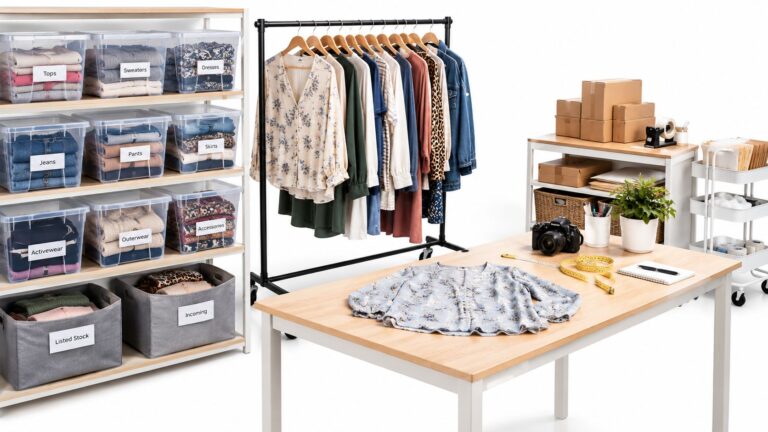
You've got a wholesale box open on your phone, a recognizable brand list, and just enough room in your inventory budget to place the order. The price looks workable. What you can't see is how much of that box will deserve a listing, how long it'll take to sell, and what you'll keep after fulfillment and returns.
Table of Contents
- The Reseller's First Decision
- What Brand-Name Clothing Wholesale Actually Means
- Supplier Types and What Each One Really Offers
- Reading the Real Numbers Behind the Box Price
- Verification and Label Compliance Before You Pay
- Matching Inventory to the Right Resale Channel
- Sustainability Claims and Lot-Level Due Diligence
- A 90-Day Sourcing Plan and Common Mistakes
The Reseller's First Decision
Decide what you can sell profitably before deciding what you can afford to buy. A mixed-brand box can look inexpensive and still become an expensive sorting project. Recognizable labels don't compensate for missing sizes, damaged garments, or stock your customers don't want.
Consider a familiar buying situation: the supplier highlights original retail prices, the product photos show attractive pieces, and the assortment description leaves the condition mix unclear. You order, then discover that the easiest items sell while the awkward sizes and flawed garments remain. Your sales dashboard looks busier than your bank account feels.
The mistake wasn't necessarily buying liquidation. It was buying without defining an acceptable outcome.
Put the offer through a buying filter
Before committing, answer these questions:
- Supplier type: Are you buying a curated assortment, brand-direct surplus, a brokered lot, or an auction pallet?
- Verification: What evidence supports the seller's identity, inventory description, condition grading, and ownership of the goods?
- Pricing math: Can the expected selling prices cover acquisition, processing, channel costs, and unsuccessful inventory?
- Minimum commitment: Can you absorb the order without compromising your ability to fulfill existing sales?
Buying rule: Treat advertised retail value as product context, not as money you expect to collect.
This discipline applies whether you run a boutique, sell on marketplaces, host live sales, or are preparing your first listings. Each business needs a different assortment, but none can afford to confuse an attractive brand list with a dependable purchase.
Write down your target categories, excluded conditions, available processing time, and maximum cash commitment before contacting suppliers. That buying specification gives you something concrete to compare against the offer. Without it, you're negotiating around whatever the seller needs to move.
What Brand-Name Clothing Wholesale Actually Means
A brand label is an identification system, not a guarantee of resale profit. It helps buyers recognize a maker, a style, and an expected standard, but you still have to evaluate the individual garment.
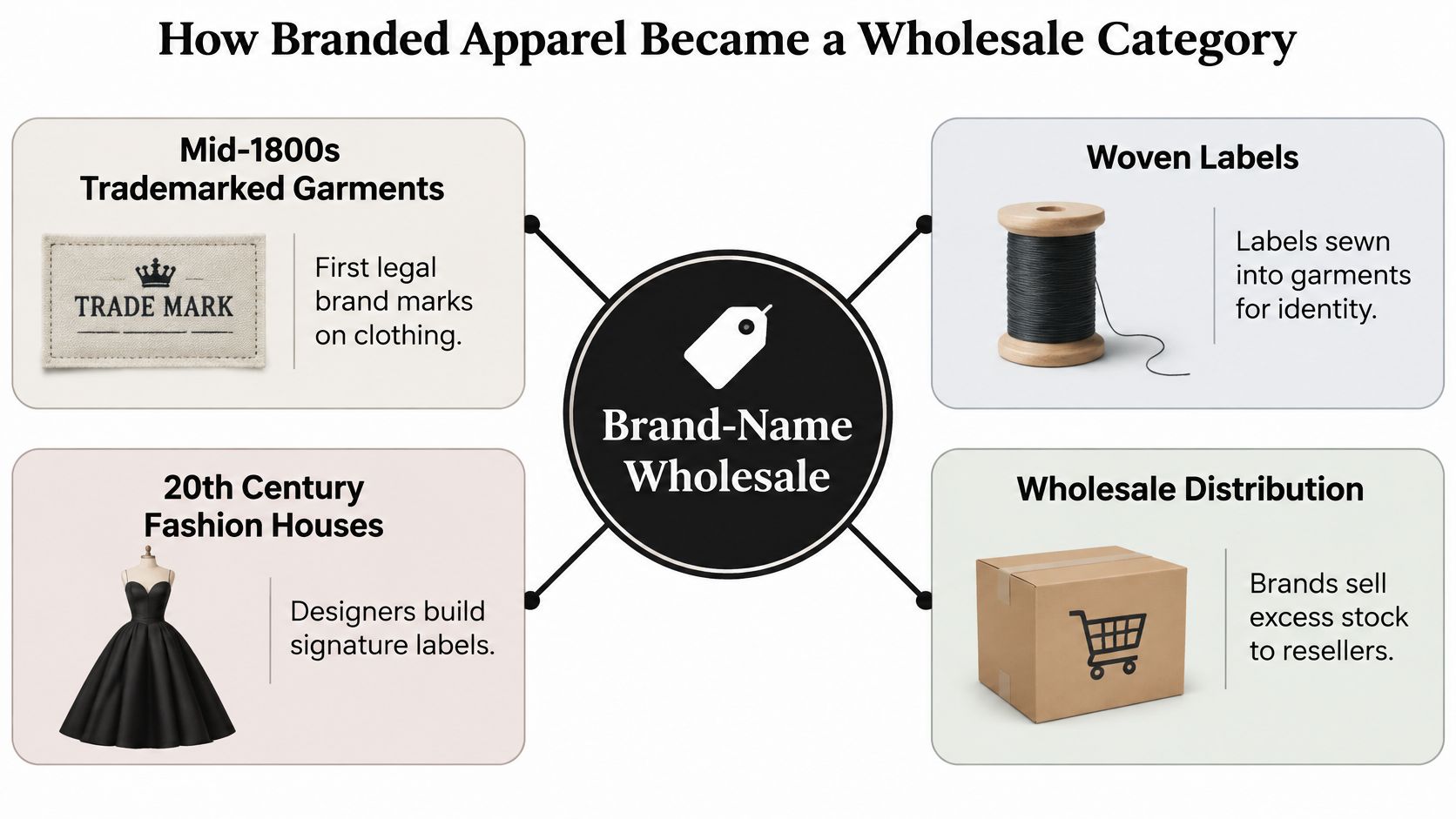
Modern clothing branding developed alongside trademarks, advertising, and broader distribution networks. Historical examples include Levi Strauss and Co.’s distinctive garment features and Worth's use of named garment labels, followed by the signature labels of twentieth-century fashion houses, as described in this history of brands and clothing labels.
The relationship between identification and distribution is illustrated below.
Separate the brand from the inventory source
In practical terms, brand name clothing wholesale means purchasing branded garments in business quantities for resale. The offer might involve overstock, shelf pulls, customer returns, or previously owned clothing, packaged as boxes, custom lots, or pallets. Those descriptions identify different sourcing situations, not interchangeable quality levels.
The supply chain can also cross borders before you receive the goods. The WTO's historical review of textiles and apparel describes an internationally distributed industry shaped by manufacturing specialization and trade policy. A familiar label therefore doesn't establish where a particular garment was produced or how it reached the wholesaler.
Use condition terminology as a starting point for questions:
| Supplier description | What you need clarified |
|---|---|
| First-quality or NWT | Whether tags are attached and garments are free of disclosed defects |
| NWOT or customer returns | Whether the terms describe tag status, return history, wear, or inspection results |
| Graded secondhand | What each grade permits, including fading, repairs, stains, and missing components |
NWOT and customer return aren't synonyms. One describes missing tags; the other describes inventory history. Ask suppliers to keep those distinctions explicit.
Vintage wholesale belongs in this sourcing picture too, but age and label recognition aren't substitutes for condition assessment. Buy the garment's documented attributes, not the romance of its category.
Supplier Types and What Each One Really Offers
Read the supplier's business model before reading the price sheet. It tells you which work the supplier performs and which work becomes your responsibility.
These broad supplier categories help organize the search, although individual businesses may overlap.
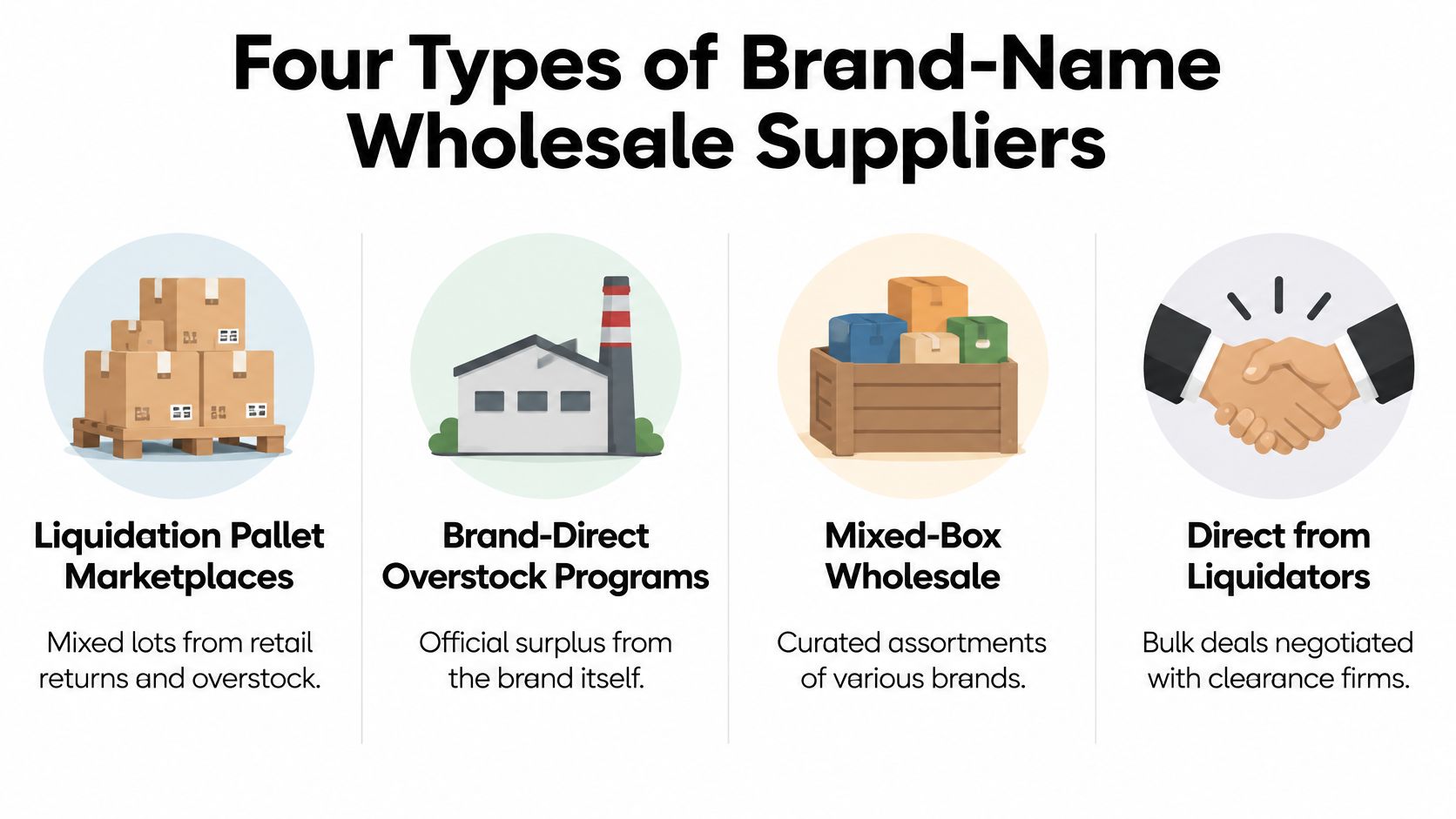
Compare the transaction, not just the merchandise
| Supplier model | What to establish before buying | Main buying constraint |
|---|---|---|
| Liquidation pallet marketplace | Seller identity, manifest quality, bidding charges, freight terms, claims process | Whether you can receive and process the entire lot |
| Brand-direct overstock program | Eligibility, available assortment, resale restrictions, replenishment expectations | Whether the brand's available stock fits your customers |
| Mixed-box wholesale specialist | Permitted brand preferences, substitution rules, condition mix, box minimum | How much selection you actually control |
| Boutique wholesale representative | Order minimums, size runs, delivery windows, cancellation terms | Whether the buying commitment fits your merchandising plan |
A liquidation marketplace gives you a place to transact. Don't assume the marketplace personally inspected every garment or guarantees every seller's description. Establish who handles discrepancies and which documents support a claim.
Brand-direct sourcing calls for a different conversation. Ask whether you're buying ongoing wholesale stock or a nonrepeatable surplus opportunity. Don't build a replenishment plan around merchandise the supplier can't commit to supplying again.
Mixed-box specialists are worth evaluating when you need to influence the assortment without taking an entire pallet. Curation has value only when the selection rules are clear. A brand preference, a guaranteed brand allocation, and an illustrative brand list are different promises.
Boutique representatives should be assessed against your merchandising calendar, not merely a comparison of the price per item. Ask how sizes are packed, when payment becomes due, and what happens if delivery misses your planned selling window.
Ask for the complete purchasing terms
Request minimum quantities, total freight, handling charges, exclusions, restocking provisions, and discrepancy deadlines in writing. Don't assume that a quoted shipping price includes every receiving requirement.
For smaller operations, the deciding issue is often time-to-list. An assortment that matches your categories and photography workflow may justify a higher acquisition price than a pallet requiring extensive sorting.
Use a structured clothing wholesale supplier evaluation to compare offers against the same questions. Choose the model your cash flow and receiving process can support, rather than the largest order you can technically purchase.
Reading the Real Numbers Behind the Box Price
Calculate cost using sellable units, not shipped units. Dividing the invoice by the advertised garment count hides the cost of unusable stock.
Use this receiving model:
Landed cost per sellable unit = (purchase price + freight + handling + inspection labor + expected defect allowance) ÷ sellable units
Exclude damaged, incomplete, counterfeit-suspect, and noncompliant items from the denominator. Include the labor needed to sort by brand, category, size, condition, and selling channel.
Keep the accounting consistent. If you recognize unusable garments by reducing the sellable-unit count, don't also charge their full acquisition cost again as a separate loss. Use a defect allowance for additional expected costs that haven't already been captured.
Calculate contribution after channel costs
The next calculation is:
Contribution per unit = realized selling price − marketplace fees − payment processing − shipping subsidy − packaging − returns allowance − allocated acquisition cost
This is not the same as markup. Markup compares selling price with acquisition cost; contribution accounts for the additional expenses associated with making the sale. It still isn't final business profit if rent, software, taxes, or other overhead remain unpaid.
The table below is a reusable worksheet, not a claim about current platform rates.
Worked Example of Landed Cost Across Channels
| Channel | Expected Selling Price | Fees and Fulfillment | Allocated Acq. Cost | Net per Unit |
|---|---|---|---|---|
| Poshmark | Your supported resale estimate | Applicable fees, packaging, shipping obligations, return allowance | Landed cost assigned to the garment | Selling price minus all listed costs |
| eBay | Estimate for matching condition and style | Applicable fees, processing where relevant, shipping, packaging, returns | Same allocation method | Selling price minus all listed costs |
| Local boutique | Expected realized price after discounts | Payment costs, bags, selling labor, applicable return allowance | Same allocation method | Selling price minus all listed costs |
| Live auction | Conservative expected closing price | Applicable fees, fulfillment, show preparation, return allowance | Same allocation method | Closing price minus all listed costs |
| Damaged or slow stock | Supported clearance or salvage estimate | Repair, markdown, handling, or disposal expense | Cost retained against the item | Recovery less remaining costs |
For percentage-based charges, solve break-even as fixed per-unit costs divided by the share of the selling price you retain. For tiered or minimum charges, use the actual applicable fee rules instead.
Returns deserve their own assumption. Apparel and footwear brands reported return rates of at least 30% in 2025 in Radial's State of Returns report. That isn't a forecast for your store, but it's a reason not to budget as though every sale stays sold.
Stress-test the box with lower realized prices, more unlisted garments, and longer holding periods. Use a consistent wholesale pricing calculation rather than improvising a margin target after delivery.
Verification and Label Compliance Before You Pay
Verify the seller and the stock separately. A legitimate business can still offer an unsuitable lot, and an attractive garment photo doesn't establish who will receive your deposit.
Use label evidence as part of the inspection, not as the entire authenticity decision.
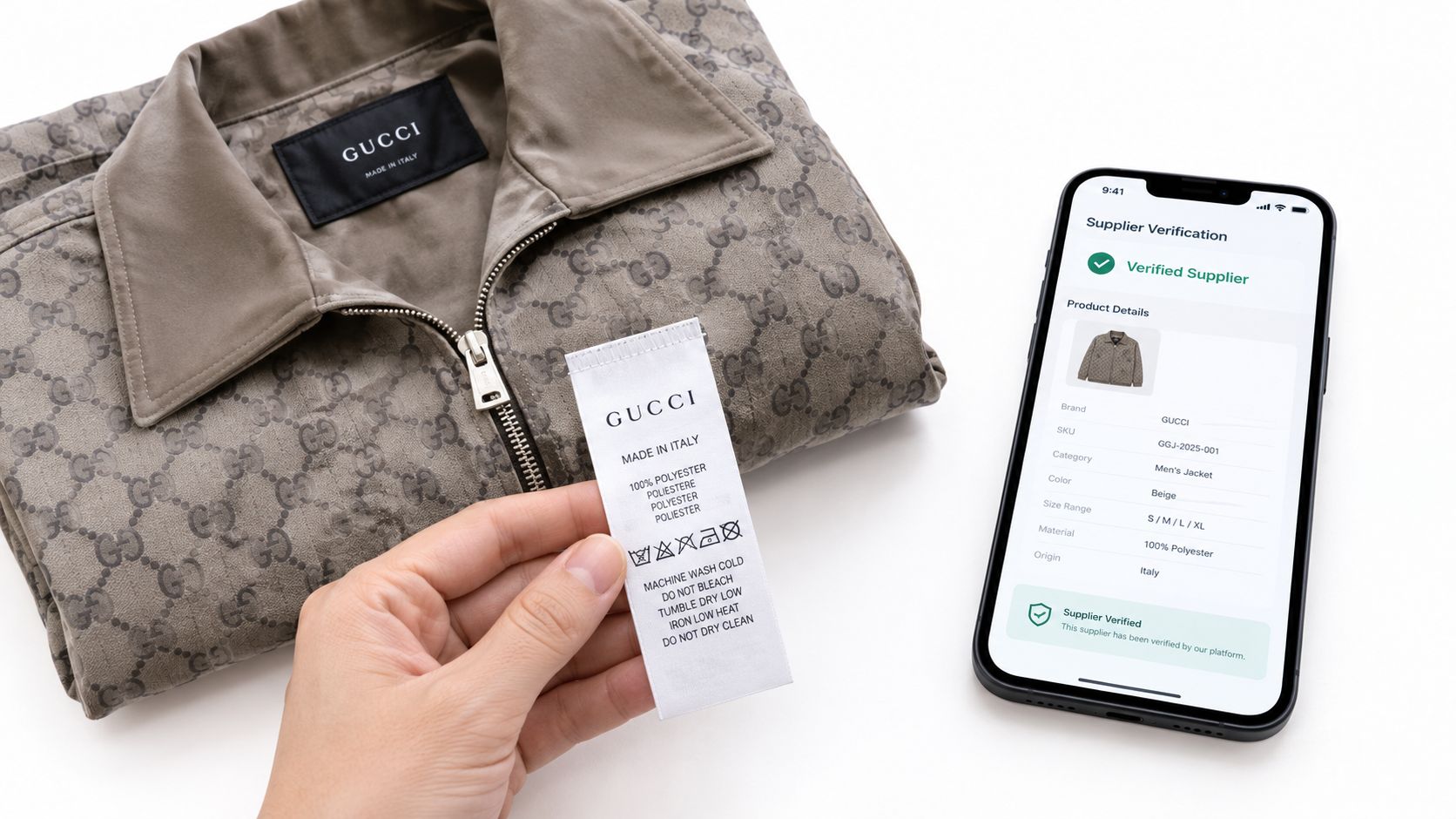
Build a payment-release file
Before wiring money, request an invoice identifying the legal seller, the lot, the promised condition, and the payment terms. Match the beneficiary details to the contracting business, and independently confirm unexpected payment instructions through an established contact method.
Your file should include:
- Inventory evidence: Current lot photographs, not only representative catalog images.
- Traceability: Brand, style or SKU when available, composition, origin, and condition records.
- Commercial terms: Substitution rules, shortage handling, defect definitions, and the claims process.
- Authenticity response: What happens when an item requires independent assessment or cannot be verified?
For U.S.-bound textile inventory, most textile and wool products require durable, conspicuous information identifying fiber content, country of origin, and the manufacturer or responsible marketing entity. Required labels must remain attached through distribution, resale, and consumer delivery under the FTC's clothing and textile guidance.
That makes labeling an inventory-control issue. Don't copy “100% cotton” or “made in the USA” from promotional copy when the garment and supporting records don't establish the claim.
Screen, quarantine, and resolve
For premium denim, sneakers, handbags, and other higher-risk purchases, compare construction details with reliable brand-specific references. Examine stitching, hardware, style identifiers, hangtags, and packaging as a group. A working QR code or convincing zipper is not conclusive authentication.
If you can't resolve a concern, hold the item for qualified assessment. Don't list first and hope the customer doesn't notice.
The embedded video is supplementary viewing, not a substitute for your lot documentation.
At receiving, assign an internal item identifier, photograph the garment and labels, record discrepancies, and separate questionable pieces from listing-ready stock. Quarantine items with missing, contradictory, or illegible required information until you've established an appropriate resolution.
Preserve the supplier correspondence alongside those records. If you need to submit a claim, a documented discrepancy is more useful than an unsupported complaint about quality.
Matching Inventory to the Right Resale Channel
Don't assign the whole box to your favorite app. Assign each garment to a selling method that fits its condition, expected selling price, and preparation requirements.
The channel map below is a starting point for allocation, not a promise of conversion speed.
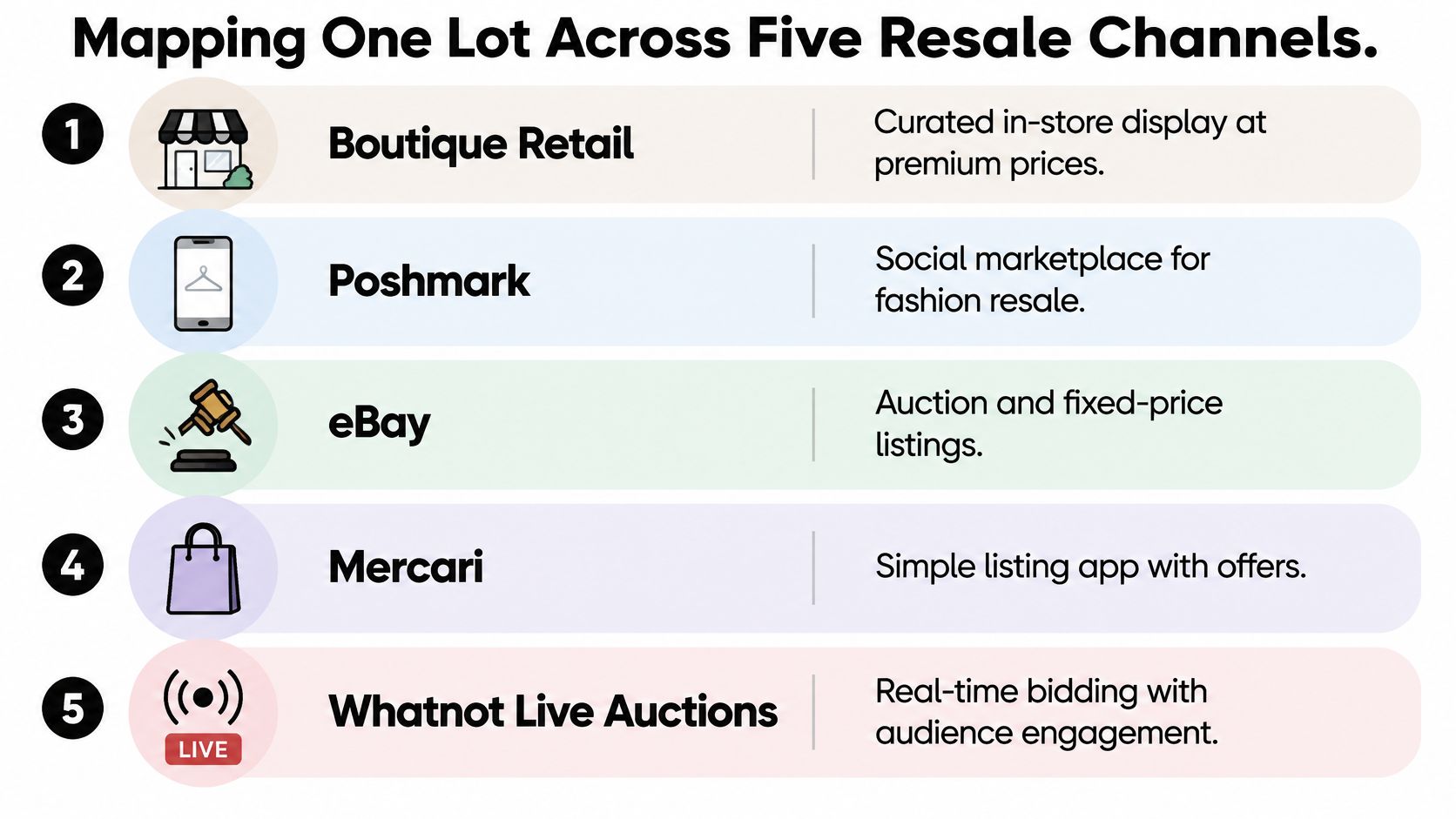
Choose the selling process you can execute
| Channel | Buying decision to test | Costs and workload to capture | Condition and return control |
|---|---|---|---|
| Boutique retail | Does the piece fit your store's customer and merchandising? | Selling labor, display space, payment costs | Inspect before display and apply a clear policy |
| Poshmark | Can your listing communicate the garment's appeal accurately? | Current applicable fees, offers, listing work, fulfillment | Photograph flaws and state measurements clearly |
| eBay | Can you identify the style and support the asking price? | Current category charges, shipping, listing effort | Match description, photos, and selected condition |
| Mercari | Is the expected sale worth the handling time? | Current transaction terms, negotiation, packing | Make defects visible before purchase |
| Whatnot | Can you present and fulfill the item confidently during a live sale? | Applicable charges, show preparation, hosting, sorting | Disclose condition before bidding |
| Consignment | Does the agreement leave an acceptable return on the item? | Commission, transport, administration, delayed payment | Confirm acceptance and unsold-item terms |
Avoid declaring premium denim or NWT sportswear automatic live-sale winners. Test them against your audience. A garment that needs explanation may benefit from a live demonstration, but a weak audience fit can still produce an unacceptable closing price.
Fixed-price listings deserve consideration when a piece needs detailed measurements, close-up photography, or time to find a specific buyer. Basics and outerwear are candidates for that approach, not guaranteed performers.
Set the channel assignment during receiving
Create practical routing categories: boutique-ready, individual marketplace listing, live-sale candidate, consignment candidate, and hold for review. Assign the route while the item is already on the inspection table.
For a marketplace workflow, use a repeatable Poshmark selling setup rather than treating every garment as a fresh operational problem. Reuse photography positions, measurement fields, and storage identifiers while keeping descriptions item-specific.
A sale isn't efficient just because it happens quickly. Count preparation, presentation, customer service, and fulfillment time.
Check current platform terms before pricing. Don't carry an old fee assumption from a previous order into a new buying decision, and don't treat another seller's experience as evidence that your assortment will move at the same pace.
Sustainability Claims and Lot-Level Due Diligence
Liquidation isn't automatically sustainable. Reselling a usable garment can extend its working life. Buying an unsellable assortment and passing the disposal burden elsewhere is a different outcome.
The distinction matters when sourcing across borders. A 2025 investigation into international textile-waste flows identified weak traceability and noted that broad customs classifications don't reliably distinguish reusable clothing from low-value waste.
Ask where the unusable pieces go
A credible sourcing conversation should cover more than the destination of the good garments:
- Origin disclosure: Ask whether the lot consists of excess inventory, customer returns, or previously used clothing.
- Condition categories: Request written grading definitions and examples of defects permitted within each grade.
- Expected unlisted stock: Ask the supplier for its estimate and the inspection basis behind it, then compare that estimate with your receiving results.
- Defective-item handling: Establish whether the supplier repairs, removes, recycles, or otherwise disposes of rejected items.
- Downstream outcomes: Keep records of resale, accepted donations, recycling, and disposal rather than assuming every transfer results in reuse.
Donations need scrutiny too. Confirm that the receiving organization accepts the garment types and conditions you intend to send. A donation receipt records a transfer; it doesn't necessarily prove that someone wore the clothing again.
Responsible sourcing test: Can you explain what happened to the pieces you couldn't sell?
Record unsold-item outcomes using the same inventory identifiers you use for sales. That connects the purchasing decision to what happened, including repair work and disposal costs.
Avoid broad environmental claims you can't substantiate. Describe the action you took, such as reselling usable overstock or documenting accepted donations, rather than claiming the entire lot had a positive environmental outcome. Transparency is more useful to your customers than a sustainability slogan.
A 90-Day Sourcing Plan and Common Mistakes
Use the sourcing period as a controlled buying trial, not a deadline for reaching pallet volume. Scale only after you've completed the receiving-to-sale cycle and reviewed the results.
Start small and earn the next order
Begin with a test order you can inspect, photograph, store, and list without creating a backlog. Define your acceptance criteria before it arrives, then compare the actual assortment with the written promise.
Once listings are active, track units received, units listed, units sold, days to sale, realized price, and return rate by brand and category. Record processing time and claim outcomes alongside those sales measures.
| Stage | Required evidence before progressing |
|---|---|
| Test box | Receiving records and a resolved discrepancy review |
| Curated reorder | Evidence that the chosen categories fit your customers |
| Custom lot or pallet | Enough processing capacity and cash to handle the larger commitment |
Avoid the mistakes that make early orders difficult to evaluate:
- Chasing retail value: Buy against supported resale expectations.
- Ignoring selling expenses: Keep channel costs in the purchasing decision.
- Skipping verification: Don't let urgency replace documentation.
- Ordering beyond capacity: Match commitments to storage and listing throughput.
- Expecting passive inventory: Budget for inspection, preparation, customer service, and fulfillment.
At the final review, compare suppliers on what arrived, how problems were handled, and what you retained after selling costs. Don't reorder merely because the first delivery was exciting.
Ask yourself: Would I still buy this lot if the advertised retail value were lower? If the answer changes but the garments don't, you're probably buying the headline rather than the inventory.
OneTrendyCloset offers curated mixed-brand apparel liquidation boxes, mix-and-match brand selection, and custom quotes for boxes or pallets. Visit with your budget, preferred brands, condition questions, and processing capacity ready, then request an assortment you can evaluate against your own resale economics.