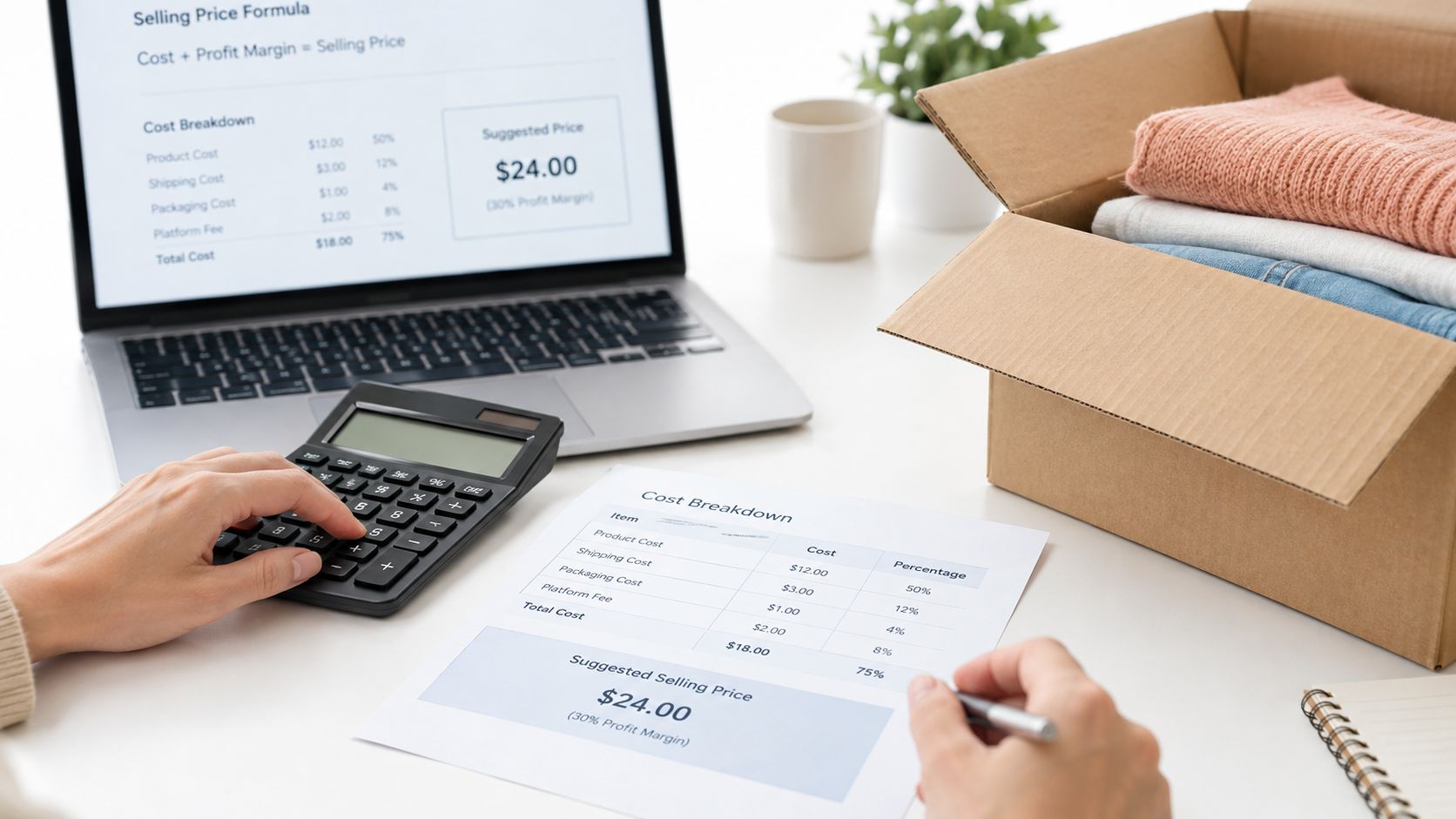
You open a mixed liquidation box, count the hangers, and do the quick math that feels safe. The receipt says one price, the box looks full, and the obvious temptation is to divide and move on. That shortcut is how resellers overpay, because the number on the quote is not the number that determines whether the box makes money.
If you want to figure out wholesale price the right way, start with what the inventory will really cost you to sell, not what the supplier wrote on the invoice. A box can look cheap and still be a bad buy once freight, defects, and selling costs show up. I've learned that the hard way on enough mixed apparel lots to stop trusting any price until I've rebuilt it from the bottom up.
Table of Contents
- Why the Stated Box Price Is Not Your Real Cost
- Markup Versus Margin and Why the Difference Costs You Money
- Apply the 2x to 2.5x Wholesale Benchmark as a Starting Point
- Value a Mixed Box by Outcome Tiers Instead of Unit Price
- Subtract Channel Fees Before Calling a Price Viable
- Compare Profit per Invested Dollar, Not Cost per Piece
- One-Page Wholesale Pricing Worksheet You Can Reuse
Why the Stated Box Price Is Not Your Real Cost
A box can look cheap and still be a bad buy. The supplier's stated unit price is only the invoice line. Your true landed cost starts with the purchase price and then adds inbound freight, duties or tariffs, brokerage, insurance, inspection, receiving, packaging, and every other expense needed to make the units saleable commercecatalyst.ai.
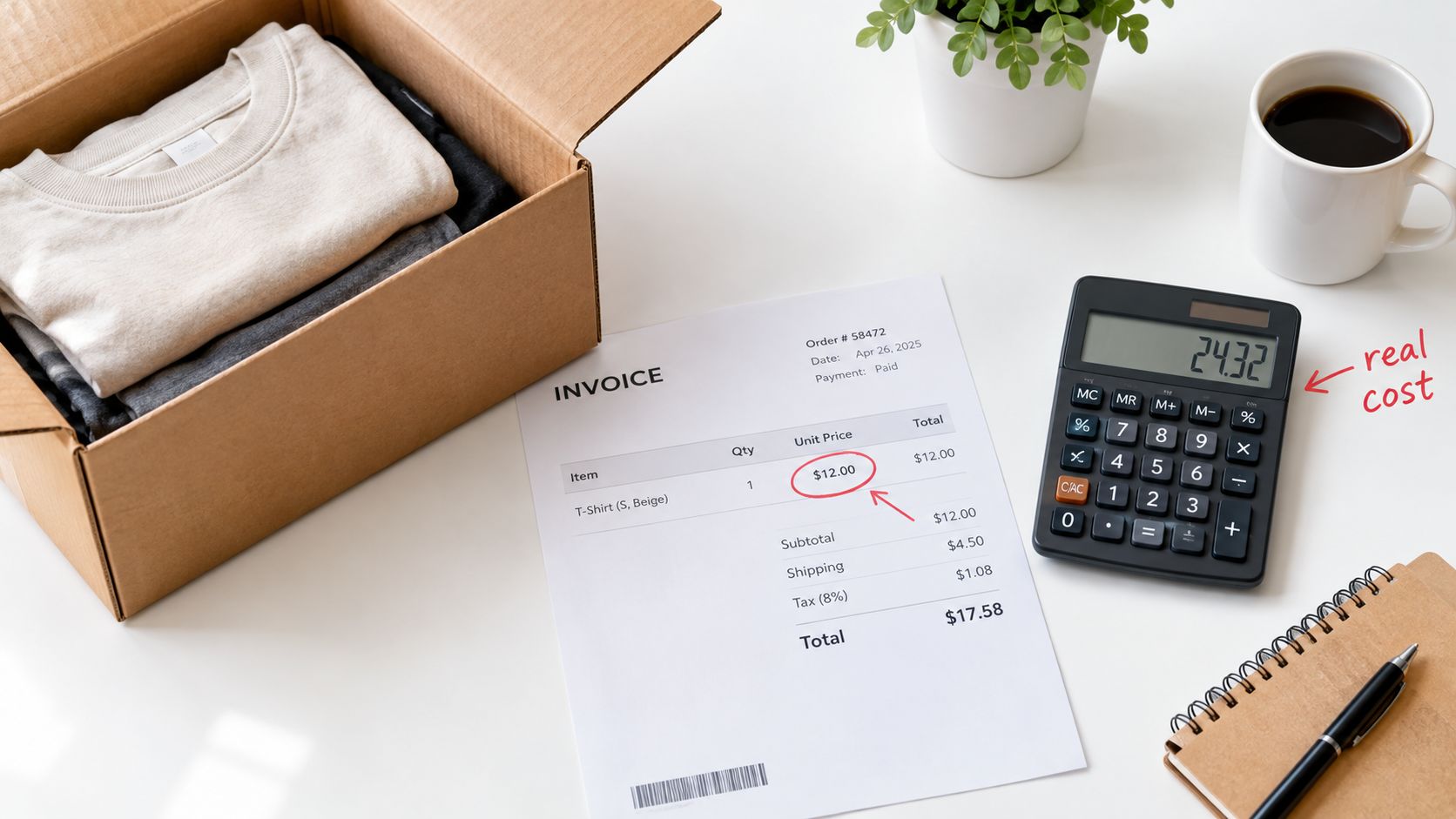
Price the box on the units that will sell. Damaged, missing, or unsellable items raise the effective cost of every good piece, because the weak units still consume cash, time, and storage. The count that arrived is not the right divisor. The count that leaves your rack, ships cleanly, and brings in money is.
I use this formula:
Landed cost per saleable unit = total landed cost ÷ saleable units
If a liquidation apparel box costs $800 and contains 100 saleable garments, the landed cost is $8 per garment. If 8 of those 100 are unsellable, the same total cost gets spread across fewer sellable units, so the effective cost per good piece climbs fast.
Practical rule: price weak units into the buy from the start. The good pieces do not get cheaper just because the damaged ones were buried under tissue paper.
What belongs in landed cost
Leave out nothing that gets the product to a sellable state.
- Purchase price: the invoice amount for the lot.
- Inbound freight: what it costs to receive the box or pallet.
- Duties or tariffs: any import cost tied to the shipment.
- Brokerage and insurance: paperwork and transit protection.
- Inspection and receiving: the labor to count, sort, and check condition.
- Packaging and prep: poly bags, labels, stickers, and anything else that makes the unit ready to list.
That list matters because a lot of new buyers price the box before they open it. That is backwards. You do not know your real cost until you know what you can sell and how much work it took.
A mixed box with missing tags, stained items, and pieces that need repacking can look fine on paper and turn ugly fast. I treat landed cost as the floor for every later decision, including whether I would buy the lot at all. For a broader look at pallet and box economics, see this pallet pricing guide.
The clean takeaway is simple. Once you know landed cost per saleable unit, your wholesale price stops being guesswork and starts reflecting reality.
Markup Versus Margin and Why the Difference Costs You Money
A lot of resellers lose money here because the words get mixed up. Markup is added on top of cost. Margin is profit as a share of the final selling price. They are not the same, and using the wrong one makes a price look healthier than it really is commercecatalyst.ai.
If your landed cost is $8, a 40% markup gives you $11.20. That sounds fine until you see it only produces a gross margin of about 28.6%. If you want a 40% gross margin, the right price is $8 ÷ 0.60 = $13.33 per garment.
The formula you should use
Use this every time:
Wholesale Price = Landed Cost ÷ (1 − Target Gross Margin)
That formula backs into the price you need instead of guessing with a markup and hoping the margin works out. Start with the margin you need, then let the math set the price. If you start with markup, you are accepting whatever margin falls out.
| Markup to Margin Quick Reference | ||
|---|---|---|
| Target Gross Margin | Markup on Cost | Multiplier |
| 25% | 33.3% | 1.33x |
| 40% | 66.7% | 1.67x |
| 50% | 100% | 2.0x |
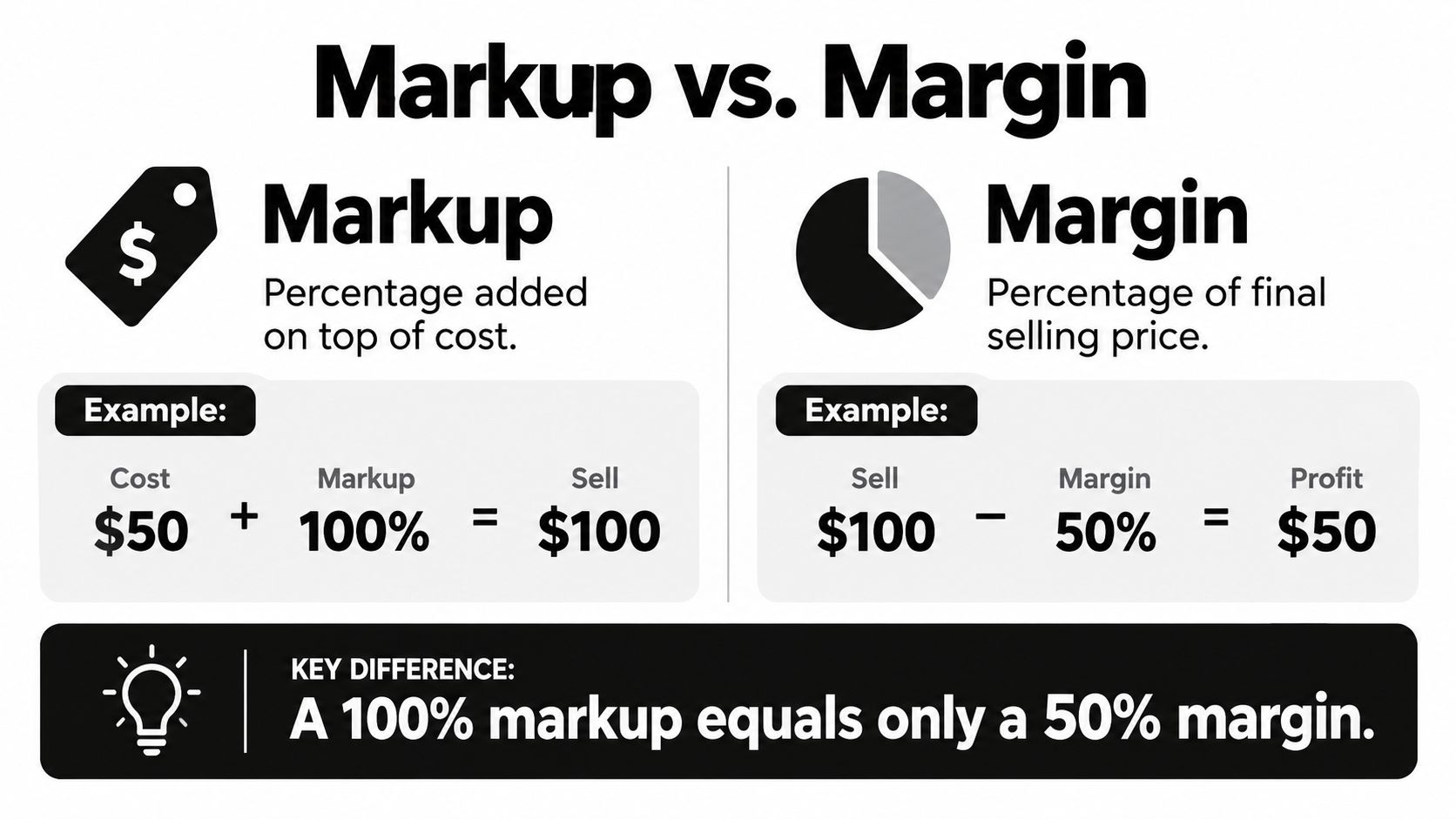
A 100% markup is not a 100% margin. If you've ever sold at “double cost” and wondered why the cash never felt as strong as expected, that is the mistake.
The problem shows up when you price mixed inventory. A reseller who thinks they are earning 40% margins because they applied 40% markup is under-earning on every unit. That gap looks small on one piece, then it eats into the whole box.
Set your target margin before you negotiate the box price, so fee stacks and markdowns later cannot erase it.
Apply the 2x to 2.5x Wholesale Benchmark as a Starting Point
A practical apparel benchmark is 2.0x to 2.5x landed cost, which puts the wholesale seller's gross margin around 50% to 60% retailerhub.ai. On a $10 landed cost, that points to a wholesale price of $20 to $25.
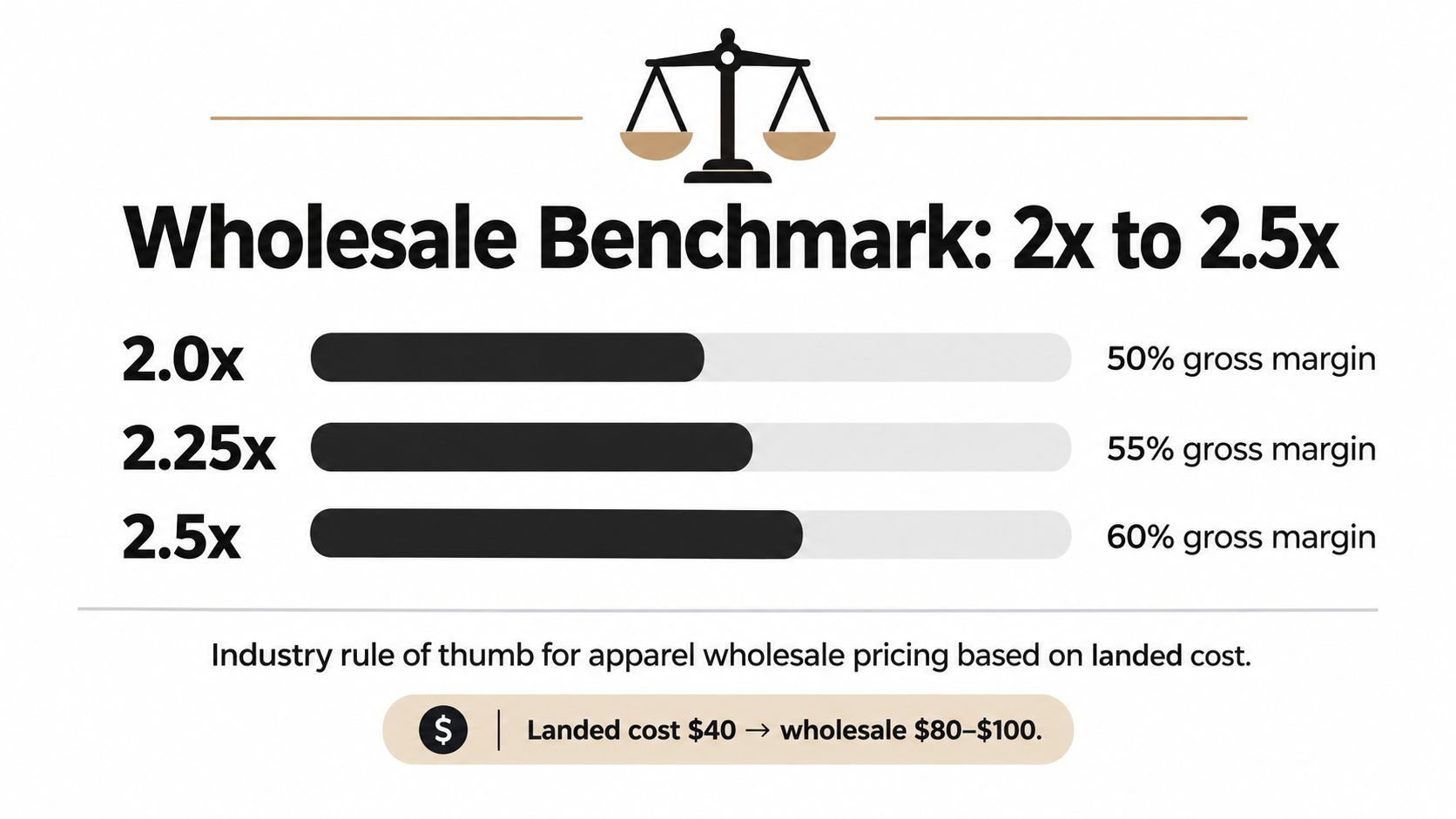
A boutique buyer who marks that up by 100% ends up around $40 to $50 retail. That is why wholesale margin and retail markup get mixed up. The math is clean. The inventory rarely is.
Mixed boxes break the benchmark fast. Brand strength, size spread, seasonality, and condition can push a lot above or below that range, which is why the box has to be priced by recovery, not by a single multiplier slapped on the whole lot.
Where the benchmark breaks down
A mixed liquidation box does not behave like a neat catalog. One lot can include a few strong sellers, a middle layer of ordinary pieces, and some items that only move with a steep discount. The right price depends on which channel you plan to sell into, boutique, marketplace, or live sale, because each channel absorbs risk differently.
Use the benchmark as a check, then price the lot against the actual condition of the box. A quote below the range can still be bad if the cleanup, defects, or slow turn kill your net. A quote above the range can still work if the strongest pieces will carry the rest.
- Charge more when the lot has stronger brands, better size spread, and easier sell-through.
- Charge less when defect risk is heavy, the brand mix is weak, or the season is wrong.
- Walk away when the quote only works if every unit sells fast at full price.
If you cannot justify the deviation from the benchmark in one sentence, treat the quote as unpriced risk and walk away.
For buyers sizing up mixed apparel lots, these wholesale clothing box notes are useful for checking the box structure before you commit. The point is simple. Use the multiplier to see whether the quote lives in the right range, then decide whether the channel can still carry the cost after fees and discounts.
Value a Mixed Box by Outcome Tiers Instead of Unit Price
A mixed box should be priced like a recovery problem, not a stack of identical items. I split every lot into full-price, ordinary discount, clearance, and unsellable tiers, then I weight the box by what each tier is likely to recover. That gives you a ceiling on what you can pay.
Here's a simple worksheet layout.
| Outcome Tier Valuation Worksheet | |||
|---|---|---|---|
| Outcome Tier | Units | Expected Price Each | Weighted Value |
| Full-price | 50 | $25 | $1,250 |
| Ordinary discount | 25 | $15 | $375 |
| Clearance | 15 | $6 | $90 |
| Unsellable | 10 | $0 | $0 |
That example box contains 100 garments and a total weighted recovery value of $1,715. That number is not your acquisition price yet. It's the top of the recovery stack before you subtract labor, storage, selling fees, shipping, and a risk reserve.
How I use the tier model
First, I estimate what each group will really do in the market. Then I assign a conservative price to each group, not the price I wish the item deserved. The math has to survive reality, because mixed liquidation does not reward optimism.
The reason this works better than a blanket multiplier is that it respects variability. A box with a few strong pieces and a lot of weak ones can still be worth buying, but only if the strong pieces carry the rest. If they can't, the lot isn't cheap, it's expensive in disguise.
A smaller box with better recovery can beat a bigger box with a lower sticker price. Cash profit matters more than unit count.
Use this question before buying any mixed lot: What is the maximum I can pay and still leave room for labor, fees, and a loss allowance? That's the correct ceiling. Not “What's the per-piece cost?” and not “How low is the supplier willing to go?”
For buyers comparing blind lots and curated lots, this mystery box pricing guide is a useful companion because it pushes the same recovery-first logic.
If you only remember one line from this section, make it this. Weighted recovery value is the ceiling, not the goal, and the ceiling still has to clear your operating costs.
Subtract Channel Fees Before Calling a Price Viable
A box can look profitable and still fail on the channel you choose. A $25 sale on Poshmark, for example, does not leave you with $25 in hand. If the platform takes a $2.95 shipping subsidy plus its commission, your take-home drops fast, while a boutique rack sale at the same sticker price usually keeps the full $25 before card processing.
That is the right way to think about net contribution. Start with expected selling price, then subtract marketplace commissions, payment processing, shipping subsidies, discounts, and labor. Whatever is left has to cover landed cost and leave room for risk.
Channel math changes the deal
Different channels charge differently and demand different work. eBay, Poshmark, Mercari, Depop, and Whatnot do not produce the same net result from the same item, even when the visible sale price matches. The fee structure, shipping setup, and labor load all hit the final number.
I do not use fake averages here because the actual cut depends on the platform terms, category, and shipping arrangement you are using. Check the published fee page for the channel before you price a lot for resale. If you skip that step, you are guessing.
Use net contribution, not hope
Use this equation for every channel:
Expected selling price − fees − processing − shipping subsidy − markdowns − labor = net contribution
If that net contribution does not clear your per-unit landed cost plus a reserve for slow movement or damage, the buy is not strong enough for that channel. The item may still sell there later, but you should not price the wholesale lot as if every outlet pays the same.
Live-sale formats are the easiest place to make this mistake. They can move pieces faster and sometimes at a higher visible price, but the labor is real. You have to host, promote, pack, and handle the sale, and all of that belongs in the math.
A wholesale buyer who works through mixed liquidation boxes learns this fast. The box does not need to win everywhere. It only needs one channel, or one mix of channels, where the expected recovery clears fees and still leaves margin. That is how you judge whether the price is viable.
OneTrendyCloset is one wholesale option in this space, because it offers curated apparel liquidation boxes and custom quotes based on brands, current inventory, and quantity ordered. Use the same rule with any supplier, channel fee math comes before you call the price viable.
Compare Profit per Invested Dollar, Not Cost per Piece
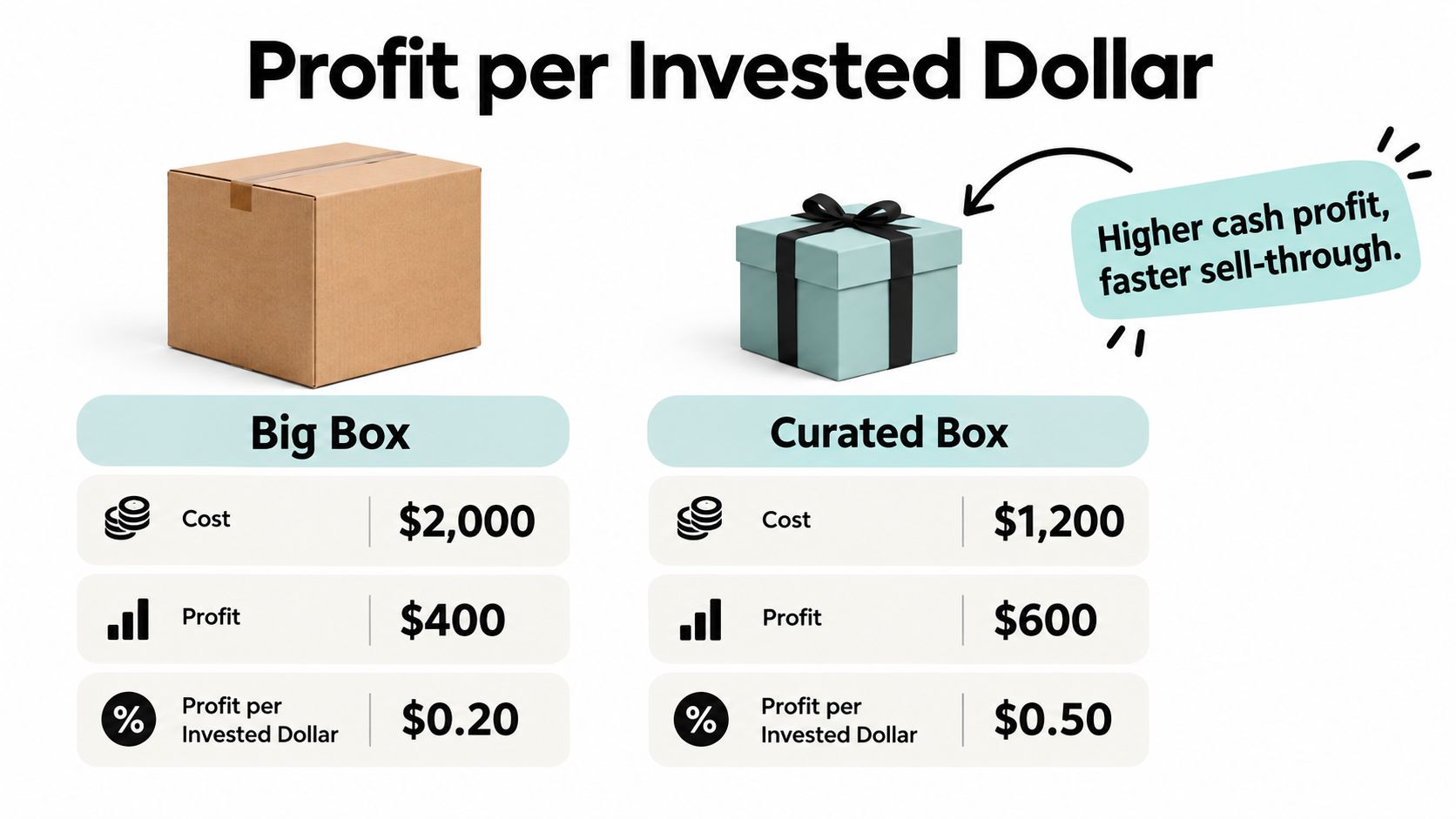
Cheap per-piece pricing tricks a lot of buyers into buying the wrong lot. I'd rather pay more for a curated box that turns fast than lock cash into a bigger box that sits. The better question is not “What does each piece cost?” It's how much profit do I get per invested dollar.
Three numbers that matter more than unit cost
Start with profit per invested dollar. If a box costs less but generates very little profit, that cheap buy is still weak. Then look at days to sell, because cash tied up in slow movers can strangle the next purchase. Finally, estimate expected recovery rate, which tells you how much of the lot you'll turn into cash instead of sitting inventory.
A small, well-curated box can win on all three. A larger box with a prettier unit cost can lose on all three. That's the trap.
| Profit per Invested Dollar Snapshot | Big Box | Curated Box |
|---|---|---|
| Acquisition cost | $2,000 | $1,200 |
| Profit | $400 | $600 |
| Profit per invested dollar | $0.20 | $0.50 |
The curated box in that comparison is the better deal even though it costs less overall. It earns more profit for each dollar tied up, and that's the metric that protects your cash flow.
If your money is tight, turnover beats volume. Inventory that sells first gives you the right to buy the next box sooner.
I use this when I'm choosing between lots. If the bigger box looks attractive only because the piece count is high, I slow down. If the smaller box has stronger recovery and quicker turnover, I'd rather own that and recycle the cash.
That mindset stops you from overpaying on the wrong lot. It also keeps you from chasing a low unit cost that doesn't translate into usable profit.
One-Page Wholesale Pricing Worksheet You Can Reuse
Keep this order every time you evaluate a quote.
- Confirm landed cost per saleable unit. Use purchase price plus freight, duties, brokerage, insurance, receiving, packaging, and prep.
- Choose target gross margin. Pick the return you need, not the return that sounds nice.
- Back into wholesale price. Use Wholesale Price = Landed Cost ÷ (1 − Target Gross Margin).
- Sense-check with the 2x to 2.5x benchmark. If you're outside the range, write down why.
- Build outcome-tier recovery. Split the box into full-price, discount, clearance, and unsellable units.
- Subtract channel fees. Confirm the channel still leaves a real net contribution.
- Score profit per invested dollar. Compare the lot to your other options, not to your hopes.
Here's the checklist I want on my desk before I buy anything:
- Saleable-unit count: not arrival count.
- Freight and handling: every dollar that moves the box to you.
- Condition notes: stains, missing tags, defects, and prep time.
- Channel plan: where each tier is most likely to sell.
- Reserve for risk: for markdowns, returns, and slow movers.
Walk-away trigger: if the quote only works when every item sells quickly at top dollar, it's not a wholesale buy. It's a gamble with nicer packaging.
The line I'd pin above the workspace is this: price the recovery, not the box. That habit keeps your buying decisions grounded in cash, not in optimism.
OneTrendyCloset curates brand-name apparel liquidation boxes and custom lots for resellers, boutiques, and live-sale sellers who need inventory that's priced with the economic realities in mind. If you're comparing mixed boxes, use the same recovery-first math you just read here, then visit OneTrendyCloset to review what they offer and request a quote that fits your channel and budget.