
You priced last season's tops again, and the margin still won't cover rent, fees, and the hours you spend photographing. Customers want labels they already recognize, but brand reps want carton minimums you can't float, and one-off sourcing has eaten the week. Brand name clothing liquidation looks like the fix: excess, returned, or discontinued apparel in a bulk lot instead of a first-run order. It can restock a rack. It can also leave you with sizes that sit and tags you can't defend. The useful question is whether the lot fits the next few weeks of selling, not how low the sticker looks.
Table of Contents
- Why Brand Name Clothing Liquidation Matters to Resellers
- How Liquidation Supply Chains Move Brand Name Inventory
- Benefits and Risks of Liquidation Stock for Resellers
- Verifying Labels, Authenticity, and Condition at Intake
- Calculating Landed Cost and Sell-Through Before You Buy
- How to Evaluate Liquidation Boxes and Suppliers
- Taking Your First Step Into Liquidation Buying
Why Brand Name Clothing Liquidation Matters to Resellers
Maya keeps a small boutique and a Saturday live sale. Her regulars ask for names they already wear. The wholesale catalogs available to her are either anonymous basics or minimums that would lock up a month of cash. She doesn't need a truck. She needs a few dozen pieces she can list before the weather changes.
That gap is why brand name clothing liquidation has become a working inventory channel, not a treasure hunt. Brands and retailers move surplus, discontinued, returned, and end-of-season goods out of the original sales path. Resellers buy those goods in lots, then sort them into what a boutique, a marketplace closet, or a live show can sell.
The buyers on the other side of that trade are already shopping secondhand. ThredUp's 2025 Resale Report, prepared with GlobalData, put the global secondhand apparel market at $227 billion in 2024, up 15% that year and equal to 9% of worldwide apparel spending. In the report's measured market, online channels accounted for 88% of resale spending. Those listings need garments. Branded surplus is one of the piles that can fill them.
Who should treat this as a plan
This path fits boutique owners, marketplace sellers, live-sale hosts, and founders opening an apparel business on a first budget. It fits poorly if you need the same style, in a full size run, on a set reorder date.
A familiar label doesn't set your price. Sell-through, condition, and the hours you spend getting a piece online do.
If you can grade mixed stock and say no to a lot that doesn't match your customer, keep reading. The rest of this walkthrough covers where the goods come from, what can go wrong, how to check labels, how to price a lot after labor, and how to choose a supplier without betting the month's cash.
How Liquidation Supply Chains Move Brand Name Inventory
Think of a store's overflow room. When that room has to empty, the branded shirts don't vanish. They get boxed, graded, and offered to someone who will dig through them. Brand name clothing liquidation is that handoff, done at a scale a single boutique never sees at the loading dock.
Where the goods start
Origin sits with brands, retailers, and manufacturers. Collection pulls together excess production, discontinued styles, seasonal leftovers, shelf pulls, and customer returns. None of those piles is the same product. A never-worn end-of-season blouse and a tried-on return can share a brand and still need different prices.
Grading sorts by condition. Lot building groups by brand, size, category, or a mixed assortment. Distribution sends those lots to wholesalers and resellers. Anything that won't sell moves to textile recovery or disposal. You usually meet the goods at distribution, long after the original retailer has stopped trying to sell them at full price.
Why the flow is this large
The U.S. Environmental Protection Agency estimated that 17.03 million tons of textiles entered the municipal solid-waste stream in 2018, 5.8% of total generation. Clothing was the main source, alongside footwear, carpets, furniture, sheets, and towels. Only 2.5 million tons were recycled, a 14.7% textile recycling rate, and clothing and footwear alone were estimated at 13%. 11.3 million tons of textiles were landfilled, 7.7% of municipal solid waste sent to landfills. Treat 2018 as a baseline, not this year's count. The point for a buyer is scale: a lot of apparel leaves its first channel while it is still wearable.
| Stage | What changes for you |
|---|---|
| Collection | Mix of new surplus and worn returns |
| Grading | Condition stops being a surprise only if someone recorded it |
| Lot building | Brand, size, and season get bundled, or they don't |
| Your intake | You inherit whatever the earlier stages skipped |
Supply stays uneven because each origin has a different reason to clear space. One lot is heavy on summer sizes from a late markdown. The next is returns with missing hangtags. Asking "is liquidation good" misses that. Ask which stage your supplier controls before the box ships.
Benefits and Risks of Liquidation Stock for Resellers
A low unit cost is not the same thing as a profitable lot. Cheap branded stock helps only after you subtract what you can't list, what you must discount, and what you spend getting it ready.
What the lot can do for a small shop
Access without a seasonal buy: You can put recognized names on the rack without a full-line minimum.
A wider mix than one catalog: A single vendor line rarely hands you denim, dresses, and knits in one delivery. A mixed lot can, which helps a live sale or a boutique that sells across categories.
A paid test: A small box lets you learn which brands your buyers take before you commit cash to a pallet.
What the return stream does to condition
Online clothing in Europe has an estimated average return rate of 20%, about three times the rate for store purchases, according to the European Environment Agency. Of those returned online garments, an estimated 22–43%, about one-third on average, is destroyed rather than resold. The agency points to minor defects, missing packaging, seasonal obsolescence, and too little time left to restock at full price. Liquidation and sale through intermediaries are established paths for goods that can't go back to the original shelf.
That is the trade. You are often buying the slice that missed a restock window. Some of it is clean. Some of it is a stain, a missing belt, or a style your city stopped wearing in March.
Sort every arrival into three paths before you price anything.
- A-grade pieces: Ready for a direct listing, with clear photos and an honest title.
- Reduced-price pieces: Need a disclosed flaw or a quick steam, lint roll, or button.
- Unsellable pieces: Stains, damage, or missing identity you won't guess at. Route them to textile recovery, not to a listing.
If you only track average cost per box, a pretty brand mix can still lose money on the third that never lists.
Record units by condition, season, size, and category. That log is what tells you whether the next order should look like this one.
Verifying Labels, Authenticity, and Condition at Intake
Buying a liquidation lot without checking labels works like buying a used car without asking for the title. The price can look right and the photos can look clean, but the paperwork is what decides what you legally own and what you can claim about it. On a garment, the labels are that paperwork.
Resale doesn't erase labeling rules. In the United States, most textile and wool products must keep fiber-content information, country of origin, and the name of the manufacturer or another responsible business, and the FTC requires care instructions on covered garments. The Consumer Product Safety Commission's apparel guide notes that misbranded or deceptively advertised textile products may violate the FTC Act. Those duties follow the garment through sale and resale, so your listing is part of the chain.
A 2025 report from BCG and Vestiaire Collective called missing data on authenticity, condition, repairs, and ownership history a critical weakness in resale, and pointed to digital product passports as one fix. Most liquidation lots arrive without anything close to a passport. You build a thinner record yourself, and it helps to split the worry into three questions. Identity: is it the brand you will name in the title? Condition: what is wrong with it, in words a buyer can't misread? Listing: can you describe it without guessing?
Mass-market tops often sell on speed, keywords, and a clear condition note. Luxury and heavily counterfeited names need a higher bar, and a supplier should show you evidence before you pay rather than after a buyer opens a case.
An intake pass that holds up
Work one carton at a time so a bad unit never gets buried under good ones.
- Photograph the fiber label, origin line, care label, and any brand mark before the garment hits a steamer.
- Write down style or SKU, brand, size, fiber percentages, origin, care text, and any relabeling or alteration.
- Match carton counts to the packing list. A short count is a supplier issue, and it belongs in a claim, not in your cost per unit.
- Isolate unlabeled, mismatched, or suspicious units. Don't sew on a guess.
- Keep the brand name and the fiber claim out of the title until a label supports them.
These steps sit alongside the wholesale quality checks you already run on bulk orders. Missing or sloppy labels create takedowns, refunds, and regulatory exposure, especially when a listing invents a fiber or an origin the tag doesn't show.
For higher-risk brands, ask what ships with the lot before you commit: item photos, style numbers, a condition note. A brand name printed on an invoice is weaker evidence than a label you can photograph. Label checks decide how much of the box you paid for can go up for sale.
Calculating Landed Cost and Sell-Through Before You Buy
A box of 80 garments arrives at your shop. The invoice looks manageable, but some pieces need repairs, others take time to measure and photograph, and a portion may not sell at all. Your buying decision depends on what each sellable item costs and how quickly you can turn it into cash.
Start with cost per sellable item
Add the inventory price, freight, packing supplies, and labor for sorting, steaming, photographing, and listing. Divide that total by the units you expect to list, not the number in the carton. If 40 of 100 pieces are unsellable, the cost is spread across 60.
Then estimate contribution margin: the amount left from a completed sale after marketplace and payment fees, landed cost, and a reserve for returns or markdowns. Base the sale price on what similar items have sold for, not the original retail ticket.
Run the numbers before scaling up
Suppose a test box costs $400, freight is $40, supplies are $20, and sorting and listing take $150 worth of labor. Your total cost is $610. If 50 of 80 garments are sellable, each sellable item carries $12.20 in landed cost.
At a $28 sale price, with $5 in fees and a $3 markdown reserve, about $7.80 remains before other business expenses. If only 30 pieces are sellable, landed cost rises to about $20.33 per item, leaving almost nothing from the same sale. The difference is the sell-through risk hidden by a low box price.
Allow for the time inventory may sit. Unsold pieces tie up cash and storage space, and may need markdowns later. A smaller lot that is ready to list can be a better use of your time than a larger lot that needs hours of sorting.
Compare the supplier's quote with your target landed cost before paying. For help setting a price that covers costs and leaves room for profit, see this guide to figuring a wholesale price.
How to Evaluate Liquidation Boxes and Suppliers
Evaluating a supplier works like appraising a house before you bid: you are really pricing how much you know before money moves. Liquidation formats split along that line. The more information you get before payment, the more of the lot you can feed into a landed-cost model.
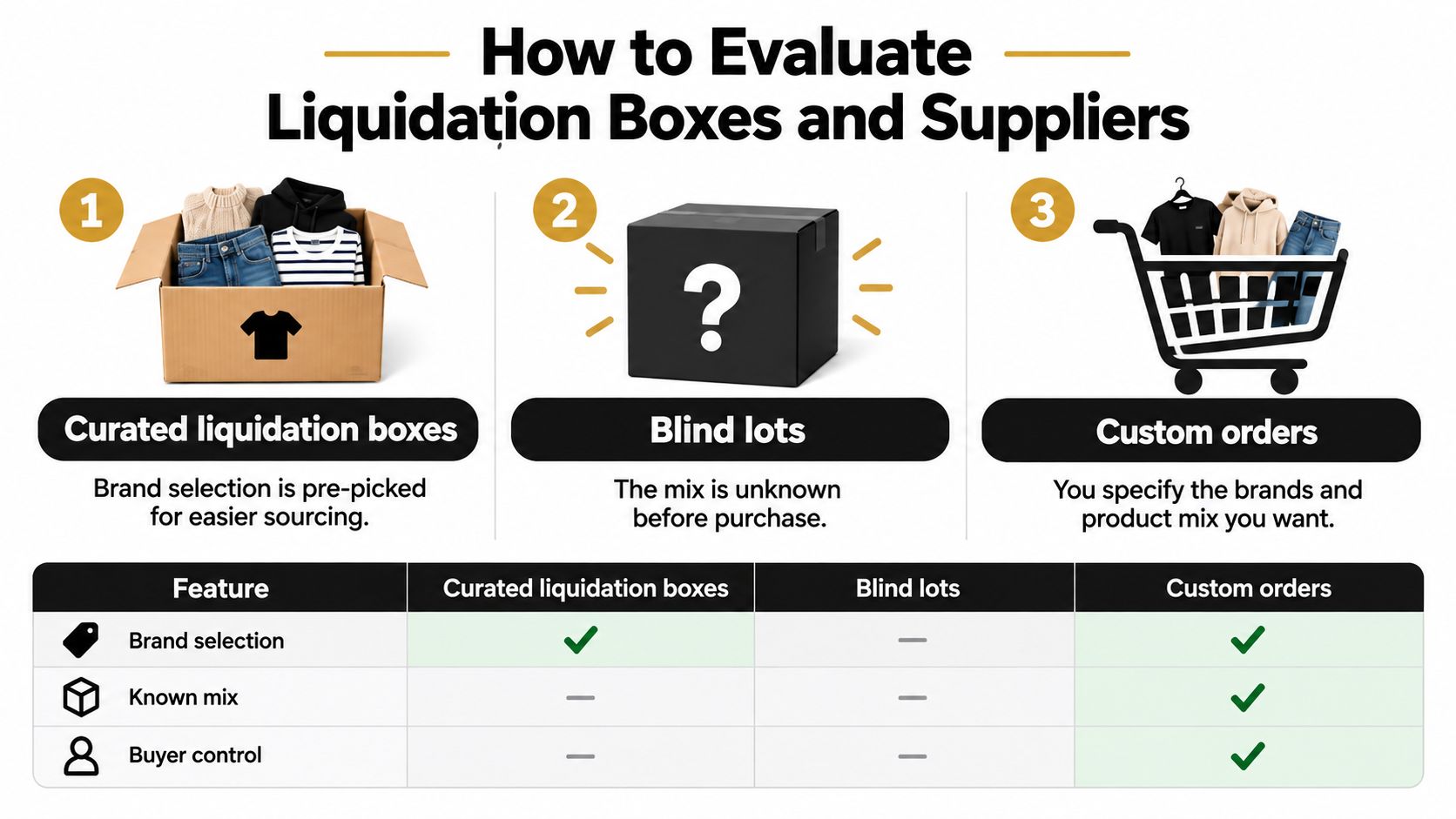
Curated boxes arrive with a brand mix someone already chose. You know the general size range and likely labels before you pay, so you can model sell-through on brands your store has already sold. You give up veto power over individual pieces, and the sorting is lighter because the guessing is lighter.
Blind lots keep the mix hidden until the carton opens. The per-piece price usually runs lowest of the three formats, and so does the amount of planning you can do in advance. A blind lot is inventory the way an ungraded fabric roll is fabric: cheap by the yard, expensive in labor. Budget real sorting hours, and skip promotions built on brands you haven't confirmed are inside.
Custom lots built to spec let you name a budget, brands, and quantity. Control is at its highest, and so is the amount of cash parked in a single delivery. A format this size earns its place when your own sales log, not a supplier's pitch, says which labels move.
What to ask before you wire anything
Each question below feeds one number in your model. A supplier who answers clearly has done this before, and vague answers are information too.
- Brand transparency: Can they name likely brands, or only a category? Your sell-through estimate depends on this answer.
- Box size: Is there a small test option, or does the range start at a pallet?
- Mix control: Can you influence which brands go in, or is the lot sealed?
- Who packs and ships: Is curation done in-house, or is the supplier brokering someone else's container?
- Quote path: Will you get a written number tied to your stated budget and quantity?
- Reply speed: Can you reach a person during the week you need the stock?
One example on the curated-and-custom side: OneTrendyCloset is a wholesale supplier founded in 2013 that handles curation, packing, and shipping in-house, accepts buyer input on brand mix, and writes custom quotes for boxes or pallets. Company materials cite 24+ brand partners and more than 5,000 customers, with email support Monday through Friday, 9 AM to 6 PM EST, and Saturdays 10 AM to 4 PM EST. Weigh answers like these against other vendors using this comparison of clothing liquidation sites, and score each one on what you can verify, not on what the listing promises.
If you want to see a mixed resale box opened and sorted before you commit, this walkthrough shows the pile as it arrives.
A supplier who can't tell you the box size, your influence over brands, and who packs the carton is asking you to pay for their uncertainty.
Taking Your First Step Into Liquidation Buying
Choose a first box the way you would run a short seam test on a sewing machine: enough stock to judge the result, but little enough to discard if the settings are wrong. Match the size to the cash available this month and to the amount you can process. Before requesting a price, write down your landed-cost target and list the brands or categories you can photograph, inspect, and ship within two or three weeks. A small box may cost more per piece; it also limits the cash trapped in stock that does not sell.
When the carton arrives, use the intake checks covered earlier before anything goes on a hanger. Verify labels, compare the contents with the packing list, and grade condition. Then record what sells by brand and size, how long each unit takes to prepare, and what remains after platform fees and shipping. Compare those results with the margin you modeled rather than relying on the original per-piece price.
A second order should follow the evidence in that log. If sell-through and handling time leave a contribution margin, ask for a written quote based on your budget, proven brands, and processing capacity. If the test stalls, adjust the categories or box size before increasing volume. A pallet is a separate decision. The first job is to finish a measured box and learn what your operation can turn.
OneTrendyCloset supplies brand-name apparel liquidation boxes and custom lots for boutique owners and online sellers. If that format fits your restock plan, request a quote using the budget, brand mix, and quantity supported by your sales log.