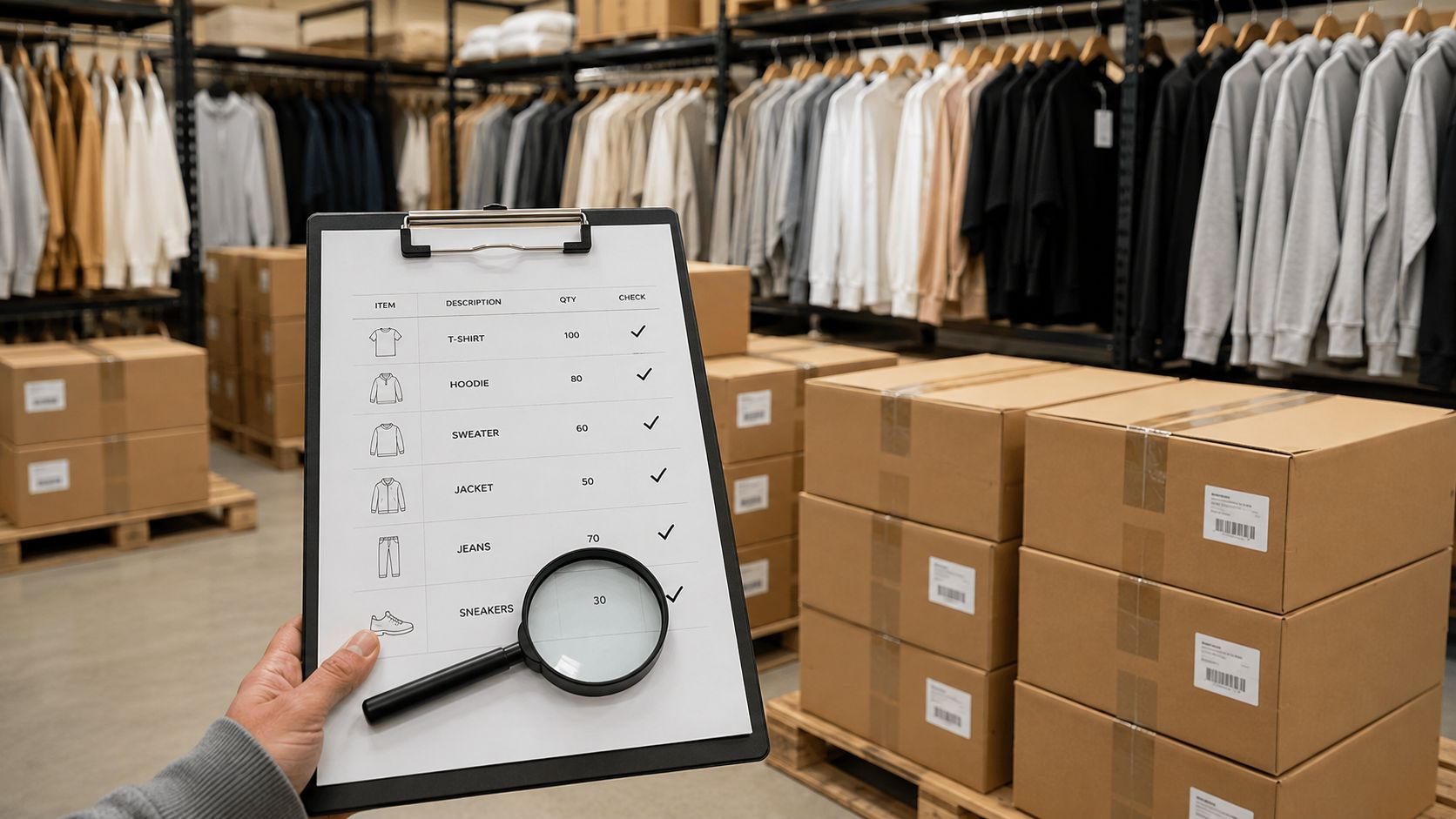
You've found a supplier offering a tempting box of “brand-name” clothing at a price that seems impossible to ignore. The photos look clean, the seller promises fast shipping, and the product description sounds flexible. Then the box arrives. The sizes are unusable for your customers, the recognizable brands are missing, and several pieces need more work than your margin can support.
That's the core supplier problem. A wholesale supplier for clothing isn't valuable because the acquisition price is low. It's valuable when the lot's condition, brand mix, sizing, documentation, and replenishment speed fit the channel where you sell. The U.S. clothing and clothing accessories wholesaling industry reached an estimated $129.3 billion in 2025, after $130.2 billion in 2024, according to Federal Reserve apparel wholesale data. In a crowded market, buyers can't afford to treat inventory as interchangeable.
The sections below give you a practical way to find suppliers, verify their claims, test a lot, negotiate terms, and monitor results after delivery. Judge the supplier by evidence and transaction terms, not dramatic savings or vague promises about “premium brands.”
Table of Contents
- When the Wrong Supplier Costs You a Season
- Where Resellers Actually Find Wholesale Clothing Suppliers
- What a Legitimate Clothing Wholesaler Looks Like
- Questions to Ask Before You Wire a Single Dollar
- Red Flags That Should Send You Running
- Matching Your Order Size to Your Channel
- Building a Supplier Relationship That Grows With You
When the Wrong Supplier Costs You a Season
A reseller once ordered a seasonal bundle after seeing photographs of neatly arranged garments and a description promising a strong brand mix. The shipment arrived with the wrong season, inaccurate pack counts, weak labels, and sizes that didn't match the seller's audience. The supplier defended the order by pointing out that the garments were technically sellable.
That defense missed the point. The inventory wasn't necessarily worthless, but it was wrong for the sales window. The reseller had already paid for freight, sorting, storage, steaming, photography, and listing work. By the time the problem became obvious, the replacement option had disappeared and the seasonal demand had moved on.
The cost is larger than the invoice
Slow-moving stock ties up cash that could have funded a better lot. It also creates markdown pressure, consumes storage space, and leaves you answering disappointed customers who expected more recognizable brands or useful size coverage. If you sell through live auctions or marketplace listings, a weak shipment can also damage the consistency buyers expect from your storefront.
The U.S. market's scale makes this risk easy to underestimate. The industry grew at a 2.5% compound annual growth rate between 2019 and 2024, while the market report lists 34,214 businesses in 2026, with the business count growing at a 4.1% CAGR between 2021 and 2026. Those figures point to a large, fragmented supplier market where operators compete on assortment, speed, and pricing, not scale alone. See the Federal Reserve's apparel wholesale series for the referenced market data.
Practical rule: A cheap lot is expensive when you can't predict who will buy it, how quickly it will sell, or what work it needs first.
A reliable supplier makes product risk easier to calculate before your money changes hands. You should be able to review a manifest, understand condition grades, confirm how substitutions work, and see what happens when the delivered lot differs materially from the agreement. That standard matters more than a polished sales page.
Where Resellers Actually Find Wholesale Clothing Suppliers
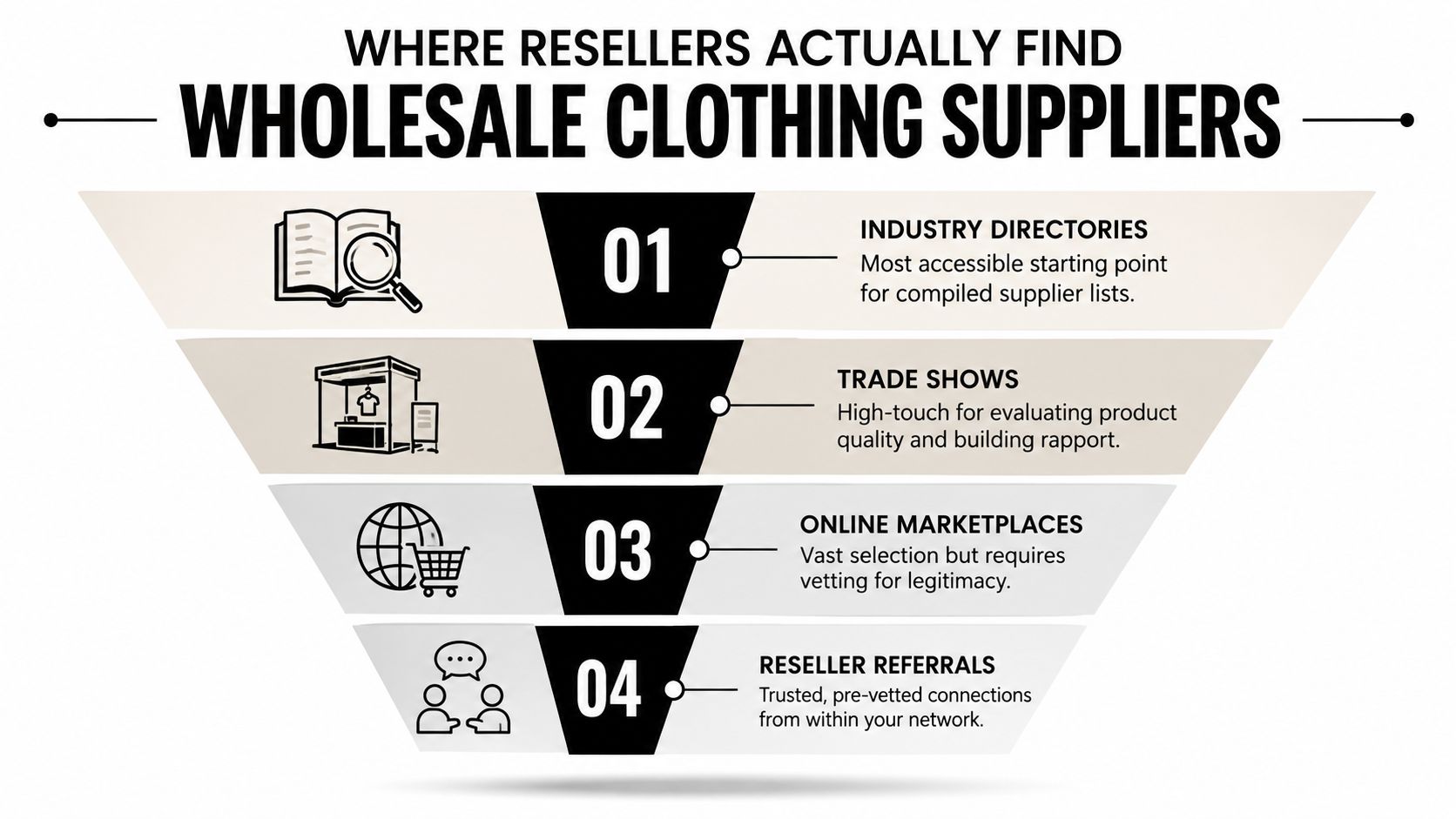
The best sourcing channel depends on your sales model, but not every channel deserves equal trust. Start where accountability is visible, then use broader marketplaces to expand your shortlist.
Rank the channels by verification strength
Industry directories are a sensible first stop because they organize suppliers by product category and location. A directory listing isn't proof of performance, but a legal business name, established contact information, and visible industry presence give you something concrete to verify.
Trade shows offer the strongest hands-on evaluation. You can inspect fabric, seams, tags, packaging, and size runs while speaking directly with the person responsible for purchasing or fulfillment. That conversation often reveals more than a product page. Ask how lots are graded, whether the business owns its inventory, and how it handles claims.
Referrals from established resellers can save time. A boutique owner, eBay seller, or live-sale host can tell you whether shipments arrive as described and whether problems get resolved. Still, treat a referral as a lead, not a guarantee. Your channel, order size, and tolerance for mixed inventory may differ from the referrer's.
Online marketplaces provide broad selection and convenient ordering, but badges and seller ratings don't prove lawful sourcing or dependable inventory. Search by specific categories, such as women's contemporary overstock or children's branded returns, then cross-check the company outside the platform. For additional sourcing ideas, review this guide to auctions for clothing.
Use a repeatable shortlist process
Build a shortlist of five suppliers and request the same materials from each:
- Business details: Ask for the legal name, physical fulfillment location, and resale documentation requirements.
- Inventory evidence: Request a current manifest and recent photographs of an actual lot, not just catalog images.
- Human contact: Speak with a representative who can explain sourcing, grading, substitutions, and claims.
- Trial order: Buy a sample lot before making a larger commitment.
A new boutique may need curated pieces and small-order flexibility. A high-volume online reseller may care more about consistent replenishment and predictable category distribution. Choose the channel that helps you inspect those specific risks.
What a Legitimate Clothing Wholesaler Looks Like
A legitimate wholesaler runs an operation, not just a website and payment page. The business stores or fulfills inventory, receives and inspects goods, tracks orders, and commits working capital before a reseller places an order. Those costs shape the lot quality and replenishment speed you depend on.
Ask where the inventory sits, who counts each unit, how condition is graded, and whether the manifest comes from a physical count or an upstream seller's file. A broker can still be useful, provided the role is disclosed clearly. If the seller does not control the goods, identify who does and who handles claims.
Look for operational proof
A strong supplier builds lots around your resale channel. Once your purchasing pattern is consistent, the supplier may adjust brand mix, size coverage, category, or price point. Ask which changes are available and which are not. If an item sells before fulfillment, substitutions may occur, but they should require your approval or follow written rules.
Replenishment speed matters as much as the opening price. A cheap lot loses value if it arrives after your selling window, comes in separate shipments without notice, or cannot be repeated when a category performs well. Ask how often inventory is updated, how quickly orders dispatch, and whether shipments leave from the stated location.
Review these signals separately:
- Resale documentation: Confirm which documents business buyers must provide, such as a resale certificate or other registration records.
- Inventory records: Request manifests, invoices, pack sheets, and the method used to count quantities.
- Warehouse information: Verify the fulfillment address and whether the seller packs orders in-house.
- Claims policy: Read the rules for shortages, misrepresented brands, condition problems, and damaged goods.
- References: Ask whether other resellers will discuss shipment accuracy and communication.
No single document proves reliability. Business registration does not guarantee accurate lots, and a warehouse photograph does not prove that the pictured stock belongs to the seller. Match the paperwork with direct answers and a sample order.
A real supplier will accept sensible verification. They will also ask about your resale channel, customer profile, purchasing needs, and documentation.
According to IBISWorld's 2023 report on Canada's textile, clothing, and footwear merchant wholesaling industry, the sector generated $19.8 billion in operating revenue. Cost of goods sold represented 68.7% of total expenses, while labor remuneration accounted for 10.8%, other operating expenses for 20.6%, and the pre-tax profit margin was 8.3%, according to industry data from IBISWorld. Inventory carries most of the financial weight, so a supplier controlling sourcing and processing should explain those controls plainly.
Questions to Ask Before You Wire a Single Dollar
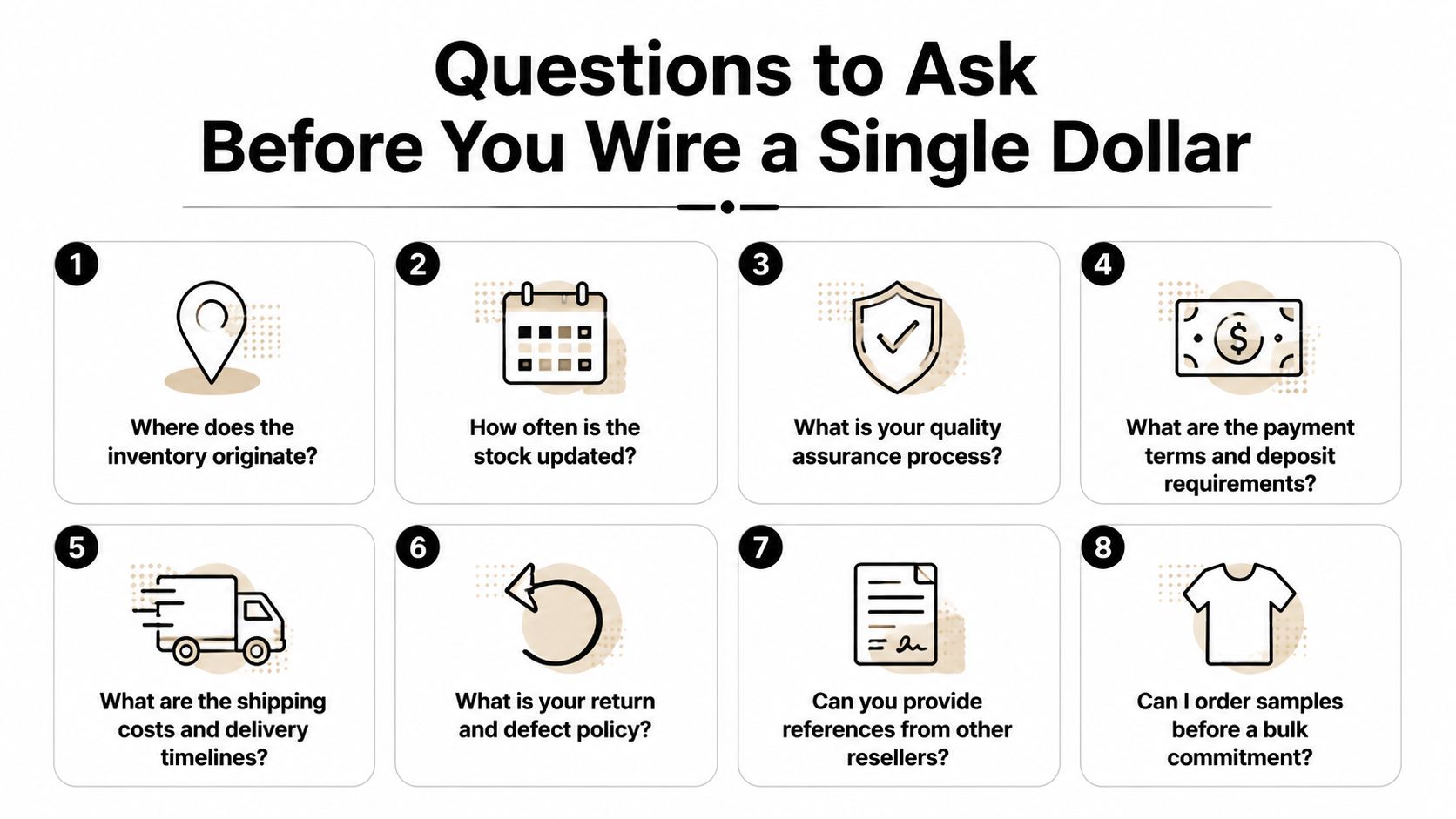
Don't let a persuasive sample bag replace due diligence. Put every prospect through the same questions, record the answers, and compare suppliers on evidence rather than enthusiasm.
Ask about the merchandise first
Start with origin. Ask whether the stock comes from retail overstock, customer returns, shelf pulls, closeouts, brand surplus, or another source. Then ask how often new inventory arrives and how quickly the supplier sells through each category.
A manifest should show more than a vague phrase such as “mixed branded apparel.” Request category, size distribution, condition grade, unit count, and brand information where available. If the seller can't provide a complete manifest for a custom lot, ask for a representative sample from a recent shipment and clarification about what can change.
Use this checklist in writing:
- Origin: Where did this specific lot come from, and can you document that source?
- Update cycle: How often does your available inventory change?
- Quality control: Who inspects the garments, and how are major, minor, and critical defects defined?
- Payment: What deposit is required, which payment methods are accepted, and when is the balance due?
- Shipping: Where does the order ship from, who pays freight, and is it palletized or floor-loaded?
- Claims: What happens when the delivered count, brand mix, or condition differs from the written description?
- References: Can you provide reseller references or verifiable customer feedback?
- Samples: Can you order a smaller lot before committing to a pallet or recurring purchase?
Watch the cost structure closely. Ask for the per-piece or per-pound calculation, including packing, pallet preparation, handling, freight, and any shrink or processing fees. Don't compare headline prices while ignoring the labor required to sort damaged or unusable pieces.
Before a quote, a reputable wholesaler may ask for your resale certificate, business registration, EIN, or sales tax documentation. That request helps distinguish a business-to-business operator from a seller moving retail goods. For a related regional sourcing example, see this guide to a clothing wholesaler in Houston.
Write every answer into a comparison sheet. Include the quoted lot description, promised ship window, claim deadline, substitution policy, and payment terms. If the supplier refuses to put those terms in writing, don't wire the deposit.
Watch the questions in this short video as another prompt for your supplier conversation:
Red Flags That Should Send You Running
Some warning signs aren't minor inconveniences. They show that the seller either doesn't understand wholesale transactions or doesn't want you examining the inventory closely.
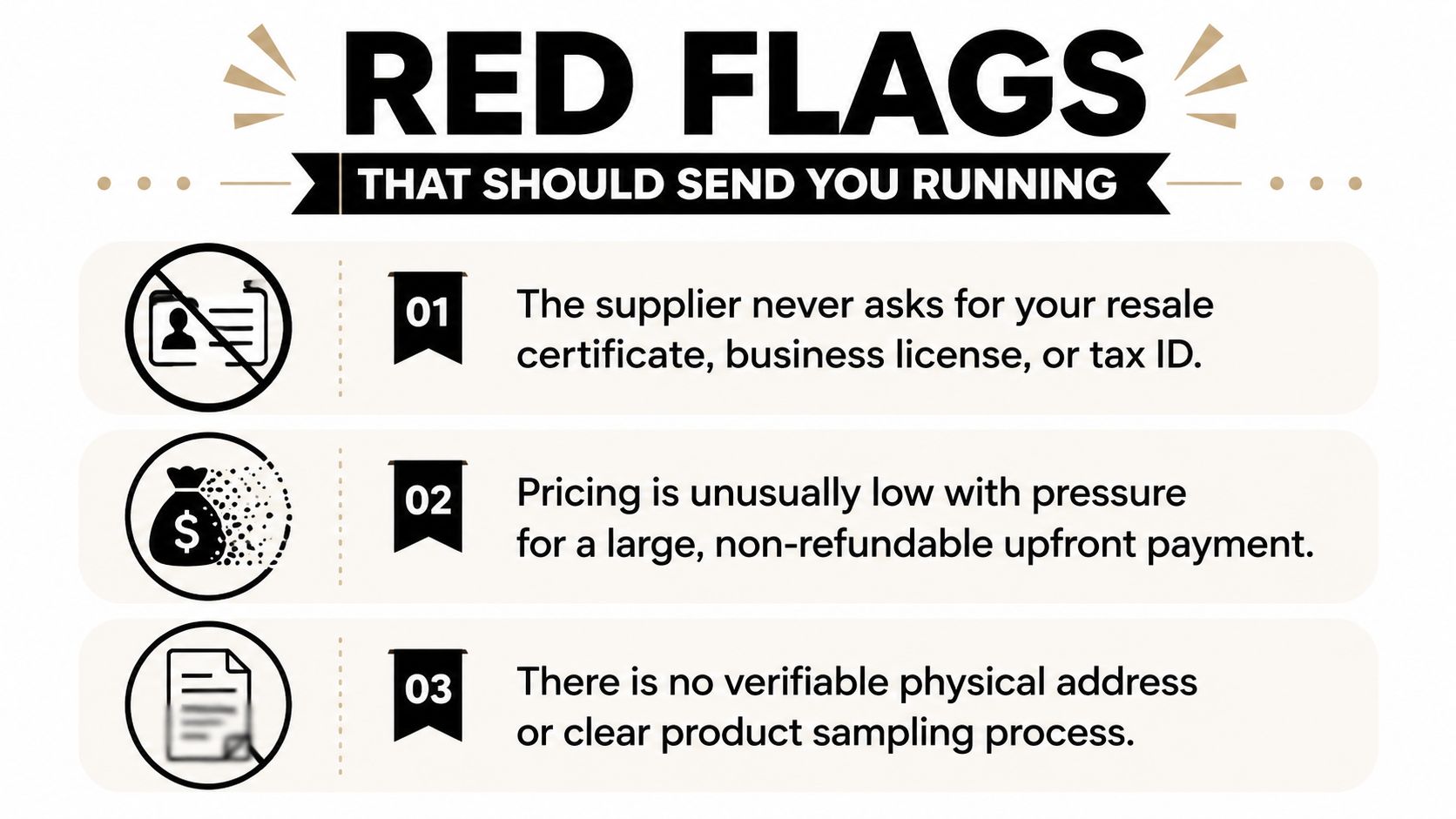
The first red flag is a supplier who never asks for your resale certificate, business license, or tax information. That may indicate a consumer-facing seller, an intermediary with limited control over the stock, or an operator working outside normal wholesale practices. Ask what documentation they require and why. Evasion is more informative than the answer.
Vague brand language is another deal breaker. “Name-brand clothing” means nothing without a manifest, product photographs, condition definitions, and a clear explanation of whether brands are guaranteed or merely possible. Ask for the original truck manifest, the source retailer, and a current lot photograph that includes identifying details.
Pressure tactics reveal the business model
Countdown timers, “today only” pricing, non-refundable deposits, and refusal to email terms all deserve immediate scrutiny. A legitimate closeout may have a real deadline, but the seller should still be able to document what you're buying and explain why the deadline exists.
Payment restrictions create additional risk. If the only accepted methods are wire transfer, cryptocurrency, or gift cards, you lose ordinary payment protections and make recovery difficult if the lot never arrives or is materially misrepresented. Request an invoice and a payment method with appropriate business records.
Blurry photographs and stock images often signal old listings, copied advertisements, or inventory the seller doesn't possess. Ask for a dated photograph or video of the actual lot, then call the published phone number independently rather than relying only on chat messages.
Walk-away test: If the seller won't identify the source, show current inventory, explain the claim process, and put the agreement in writing, keep your money.
Matching Your Order Size to Your Channel
Order structure should follow your sell-through and operational capacity, not your excitement about a low unit price. A reseller who can't photograph, list, store, and move a large lot will turn a bargain into a warehouse problem.
| Structure | Typical Weight | Price Range | Best Channel |
|---|---|---|---|
| Liquidation boxes | 25 to 50 pounds | $0.85 to $2.50 per pound | New resellers, flea markets, and bin-store operators |
| Custom pallets | 250 to 500 pounds | Quote-based | Established eBay and Poshmark sellers |
| Curated brand-mix lots | Supplier-defined | Quote-based | Boutiques and Shopify sellers |
Liquidation boxes suit testing. They let a new reseller learn which categories, sizes, conditions, and brands move without committing to a warehouse-scale purchase. The tradeoff is less control over the assortment, so request the clearest available description before ordering.
Custom pallets make more sense once your channel has regular demand. You can specify category, size priorities, and preferred brands, but you'll also inherit more storage, sorting, photography, and cash-flow exposure. Review pallets for sale as a sourcing option, then ask the supplier how much of the final composition is guaranteed.
Curated brand-mix lots target sellers who can convert brand recognition into stronger listings or boutique presentation. They're useful when your customer base expects a defined aesthetic rather than random clearance inventory. Don't pay for the word “curated” alone. Demand a written description of the mix and the process behind it.
Match volume to capacity
If your weekly sell-through is modest, start with a box. Move to a pallet only when your listing workflow, storage, and cash reserve can absorb it. Larger orders need more than product budget. They require room for inspection, time for measurements, equipment for photography, and a plan for pieces that don't fit your channel.
The right supplier will help you scale gradually. The wrong supplier will encourage the largest possible order before you've tested accuracy.
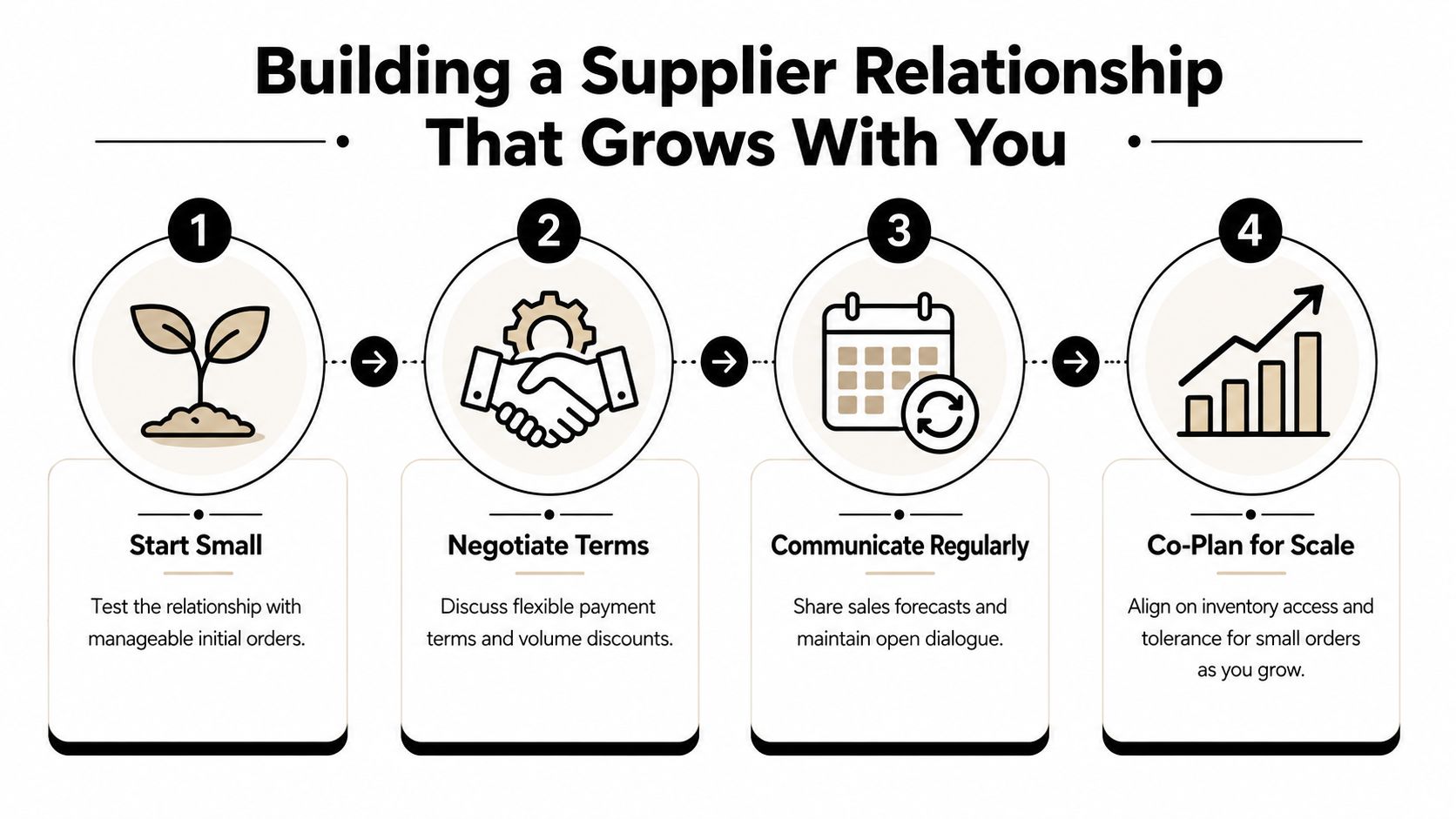
Building a Supplier Relationship That Grows With You
Your supplier becomes part of your operating system after the first successful shipment. Their inventory access affects what you can list, their communication affects replenishment, and their tolerance for smaller orders affects how safely you can grow.
The relationship should start with a controlled test, not a grand promise. Audit any current supplier against the standards above, send the same questions to two new prospects, request samples, and document what arrives. Record count accuracy, brand mix, condition, size distribution, packing quality, dispatch timing, and how quickly the supplier resolved discrepancies.
Review performance instead of relying on memory
After each shipment, compare the promised lot with the delivered lot. Re-evaluate the relationship after every third shipment, or sooner if a claim exposes a recurring problem. Keep supplier scorecards simple enough to maintain:
- Accuracy: Did the quantity, category, brands, and condition match the agreement?
- Economics: Did the lot generate enough sellable inventory after sorting and preparation?
- Responsiveness: Did the supplier answer questions and resolve claims promptly?
- Replenishment: Can you access a similar mix when your customers respond well?
- Risk: Are you becoming dependent on one source?
Don't trade predictability for a slightly lower price without calculating the labor and cash-flow consequences. A supplier who consistently delivers usable inventory may be more valuable than one who offers a cheaper but erratic assortment.
Concentration creates its own risk. Keep alternative suppliers qualified, even when one partner performs well, and avoid allowing a single source to control your entire assortment. As your volume grows, use documented order history to negotiate better communication, clearer substitutions, flexible payment terms, or priority access. Your negotiating power comes from being a reliable buyer with specific requirements, not from making vague promises about future volume.
The best wholesale supplier for clothing isn't a permanent label. It's a relationship that keeps earning its place through accurate lots, transparent terms, and dependable replenishment.
This week, audit your current supplier, send the checklist to two prospects, and order a sample before approving a pallet. OneTrendyCloset offers curated brand-name apparel liquidation boxes, mix-and-match brand selection, and custom quotes for resellers who need a more controlled path from test inventory to larger lots. Visit OneTrendyCloset to review its sourcing options and request inventory aligned with your channel.