You've found a listing for Amazon pallets for sale that appears to promise an easy margin. The manifest looks impressive, the retail value is much higher than the bid, and the seller wants a decision before the lot disappears. Then the practical questions arrive: Who owns the inventory? What condition is it in? How much will freight cost? How much of it can you sell without violating marketplace, shipping, or product-safety rules?
Those questions matter more than the auction headline. Amazon liquidation pallets can be useful inventory, but they're high-variance assets, not guaranteed treasure chests. Curated wholesale boxes cost more per unit, yet they can reduce the inspection, sorting, and category risk that consumes a small reseller's time and cash.
Table of Contents
- The Moment Every Reseller Hits the Crossroads
- What Amazon Pallets for Sale Actually Means in 2026
- Side by Side How Amazon Pallets and Curated Boxes Stack Up
- The Verification Problem Most Listings Never Address
- Real Landed Cost and Compliance Behind the Sticker Price
- Inspection Checklist Before You Pay for Any Pallet
- Which Sourcing Channel Fits Your Reseller Stage
The Moment Every Reseller Hits the Crossroads
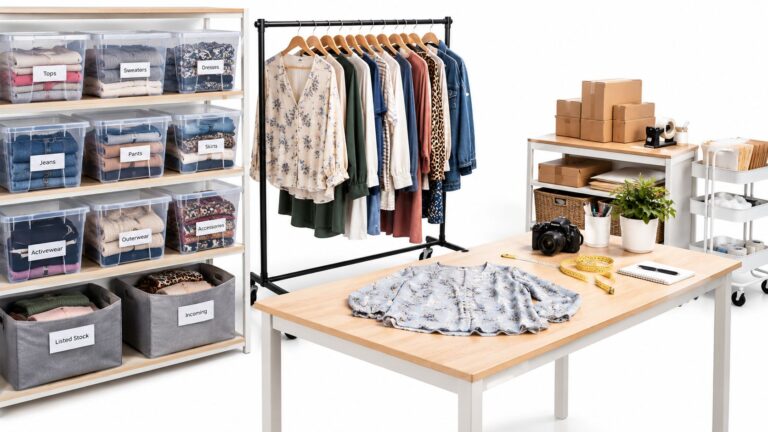
An eBay seller works from a 900-square-foot garage and has spent two years buying curated brand-name apparel boxes. She pays $1,400 landed for a box with a dependable manifest, recognizable brands, and condition information she can use when planning listings. The process is repetitive, but it works. She knows how much rack space a shipment needs and how quickly she can photograph and publish the items.
Then she sees a liquidation marketplace listing for 26 Amazon return pallets at $9,800. The page promises $40,000 in retail value. She has $14,000 in working capital and 30 days to decide whether the lot is the breakthrough her business needs or a cash-flow trap.
The listing creates a misleading comparison. Her curated box feels expensive because the price is clear and the contents are controlled. The Amazon lot looks cheap because the retail figure is displayed prominently, while the work needed to verify that figure remains invisible. She'd need to investigate the seller, confirm the source, inspect the manifest, estimate freight, plan for damaged goods, and find room for inventory that may not match her existing workflow.
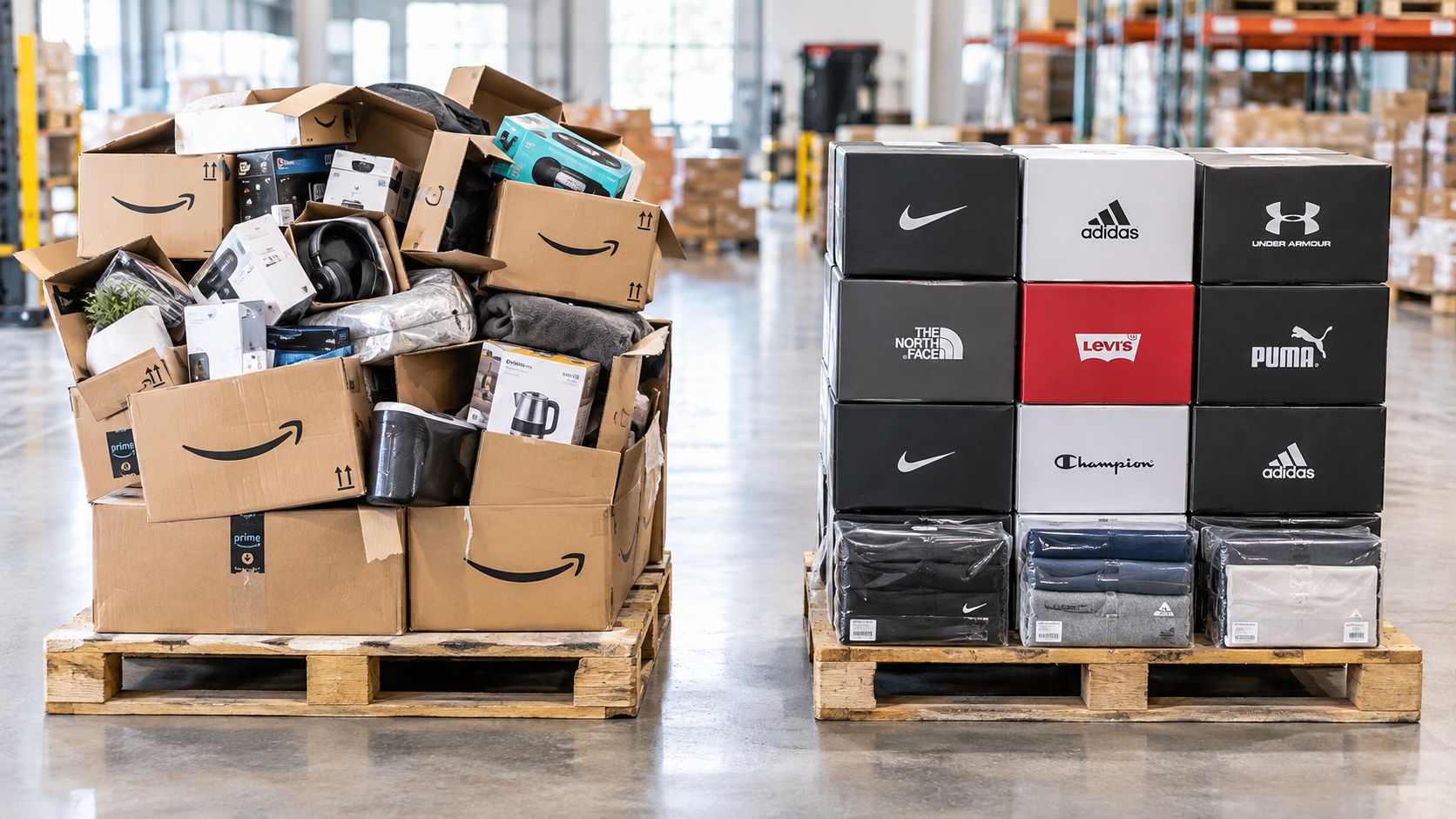
This isn't really an auction-versus-boutique decision. It's a choice between variable risk and curated risk. An auction lot may offer broader upside and a lower entry price, but the buyer absorbs uncertainty around condition, counts, category mix, freight, and disposal. A curated box usually limits variety and may carry a higher unit cost, but the supplier absorbs more of the selection and preparation burden.
The cheapest lot is only cheap before you add the work required to make it sellable.
For a single-operator business, the practical question is simple: which channel protects margin after freight, unsellable inventory, compliance, and labor are priced into the decision?
What Amazon Pallets for Sale Actually Means in 2026
“Amazon pallets for sale” usually refers to liquidation inventory associated with Amazon's returns, overstock, and warehouse-damaged goods. The official historical channel is Amazon Liquidation Auctions on the B-Stock marketplace, where bulk lots are auctioned by pallet or truckload rather than sold as ordinary retail stock. The auction structure adds a flat 10% buyer premium to the winning bid, and buyers typically arrange freight through LTL shipping from the fulfillment center where the lot ships, as described in this guide to Amazon Liquidation Auctions.
That distinction matters because many online listings use Amazon's name without selling inventory directly from Amazon. A marketplace page can show an Amazon-related category while the actual transaction is handled by a liquidator, broker, return processor, or regional wholesaler. Read the seller terms, source description, pickup location, payment rules, and condition language before treating the listing as an Amazon-origin lot.
Read the listing in layers
Start with the inventory format. Customer returns may include opened packaging, used products, missing components, and items that need testing. Shelf pulls are generally products removed from retail or fulfillment circulation, so packaging and condition may be cleaner, but the lot can still contain discontinued, incomplete, or seasonally difficult stock. Overstock usually means unsold inventory, and it can be more uniform, although the product mix may be less attractive to your audience.
Then inspect the transaction mechanics:
- Auction window: Confirm when bidding closes and whether the platform extends bidding near the deadline.
- Buyer premium: Add the stated premium to your maximum bid before you submit it. The official Amazon Liquidation Auctions structure cited above uses 10%, but other platforms can set different terms.
- Freight responsibility: Assume you'll need to arrange and pay for transportation unless the listing explicitly states otherwise.
- Pickup conditions: Check the shipping origin, appointment rules, dock requirements, and whether liftgate service is available.
- Final-sale terms: Liquidation purchases commonly provide limited or no return rights, so the condition description carries real financial weight.
Industry guides describe Amazon return lots ranging from about 100 to 500 items, with prices from roughly $200 to $2,000, depending on condition, manifest detail, and product mix. Those ranges are market descriptions, not a valuation formula. A pallet with many small accessories behaves very differently from a pallet dominated by bulky home goods or electronics, as explained in this overview of Amazon return pallets.
Manifest access also varies. A detailed manifest can help you research individual SKUs, but it doesn't turn a return pallet into a guaranteed inventory count. Treat it as a planning document and price your bid around what you can verify, not the most optimistic interpretation of the list.
Side by Side How Amazon Pallets and Curated Boxes Stack Up
The useful comparison isn't “cheap versus expensive.” It's uncertainty versus control across the parts of your operation that determine net return.
| Criteria | Amazon Pallets (Auction) | Curated Brand-Name Boxes |
|---|---|---|
| Condition grading | Often mixed, with returns, overstock, shelf pulls, and damaged goods in the broader liquidation market | Pre-selected around a stated category, brand profile, or condition expectation |
| Manifest accuracy | High variance. Manifests should guide planning, not guarantee exact contents | Usually narrower and easier to validate against the supplier's box description |
| SKU mix | Broad and unpredictable, which can create both discoveries and dead stock | More focused, useful for a defined boutique or marketplace audience |
| Unit cost versus retail recovery | Lower sticker cost can produce attractive upside, but recovery depends on testing, disposal, and sell-through | Higher unit cost buys selection and predictability, which can support faster listing |
| Post-purchase workload | Sorting, testing, photographing, categorizing, storing, and handling restricted goods | More preparation is done before shipment, so the buyer can concentrate on selling |
A $2,200 manifest pallet of mixed home goods might contain useful kitchen products, storage items, small appliances, and accessories. It might also require testing, missing-part checks, bulky storage, and separate selling strategies. The purchase can work for a reseller who already has those systems. It's a poor fit for someone whose strongest channel is branded apparel and whose workspace is already full.
A $1,400 curated 250-piece branded apparel box creates a different operating profile. The buyer may pay more for each unit, but the category is easier to photograph consistently, easier to organize by size and style, and more suitable for a focused storefront. The box won't provide the same surprise upside as a mixed return lot. It can provide something more valuable to a small seller, predictable work.
The pallets for sale guide is useful when comparing formats, but the decision should still be based on your actual workflow. A pallet is attractive only if you can process its contents without delaying existing inventory or tying up the cash needed for replenishment.
Manifest accuracy changes the math
Industry liquidation guidance warns that manifests are rarely perfectly accurate. One source says general merchandise manifest accuracy can fall to roughly 60% to 70%, which is why item-level resale checks matter before bidding. Review the Amazon customer returns manifest guidance as a reminder that declared MSRP and line-item counts are not the same as realized selling value.
Auction channels trade a lower visible entry price for verification and labor burden. Curated channels trade some upside for reduced variance. For a solo seller, the second trade is often the healthier one until the business has enough space, cash, and labor to absorb the first.
The Verification Problem Most Listings Never Address
Amazon doesn't generally sell pallets directly to consumers through random social-media listings. Independent fact-checking and consumer-safety coverage has challenged viral promotions that imply direct Amazon pallet sales. AFP's reporting on the pallet-sale claims and the related consumer warnings should change how you read every “Amazon pallet” advertisement.
The source may be a third-party liquidator, a return processor, or a broker combining freight from several retailers. That doesn't automatically make the inventory illegitimate. It does mean the seller must identify the chain of custody instead of relying on the Amazon name.
Screen the seller before studying the manifest
Ask for the exact warehouse or pickup location, the source retailer, the lot number, the condition code, and photos tied to your specific lot. A legitimate seller should be able to explain why the lot is being sold, how the manifest was created, and whether the photographs show the actual inventory rather than a representative load.
Watch for these patterns:
- Inflated retail claims: A large MSRP number appears without SKU-level detail or current resale comparisons.
- Borrowed photography: The same pallet images appear across unrelated listings or show labels that don't match the advertised lot.
- Restricted evidence: The seller refuses location-specific photos, box counts, weights, or a walkthrough of the actual shipment.
- Payment pressure: The seller insists on wire transfer or cryptocurrency and avoids payment methods with meaningful buyer protections.
- Identity gaps: The domain, company name, invoice, warehouse address, and payment recipient don't align.
- Source refusal: The seller won't identify whether the goods came from Amazon, another retailer, a return processor, or a broker.
Auction platforms can provide a more formal transaction environment, but a bid deposit doesn't guarantee that every unit will match your assumptions. Read the platform's terms and preserve the listing, manifest, invoice, and communications.
| Signal | Red Flag | Legitimate Seller |
|---|---|---|
| Source | “Amazon direct” with no documentation | Names the source category and explains the supply chain |
| Photos | Generic images or inconsistent labels | Provides photos tied to the specific lot |
| Manifest | Retail value dominates, SKU detail is thin | Shows item descriptions, quantities, and condition information |
| Payment | Urgent wire-only request | Uses documented checkout or a business payment process |
| Pickup | Address changes or doesn't match paperwork | Invoice, warehouse, and shipping details agree |
| Terms | No written condition or dispute policy | Publishes final-sale, inspection, and freight terms |
Curated wholesale suppliers have a different verification model. They may publish recurring inventory descriptions, accept purchase orders, provide fixed box specifications, and answer questions about brand or category composition. That doesn't eliminate risk, but it gives you more evidence before payment.
Verification isn't paranoia. It's part of the purchase order.
Real Landed Cost and Compliance Behind the Sticker Price
A $2,500 pallet can look profitable until it reaches your dock. The winning bid is only the starting point. Your landed cost includes the premium, freight, handling, storage, labor, preparation, and inventory you cannot sell.
Per the AFP liquidation-pallet fact-check, buyer premiums commonly run 10% to 15%, freight can add about $200 to $500 per pallet, and junk rates can reach 20% to 30% or higher. Treat those figures as planning ranges, not promises for a particular lot.
Use this cost structure before you bid:
- Winning bid: The amount submitted for the lot.
- Buyer premium: Add the platform's stated percentage to the winning bid and verify the terms before payment.
- Freight: LTL pricing depends on origin, destination, pallet dimensions, weight, access, liftgate service, residential delivery, and appointment requirements.
- Handling and storage: Delayed pickup, warehouse handling, wrapping, and temporary storage can add cost before resale work begins.
- Labor: Budget for unloading, sorting, testing, cleaning, photographing, measuring, listing, packing, and disposal.
- Loss: Broken, incomplete, unsafe, counterfeit, recalled, or unprofitable items reduce the sellable portion.
| Cost Line | Estimate | Notes |
|---|---|---|
| Winning bid | Your bid amount | Set a ceiling from verified resale comps, not stated MSRP |
| Buyer premium | Platform-specific | Confirm the exact rate and payment terms before bidding |
| Freight | Lot-specific | Distance, weight, carrier access, liftgate needs, and appointment rules matter |
| Unsellable inventory | Often material | Returns and salvage can leave a substantial portion without a viable resale path |
| Labor | Your measured internal cost | Include sorting, testing, photography, listing, packing, and disposal |
| Compliance handling | Lot-specific | Hazmat, recalls, batteries, personal care, and child-safety products need extra screening |
Here is the math for a $2,500 winning bid that reaches a $4,200 dock total:
- Winning bid: $2,500
- Buyer premium: $250
- Freight: $800
- Handling and storage: $250
- Receiving and preparation: $400
- Disposal and other acquisition costs: $0? No. The remaining $0 would make the example unclear, so itemize the total before bidding.
A cleaner working example is to record every invoice and operating charge until the total equals the actual dock cost. If the pallet arrives at $4,200, your resale target must cover that amount plus selling fees, labor after receipt, storage, returns, and tax obligations. The headline retail value does not answer that question.
Compliance can erase an apparent bargain
Lithium-battery products, damaged electronics, recalled merchandise, personal-care goods, and child-safety products may create shipping, safety, or marketplace restrictions. A manifest is not permission to list. Check condition, recall status, battery condition, packaging, and the rules of the marketplace where you intend to sell.
Curated apparel often gives a small seller cleaner costing because the category is narrower and unit economics are easier to forecast. Inspect for damage, authenticity, and seasonality, then compare the predictable box cost with the variable labor and loss carried by a mixed pallet.
Inspection Checklist Before You Pay for Any Pallet
Use a checklist that separates pre-purchase evidence from on-dock verification. The purpose isn't to make a liquidation lot risk-free. It's to stop a vague listing from becoming an expensive surprise.
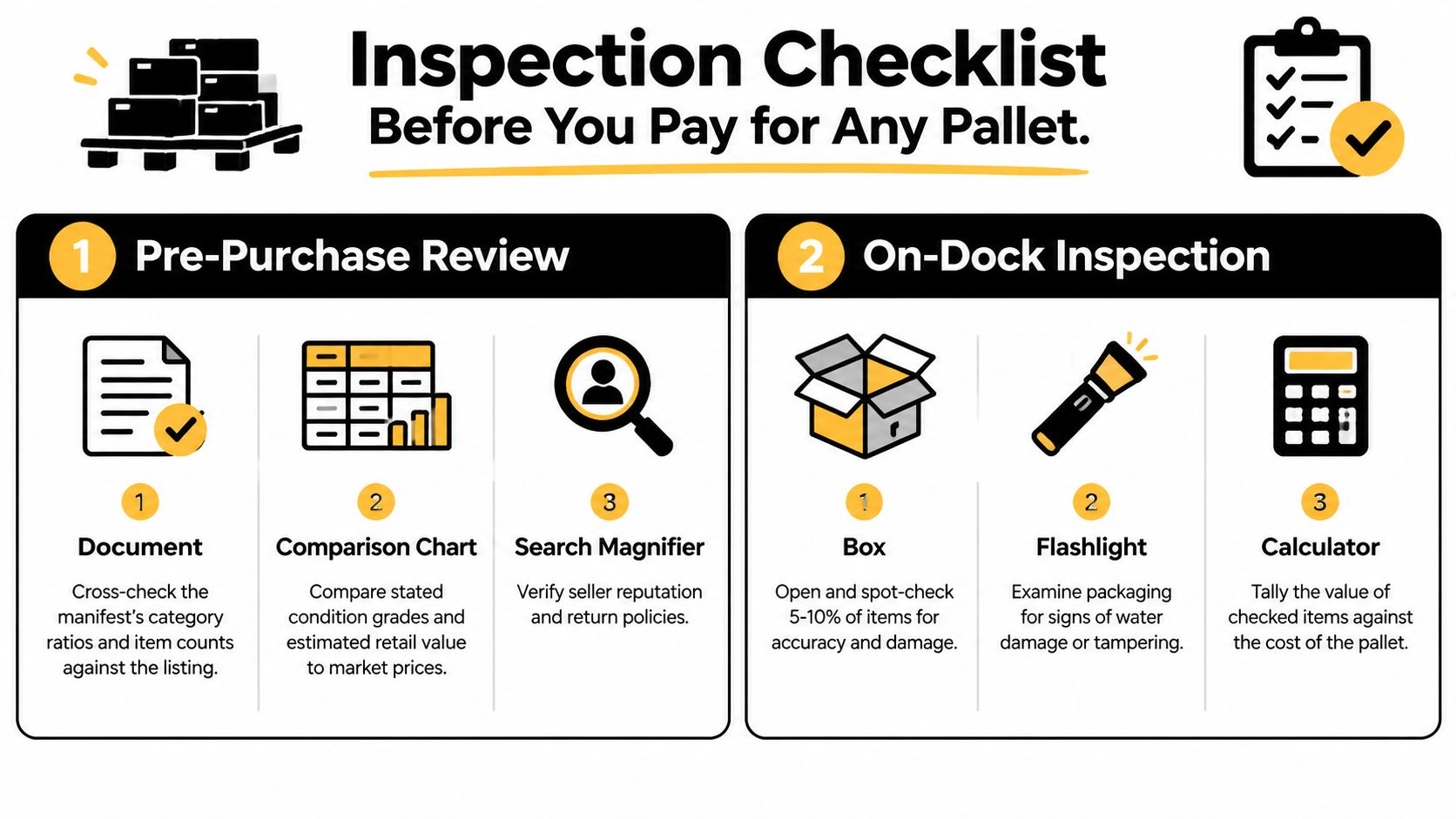
Before bidding or paying
- Match the manifest: Compare item counts, category ratios, condition codes, and stated pallet count with the actual listing.
- Check resale comps: Search individual SKUs on eBay, Facebook Marketplace, and the marketplace where you sell. Use completed sales where available, not optimistic asking prices.
- Request exact-lot photos: Ask for photos tied to the warehouse location, lot number, and shipping origin.
- Confirm the condition: Get written confirmation that the load is customer returns, shelf pulls, overstock, salvage, or a mixture.
- Calculate freight: Obtain a quote using the correct destination, pallet count, weight, dimensions, liftgate requirement, and access type.
- Review the seller: Check business identity, payment recipient, written terms, and dispute process before sending funds.
At the warehouse or dock
Before unloading, photograph the pallet wrap, labels, seals, visible damage, and carrier paperwork. Count the cartons against the manifest and record discrepancies immediately. Open a sample across the top, middle, and bottom layers rather than checking only the easiest boxes.
If the lot is large, sample roughly 5% to 10% of items as an initial inspection range, but don't treat that sample as proof that the remaining inventory is sound. Test electronics, check accessories, isolate possible hazmat or battery items, and quarantine anything recalled, counterfeit-looking, leaking, or unsafe.
Keep the bill of lading, condition-code sheet, invoice, manifest, photographs, timestamps, and resale certificate together. The liquidation-by-the-pallet resource can help you compare pallet purchasing with more controlled wholesale formats, but your own receiving records should drive future bids.
If you can't document the discrepancy, you'll struggle to prove it later.
Which Sourcing Channel Fits Your Reseller Stage
Your best source depends on your operating model, not on the lowest advertised price.
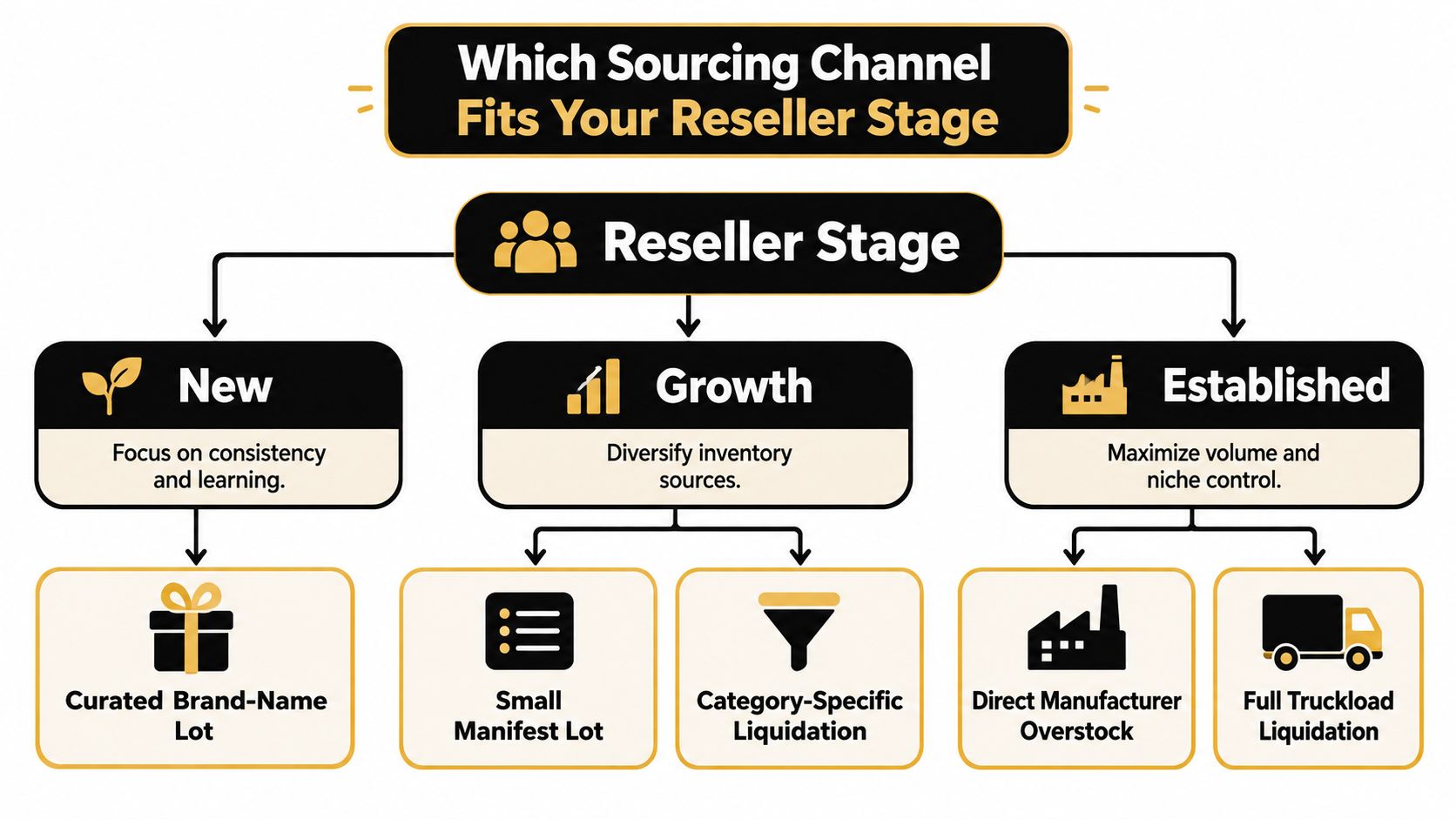
A new reseller should start with one curated brand-name apparel box or a small, tightly defined manifest lot. Consistent category content makes it easier to learn photography, condition grading, pricing, and listing without turning the garage into a returns-processing center. Choose a shipment you can receive, inspect, and list without using money reserved for fees or replenishment.
A marketplace seller with experience processing variable inventory can test Amazon returns pallets, but only after separating the manifest value from the freight quote. Reserve cash for removal, preparation, damaged goods, and stock that sells slowly. Start with a lot small enough to measure realized selling price after marketplace fees and labor.
Live-sale hosts need visual consistency and reliable replenishment. A host selling branded clothing benefits from cartons that can be opened, sorted by size or category, and presented quickly on camera. For that model, curated clothing boxes usually fit better than ungraded mixed cartons.
Established resellers with staff, storage, testing equipment, and disposal procedures can use mixed Amazon pallets as an opportunity stream. They can route clean units to online listings, suitable bundles to local sales, salvage to recovery channels, and restricted goods to proper disposal. Without that separation process, volume multiplies the mess.
Offline boutiques and pop-up sellers should favor recognizable brands and a seasonally appropriate mix. Specialized sellers should seek narrow manifests that match a proven niche, such as home organization, apparel, or a specific electronics category, rather than buying a general merchandise load because the retail estimate looks large.
Match the channel to the work you can actually perform
Use auctions for clothes when you understand the bidding terms, condition variance, and processing workload. Don't use auctions to compensate for an undefined niche or a lack of working capital.
The strongest operating rule is straightforward: buy a small test lot, record the actual outcome, and scale only after the measured margin survives fees, labor, freight, and unsold inventory. A low-cost auction lot can be excellent for a prepared operator. A curated box can be the more profitable choice for someone who values speed, consistency, and space.
OneTrendyCloset offers curated brand-name apparel liquidation boxes, mix-and-match brand selections, and custom box or pallet quotes for boutiques, marketplace sellers, and live-sale hosts. If you want a more controlled alternative to mixed Amazon returns, visit OneTrendyCloset and request an inventory option aligned with your budget, category, and selling channel.