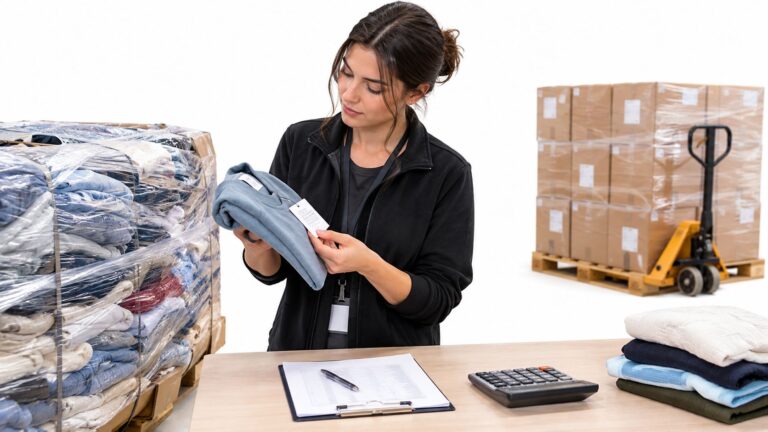
You walk into a Houston warehouse district with a clipboard, a resale certificate, and more questions than answers. The pavement is hot, the parking lot is arranged for box trucks rather than first-time buyers, and several neighboring units carry little more than a faded sign and a phone number. Inside, you may find garment racks, closeout cartons, import inventory, and brand reps sharing the same industrial corridor. The difficult part isn't finding clothing. It's identifying the supplier that will describe the inventory accurately, honor the terms, and still answer your call after payment.
Houston rewards buyers who treat sourcing as a process rather than a single shopping trip. You need a supplier map, a way to verify each business, and a margin model that accounts for freight, sorting, damaged units, and slow sellers. You also need to know when local access helps and when a wider Gulf Coast strategy, including Dallas, gives you the assortment Houston alone can't provide.
Table of Contents
- Starting Your Houston Clothing Sourcing Journey
- Understanding Houston's Wholesale Apparel Landscape
- Where to Find Clothing Wholesalers in Houston
- When to Look Beyond Houston for Better Assortment
- How to Verify and Evaluate Any Wholesaler
- Pricing, Margins, and the Math Behind Wholesale Boxes
- Your First 30 Days as a Houston Clothing Reseller
Starting Your Houston Clothing Sourcing Journey
A first visit to a clothing wholesaler in Houston can feel improvised. Showroom hours may be limited, some warehouses expect a resale certificate before they discuss pricing, and a supplier may quote a case price without explaining the grade, size mix, or damage policy. New buyers often make the same expensive mistake, they buy the largest lot available before learning how that supplier labels, packs, and handles returns.
Start with a written buying brief. Define your customer, preferred categories, target sizes, acceptable condition, selling channels, and maximum landed cost. A boutique serving local walk-in shoppers may need a tighter assortment than a live-sale host who can move mixed styles quickly. A marketplace seller should also account for photography and listing time before treating a low unit price as a bargain.
Build a supplier map before visiting
Search by warehouse location, product category, and business model, not just by the phrase “Houston wholesale clothing.” Separate potential contacts into manufacturer-direct representatives, jobbers, liquidators, import distributors, and off-price operators. Each channel solves a different inventory problem, and mixing them together makes price comparisons unreliable.
Call before driving across town. Ask whether the supplier sells to new businesses, requires a Texas resale certificate, allows physical inspection, offers samples, and publishes minimum order requirements. Take photographs of labels and packing slips when permitted, and record the salesperson's name. Those details make it easier to compare a legitimate offer with a vague online listing.
Practical rule: Never let the excitement of a full rack replace a written description of what you're buying.
A workable Houston sourcing plan has four parts: identify the market channels, verify the businesses, calculate landed cost, and test small before scaling. The final section turns those habits into a first-month schedule, but the discipline starts with your first warehouse visit. You're not looking for the cheapest door. You're looking for a repeatable supplier relationship that produces sellable inventory.
Understanding Houston's Wholesale Apparel Landscape
Houston is more than a collection of independent clothing warehouses. The Greater Houston regional economic profile records 10,919 wholesale trade establishments, 321,531 wholesale and retail trade employees, and 166,334 wholesale trade employees, with average wholesale-trade wages of $109,096. Those figures cover wholesale trade broadly, not clothing alone, but they show why Houston supports a substantial network of distributors, importers, jobbers, and retail suppliers.
The same profile lists 2,452 establishments in textiles, apparel, and leather, the closest published regional measure tied to clothing and apparel distribution in Houston's broader wholesale ecosystem. That distinction matters. A buyer shouldn't assume every large wholesale facility carries fashion inventory, and shouldn't judge the apparel market by the number of consumer-facing boutiques on one street.
Texas adds another layer. IBISWorld's Texas clothing and clothing-accessories wholesaling market profile tracks the sector as a standalone market with historical coverage from 2015 to 2030, while Texas had about 17,100 textile, apparel, and leather manufacturing jobs in 2016. Houston sits within that statewide chain, connecting manufacturing, wholesale distribution, and retail demand rather than operating as an isolated local market.
Match the channel to the inventory problem
Houston's logistics infrastructure supports quick replenishment and access to imported goods, while its multicultural customer base creates room for varied fits, colors, occasionwear, and price points. In practice, the strongest buying signal isn't a supplier's marketing language. It's the combination of current stock, clear labeling, consistent pack information, and an order minimum you can absorb.
| Channel Type | Pricing Model | Typical MOQ | Best For |
|---|---|---|---|
| Manufacturer-direct representative | Set wholesale price or negotiated account pricing | Often higher | Repeatable styles and planned replenishment |
| Jobber | Per-piece or case pricing | Low to moderate | Fast-moving basics and flexible tests |
| Liquidator | Lot, carton, pallet, or negotiated closeout price | Varies by lot | Brand returns, surplus, and opportunistic buying |
| Off-price middleman | Discounted wholesale or case price | Moderate | Buyers seeking recognizable labels without direct-brand access |
Walk the facility with a buyer's eye. A serious operator can explain whether inventory is first quality, customer return, shelf pull, overstock, or mixed condition. Check whether cartons have SKU or UPC information, whether garments are sorted by size, and whether the posted minimum matches what the salesperson says. A messy warehouse can still contain profitable stock, but unclear inventory descriptions create risk that a low price won't fix.
Where to Find Clothing Wholesalers in Houston
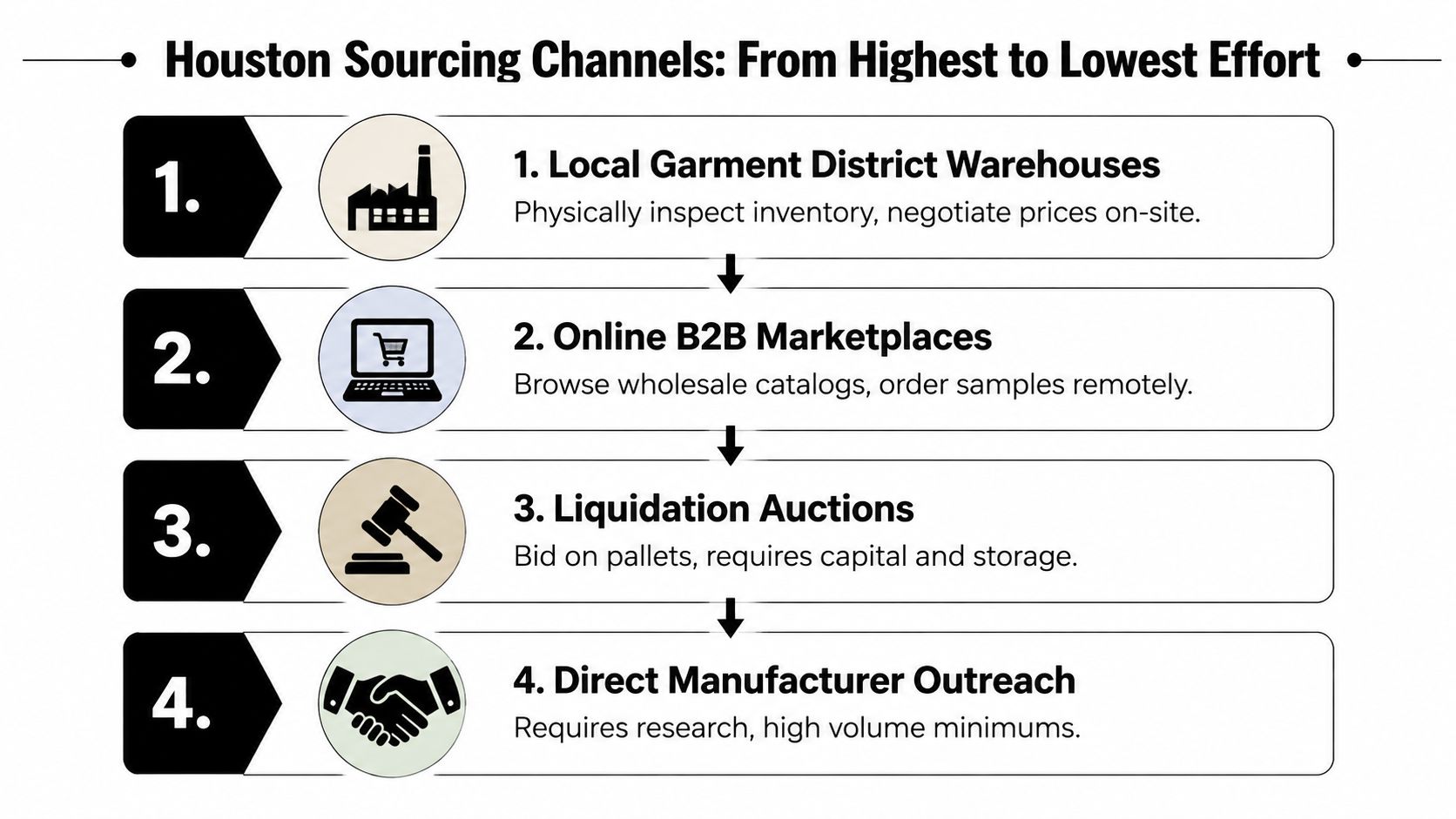
A Houston reseller usually has four workable sourcing routes: local warehouses, regional representatives, liquidation operators, and online B2B listings. Each shifts the risk differently. Warehouses allow physical inspection and faster pickup. Online marketplaces simplify comparison but may hide the inventory's real location. Liquidation can produce strong buys, yet sorting, storage, and inconsistent condition become part of the order.
Start with local warehouses and representatives
Call local garment warehouses and Texas distribution representatives when fabric, fit, color, or label condition needs a hands-on check. These suppliers can support core products that require regular replenishment. Their limitations are practical: showroom inventory changes quickly, and some operators do not maintain catalogs designed for small retailers.
Request a current line sheet, pack breakdown, reorder process, and damage allowance. Confirm whether the merchandise is physically in Houston or available only through a remote fulfillment partner. If the representative cannot answer clearly, treat the company as a broader supplier rather than a local source. That distinction affects pickup, lead time, and freight planning.
Use closeouts and liquidation selectively
Southwest Houston industrial areas and nearby commercial corridors may connect buyers with closeout trucks, surplus brokers, and liquidation operators. Mixed lots shift more work to the buyer, including checks for condition, seasonality, size balance, and style mix. A brand list is not enough to evaluate a pallet. Ask for a real manifest, recent photographs, or a small test lot when the seller can provide one.
For a practical explanation of how lots of clothing can suit different reseller models, compare the expected sorting time with your sales channel before ordering. A boutique may need a clean, coordinated assortment. A live seller may accept more variation when each piece is easy to show and describe.
Treat online B2B listings as leads
Filter B2B marketplaces for Houston-based suppliers, then verify the warehouse address, pickup option, and inventory ownership. A local-looking profile may still dropship from another state. Ask for a video call from the warehouse, a sample invoice, and the exact condition terms used in the listing.
Trade events and market weeks serve a separate purpose. Smaller Houston apparel events can introduce regional representatives, while broader nearby markets can add assortment depth to a Gulf Coast sourcing plan. Referral networks also matter. Boutique owner groups, reseller communities, buying groups, and freight forwarders may point to import closeouts that receive little public advertising.
Build a shortlist before traveling, book appointments where possible, and compare offers in the same worksheet. Record product category, condition, pack, minimum, freight, payment terms, and return policy for every vendor. That process makes Houston useful for quick tests and replenishment while leaving room to source deeper categories from nearby markets when local stock is uneven.
When to Look Beyond Houston for Better Assortment
A Houston buyer can build a dependable local program and still find gaps when a season or category changes. Contemporary plus-size inventory, premium denim, children's wholesale, and heavier fall or winter goods may require searches beyond the city. Houston's warm climate also makes local demand a weaker guide for cold-weather inventory sold elsewhere.
A multi-market Gulf Coast plan gives each market a defined job. Houston warehouses work well for relationship-based buying, quick inspection, pickup, and replenishment. Dallas adds broader category coverage through concentrated showrooms and planned market appointments. That combination helps a reseller test locally, then add depth when Houston stock is uneven.
Compare the two buying models
| Factor | Houston Local Wholesalers | Dallas Market Center |
|---|---|---|
| Primary advantage | Local relationships and physical access | Concentrated assortment and showroom coverage |
| Buying style | Appointment, warehouse visit, or direct negotiation | Planned market visit across many showrooms |
| Best use | Replenishment, closeouts, quick tests | Seasonal planning and category expansion |
| Main trade-off | Assortment can be uneven across categories | Travel and freight require advance planning |
| Buyer strength required | Strong inspection and negotiation | Strong line planning and appointment management |
Judge the trip by more than gas, hotel, or freight. Compare time saved, category coverage, freight consolidation, and margin per rack space. Several Houston stops may produce disconnected cartons, while one regional visit can fill a coordinated seasonal assortment. The extra travel earns its place when it improves sell-through or reduces time spent chasing missing categories.
Houston still serves as the relationship layer. A local supplier may alert you to a closeout, permit a quick inspection, or replenish a proven basic without a major travel commitment. Dallas can provide breadth. Atlanta or Los Angeles may become useful when customer demand reaches categories that Houston and Dallas do not cover.
Keep the sourcing map flexible. A guide to New York clothing wholesalers shows how specialized markets differ from Houston's warehouse-led model. Local buying remains important; the aim is to prevent a city boundary from limiting your assortment.
How to Verify and Evaluate Any Wholesaler
A resale certificate and a friendly handshake don't establish supplier reliability. Before you wire money or load a truck, confirm who owns the business, where the inventory sits, what condition it's in, and what happens when the shipment doesn't match the description.
Run the basic identity check
Request the legal business name, EIN information, physical warehouse address, resale documentation, invoice terms, and a contact who can resolve discrepancies. Match the business name across the invoice, payment instructions, website, and warehouse signage. A PO box, shared office, or last-minute change in payment details deserves additional scrutiny.
Ask for two business references from resellers who buy comparable inventory. Don't ask only whether the supplier is “good.” Ask whether the shipment matched the manifest, whether communication continued after payment, and whether damaged or missing units were resolved.
Test the order before trusting the relationship
Order the smallest useful sample that reveals quality, pack accuracy, and shipping performance. Inspect UPC labels, size tags, stitching, stains, odor, packaging, and brand presentation. If the supplier sells branded goods, ask what documentation supports the inventory and whether brand authorization or authenticity records are available when relevant.
Watch for red flags that sound like convenience:
- Unclear condition language: Terms such as “assorted,” “premium,” or “like new” mean little without an inspection standard.
- Payment pressure: A demand for wire, Zelle, or another difficult-to-reverse payment method should slow the transaction.
- Extreme price claims: Pricing far below comparable offers may reflect missing units, damaged goods, unauthorized merchandise, or a misleading pack.
- Refusal to document terms: A supplier who won't put damage allowances, returns, and freight responsibilities in writing is shifting the risk to you.
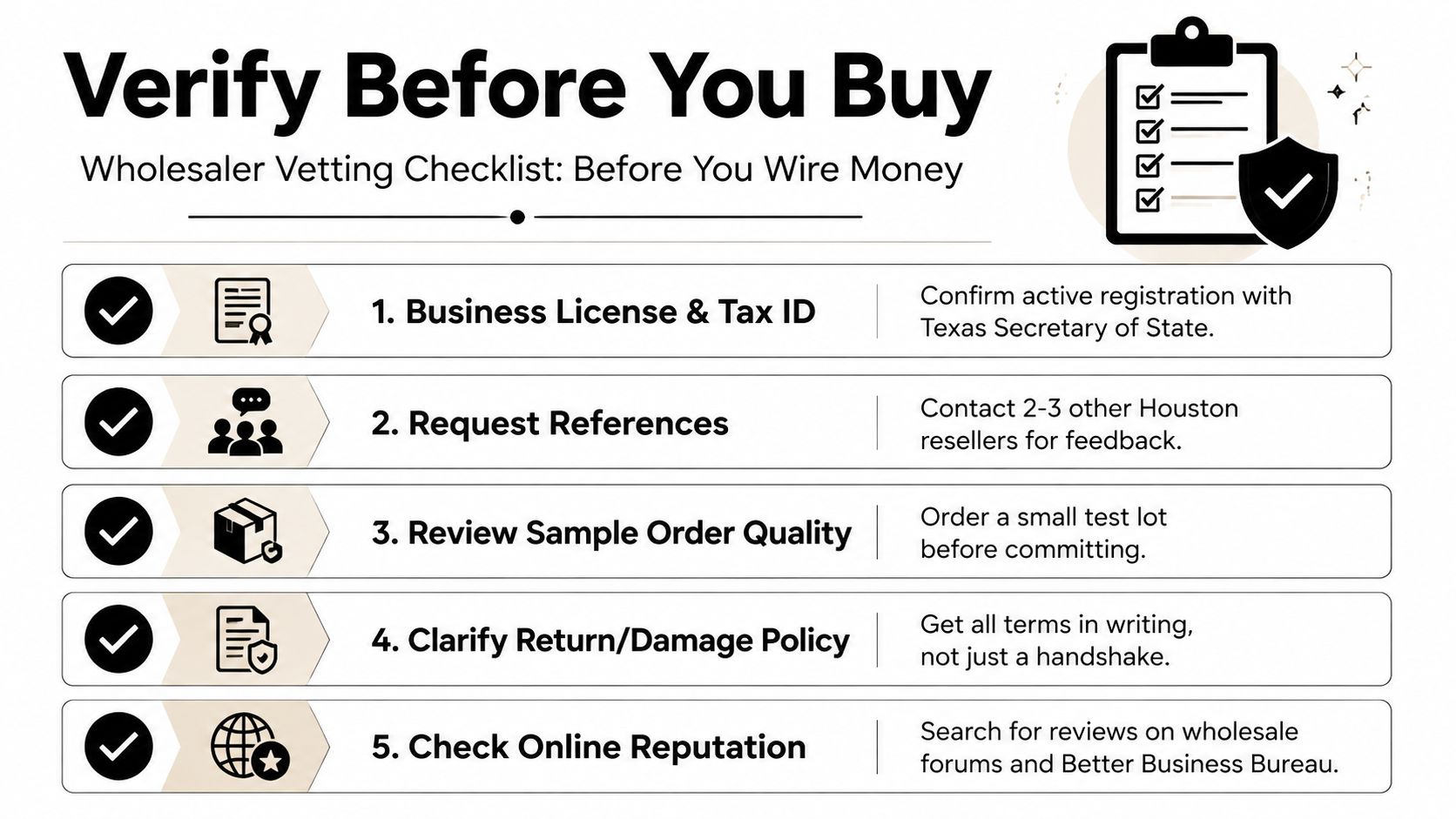
Use a scorecard after the test order. Grade price, fill rate, condition accuracy, return policy, response speed, and shipping reliability. A slightly higher price can be the better decision if the supplier consistently ships what you can list and sell. Check public reviews, wholesale forums, and Better Business Bureau records as signals, not as substitutes for your own sample inspection.
Pricing, Margins, and the Math Behind Wholesale Boxes
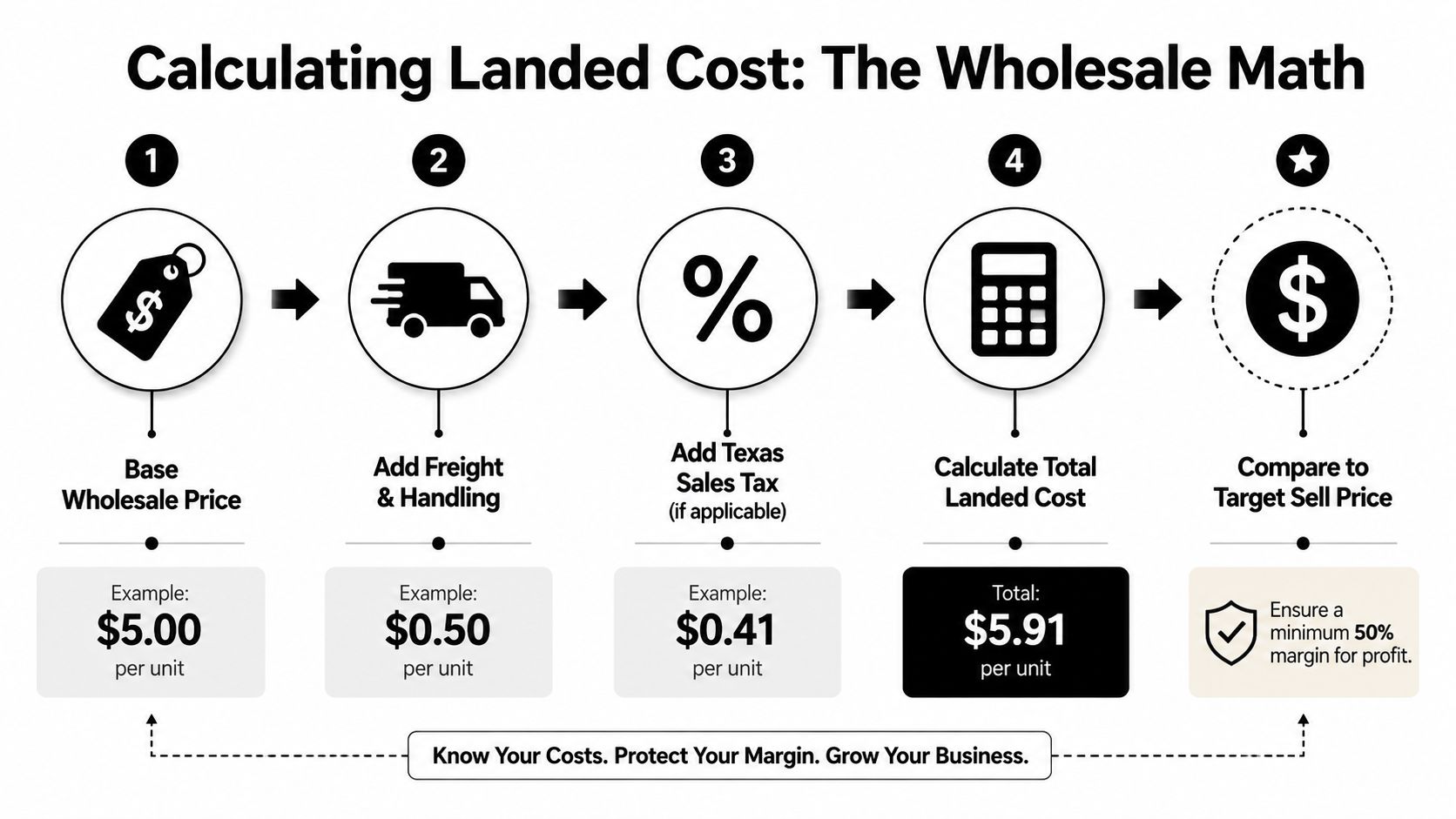
A wholesale price is only the starting point. Your real cost includes the purchase, freight, handling, sorting labor, cleaning or steaming, photography, marketplace fees, packaging, and the units that never become sellable listings.
Liquidation economics are especially sensitive to recovery. Liquidata's apparel and soft-goods liquidation benchmarks place common recovery around 5% to 35% of retail value, with many cases near 8% to 20%, while bulk or jobber clearance can recover under 7% of garment value. These are benchmarks, not promises for a specific Houston lot. Use them as a warning against paying for imagined retail value.
Price backward from the channel
Start with the price you can realistically achieve on your chosen channel. Then subtract selling fees, expected discounts, shipping absorbed by you, and the cost of preparing the item. What remains is the maximum landed cost that preserves your target spread.
For a lot, calculate:
- Total purchase cost, including the negotiated lot price.
- Freight and handling, allocated across all received units.
- Sorting and preparation, including labor time.
- Sellable-unit count, after damage and unusable pieces.
- Expected revenue, based on channel-specific sell-through rather than the highest possible listing price.
- Gross spread, revenue minus the full landed and preparation cost.
The pallets for sale you compare should pass this calculation before you bid. A branded return lot may look attractive but require intensive inspection and photography. A lower-priced basics lot may move more easily, yet produce too little spread after freight and labor. Reject any lot whose expected recovery falls below your target margin after sorting and shipping.
Buy the inventory your sales process can handle, not the inventory that looks cheapest on a manifest.
Your First 30 Days as a Houston Clothing Reseller
A productive first month should produce evidence, not just inventory. You're testing suppliers, categories, condition language, selling channels, and your own ability to process stock quickly enough to protect margin.
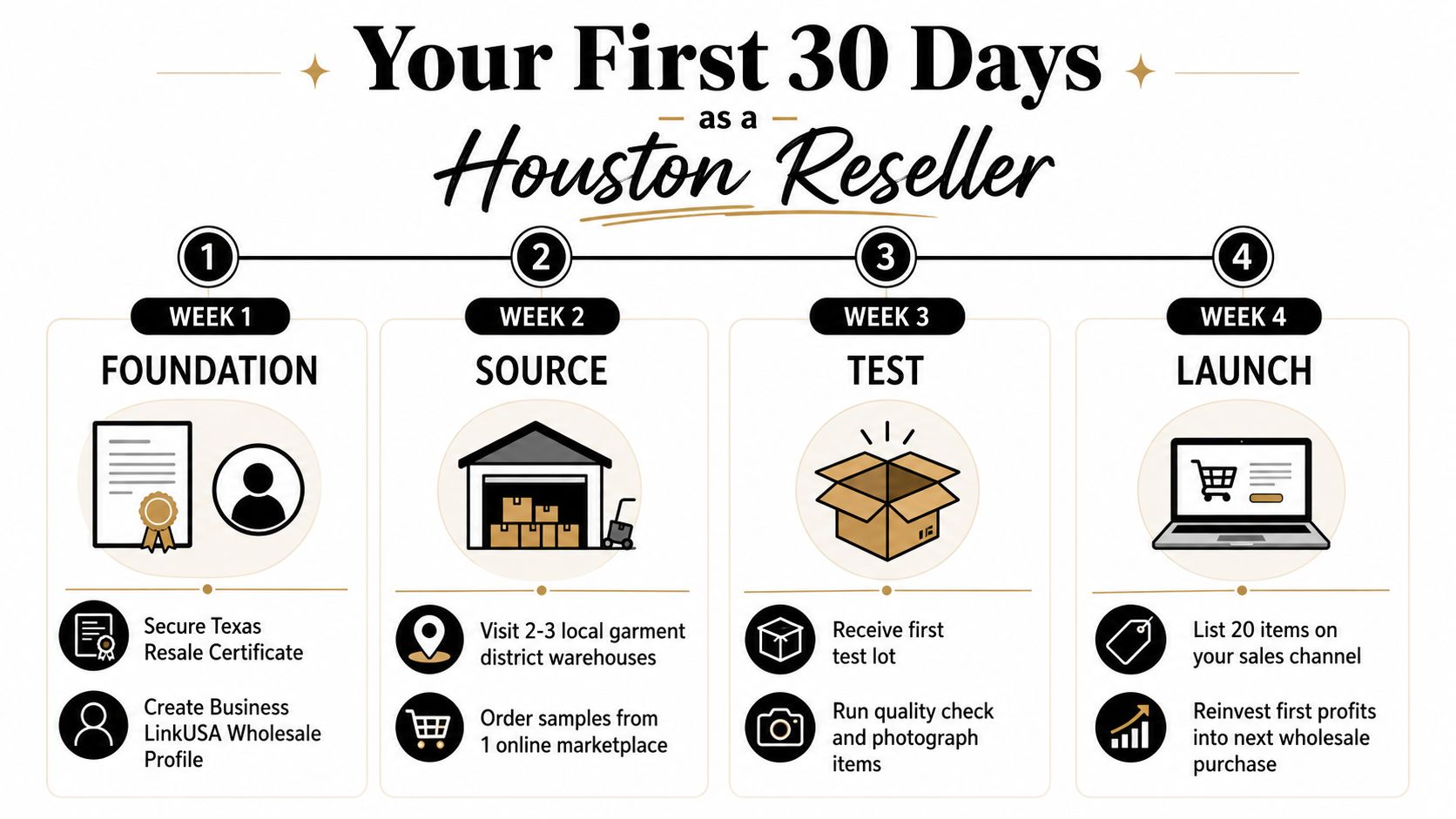
Week one builds the operating base
Secure your Texas resale certificate and organize the documents suppliers will request. Create a Business LinkUSA wholesale profile, prepare a short description of your business, and write your buying brief before contacting warehouses. List the categories, sizes, conditions, and channels you can support now, not the assortment you hope to carry eventually.
Week two is for controlled sourcing
Visit local garment district warehouses and meet brand representatives where possible. Order samples from an online B2B marketplace only after confirming whether the stock is local. Record every offer in one worksheet so you can compare unit price, minimum, freight, condition, and terms without relying on memory.
Week three tests the merchandise
Receive the first test lot, count every unit, inspect labels and damage, and photograph representative pieces. Track the time spent sorting and preparing the inventory. If the lot requires more labor than expected, update the landed-cost model before ordering again.
Week four turns evidence into a decision
List a controlled selection on your chosen sales channel, observe which categories attract attention, and contact the supplier with specific questions about missing or damaged units. Reorder only the inventory that fits your customer and processing capacity. If local wholesale falls short on volume or category depth, use OneTrendyCloset as a national backup layer for curated brand-name apparel liquidation boxes and custom lots, rather than abandoning your Houston relationships.
Track cost per piece, sell-through rate, average preparation time, supplier response time, damage rate, and gross spread. Those measures tell you whether a wholesaler is helping your business or just keeping your racks full.
If Houston inventory doesn't provide the brand mix, category depth, or order flexibility you need, OneTrendyCloset offers curated brand-name apparel liquidation boxes, mix-and-match options, and custom quotes for boutiques, marketplace sellers, and live-sale operators. Visit the site to compare a test box or custom lot with your local Houston sourcing plan, then choose the supplier that fits your actual selling channel and margin model.