You've found a pallet listing that appears to offer far more retail value than its asking price. The manifest looks promising, the photos show recognizable brands, and the seller wants payment before freight is scheduled. You're already calculating what the inventory could bring on eBay, Poshmark, Shopify, or a live sale.
The difficult part begins when the pallet arrives. A returned hoodie may have a damaged tag, a missing drawstring, or an odor that makes it impossible to list as new. A jacket that looks valuable on the manifest may need cleaning, measurements, photography, and several weeks of storage before a buyer appears. Liquidation by the pallet isn't mainly a question of whether the deal is a scam. It's a question of how much usable margin survives sorting, labor, freight, and unsellable inventory.
Table of Contents
- A Reseller's First Look at Liquidation by the Pallet
- What Liquidation by the Pallet Means
- Grading, Condition, and Where Margin Leaks
- Where Apparel Pallets Come From and Who Sells Them
- How Pallet Pricing Really Works for Resellers
- Logistics, Freight, and Matching Pallet Size to Your Channel
- A Working Framework Before You Commit to Your Next Pallet
A Reseller's First Look at Liquidation by the Pallet
A first-time buyer may commit serious cash to a mixed apparel pallet expecting clean, ready-to-list inventory. The shipment can instead include customer returns, shelf-pulls, stained labels, damaged packaging, and pieces that do not fit the category description or the intended sales channel. That outcome alone does not establish fraud. It shows why the manifest, condition language, and source history deserve more attention than the headline retail total.
Liquidation is a longstanding secondary-market channel. Colorado State University data cited by CNBC's report on the liquidation industry estimated the U.S. liquidation market at $644 billion in 2020. The report also said retail returns reached a record 16.6% of all merchandise sold in 2021, compared with 10.6% in 2020. E-commerce returns averaged 20.8% in 2021, compared with 18% in 2020. Those volumes help explain why retailers transfer goods in bulk instead of processing every unit individually.
Why pallets became the practical buy unit
A pallet lets retailers and processors consolidate inventory, reduce handling, and pass sorting responsibility to a buyer with a resale outlet. For a small operator, it provides a workable test size. You can purchase one pallet, inspect its actual condition mix, and compare the result with your selling channel before considering a larger lot.
The ecosystem ranges from a single gaylord or stack of cartons to multi-pallet lots and full truckloads. Each increase brings more inventory, along with greater demands for storage, labor, cash flow, and supplier confidence.
Operational rule: Treat the pallet door as the start of the work, not the end of the purchase.
A low acquisition price can disappear after days spent separating sellable pieces from damaged returns. Condition variance is the main margin risk. Two pallets with similar manifest retail can produce very different sell-through, labor requirements, and net proceeds.
Use a working question before buying: what share can you sell, through which channel, after inspection, cleaning, listing, storage, and disposal costs? That answer is more useful than retail value alone because it accounts for the units and labor that reduce the payout.
What Liquidation by the Pallet Means
A reseller opens a pallet expecting inventory, but the outcome depends on what arrives, how quickly it can be processed, and how many units survive inspection. Liquidation by the pallet means buying merchandise in a bulk unit, usually from a retailer, manufacturer, returns processor, wholesaler, or liquidation marketplace. The seller transfers a grouped load to another business instead of selling each garment directly to an end customer.
The inventory may come from customer returns, excess stock, cancelled orders, shelf-pulls, or closeouts. It may be manifested, meaning the seller provides an itemized list, or unmanifested, meaning you receive only a broad category description without a complete item list. A manifest helps you plan, but it doesn't convert estimated retail value into guaranteed resale revenue.
Match the format to your operation
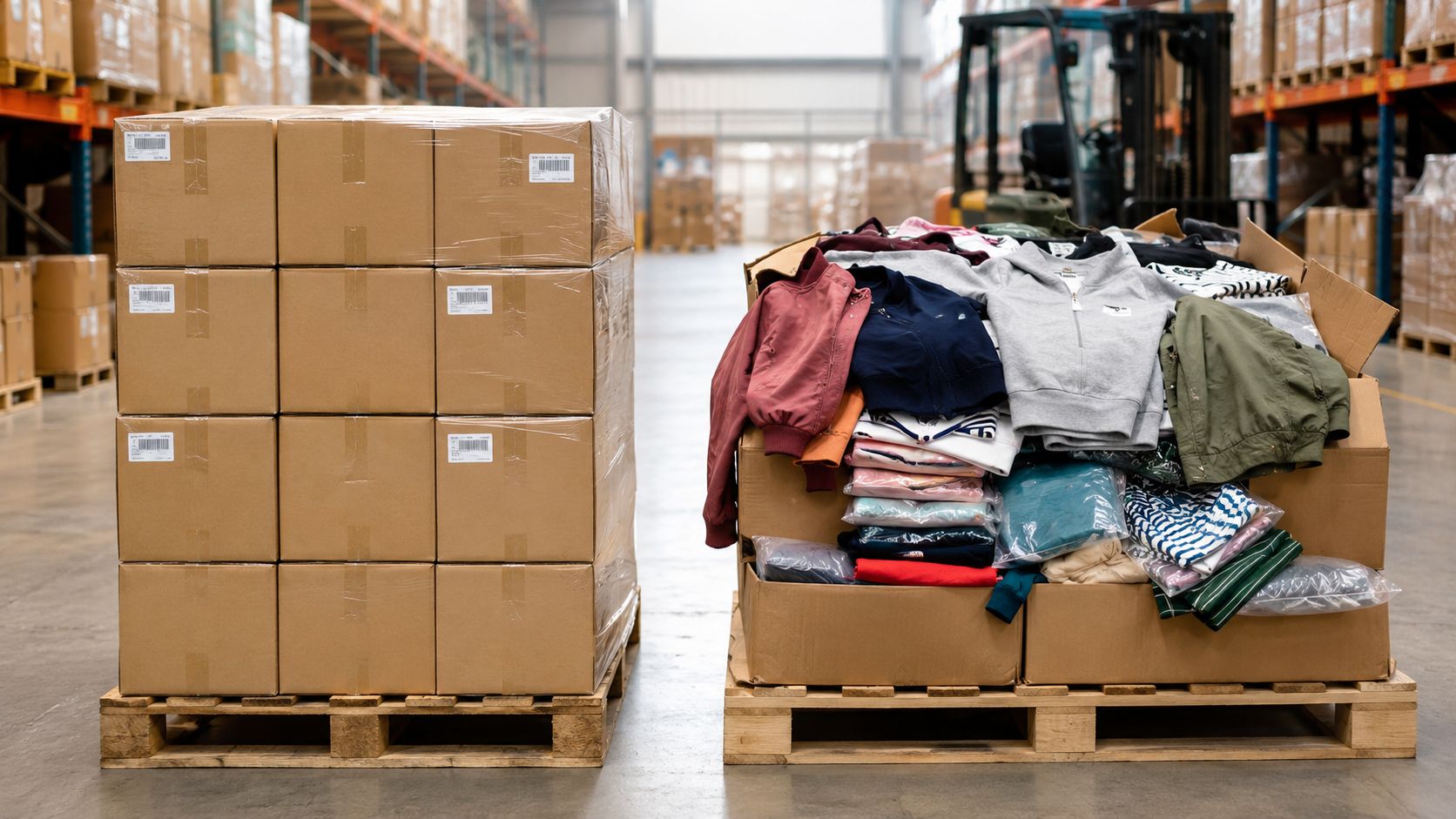
A single pallet is the most approachable starting point. In apparel, it may contain one gaylord or a stack of cartons holding mixed tops, bottoms, outerwear, or accessories. A boutique owner can use this format to test a brand direction. A new marketplace seller can also measure the work required to inspect, measure, photograph, and list each unit.
That labor matters because the purchase is only the beginning of the cost calculation. Sorting time, cleaning, storage, discounts, and unsellable pieces can reduce the margin even when the manifest shows attractive retail value.
A multi-pallet lot combines several pallets in one purchase. The seller may organize the load by category, brand tier, season, or condition. This format fits an established eBay seller or online reseller with listing routines, storage capacity, and a way to move slower pieces without depending on one sales channel.
A full truckload serves higher-volume operations. It may contain multiple categories or a consistent apparel program, depending on the source and contract. A live-sale operator, bin-store model, or wholesale buyer may absorb that volume, while a small boutique could run out of storage before generating revenue.
| Format | Typical Item Count (Apparel) | Best-Fit Channel | Freight Note |
|---|---|---|---|
| Single pallet | Varies by garment size and packing method | Boutique test, new reseller, curated marketplace | Confirm whether delivery is commercial or residential |
| Multi-pallet lot | Varies by category and pallet build | Established marketplace seller, growing boutique | Consolidated freight can simplify receiving, but requires staging space |
| Full truckload | Varies by source and product mix | High-volume reseller, live-sale operation, wholesale outlet | Plan receiving access, unloading equipment, and storage before purchase |
Choose the format based on throughput, not ambition. If you can inspect and list only a small batch each week, a large lot may become an unpaid holding area. If buyers are already waiting and staff can sort inventory across several channels, a larger format may distribute handling work across more units.
Grading, Condition, and Where Margin Leaks
A grade describes expected condition, but uncertainty remains. Grade A apparel generally supports the cleanest resale presentation, while Grade B, Grade C, and ungraded returns require increasingly careful inspection. The difference appears in the work required before each item can be listed and the number of units that remain sellable afterward.
Grade A may include new units, shelf-pulls, or customer returns with packaging intact. Grade B often combines usable pieces with damaged packaging, visible handling, or minor defects. Grade C and ungraded returns can contain stains, odors, missing components, or defects that force you to discount, bundle, donate, or discard the item.
Translate condition into selling behavior
A manifest retail figure is a reference point, not a sales forecast. Independent guidance on inspecting liquidation pallets notes that lots may sell for about 5% to 25% of listed manifest retail value, with condition variance driving much of the difference. New and shelf-pull units generally retain more resale potential. Open-box, untested, and salvage merchandise usually requires heavier discounting.
Use the grade to estimate both the workflow and the likely margin pressure:
- Grade A: Prioritize direct listings, clean photography, accurate measurements, and full-price positioning where the market supports it.
- Grade B: Budget time for repackaging, steaming, stain checks, and condition disclosures. Some units may still sell individually, while others fit bundles.
- Grade C: Sort aggressively. Separate repairable pieces, low-price inventory, textile lots, and items with no sensible resale path.
- Ungraded returns: Assume the widest range of outcomes until inspection proves otherwise. Do not base the purchase decision on the most attractive items pictured.
| Grade | Typical Condition | Unsellable Rate | Common Defects | Realized Margin |
|---|---|---|---|---|
| A | New, shelf-pull, or clean return | Depends on inspection and channel | Minor handling or packaging issues | Strongest potential, but still subject to market demand |
| B | Mixed usable condition | Depends on defect mix | Damaged packaging, wear, missing tags | Moderate potential after sorting and disclosure |
| C | Heavily handled or damaged | Can be substantial | Stains, odors, defects, missing components | Often depends on bundles, seconds, or wholesale outlets |
| Ungraded | Unknown until opened | Highly variable | Any return or salvage issue | Highest uncertainty and widest margin range |
Margin loss begins at receiving. Labor can include inspection, steaming, measuring, photography, descriptions, storage, and customer questions. Marketplace costs add further pressure. A hoodie that appears profitable against manifest retail can become a weak unit after preparation and selling expenses. A less distinctive basic may perform better if it needs little work and sells quickly.
For a focused apparel example, review this guide to a box of hoodies before buying. The working rule is simple: count sellable units after inspection, not units printed on the manifest.
Where Apparel Pallets Come From and Who Sells Them
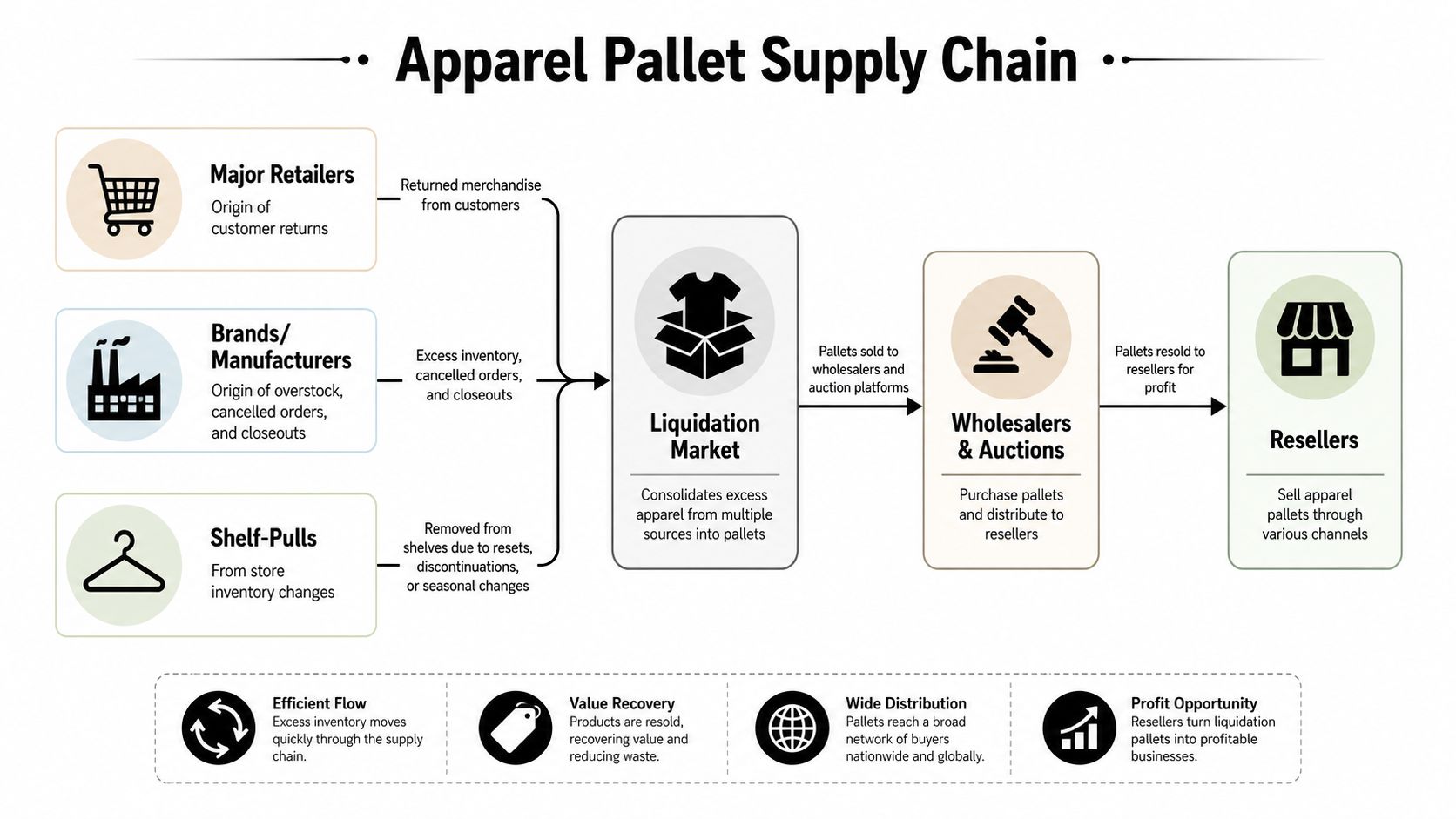
A pallet's origin shapes its assortment before a liquidator creates the listing. Customer returns often mix sizes, colors, and conditions. Overstock and cancelled orders may offer cleaner assortments, though they may fit current demand less closely. Shelf-pulls reflect store inventory changes, while manufacturer closeouts can concentrate on a season, style, or brand program. Each source changes how much sorting time and condition risk you should price into the lot.
Follow the supply chain
Major retailers produce customer returns and excess inventory. Brands and manufacturers add overstock, cancelled orders, and closeouts. Stores release shelf-pulls as assortments change. These goods can pass through liquidation divisions, returns processors, B2B marketplaces, regional wholesalers, auctions, and brokers before reaching a reseller.
The seller's role affects how much information you receive. A direct retailer program may suit a boutique seeking a defined brand assortment. A marketplace seller may choose an aggregated lot for variety and a clear manifest. A live-sale host may prioritize quantity and quick sorting when products can move through an audience without extensive individual listings.
Use supplier questions to trace the goods:
- Origin: Ask whether the load contains returns, overstock, shelf-pulls, or closeouts.
- Condition: Confirm whether the grade covers every unit or only most of the load.
- Manifest: Ask what the list includes, how current it is, and whether quantities are guaranteed.
- Handling: Find out whether the seller inspected, sorted, repacked, or transferred the pallet.
- Freight: Confirm whether shipping is included or added after checkout.
Brokers can combine smaller lots and make access easier, but opacity should lower your bid ceiling. Vague origin details, generic photographs, incomplete manifests, and reluctance to discuss condition leave more margin exposed to sorting time and unsellable units.
For a narrower assortment, compare brand-name clothing pallets with mixed lots by brand preference, condition expectations, and intended selling channel.
How Pallet Pricing Really Works for Resellers
Liquidation pricing usually begins with estimated retail value, then adjusts for condition, demand, manifest quality, source, and handling risk. Lots may sell for about 5% to 25% of the manifest's listed retail value, as described in this liquidation pallet inspection guide. That range is a discount for uncertainty, not a profit promise. Your real question is how much value disappears during inspection, sorting, preparation, and disposal.
Build the purchase around unit economics. Estimate revenue from units you can sell, then subtract every cost required to make those sales:
Expected sales revenue minus pallet cost, freight, sorting labor, preparation, platform fees, fulfillment, storage, and unsellable inventory equals operating contribution.
The manifest total is not expected revenue. Price each condition group for your chosen channel, then assign conservative outcomes to items that may need bundles, discounts, or wholesale disposal. A pallet can look inexpensive while losing margin through labor and weak sell-through.
Three pricing situations
A premium Grade A lot may command a larger share of manifest value because it offers more usable inventory and less uncertainty. It can suit a boutique whose customers expect presentation, accurate sizing, and a consistent brand identity.
A mixed-return lot generally has a lower entry price, but the savings must cover additional work. Marketplace sellers can make this model work with disciplined listing systems and enough demand for varied products. Every hour spent measuring, photographing, correcting descriptions, or handling defects belongs in the calculation.
An untested or unmanifested lot is a volume play. Live-sale operators and experienced buyers may accept the uncertainty because they can sort quickly and move goods through several price tiers. A new reseller has less protection. One weak load can consume available cash and storage before the inventory has a chance to sell.
| Grade | % of Manifest Retail | Expected Sell-Through | Best-Fit Channel |
|---|---|---|---|
| A | About 25% at the upper end of common pricing, depending on the lot | Higher potential after inspection | Boutique, curated marketplace |
| B | Often positioned within the middle of the common range | Mixed, with sorting required | Marketplace seller, online apparel store |
| C | Often positioned toward the lower end of the common range | More variable, with greater discounting | Live sale, bins, wholesale outlet |
| Ungraded | Pricing reflects uncertainty rather than a reliable condition promise | Unknown until opened | Experienced volume buyer |
Pricing traps often start with inflated retail assumptions, late freight charges, or broker markup that adds no inspection or service value. Compare the seller's advertised price with your break-even worksheet, including the units you expect to reject. The checkout price is only the first line of the investment.
The retailer's economics explain why these goods enter liquidation channels. CNBC reported that processing a return can cost retailers up to 66% of the item's original price. A bulk transfer can recover some value more practically than individually reprocessing every return. That choice passes sorting risk to you, so your bid must compensate for the time and inventory you may not recover.
For a focused purchasing route, apparel pallets for sale can be compared by advertised assortment, expected condition, selling channel, and break-even point, rather than by retail total alone. The strongest bid is the one that still works after condition variance is priced in.
Logistics, Freight, and Matching Pallet Size to Your Channel
The carrier calls while your pallet is still a line on a spreadsheet. At that point, the purchase becomes an operating task. Confirm the delivery address, unloading method, staging area, and inspection plan before payment. A residential address may need liftgate service. A commercial warehouse with a loading dock can usually receive freight with less handling.
Match the pallet to your selling channel
A boutique often benefits from a curated, manageable shipment. Staff can receive apparel, steam it, organize it by size and brand, then present it in-store or through a polished online collection. That extra attention can support higher presentation standards, but your margin must include the labor required for each unit.
A marketplace seller needs a repeatable preparation line. Depending on the item, staff may record measurements, write condition notes, take photographs, assign SKUs, package orders, and hand them to a platform or third-party logistics provider. A mixed pallet creates more sorting decisions, so inconsistent condition can reduce margin through both labor and rejected units.
A live-sale operator values speed and camera-ready presentation. Inventory may be grouped into opening-price lots, featured pieces, bundles, and clearance bins. This channel can move mixed returns, provided audience demand and staging space are sufficient. Otherwise, unsold items remain tied up while the pallet continues consuming room and attention.
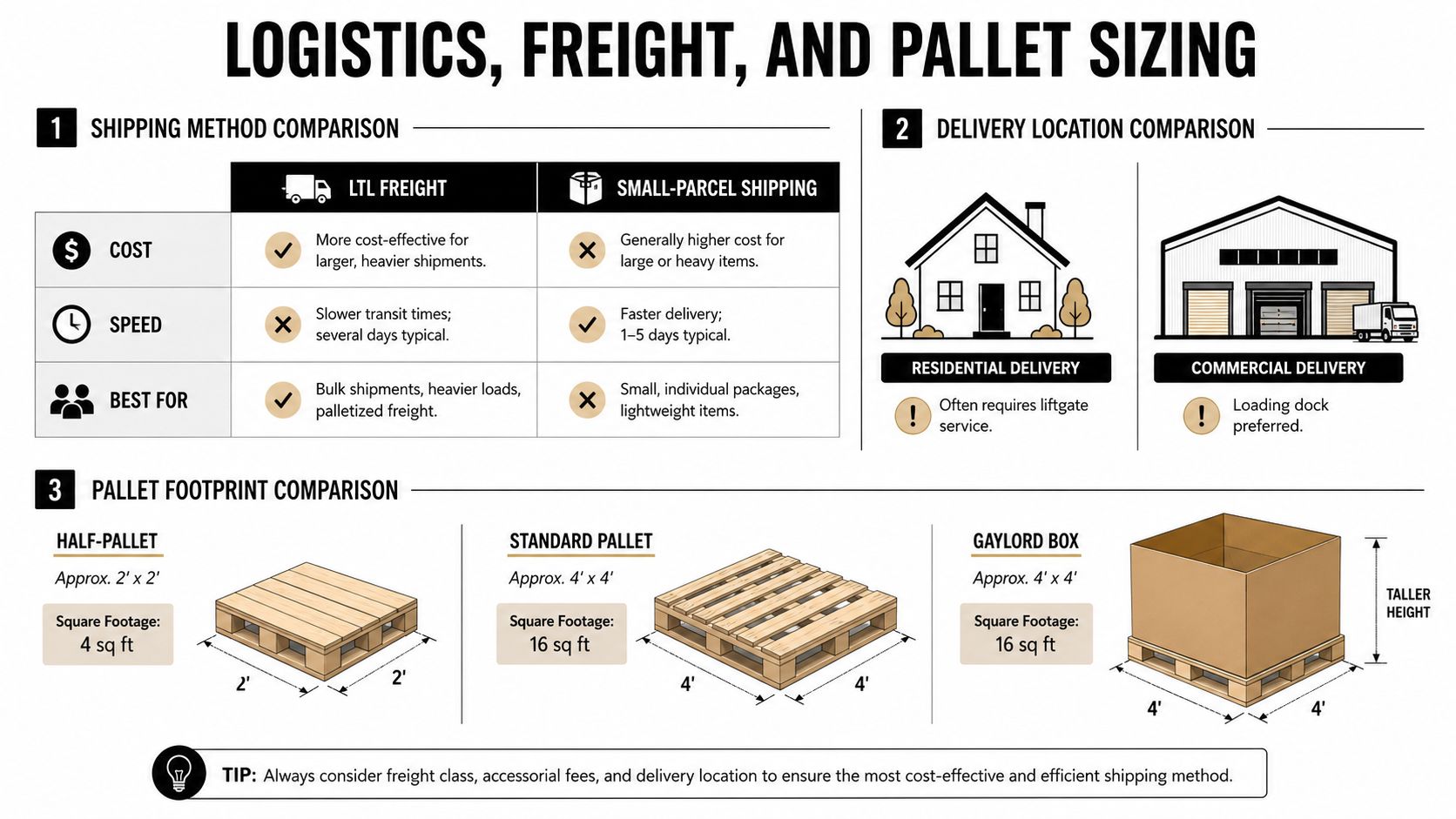
LTL freight generally suits palletized inventory. Small-parcel shipping makes more sense after the load has been divided into individual orders or cartons. For residential delivery, verify truck access, liftgate requirements, driveway limits, and where the carrier may leave the pallet. A delivery that reaches your address can still create a handling problem if the pallet cannot be placed near your receiving area.
Count space, handling, and margin leakage
A standard pallet footprint may fit in a garage or small warehouse, yet the load needs working space around it. You need room to open cartons, sort apparel, photograph items, and repack orders. A tall gaylord can be harder to work with than its floor area suggests because safe access to the contents takes additional space and time.
Budget for repackaging supplies, shrink-wrap, receiving labor, storage, customs charges on cross-border shipments, and detention or waiting charges at the receiver. Freight is complete only after the inventory has been counted, sorted, protected, and prepared for sale. Those steps reveal the core question: how much margin disappears through condition variance, sorting time, and unsellable units?
Use the following video as a visual supplement while planning your receiving process:
A Working Framework Before You Commit to Your Next Pallet
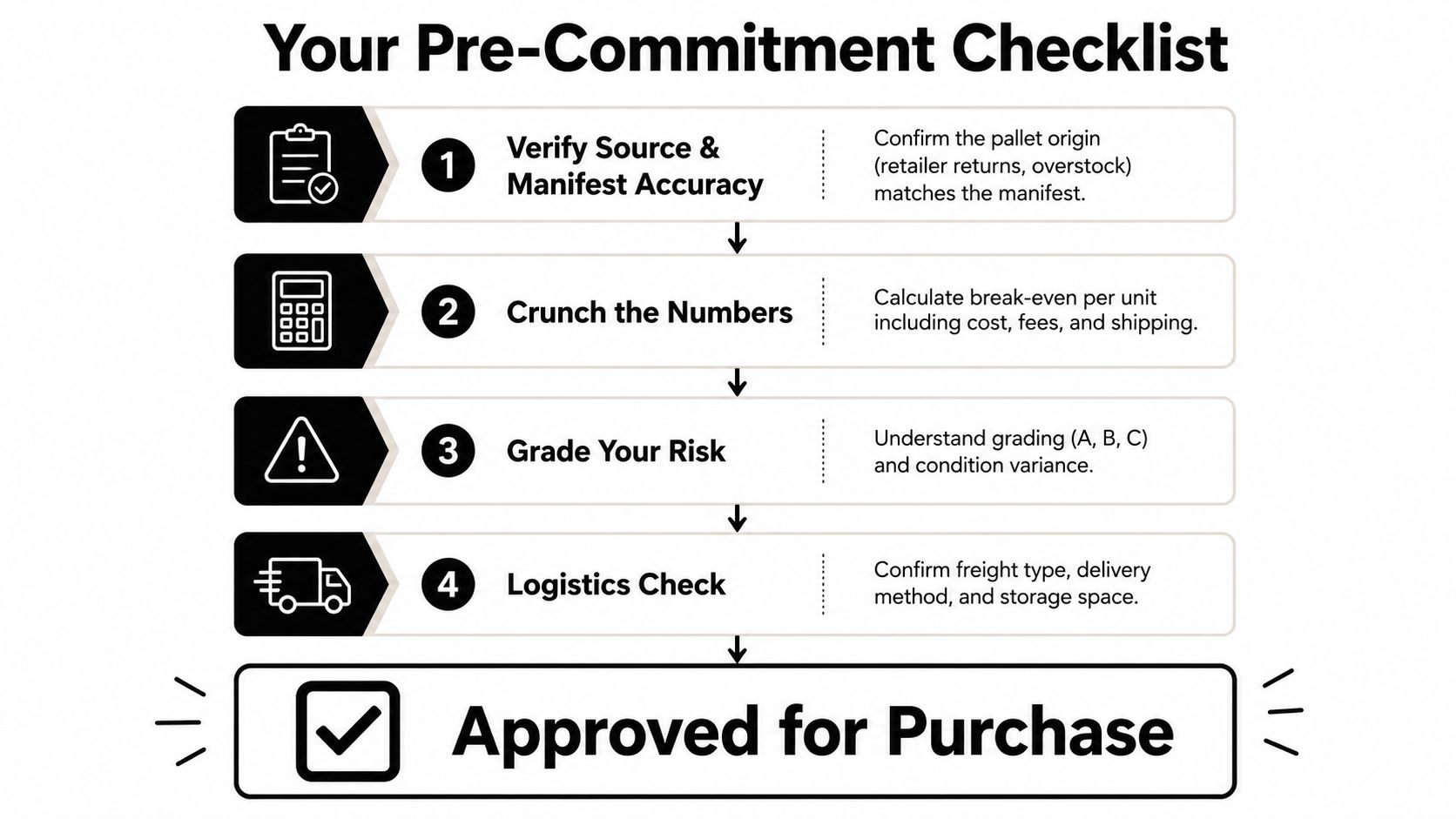
A pallet can look profitable until condition variance turns sellable pieces into markdowns and sorting time into unpaid labor. Before committing, set a written ceiling that still protects your margin when the load contains fewer ready-to-list units than expected.
Verify the source and manifest
Ask where the merchandise originated and whether the stated condition fits that source. A shelf-pull description should not come with details that suggest an untested customer-return load. Save the listing, manifest, photographs, freight terms, and written condition notes before payment. These records give you a reference if the delivered load differs from what was described.
Calculate the real break-even
Build the worksheet around sellable units, not the total piece count. Include the pallet price, freight, receiving, sorting, cleaning, packaging, platform charges, storage, and the value of your own time. Then assign a realistic outcome to damaged, incomplete, or slow-moving items. Some may become bundles or discount listings. Others may have no resale value.
A useful question is: How much revenue must each sellable unit produce for the pallet to clear every cost? If that figure depends on optimistic pricing, perfect condition, or unusually fast processing, the lot is priced beyond your workable risk.
Grade the risk
Separate condition risk from seller risk. A transparent seller may still offer a difficult returns pallet, while an attractive listing may disclose too little. Decide before bidding whether your channel can handle Grade B, Grade C, or ungraded merchandise. Making that choice beside an opened gaylord usually means the purchase has already made it for you.
Confirm the logistics
Know the delivery method, unloading requirements, storage location, and first sorting session before the shipment leaves the seller. Match the pallet to your sales channel. A boutique may need a tighter assortment, a marketplace seller may need a repeatable listing workflow, and a live-sale host may need volume that can be processed quickly.
Set a hard maximum bid and leave the lot when the numbers exceed it. If you are exploring branded apparel liquidation, OneTrendyCloset offers curated boxes and custom quotes for resellers who want to align brand selection with their selling channel. Visit OneTrendyCloset to request a quote and discuss the assortment, budget, and quantity that fit your operation.