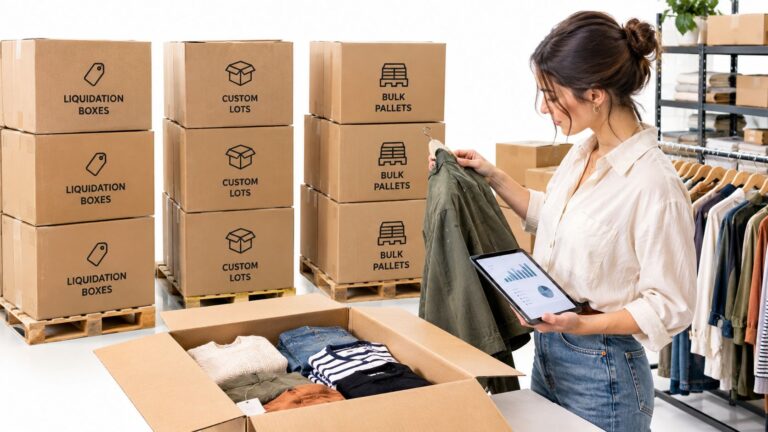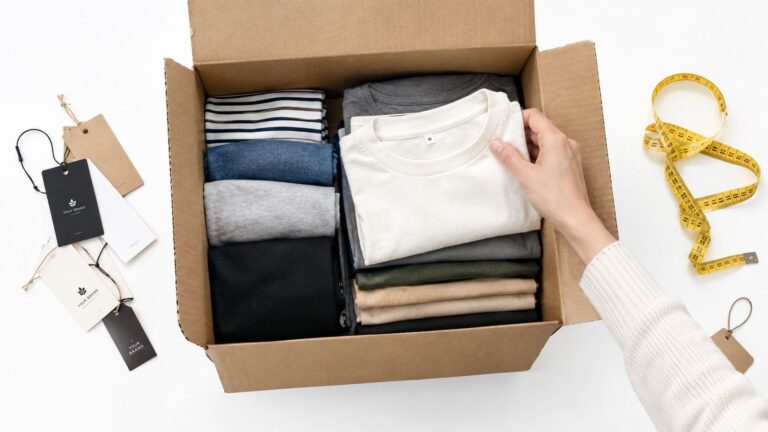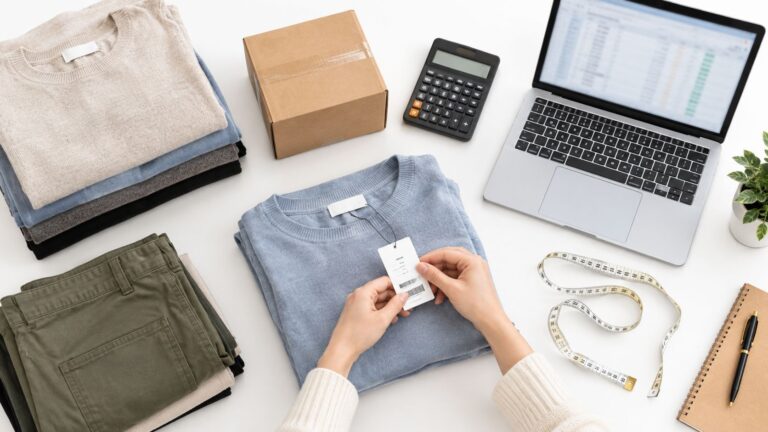
You've found a supplier, chosen a box, and paid for inventory that looked excellent on the product page. Then the carton arrives. The first pieces are promising, but the size run is uneven, several garments need steaming, and the “brand-name assortment” includes more private-label basics than expected. Your real question isn't whether the box was cheap. It's whether the inventory can move through your sales channel without consuming the margin in sorting, photography, repairs, and returns.
That's the right way to evaluate wholesale clothing boxes. Treat them as an inventory decision, not a bargain hunt. A box can give a boutique a flexible restocking source when traditional wholesale becomes expensive or unpredictable, but only if you understand the assortment, grade, freight, and labor before ordering.
Table of Contents
- What a Wholesale Clothing Box Actually Is
- The Building Blocks Inside Every Box
- Curated, Blind, and Custom Pallets Compared
- How Wholesale Clothing Box Pricing Works
- Condition Grades and Quality Expectations
- Sourcing and Logistics Behind the Box
- How to Choose a Wholesale Clothing Box Supplier
- Scaling from a First Box to a Working Inventory Pipeline
What a Wholesale Clothing Box Actually Is
A first-time boutique owner often assumes a wholesale clothing box works like a standard fashion wholesale order. You choose a style, select sizes, confirm quantities, and receive a predictable shipment. A liquidation box works differently. The box itself is the unit of sale, and the supplier usually sells the assortment as a combined lot rather than letting you select every individual garment.
A wholesale clothing box is a sealed bulk carton of apparel sourced from streams such as overstock, seasonal clearance, discontinued styles, shelf pulls, and customer returns. These are common inputs in liquidation clothing because retailers, brands, distributors, and fulfillment networks need surplus inventory cleared from their systems. The liquidation apparel supply chain explains why these products reach resellers in mixed lots instead of regular retail assortments.
Before you buy, ask five questions:
- Who is represented? Recognized brands, private-label products, and unbranded basics create very different listing and pricing opportunities.
- What sizes are included? A women's box with a narrow size range may work for a focused online seller but fail in a broad boutique.
- Which categories dominate? Tops and T-shirts are especially important in secondhand apparel, representing roughly 35% of the global market according to industry analysis of secondhand wholesale.
- Which season is arriving? Past-season inventory can still sell, but you may need a different channel or a deeper discount.
- What condition grade applies? “Liquidation” describes the source, not the quality of every item.
The phrase covers a wide operating range, from a manageable starter carton to a full pallet commitment. Don't compare two offers until you know their weight or piece count, category balance, brand policy, grade, and freight terms. A lower box price can be worse value if it leaves you with unusable sizes or labor-heavy returns.
The Building Blocks Inside Every Box
Think of each box as a portfolio. Brand, size, category, season, and condition work together, and a weakness in one area can reduce the value of the others.
Brand mix
A box built around recognized labels may support stronger buyer interest and more effective marketplace search terms. Private-label and unbranded garments can still work for live selling, bundles, basics racks, or price-led stores, but they need a different merchandising plan. Ask whether the supplier provides a brand list, a brand tier, or only a general description such as “mixed brand apparel.”
Size distribution
Size mix determines how widely you can sell the lot. An adult-only assortment might suit a women's boutique, while a family box can create useful breadth for a general resale operation but make presentation less consistent. Ask whether the mix includes junior, misses, plus, men's, or kids' sizes, and whether the supplier can exclude categories that don't fit your customer.
Category balance
A carton of everyday tops is easier to photograph, store, and list than a carton split between dresses, denim, coats, accessories, and specialty garments. That doesn't mean variety is bad. It means the mix must match your channel. A boutique needs a rack-ready assortment, while a marketplace seller may prefer individual pieces with strong searchable attributes.
Season and condition
Current-season pieces generally require less explanation to shoppers, while past-season garments may need outlet pricing or content that focuses on fabric, fit, and use rather than trend relevance. Condition then determines how quickly each item becomes sellable.
Buyer's rule: Never judge a box by its average unit cost alone. Judge the number of pieces that fit your customer, your calendar, and your listing process.
| Variable | What It Controls | Key Question to Ask |
|---|---|---|
| Brand mix | Search appeal, pricing position, and buyer trust | Which brands or brand tiers are actually included? |
| Size distribution | Customer coverage and sell-through flexibility | Is the size run broad enough for my channel? |
| Category mix | Merchandising, storage, and listing workload | What share is tops, bottoms, dresses, outerwear, or accessories? |
| Season | Timing and markdown pressure | Is the assortment current, transitional, or past-season? |
| Condition | Inspection time, presentation, and recovery | What grade applies, and how is it verified? |
Curated, Blind, and Custom Pallets Compared
The format you choose should reflect your tolerance for assortment risk. A new boutique usually needs control more than the lowest possible unit cost. An established online seller may value volume and speed more than a perfectly balanced rack.
Curated boxes are assembled against a buyer brief. You may specify a category, size preference, price position, or brand direction. That control reduces the chance of receiving inventory that conflicts with your store identity, although the extra selection work can raise the per-piece price. Curated inventory fits a boutique owner who needs a coherent presentation and wants to test a supplier without absorbing a chaotic assortment.
Blind boxes are sealed assortments with limited or no item-level disclosure. They can offer a lower acquisition cost, but the buyer must be prepared to process whatever arrives. Blind inventory works best when you already have several outlets, such as marketplace listings, live sales, bundles, clearance racks, or donation and exit channels. A narrow sales model makes blind buying dangerous because one weak category can stall the entire carton.
For a plain-language overview of the mystery-box model, review this guide to mystery box wholesale buying, then ask the supplier what “mystery” means in practice. It may mean mixed brands, unknown styles, undisclosed condition, or all three.
Custom pallets move the conversation from a test purchase to an inventory program. You can negotiate category ratios, brand preferences, condition thresholds, and shipment cadence, but you'll commit more cash and storage capacity. Pallets make sense when your sales data proves that a repeatable mix performs better than random variety.
| Format | Risk Level | Typical Per-Piece Cost | Volume | Best Fit For |
|---|---|---|---|---|
| Curated box | Lower assortment risk | Usually higher than blind inventory | Small to moderate | New resellers and focused boutiques |
| Blind box | Higher assortment risk | Usually lower than curated inventory | Small to moderate | Flexible, high-throughput online sellers |
| Custom pallet | Lower risk after specifications are proven | Negotiated around volume and grade | Large | Established operators with repeat demand |
Don't choose a custom pallet because it sounds like growth. Choose it because your existing channel can absorb the volume, your storage is ready, and your listing or selling process won't slow down when the shipment lands.
How Wholesale Clothing Box Pricing Works
Suppliers generally quote apparel lots in one of four ways. The first is a per-piece rate, useful when the assortment is loose or the supplier can count individual units. The second is a per-box price, where the carton is sold as a fixed assortment. The third is a per-pallet quote, normally based on a larger commitment and negotiated grade or category. The fourth is a custom quote, used when you request specific brands, sizes, categories, or packing requirements.
Don't compare these models by headline price. Compare them by landed, sellable unit cost.
A box priced attractively at the warehouse can become expensive after freight, duties, palletizing, handling, and local delivery. The same carton can also require different labor depending on whether garments arrive tagged, folded, bagged, sorted, or mixed. Ask the supplier to separate merchandise cost from freight and accessorial charges so you can identify where the quote is moving.
Build the calculation around sellable units
Your first estimate should include:
- Merchandise cost: The invoice amount for the lot.
- Freight and import costs: The charges required to get the carton to your receiving location.
- Processing labor: Inspection, steaming, folding, repairs, photography, measurements, and listing.
- Selling costs: Marketplace fees, payment processing, packaging, and returns.
- Exit cost: The discount or disposal route for pieces that don't fit your primary channel.
Then divide total landed and processing cost by the number of pieces you expect to sell through your intended channel. Don't count every garment as a full-value unit. A return that needs cleaning or a jacket that arrives without a component has a different economic role from a tagged, ready-to-list top.
| Pricing Model | Typical Range | Best For | Risk Level |
|---|---|---|---|
| Per piece | Supplier-specific | Buyers who need clear unit economics | Moderate |
| Per box | Supplier-specific | Test orders and manageable restocks | Moderate to high |
| Per pallet | Negotiated | Repeat buyers with storage and demand | High commitment |
| Custom quote | Negotiated | Defined brand, category, or grade requirements | Depends on specification |
Use the quote to test a decision, not to justify a purchase. If the supplier can't explain what the price includes, pause the order. A vague freight answer is often more damaging than a high merchandise price because it prevents accurate margin planning.
Condition Grades and Quality Expectations
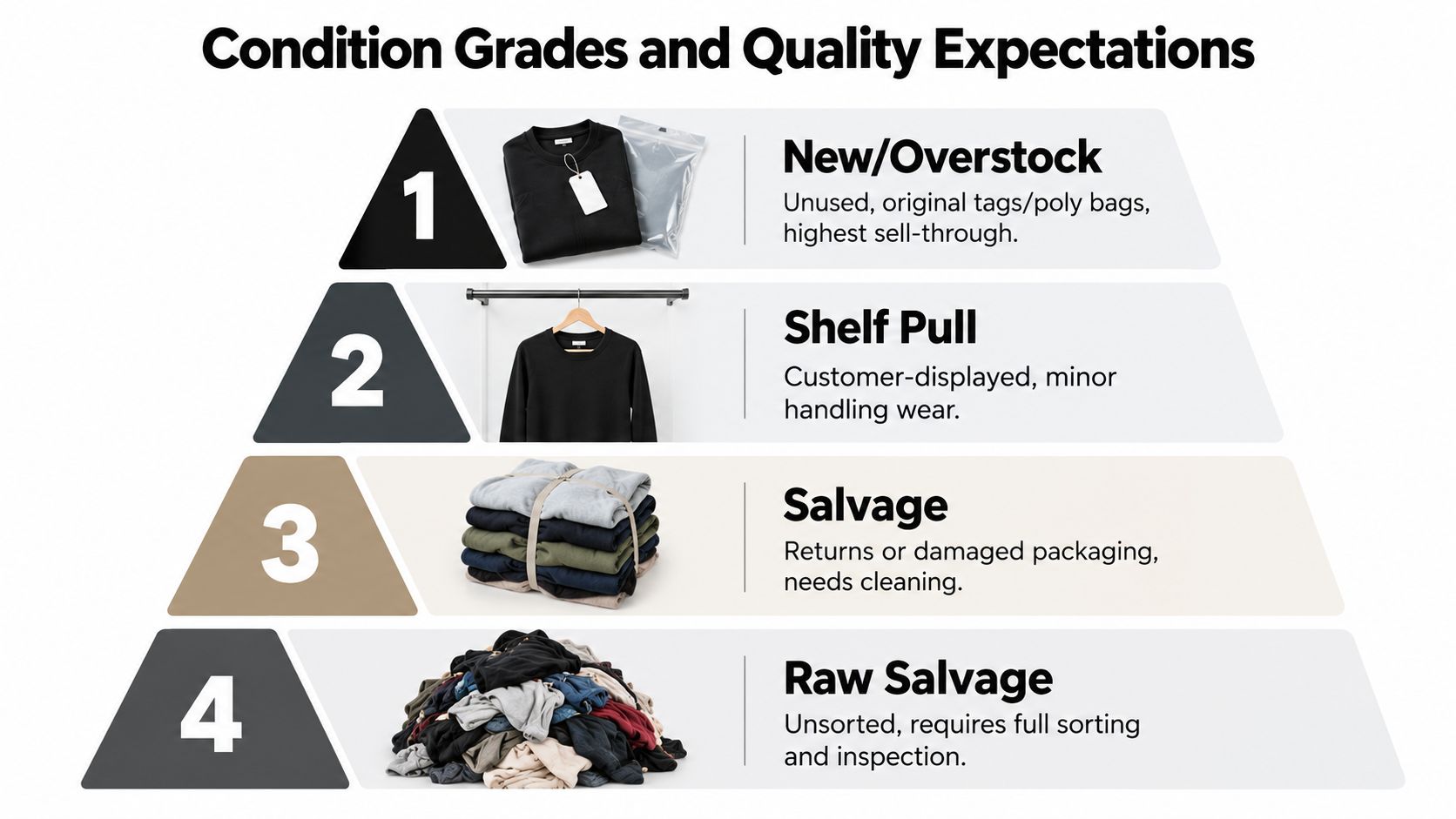
Condition is the biggest driver of liquidation value and labor. A category label such as “women's apparel” tells you what the products are. The grade tells you how much work stands between the carton and the sales floor.
New/Overstock is the closest to retail-ready. Items are generally unused and may retain original tags or poly bags. This grade supports the fastest intake process, but you still need to check for outdated packaging, hidden defects, incorrect sizes, and stale seasonal demand.
Shelf Pull inventory has been removed from a retail display or store system. It may have minor handling wear, missing tags, creasing, or packaging changes. It can work well for boutique racks and value-oriented displays when your team has a reliable inspection routine.
Customer Return inventory demands more scrutiny. Garments may have been tried on, worn briefly, repackaged, or returned for an unclear reason. Budget time for checking stains, odors, makeup marks, missing components, stretched fabric, and inaccurate condition descriptions.
Salvage is the labor-heavy end of the spectrum. Damaged, stained, incomplete, or severely mishandled garments may belong in repair, craft, bundle, textile recovery, or exit channels rather than standard listings. The liquidation manifest guide distinguishes these grades and explains why recovery expectations fall as condition worsens.
Turn grade into a labor plan
Before ordering, decide who will inspect the shipment and how items will be routed. Use separate bins for ready to list, needs steaming, needs repair, uncertain condition, and exit inventory. Photograph representative defects and record them against the packing list. This creates evidence for supplier conversations and teaches your team what the grade means in practice.
A low-grade box isn't automatically bad. It's bad when you buy it expecting retail-ready inventory. A customer-return lot can suit a bin store or live seller with fast sorting, while New/Overstock may justify a boutique presentation and more deliberate pricing.
Here's a practical explanation of how quality changes the work involved:
Sourcing and Logistics Behind the Box
The carton usually starts inside a retailer, brand warehouse, distribution center, or third-party logistics facility. Inventory is cleared, consolidated, graded, packed, and sold into a secondary distribution channel. Your supplier's job is to convert that large, messy flow into a shipment you can receive and process.
The physical mix matters because garments occupy very different amounts of space. Garment CBM guidance places T-shirts at roughly 0.003 to 0.005 cubic meters each, hoodies and sweatshirts at roughly 0.015 to 0.025 cubic meters, and outerwear at roughly 0.03 to 0.06 cubic meters. Those figures show why two shipments with similar piece counts can require very different carton sizes and freight budgets.
Ask how the carton was packed
A dense carton of folded basics may use space efficiently, but aggressive compression can crease garments, damage packaging, and create carton stress. Bulky knitwear and jackets need more room and stronger void control. Ask these questions before committing:
- Bagging: Are items sealed in original poly bags, individually bagged, or loose?
- Packing method: Are garments flat-packed or hanger-packed?
- Sorting: Are cartons labeled by category, size, grade, or not sorted at all?
- Pallet condition: Are cartons secured on a pallet or loose-loaded?
- Carton integrity: Has the supplier checked dimensions, compression strength, and water exposure?
Freight terms also change your responsibility. EXW generally leaves pickup, export handling, and much of the transport process to the buyer. FOB typically assigns responsibility at the named shipping point, so confirm exactly where risk transfers. DDP is designed to place delivery and import obligations with the seller, but you should still request a written breakdown of duties, brokerage, and final-mile delivery.
If you're evaluating larger commitments, compare the box economics with the operational realities described in this guide to wholesale clothing pallets for sale. A pallet isn't just a bigger box. It changes receiving, storage, labor scheduling, and cash exposure.
How to Choose a Wholesale Clothing Box Supplier
The cheapest supplier is rarely the safest first supplier. Your first order should test the seller's accuracy, communication, packing discipline, and response when the contents don't match the description.
Start with the manifest. A useful manifest should identify the broad category, expected grade, quantity basis, and any exclusions. It doesn't need to reveal every SKU for a blind lot, but it should tell you enough to decide whether the shipment fits your sales channel.
Then test the supplier against observable proof:
- Manifest accuracy: Ask for a sample packing list and compare it with customer unboxing evidence.
- Condition disclosure: Confirm whether “mixed grade” includes returns, salvage, or only retail-ready products.
- Brand transparency: Ask whether brand examples are representative or merely occasional inclusions.
- Order flexibility: Find out whether you can start with a box before committing to a pallet.
- Freight clarity: Request the delivery method, carton count, accessorial charges, and responsibility for duties.
- Damage policy: Get the process for reporting crushed cartons, missing pieces, or materially misrepresented condition.
Reviews help, but they aren't enough. Look for dated unboxing videos, detailed buyer photos, sample invoices, and answers that address difficult questions directly. A supplier that only talks about savings is avoiding the part that determines your margin.
| Evaluation Criteria | Mechanism | How OneTrendyCloset Answers It |
|---|---|---|
| Manifest and assortment | Review stated brand, size, category, and quantity expectations | Offers curated sets and disclosed assortment information for selected products |
| Brand control | Compare requested brands with the supplier's selection process | Supports mix-and-match brand selection within available box formats |
| Grade options | Match quality to the buyer's margin and labor model | Provides mixed-grade options for different sourcing requirements |
| Scaling path | Test small, then request a larger configuration | Handles box orders and custom quote requests for larger lots |
| Channel fit | Connect the lot to boutiques, marketplaces, or live selling | Structures apparel liquidation inventory for reseller use across those channels |
For a worked supplier example, OneTrendyCloset's wholesale clothing supplier page describes curated brand-name liquidation boxes, custom lots, and a progression from smaller orders to larger pallet discussions. Treat those features as questions to verify against the specific quote you receive, not as a substitute for reading the manifest and policies.
Scaling from a First Box to a Working Inventory Pipeline
Start with one curated test box that matches the channel you already understand. Don't test a new supplier, a new category, a new marketplace, and a new pricing strategy at the same time. You need to know whether the inventory worked before you can diagnose why it worked.
Track three operating signals from the first receiving day:
- Processing speed: How long does it take to inspect, steam, photograph, measure, and list each category?
- Category sell-through: Which categories attract views, offers, live-sale bids, or in-store purchases?
- Condition mismatch rate: How often do items fail the grade or description you paid for?
If the box performs consistently, move to a small pallet only after your storage, cash flow, and labor can handle the increase. At that stage, negotiate the variables that matter most, such as category balance, grade threshold, carton labeling, and freight. Don't negotiate only on unit price. A slightly higher price for a cleaner, more consistent shipment may produce better operating profit.
Recurring weekly or monthly shipments belong at the end of the process, not the beginning. Before agreeing to a cadence, formalize a receiving checklist, photograph damaged cartons, reconcile the packing list, and create a route for items that don't fit your main channel.
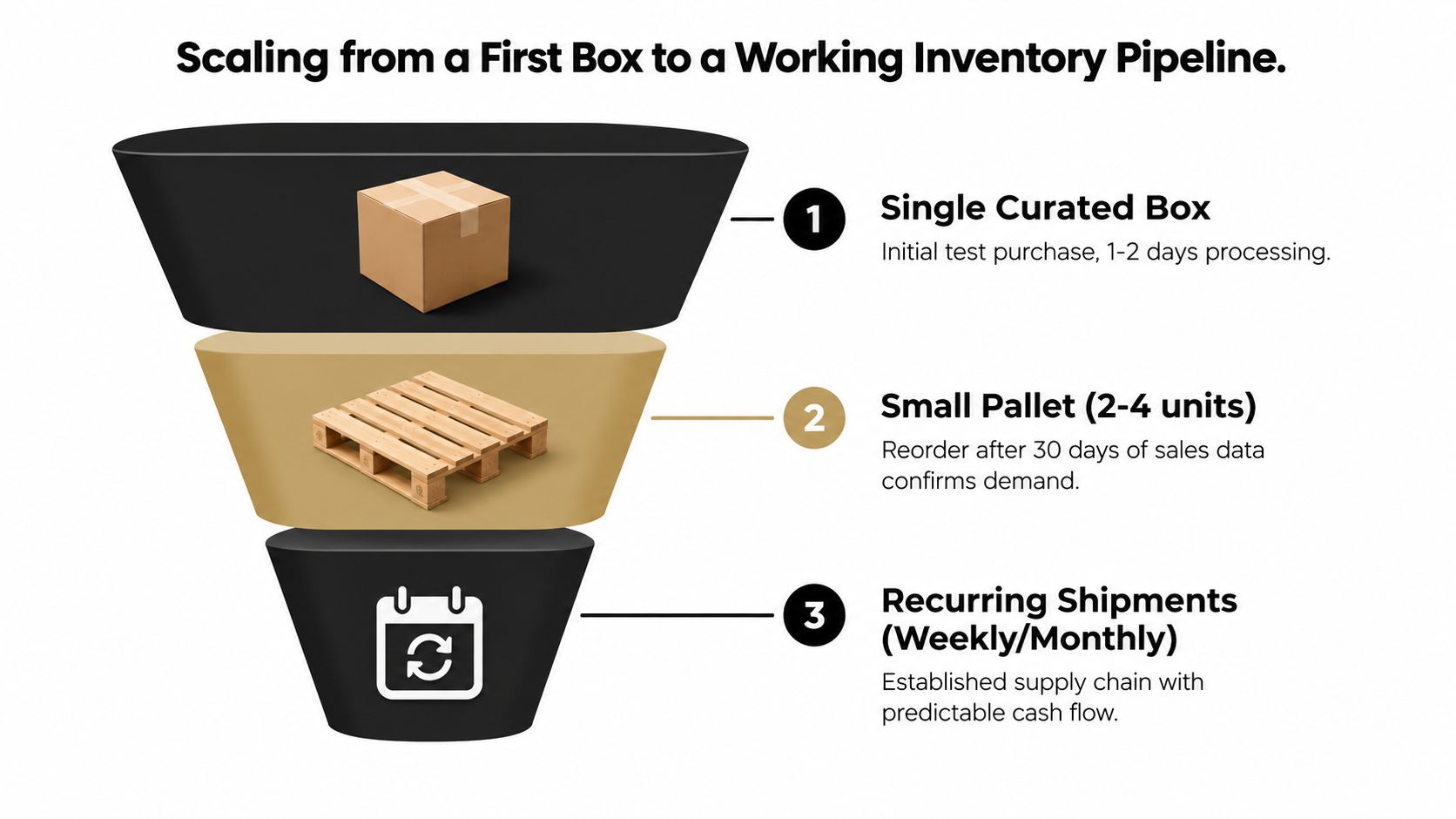
You're ready to become a repeat inventory partner when your processing time is predictable, your category-level sell-through is strong enough to justify reordering, and condition disputes remain manageable. If one of those signals is weak, buy another test lot or change the specification before increasing volume.
OneTrendyCloset offers curated brand-name liquidation boxes, mix-and-match brand options, and custom box or pallet quotes for resellers with defined quantity and assortment needs. Visit OneTrendyCloset with your target category, size preferences, condition requirements, and budget ready, then request a test order you can measure before building a larger supply pipeline.