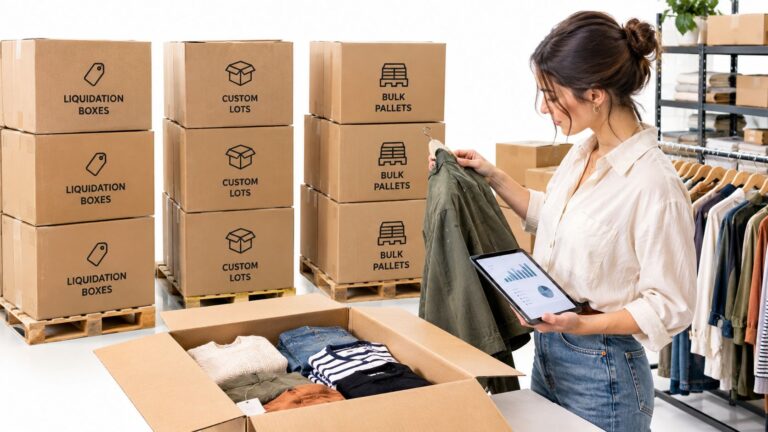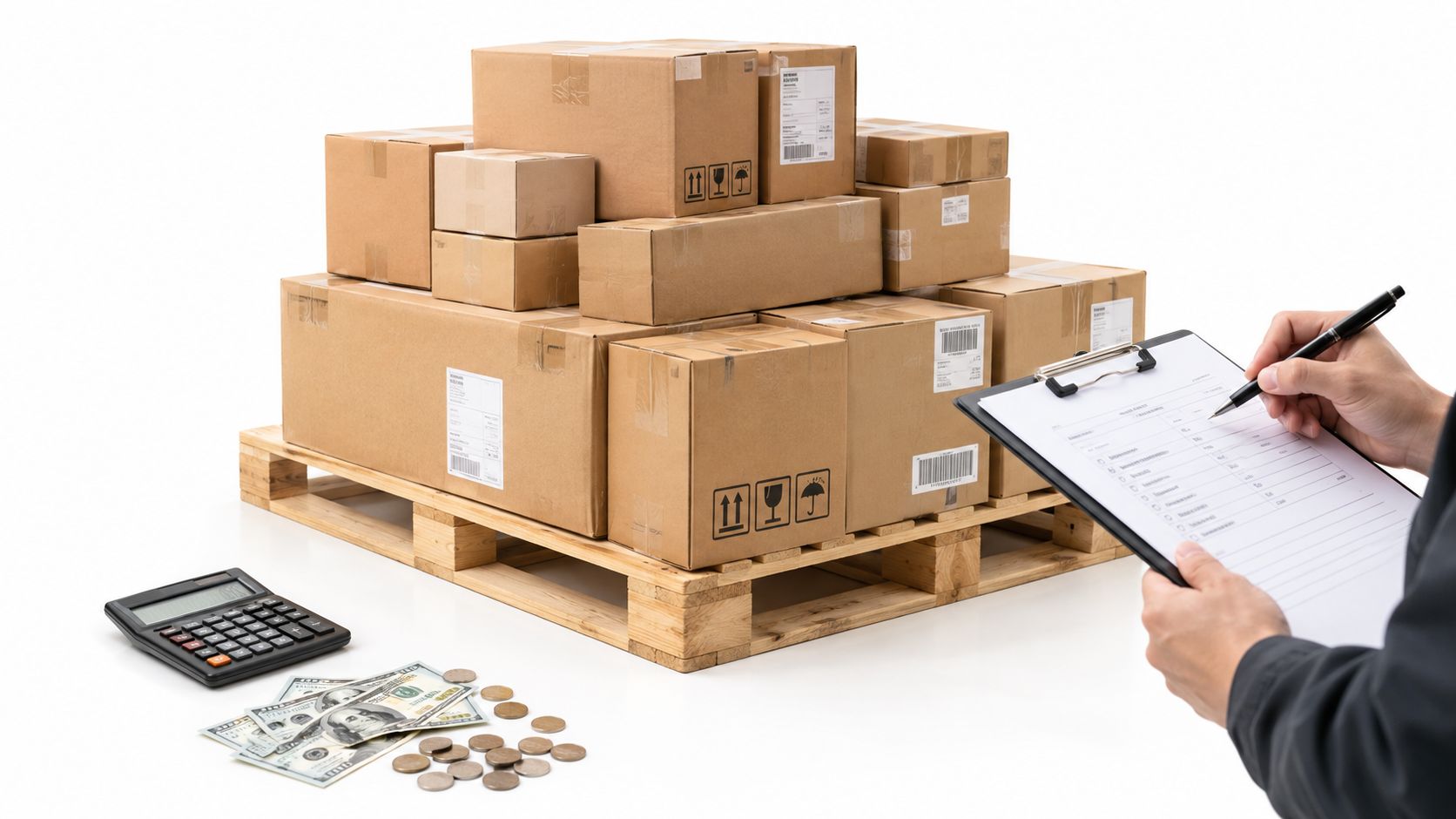
A single liquidation pallet typically costs about $150 to $2,000 before freight and fees, with apparel lots often sitting toward the lower end. The landed cost can rise sharply once you add a buyer premium and freight, so the bid is only the starting point, not your inventory cost.
That distinction decides whether a pallet makes money. A $400 clothing pallet can become $590 to $710 before storage, labor, platform fees, and tax when freight and the applicable buyer premium are added, according to liquidation pallet pricing guidance. Your real question isn't, “How much do liquidation pallets cost?” It's, “What will each wearable, listable garment cost me after the pallet arrives?”
I've seen new resellers chase the lowest bid, then discover that damaged pieces, weak brands, residential freight, sorting time, and markdowns have consumed the apparent bargain. Experienced buyers judge three figures: the posted price, the landed pallet cost, and the landed cost per sellable garment. The third figure is the one that belongs in your buying decision.
Table of Contents
- What Liquidation Pallets Cost in 2026
- The Five Factors That Drive Pallet Price
- Price Brackets by Category and Condition
- Landed Cost vs Sticker Price
- Why a Cheaper Pallet Can Cost You More
- How to Budget and Negotiate With Suppliers
- A Simple Decision Framework Before You Buy
What Liquidation Pallets Cost in 2026
A single liquidation pallet commonly costs $150 to $2,000 before freight, while apparel-focused shelf-pull and mixed-fashion lots often fall around $150 to $600, according to this apparel pallet buying guide. Treat those figures as screening ranges, not as your inventory budget. Your margin depends on what arrives, what can be sold, and what each sellable garment costs after delivery.
A $200 bid is not $200 of usable stock. Calculate the purchase this way:
Landed cost = bid or fixed price + buyer premium + tax + freight
Then divide the total by the garments you can realistically sell. A manifest count is not a sellable-unit count. Sellable units are authentic, wearable, seasonally relevant pieces that you can photograph, list, price, and move through your chosen channel.
The three prices every buyer should track
Posted price is the auction bid or supplier's listed amount. Use it to compare lots, but never use it as your final buying figure. It excludes the charges and losses that determine your actual margin.
Landed pallet cost includes the amount charged before you process the inventory. Liquidation.com identifies the final auction price, buyer premium, applicable taxes, and shipping as buyer costs. Its buyer information page also explains why LTL freight depends on distance, freight class, dimensions, and weight. Freight is not ordinary parcel postage, and residential delivery can change the economics quickly.
Cost per sellable garment is the number that should control your bid. A $400 apparel pallet with a 10% buyer premium and $200 freight lands at $640 before tax. If 100 sellable garments remain, acquisition cost is $6.40 per sellable unit, before cleaning, photography, labor, returns, and marketplace fees.
Use this calculation while reviewing pallets for sale. I would pay more for a transparent, curated lot when its sellable-unit cost beats a cheap blind pallet. The headline bid attracts attention. Landed cost per sellable garment determines whether the lot produces workable margin. Judge every purchase by that figure, not by the auction price or stated retail value.
The Five Factors That Drive Pallet Price
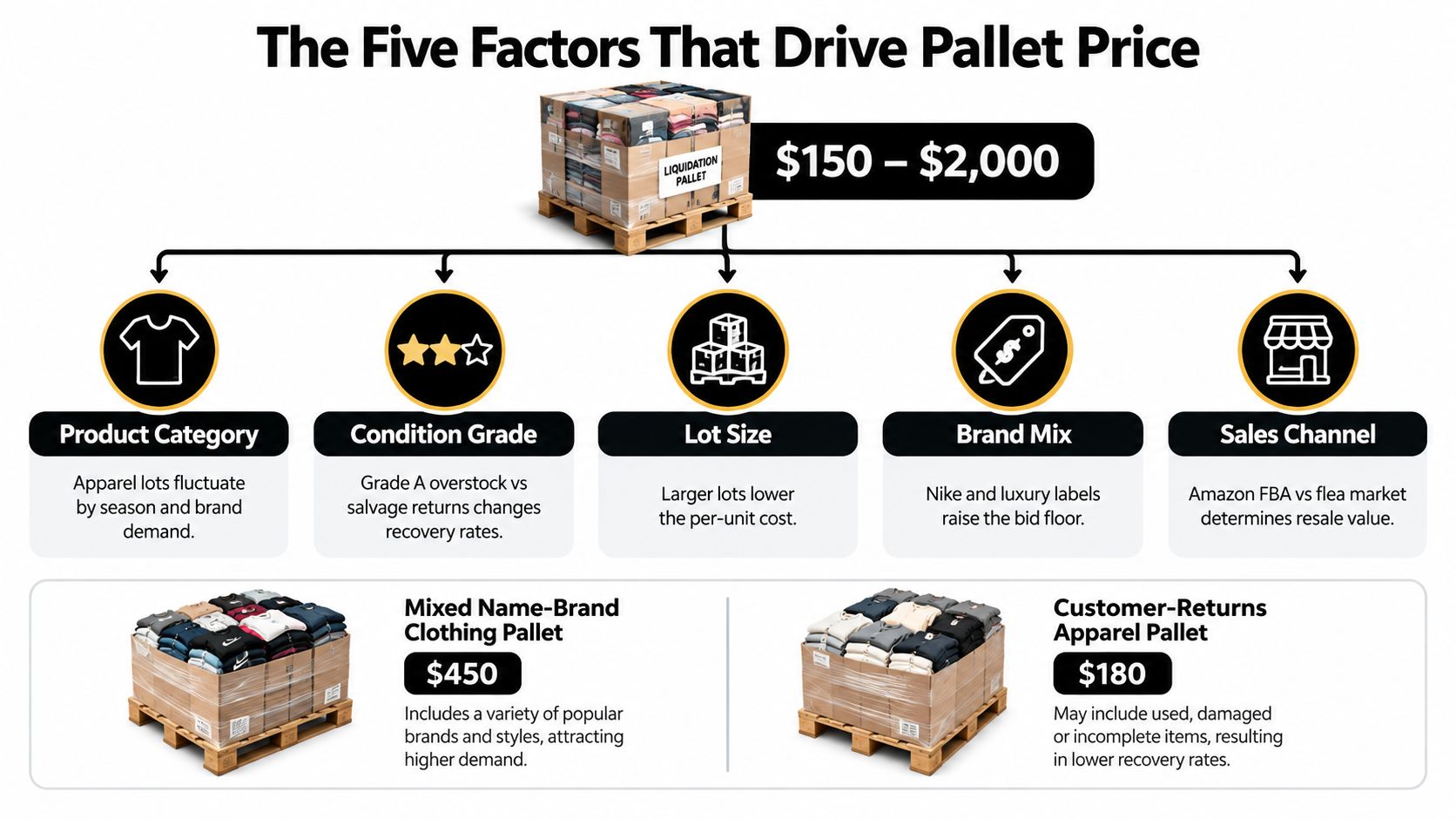
Five variables can move an apparel pallet from the low hundreds to roughly $2,000: product category, condition, lot size, brand mix, and sales channel. Each one changes the recovery you can expect. Ignore one, and your bid rests on incomplete information.
Product category
Apparel, general merchandise, electronics, and home-improvement goods do not attract the same bids. General-merchandise returns commonly fall around $300 to $800, while apparel can run about $200 to $600. Electronics often reach $600 to $2,000, and home-improvement goods can reach $700 to $1,800.
Within clothing, basics and mixed fast-fashion pieces usually draw less bidding pressure than recognizable athletic wear, premium denim, outerwear, or sought-after labels. A pallet full of seasonal dresses can look impressive and still perform poorly if your audience is not buying that category when the inventory arrives. Match the category to an existing customer base before you bid.
Condition grade
Overstock and shelf pulls usually give buyers more resale confidence than customer returns. Clean merchandise can move from inspection to photography and listing with less labor. Returns bring uncertainty around stains, missing components, wear, odors, and inaccurate descriptions.
Treat “new” and “like new” as separate grades. Ask how the supplier defines each term, whether the grade applies to the full lot or only a sample, and how defects are documented. For additional context, learn how Amazon pallet sales are graded and sourced in this what is an Amazon pallet sale guide.
Lot size
A single-SKU or tightly grouped lot can command a higher per-unit price because it gives you predictable inventory. Mixed lots may cost less to enter, but sorting, grading, and slower listing consume that apparent savings.
Larger lots can reduce the effective unit cost when the assortment fits your channel. They can also leave you with more unwanted stock when the mix includes sizes, styles, or seasons your customers do not buy. Buy volume only when you have a clear outlet for the full assortment.
Brand mix
Brand recognition affects both the bid and resale speed. A concentrated lot of desirable labels can support a higher acquisition cost because shoppers understand the offer. A generic assortment requires sharper pricing and more work to earn attention.
Stated retail value remains a poor profit forecast. Listings may show retail totals of $2,000 to $4,000 against pallet prices of $600 to $1,200, yet recoverable value depends on condition, desirability, seasonality, and sell-through speed. Evaluate brand-name clothing pallets by usable assortment, not label count.
Sales channel
A boutique, live-sale host, and flea-market seller value the same pallet differently. A clean, brand-focused assortment suits marketplace listings, while a highly mixed return lot may be difficult to present consistently in a boutique.
Choose the sales channel before bidding. It sets the acceptable condition, photography workload, pricing discipline, and labor your margin must support.
Price Brackets by Category and Condition
Apparel buyers need a bracket that reflects both category and condition, not a single universal answer. A lower price can signal more sorting risk, while a higher price may buy better curation and a faster path to listing.
The ranges below use the verified apparel benchmarks for single pallets and broader liquidation categories. They are buying zones, not guaranteed quotes. Actual prices change with the manifest, source, season, brand concentration, and freight.
| Category | Condition | Price Range | Target Buyer |
|---|---|---|---|
| Mixed fashion and shelf pulls | Mixed, with resale-ready and lower-grade pieces | $150–$600 | New resellers testing a familiar category |
| General-merchandise returns containing apparel | Customer returns, mixed condition | $300–$800 | Experienced sellers with sorting capacity |
| Brand-focused apparel | Curated or more predictable assortment | Around $150–$400 for many brand-name lots | Boutiques and marketplace sellers |
| Electronics or non-apparel comparison lots | Varies widely by grade | $600–$2,000 | Specialized buyers with category expertise |
| Home-improvement comparison lots | Varies by product and condition | $700–$1,800 | Buyers with a dedicated hardware channel |
A clothing reseller should start with the first or third row only when the assortment matches an existing audience. A mixed pallet that includes the right sizes, styles, and seasons can outperform a supposedly premium lot that doesn't fit your customers.
Condition changes the bracket
Condition can move a pallet into a different buying tier even when the category stays the same. Shelf pulls and current branded apparel usually deserve more attention than damaged or incomplete returns, but “higher grade” doesn't remove the need for inspection.
The most useful questions are practical:
- What percentage is expected to be wearable? Ask how the supplier calculates that term.
- Are defects itemized? Look for stains, holes, missing tags, odors, and incomplete sets.
- Is the manifest current? A generic category label isn't enough for a serious bid.
- Can you see the actual lot? Stock photography tells you very little about the pallet you'll receive.
Don't use MSRP as your ceiling. Industry liquidation guidance places mixed customer-return auctions around 10% to 30% of MSRP, but those figures aren't guarantees for apparel. Current branded garments in resale-ready condition can outperform heavily mixed, damaged, off-season stock.
Landed Cost vs Sticker Price
The sticker price is the number that gets attention. Landed cost is the number that determines your margin.
Use this formula before you bid:
Bid or fixed price + buyer premium + tax + freight = landed pallet cost
Then use:
Landed pallet cost ÷ expected sellable units = acquisition cost per sellable garment
For a verified apparel example, start with a $400 pallet, apply a 10% buyer premium, and add $200 freight. The pre-tax landed cost becomes $640. If the pallet contains 100 sellable garments, the inventory cost is $6.40 per garment before cleaning, photography, packaging, returns, labor, platform fees, and tax.
| Cost Line | Amount |
|---|---|
| Pallet price | $400 |
| 10% buyer premium | $40 |
| Freight | $200 |
| Pre-tax landed cost | $640 |
| Expected sellable garments | 100 |
| Cost per sellable garment | $6.40 |
The example exposes the trap. The advertised $400 price makes the lot look inexpensive, but freight and the premium add $240 before tax. If only part of the shipment is wearable and listable, the effective unit cost rises again.
Freight deserves its own line
Single pallets generally move through LTL freight, not ordinary parcel shipping. Distance, freight class, dimensions, weight, residential delivery, and liftgate requirements can alter the final charge. Request the pallet dimensions, estimated weight, delivery terms, and every residential or liftgate fee before you commit.
Count sellable garments conservatively
A manifest count is not a sellable count. Separate garments into four groups when the shipment arrives:
- Ready to list.
- Usable after cleaning or minor preparation.
- Saleable only at a markdown.
- Donation, repair, or disposal.
Only the first two groups should support your primary acquisition calculation, and the second group still requires a labor allowance. A supplier's stated retail value can help you understand the lot, but it can't replace a conservative recovery estimate. The retail liquidation auction report illustrates why acquisition and recovery rates matter more than the original ticket price.
Why a Cheaper Pallet Can Cost You More
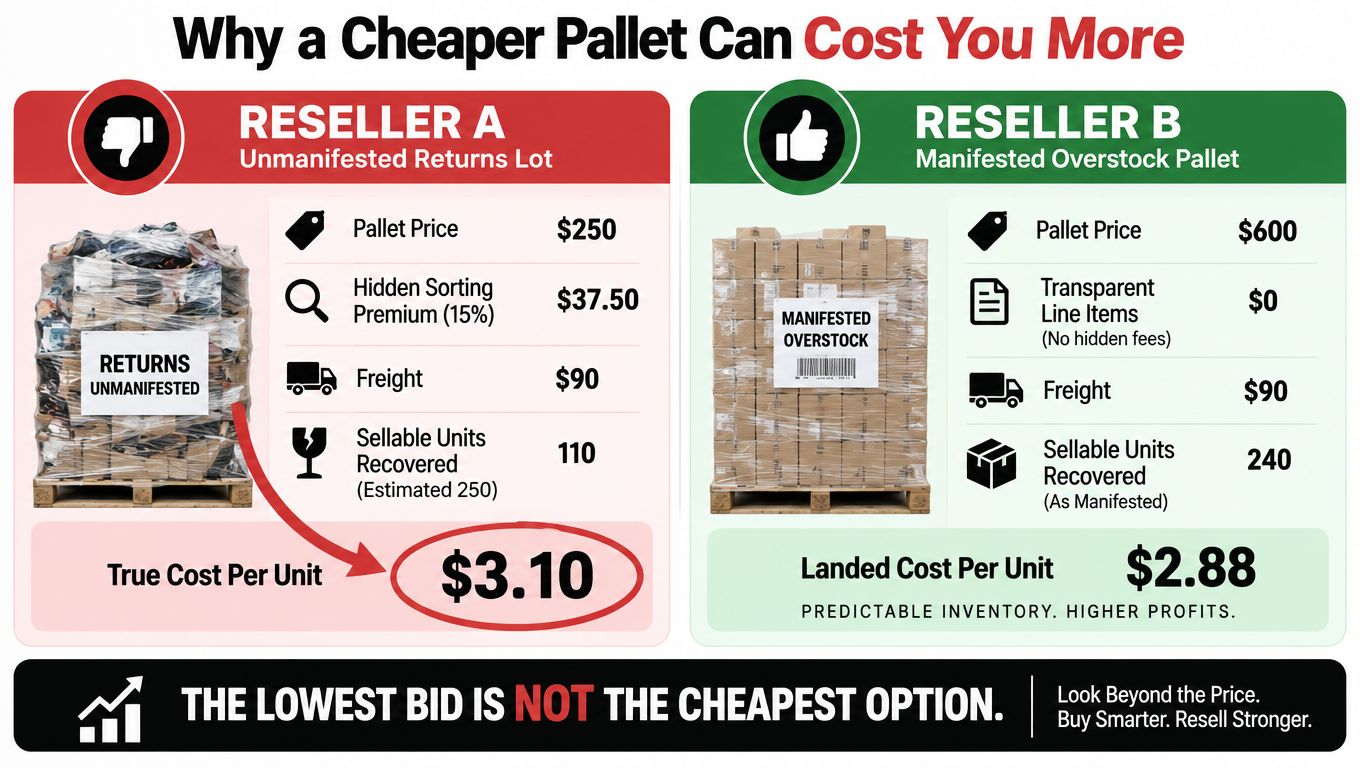
The cheapest pallet often contains the most expensive labor. Unmanifested returns force you to discover the assortment after payment, then absorb the time required to inspect, clean, grade, photograph, list, discount, and dispose of weak pieces.
A curated lot costs more for a reason. Someone has reduced uncertainty before the inventory reaches your workroom. That doesn't make every curated pallet profitable, but it can lower the number of garments that consume labor without producing revenue.
Compare recovery, not bids
Reseller A may win a blind returns pallet at a low price and discover that many pieces have defects, weak demand, poor sizing, or no practical resale channel. Reseller B may pay more for a manifested assortment but receive garments that can be sorted quickly and listed with consistent pricing.
The second buyer can make more money even with a higher invoice because the business is built on recoverable inventory, not pallet volume. A low price per piece means nothing if the pieces cannot sell.
Practical rule: Pay more for information when that information removes sorting risk, brand uncertainty, and avoidable markdowns.
The economics become clearer when you compare the same target selling price. If a garment is intended to retail at $19, the acquisition cost still isn't the margin. You must subtract platform fees, packaging, labor, returns, discounts, and any preparation required before listing. A garment that costs $4 to acquire may be less attractive than one that costs $7 if the first requires extensive work and sells slowly.
What “sellable” should mean
Use a strict definition:
- Authentic: The brand and item can be represented accurately.
- Wearable: No defects that make the garment unsuitable for your audience.
- Relevant: The style, size, and season fit current demand.
- Listable: You can prepare useful photos and a truthful description.
- Movable: Your chosen channel has a realistic buyer for it.
A recent textile consultation distinguishes between clothing that is wearable, resalable, or repurposable and clothing that is ultimately discarded. That distinction matters because wearable doesn't automatically mean profitable. Brand demand, seasonality, size distribution, defects, listing time, fees, and sell-through speed decide whether a garment becomes cash.
Use the video as a prompt to examine your own workflow, not as a substitute for a manifest or landed-cost calculation. Your first purchase should teach you how your supplier grades goods and how your audience responds, without putting your operating cash under pressure.
How to Budget and Negotiate With Suppliers
Start with the inventory question, not the discount question. Ask the supplier for the manifest, condition definitions, estimated unit count, source type, actual-lot photos, and the freight terms before discussing a final price.
Ask for evidence before you quote
A serious supplier should be able to clarify:
- Manifest detail: Brand, product type, size information, quantity, and condition notes.
- Actual photos: Images of the pallet or box you'll receive, not generic catalog photography.
- Freight terms: Whether the shipment is picked up, delivered to a commercial address, or subject to residential and liftgate charges.
- Unit assumptions: Whether the count includes damaged, incomplete, or untested merchandise.
- Return policy: What happens if the shipment materially differs from its description.
Compare suppliers within the same category. A quote for curated brand-name apparel isn't directly comparable to a blind general-merchandise return lot, even when both listings use the word “pallet.”
Negotiate the risk, not just the price
If a supplier won't reduce the invoice, ask for better information, clearer grading, pickup options, or a more suitable brand mix. A smaller, focused lot can be a better concession than a nominal price cut on inventory you don't know how to sell.
For a first purchase, use an amount you can fully absorb as a learning cost. Don't put your operating capital into a blind lot just because the bid appears cheap. Keep enough cash available for freight, preparation, packaging, platform charges, and the next inventory opportunity.
A practical budget rule is simple: don't let one unmanifested pallet consume more than 15% of your starting inventory capital. That limit is a risk-control rule, not a claim about market performance. It prevents one bad assortment from stopping your business before you've learned your channel.
A Simple Decision Framework Before You Buy
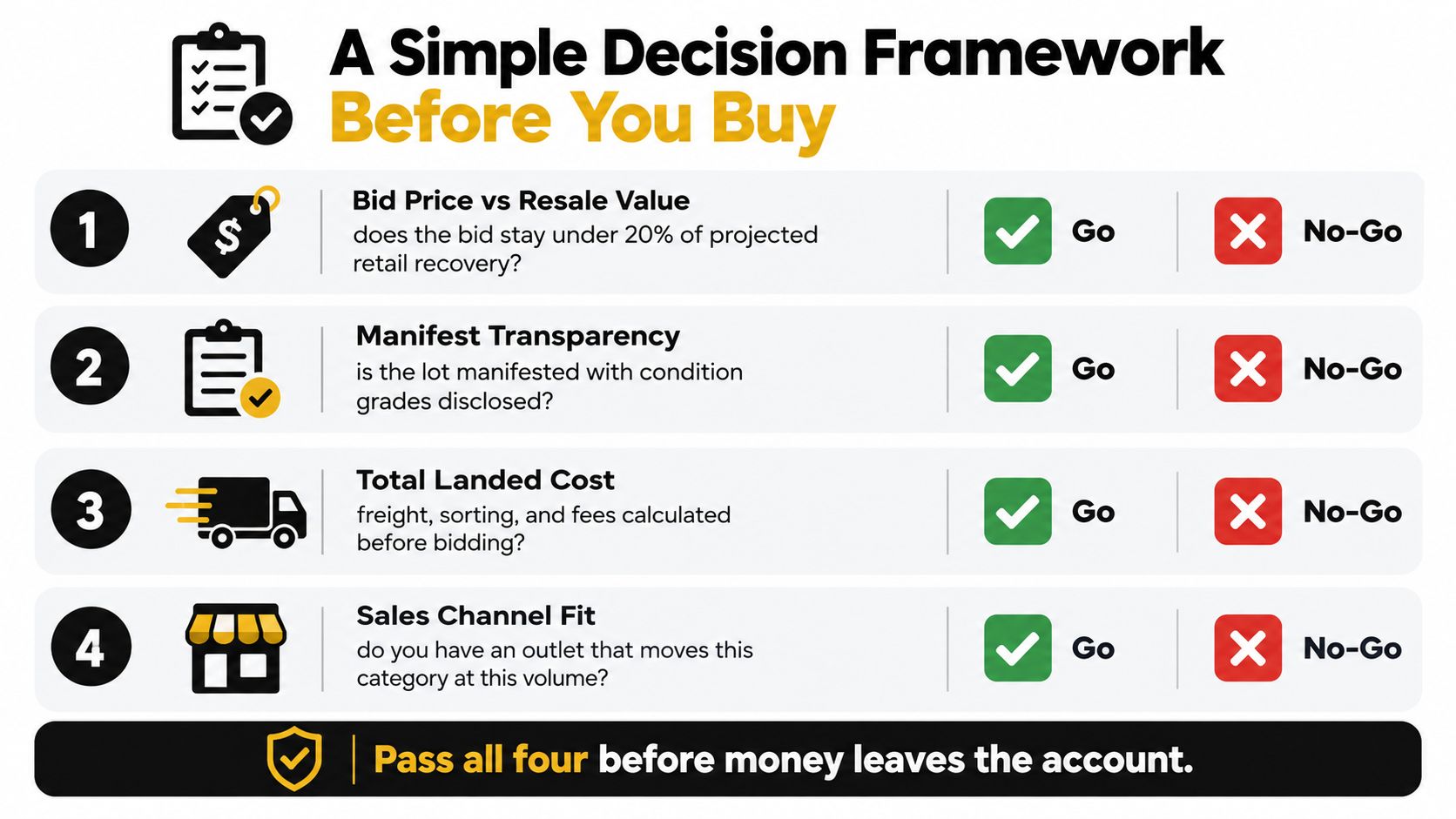
Run every pallet through the same four checks. If the lot fails one, fix that specific problem before paying. If you can't fix it, walk away.
1. Does the bid fit the category?
Compare the quote with the apparel brackets above. A price outside the expected range isn't automatically wrong, but it demands a clear explanation, such as unusually strong brand concentration, verified condition, or meaningful curation.
Pass: The supplier can explain the premium.
Fail: The price relies only on inflated retail value.
2. Can you calculate landed cost per sellable garment?
You need the bid, premium, freight, taxes, and a conservative sellable-unit estimate. If the supplier won't provide enough information to calculate the result, treat the lot as high risk.
Pass: You have a defensible unit cost.
Fail: You're dividing the pallet price by an optimistic manifest count.
3. Does the margin survive ordinary costs?
Subtract platform fees, packaging, labor, markdowns, returns, and grading losses from your expected selling price. Don't call gross sales profit. If the remaining margin depends on every garment selling at full target price, the lot is too fragile.
Pass: The economics work under conservative pricing.
Fail: One damaged batch or freight adjustment destroys the margin.
4. Do you have an exit channel?
Know where the garments will go before they arrive. A boutique, marketplace, live-sale format, and local sale each reward different assortments and conditions.
Pass: Your channel already serves the category and volume.
Fail: You're buying first and hoping to find customers later.
If only freight fails, renegotiate delivery, arrange commercial pickup, or reject the quote. If the manifest fails, request a better assortment or a smaller test lot. If the sellable count is uncertain and the supplier won't clarify it, walk away. A disciplined buyer doesn't need every pallet. They need the right pallet at a cost their channel can support.
OneTrendyCloset offers curated brand-name apparel liquidation boxes, mix-and-match brand selection, and custom quotes for larger lots based on budget, preferred brands, and quantity needs. Visit OneTrendyCloset to compare a more predictable apparel assortment against the landed cost of a blind pallet before placing your next order.