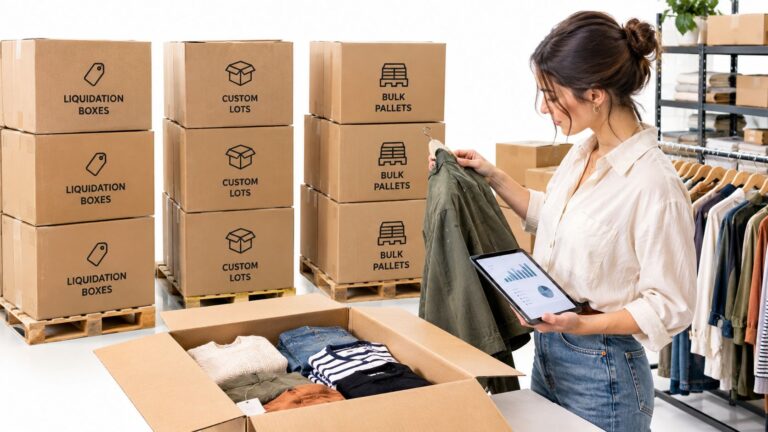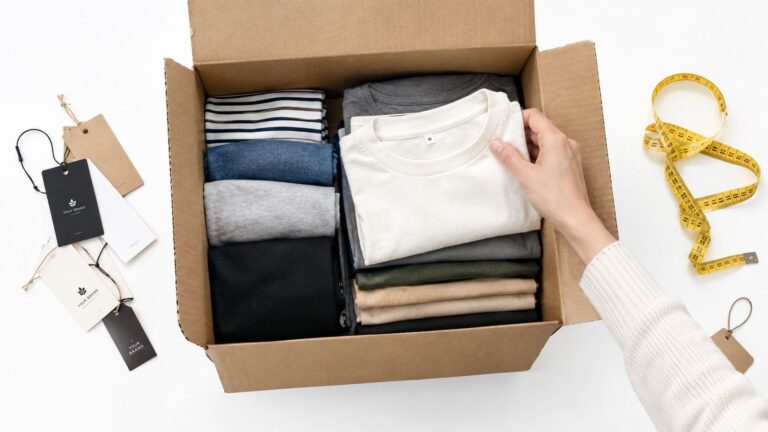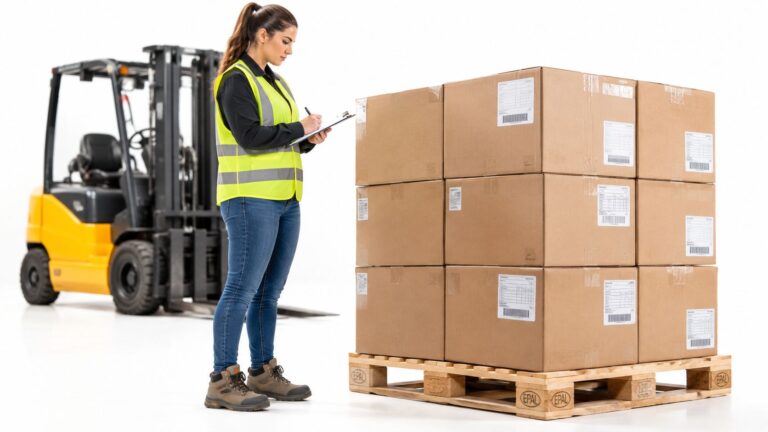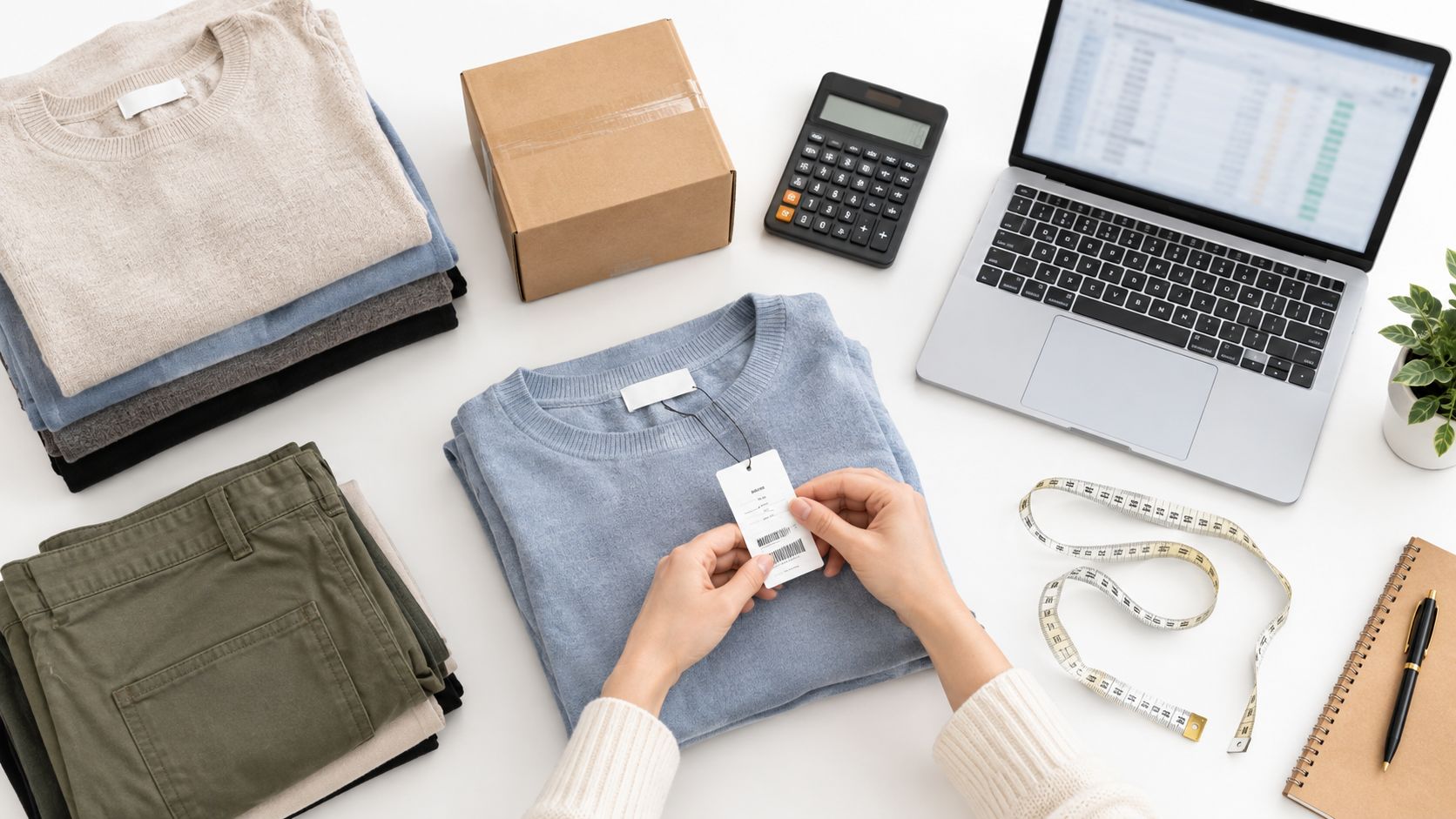
You've found two wholesale clothing offers that look almost identical. One has the lower price per piece, while the other costs slightly more but includes clearer condition notes, documented sizing, and a shipping timeline you can plan around. The cheaper box is tempting until you discover missing tags, uneven sizes, hidden defects, and a delay that leaves your store short of inventory during a selling window.
That's how many first wholesale orders lose money. The supplier's unit price gets all the attention, while landed cost per sellable item, return exposure, condition, and replenishment reliability stay in the background. Learning how to buy wholesale clothing profitably means evaluating the inventory you can list and sell, not the number printed beside each garment.
Table of Contents
- Two Wholesale Offers and the Question Most Buyers Forget to Ask
- Why Wholesale Clothing Buying Is Bigger and Riskier Than It Looks
- Choosing Suppliers and Understanding Minimum Orders
- Calculating the Real Landed Cost Before You Pay
- Grading Condition, Sizing, and Tags Before You Buy
- Inspecting, Shipping, and Receiving Your First Order
- Your First Wholesale Order Plan and Buyer FAQs
Two Wholesale Offers and the Question Most Buyers Forget to Ask
A first-time reseller often compares offers in a spreadsheet with only three columns: supplier, quantity, and price per item. That comparison can make a blind liquidation lot look better than a curated assortment, even when the curated box produces more usable listings.
The question buyers forget is simple:
How many items will I be able to sell confidently, at my intended price, after freight, sorting, defects, and returns?
A box advertised as inexpensive may contain mixed sizes, incomplete sets, missing care labels, or garments that need steaming, repair, and extra photography. None of those problems necessarily make the inventory worthless, but each one consumes time or reduces the amount you can recover. If the lot includes products you can't describe accurately, you may also face customer disputes and marketplace returns.
The more expensive offer can win when it provides predictable condition, usable size distribution, readable labels, and a supplier you can reorder from. Repeatable sourcing matters because a successful category loses momentum if the next shipment arrives with a completely different assortment or a much longer lead time. A supplier's ability to explain the lot may be more valuable than a small discount.
Before paying a deposit, compare more than the quote:
- Sellable quantity: Estimate how many pieces should be ready for listing and how many may need markdowns or bundling.
- Total exposure: Add merchandise, freight, duties where applicable, payment fees, inspection time, and expected loss.
- Operational fit: Check whether the order size, delivery schedule, and sorting requirements match your storage and selling capacity.
- Supplier accountability: Confirm what happens when the shipment differs materially from the description.
The rest of the buying process follows that logic. You'll assess supplier types and minimum orders, calculate real landed cost, test condition and sizing claims, receive the shipment systematically, and use sell-through data before scaling. Bargain hunting has its place, but a cheap item that can't become a reliable sale is not a cheap item.
Why Wholesale Clothing Buying Is Bigger and Riskier Than It Looks
Small resellers operate inside a wholesale channel much larger than their own businesses. Federal Reserve Bank of St. Louis data based on Census reporting show that U.S. apparel, piece-goods, and notions merchant wholesalers recorded approximately $156.7 billion in annual sales in 2024, compared with $160.2 billion in 2023 and $182.5 billion in 2022. The same series recorded $135.0 billion in 2020, illustrating how sharply channel conditions can move across economic cycles. See the Federal Reserve apparel-wholesale sales series for the underlying history.
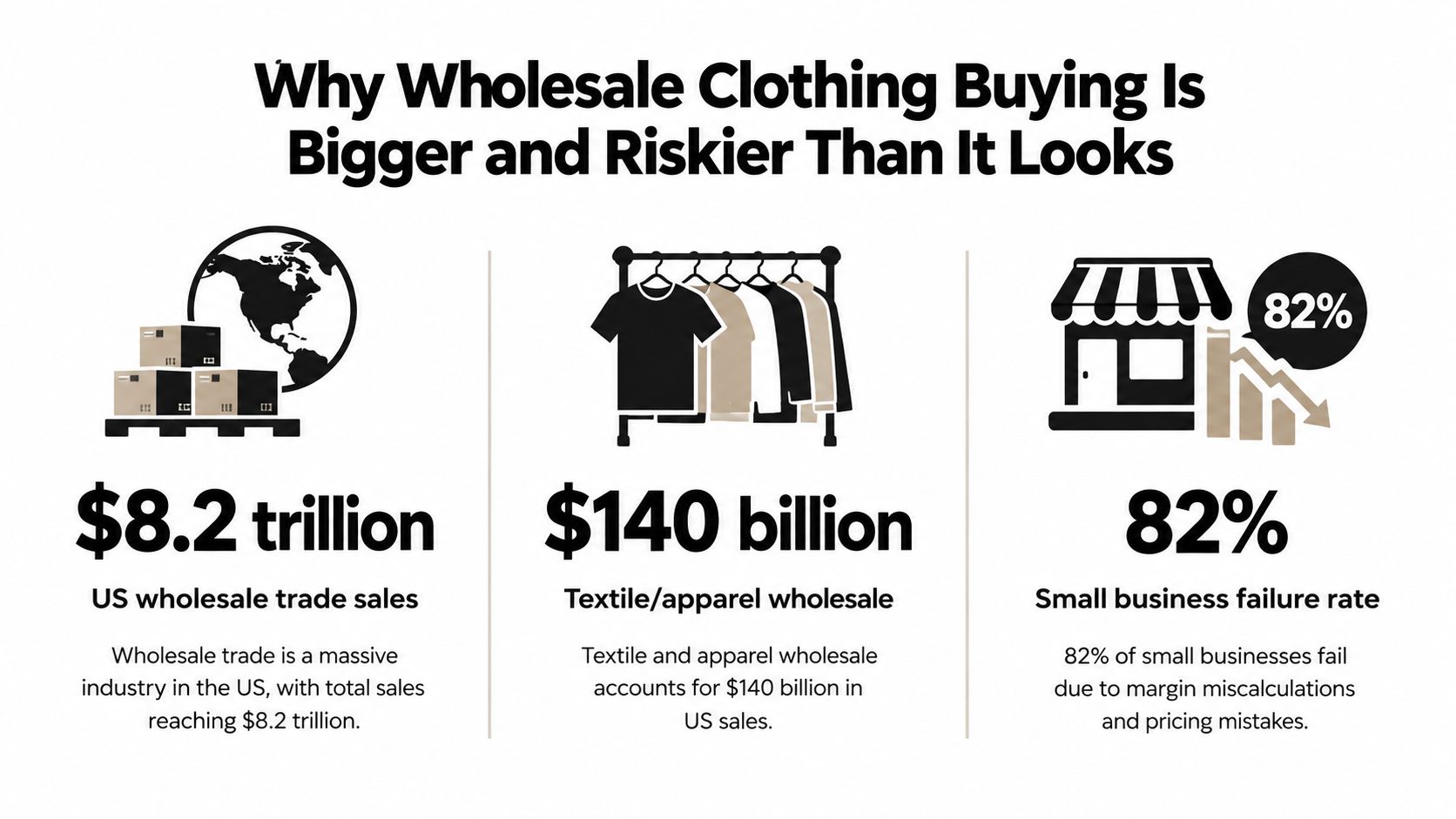
That scale creates opportunity, but it also explains why a supplier's quote can change. Availability, closeout volume, consumer demand, freight capacity, and category performance all affect what sellers can source. A price that worked in one buying period may not remain available later, and a category that moved quickly for one reseller may stall when sizes, seasons, or customer expectations differ.
For a small boutique or marketplace seller, the practical response is to treat buying as inventory management, not bargain hunting. The relevant question isn't whether the supplier offers a strong discount. It's whether the purchase converts cash into saleable inventory quickly enough and with enough margin to justify the risk.
The risk sits downstream from the purchase
Wholesale apparel exposes buyers to several connected problems:
- Condition uncertainty: Returns, shelf pulls, overstock, and damaged goods require different pricing and preparation.
- Size imbalance: A lot with attractive styles can still perform poorly if the size run doesn't match your customer base.
- Return exposure: Fit and condition problems can turn a completed sale into a markdown, replacement, or refund.
- Fulfillment variability: Slow or inconsistent shipping can leave you unable to restock a proven category.
- Import complexity: Overseas orders may involve customs paperwork, duties, clearance delays, and responsibility questions.
A supplier with transparent lot descriptions and reliable fulfillment can therefore be more valuable than a supplier with the lowest nominal price. Your purchasing model should reward predictability, documentation, and replenishment, especially when unsold stock could tie up cash for months.
Choosing Suppliers and Understanding Minimum Orders
Wholesale channels suit different kinds of sellers. A liquidation house may offer branded customer returns or overstock at an attractive price, but the assortment can be unpredictable. An importer may provide broader volume and repeatable categories, while a curated box supplier may give a smaller reseller more control over brand mix and condition.
Start by identifying what you can sell consistently. A boutique with a defined customer profile may need coordinated categories and dependable sizes. A live-sale host can tolerate more variety if the items are easy to demonstrate and bundle. A marketplace seller usually needs accurate measurements, clean photographs, and enough product information to create individual listings.
| Channel | Typical MOQ | Condition | Best For |
|---|---|---|---|
| Liquidation house | Varies by lot or carton | Returns, overstock, shelf pulls, or mixed grades | Buyers comfortable with sorting and uncertainty |
| Brand-name lot seller | Often tied to a curated box or lot | Usually described by category and grade | Resellers seeking recognizable labels |
| Importer or manufacturer | May require larger commitments | New production or factory-defined goods | Sellers planning repeatable collections |
| Curated box supplier | Often smaller than a pallet program | Selected inventory with stated criteria | Boutiques and new resellers testing demand |
Minimum order quantity, or MOQ, isn't just a purchasing hurdle. It determines how much capital you commit before seeing the supplier's actual quality. A lower MOQ can be useful for testing, but it may come with higher per-unit shipping or a narrower selection. A larger MOQ can improve pricing while increasing exposure to slow sizes and weak categories.
Before sending money, ask the supplier for written answers to these questions:
- What is the inventory provenance? Is it new, returned, overstock, shelf-pull, or damaged?
- How is condition assigned? Does the supplier inspect every piece, sample the lot, or provide only an aggregate estimate?
- What does the quote include? Ask about freight, duties, handling, insurance, and payment fees.
- Can you inspect a sample? Request current photos, a packing list, or a sample order rather than relying only on stock images.
- What happens when the lot is materially different? Clarify claims timing, evidence requirements, and possible remedies.
- Can successful categories be replenished? Ask whether future lots are built from the same source or assembled opportunistically.
A practical guide to finding a wholesale supplier for clothing can help you compare sourcing paths, but the final decision should come from the supplier's documentation and your own operating constraints. The right supplier is the one whose process your business can handle after the invoice is paid.
Calculating the Real Landed Cost Before You Pay
The supplier's unit price is only the starting point. A useful model divides the complete order cost by the number of pieces that are saleable:
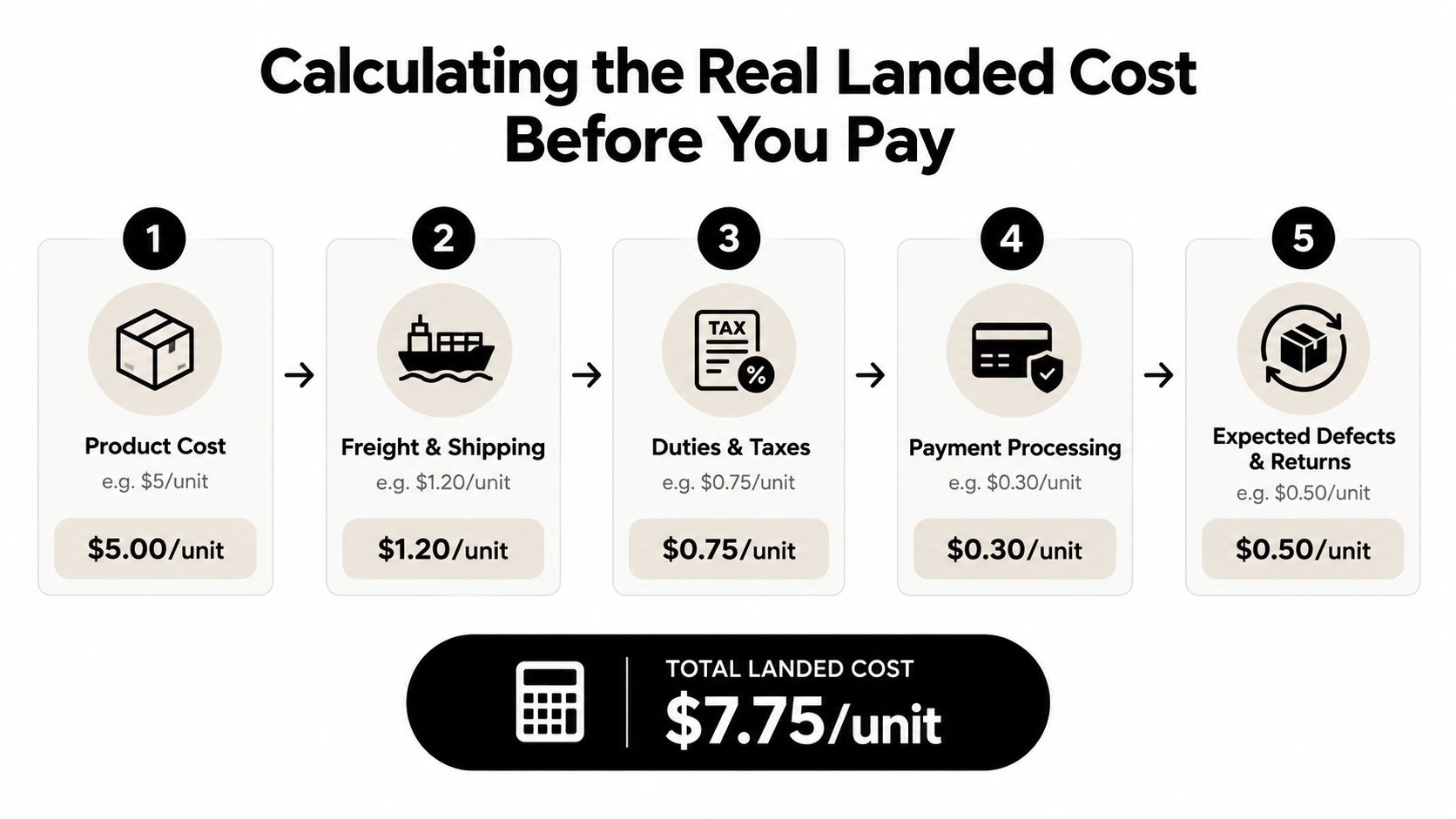
Landed cost per sellable item = total purchase cost, freight, duties, fees, and expected loss ÷ sellable items
Expected loss can include defects, missing components, unlisted sizes, markdown exposure, and inventory you decide to bundle rather than sell individually. If you divide by every item in the carton, you'll make a damaged or unsellable piece look as though it contributed to your margin.
Use a spreadsheet with separate fields for:
- Merchandise cost
- Domestic or international freight
- Duties and customs charges
- Broker, handling, or warehouse fees
- Payment processing
- Inspection and preparation
- Expected defects and returns
- Markdown or bundle allowance
- Number of sellable items
For example, an illustrative order might have a product cost of $5 per unit, freight of $1.20, duties and taxes of $0.75, payment processing of $0.30, and expected defects and returns of $0.50. Those inputs produce an illustrative total of $7.75 per unit, but they are planning assumptions, not a universal apparel cost. Replace them with the figures on your own quote before deciding.
A domestic carton may show a higher supplier price but a more predictable delivered cost. An imported carton may appear cheaper until customs paperwork, duties, clearance delays, and defect exposure reduce the number of pieces you can sell. The comparison should use the same denominator, saleable items, rather than the supplier's stated item count.
Import questions that must be answered
The U.S. treatment of low-value imports changed when the former $800 de minimis exemption was suspended for low-value imports from all countries effective August 29, 2025, according to Infios' explanation of the de minimis change. Buyers should expect more attention to customs declarations, possible duties, and clearance timing than a quote based on the old assumption may suggest.
Ask the supplier:
- Who is the importer of record?
- Is the quote delivered-duty-paid, or will you pay charges on arrival?
- Which documents will accompany the shipment?
- Who handles customs communication if the shipment is delayed?
- What happens if clearance takes longer than the stated delivery window?
You can also compare this calculation with the practical cost considerations in how much liquidation pallets cost. Never accept a delivered-cost label without confirming exactly what “delivered” includes.
Grading Condition, Sizing, and Tags Before You Buy
Mixed lots become profitable or painful during grading. A supplier's label such as “premium,” “A grade,” or “mixed condition” means little unless you know what the term includes and how often the supplier applies it consistently.
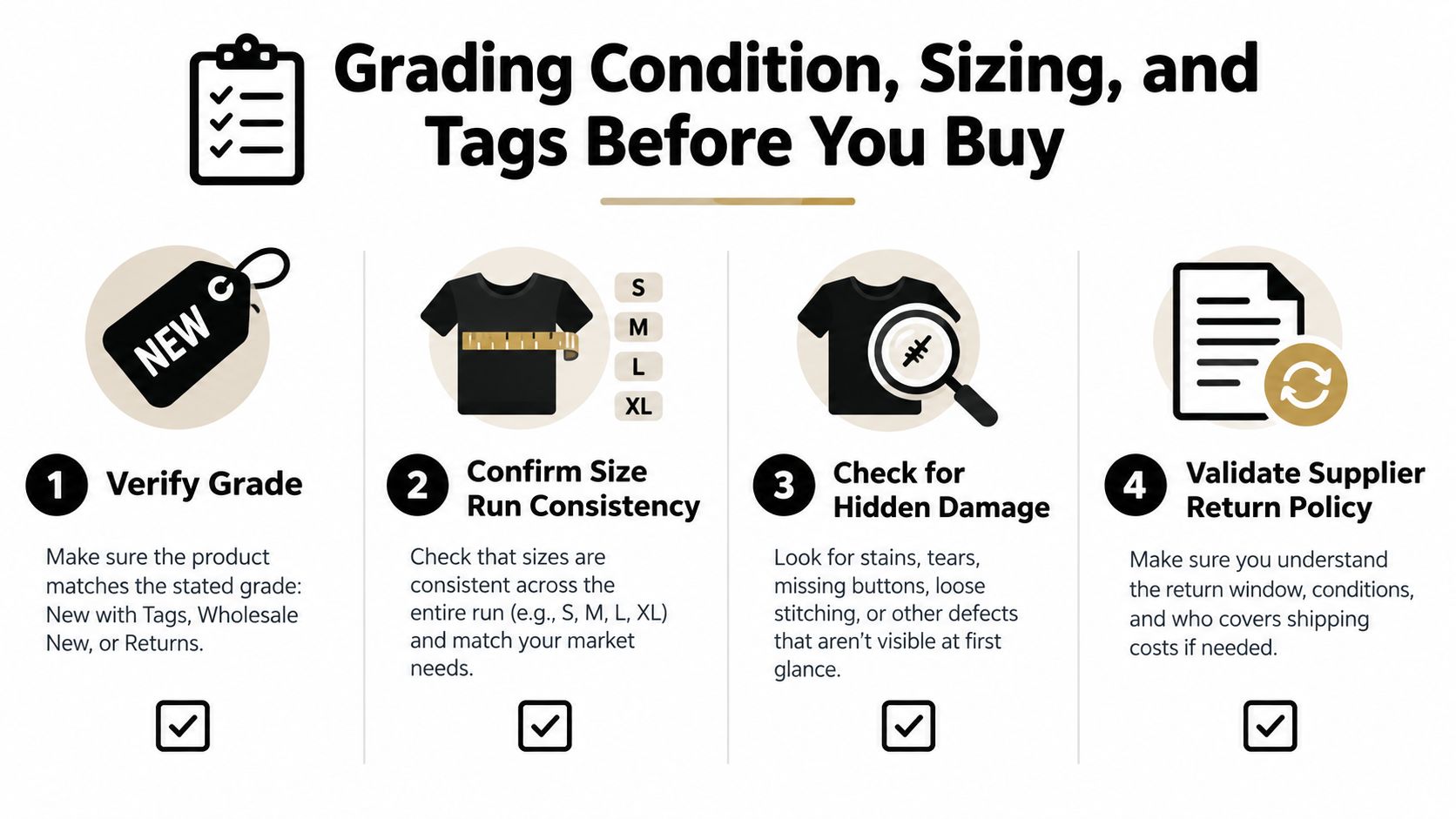
Ask for the inventory's provenance first. New with tags, overstock, shelf-pull, customer return, and damaged goods are different products, even when they share the same brand. A customer return may be clean and ready to list, or it may have makeup marks, missing components, stretched fabric, or signs of wear. You need the supplier to explain the source before you estimate revenue.
The pre-purchase test
Send a written questionnaire and save the response with your invoice:
- What condition categories are included? Request definitions for new, returned, damaged, and incomplete items.
- How are defects disclosed? Ask whether defects are individually listed, photographed, or provided only as an overall estimate.
- Are size runs documented? Request a breakdown by size, not just a statement that the lot contains assorted sizes.
- What percentage may lack tags? Confirm whether original brand and care tags remain attached and readable.
- Are sets complete? For coordinated garments, ask whether missing belts, buttons, liners, or matching pieces are possible.
- What evidence supports a claim? Find out whether you must report defects within a specified period and provide photographs.
Sizing deserves its own revenue estimate. A box can contain attractive pieces but still underperform if most garments fall outside your customers' preferred range. Use your existing sales history when available, and don't assume an even size distribution unless the supplier provides documentation.
Labels are part of the product
For U.S. resale, the Federal Trade Commission's clothing and textiles guidance says most textile and wool products must disclose fiber content, country of origin, and the identity of the manufacturer, importer, or another responsible business. Clothing generally also requires care instructions, including whether the item should be washed or dry-cleaned and, where washing is permitted, the appropriate method and water temperature.
Inspect sample labels before buying a large lot. If garments are ready for consumer sale, missing or inaccurate information can create listing problems, customer disputes, compliance concerns, and avoidable returns. Products in an intermediate production stage may use an invoice containing required information, but that doesn't automatically solve the labeling needs of finished retail garments.
Reserve time and budget for sorting, photography, measurements, quality checks, and any legally appropriate relabeling. If a supplier can't explain where the garments came from, how they were graded, or how missing information will be handled, reject the lot even when the price looks attractive.
Inspecting, Shipping, and Receiving Your First Order
Receiving day exposes whether the supplier's description survives contact with the inventory. Before opening the carton, clear a worktable, keep the invoice and packing list nearby, and photograph any visible shipping damage. A rushed count can turn a correctable shortage into an expensive assumption.

Count and sort the garments before deciding what can sell. Separate items by condition, category, size, and tag status. Record each discrepancy while the order is open, then calculate the landed cost per sellable item after removing pieces that need cleaning, repair, markdowns, or bundling.
- Photograph evidence: Capture stains, tears, missing labels, broken closures, and packaging damage beside the garment or packing list.
- Separate grades immediately: Keep ready-to-list pieces away from inventory that needs work or will sell only through a lower-value channel.
- Check the expected assortment: Compare brands, sizes, categories, and quantities with the supplier's written description.
- Protect the claim window: Send a concise report with order details, photographs, and the resolution you want.
- Choose a disposition: List strong pieces individually, markdown marginal items, and bundle unsuitable pieces when that channel still supports a positive margin.
Shipping method changes both cost and labor. Parcel delivery can suit smaller boxes, while freight may make more sense for heavier cartons or pallets. See this guide to wholesale clothing boxes and how box-based orders typically arrive. Ask who schedules delivery, whether liftgate service is included when needed, and what condition the shipment must be in when you sign. Record damage before accepting the delivery if the carrier process allows it.
Returns make receiving discipline part of the buying decision. The National Retail Federation estimated that U.S. retailers expected 15.8% of merchandise sales to be returned in 2025, representing approximately $849.9 billion, while online sales had an estimated 19.3% return rate, according to its 2025 retail returns release. These figures cover retail merchandise broadly, not a guaranteed apparel rate for your store. They still show why fit, condition, and accurate listings affect return exposure.
Keep a receiving log for every order. Include the supplier, order date, delivery date, item count, grade distribution, tag status, defects, listing date, sale price, and return outcome. Over several orders, that record shows whether the supplier's condition grading and assortment produce enough sellable inventory to justify the next purchase.
Your First Wholesale Order Plan and Buyer FAQs
A sensible first order is small enough to inspect and large enough to reveal whether the supplier's process matches the description. Choose one category or a tightly related assortment, calculate landed cost per sellable item, document the size distribution, and track sell-through by condition grade. Scale only after the supplier and category have produced evidence you can use.
Your one-page buying plan should include:
- Target customer: Define the sizes, categories, brands, and price points you can sell.
- Maximum exposure: Set the total amount you can leave in inventory without disrupting operating cash.
- Supplier evidence: Save the quote, condition definitions, photographs, packing list, and policy terms.
- Receiving process: Decide who will count, inspect, photograph, measure, and report discrepancies.
- Scale trigger: Increase volume only when sell-through, margins, return patterns, and replenishment quality support it.
A boutique may start with a curated assortment that fits its store identity. A marketplace seller may prefer individually listable branded pieces with complete labels and measurements. A live-sale operator may accept more category variety, provided the condition is easy to demonstrate and bundle.
How should I verify a supplier? Request current inventory photographs, written condition definitions, a sample or small opening order, complete payment and shipping terms, and a claims procedure. Search for consistency between the supplier's promises and the shipment you receive.
Can I negotiate wholesale clothing returns? Sometimes, but don't assume a standard return right exists. Negotiate the process before payment, including the claim window, acceptable evidence, responsibility for return freight, and whether the remedy is replacement, credit, or refund.
What should I do with missing tags? Separate those garments during receiving. Verify whether the necessary product information is available through documentation, and don't publish material, origin, care, or responsible-business details you can't support.
OneTrendyCloset offers curated brand-name apparel liquidation boxes, mix-and-match brand selection, and custom quotes for resellers, boutiques, marketplace sellers, and live-sale operators. Treat any box as a testable inventory decision, and compare its documented assortment and landed cost with other suppliers before scaling.
If you want a sourcing option built around curated brand-name apparel boxes and custom lots, visit OneTrendyCloset to review available inventory and request a quote. Share your preferred brands, categories, sizes, and budget so the team can match the order to your resale model rather than sending an unfocused assortment.