The most popular advice about liquidation pallets is to find the lowest price per piece. That's how buyers end up paying freight on inventory they can't sell. A low bid only matters if the goods arrive as described, you can authenticate the brands, and the landed cost per sellable unit leaves room for fees, labor, and unsold stock.
A practical way to buy liquidation pallets is to price the downside before bidding. Treat a manifest as an estimate, not a promise, and judge the lot by what you can realistically sell, not by its advertised retail value.
Table of Contents
- What Liquidation Pallets Really Cost
- Where to Source Apparel Liquidation Lots
- Buy a Test Box Then Bid Step by Step
- Inspect and Authenticate the Pallet on Arrival
- Price for Net Profit Not Retail Value
- Resell Through the Right Channel
What Liquidation Pallets Really Cost
The cheapest price per piece can still leave you with the most expensive inventory to process. Compare lot types by condition, likely sellable share, and the work each one requires.
| Liquidation lot types and what they really cost | Buy versus retail | Typical minimum | Condition mix | Best fit |
|---|---|---|---|---|
| Customer-return apparel pallet | Discounted lot price; the real cost depends on the sellable share | One pallet | Mixed grades, wear, missing tags | Resellers with time to sort |
| Shelf-pull or overstock pallet | Discounted lot price, plus freight and fees | One pallet | Mostly new, seasonal or size-broken | Boutiques wanting cleaner goods |
| Manifested small box or partial pallet | Often higher per piece than a blind lot | One box | Graded, photos more common | First purchase or a niche test |
| Blind mixed pallet | 5–20% headline, unknown after loss | One pallet | Brands and defects undisclosed | Only surplus cash, high risk |
| Truckload | Lowest per piece if sell-through holds | 8–26 pallets | Mixed grades; condition depends on the load's source | Teams with storage and labor |
| Curated brand-name apparel box | Higher per piece than a blind pallet | Box sizes up to a custom pallet | Selected brands and stated grades | Boutiques and live sellers |
Retail returns create a large supply of liquidation inventory, but volume does not make any individual pallet a bargain. The National Retail Federation's 2024 returns announcement projected approximately $890 billion in returned merchandise to U.S. retailers in 2024, equal to 16.9% of annual retail sales. That figure describes total retail returns, not the condition or resale potential of a specific lot. Returns may be unused, unwanted, out of season, or difficult to put back into regular stock.
The advertised piece count is only a starting point. Add the purchase price, any buyer premium, tax, freight, handling, cleaning, testing, storage, packaging, marketplace fees, and an allowance for units you cannot sell. Divide that total by the pieces you realistically expect to sell. The guide to how much liquidation pallets cost covers the cost components to include.
A downside case before you bid
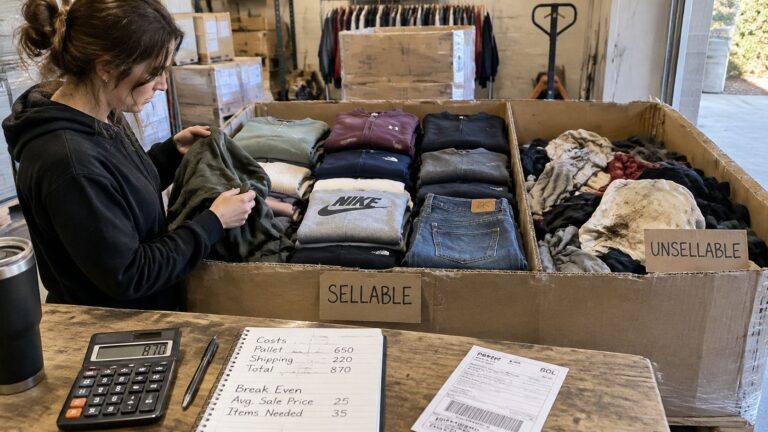
A hypothetical apparel pallet costs $400, carries a 10% buyer premium ($40), and requires $180 in freight. Its landed cost is $620 before tax, supplies, or labor. If it contains 80 pieces and you expect to remove 25% for damage, broken size runs, or weak demand, you have 60 sellable units. That puts landed cost at about $10.33 per sellable unit, rather than $7.75 when you divide by all 80 pieces.
At an average sale price of $18, a hypothetical 15% fee takes $2.70, leaving $15.30 before supplies and labor. The remaining amount over the $10.33 landed cost is about $4.97 per unit. Cleaning, storage, price reductions, and listing time can quickly consume that margin. Track the hours spent sorting and preparing the lot, too: a pallet with a positive per-unit margin may still deliver weak net contribution per labor hour.
Bid rule: Keep landed cost per sellable unit below a conservative expected sale price after fees. If the downside case does not work, the manifest's retail value will not rescue the purchase.
Where to Source Apparel Liquidation Lots
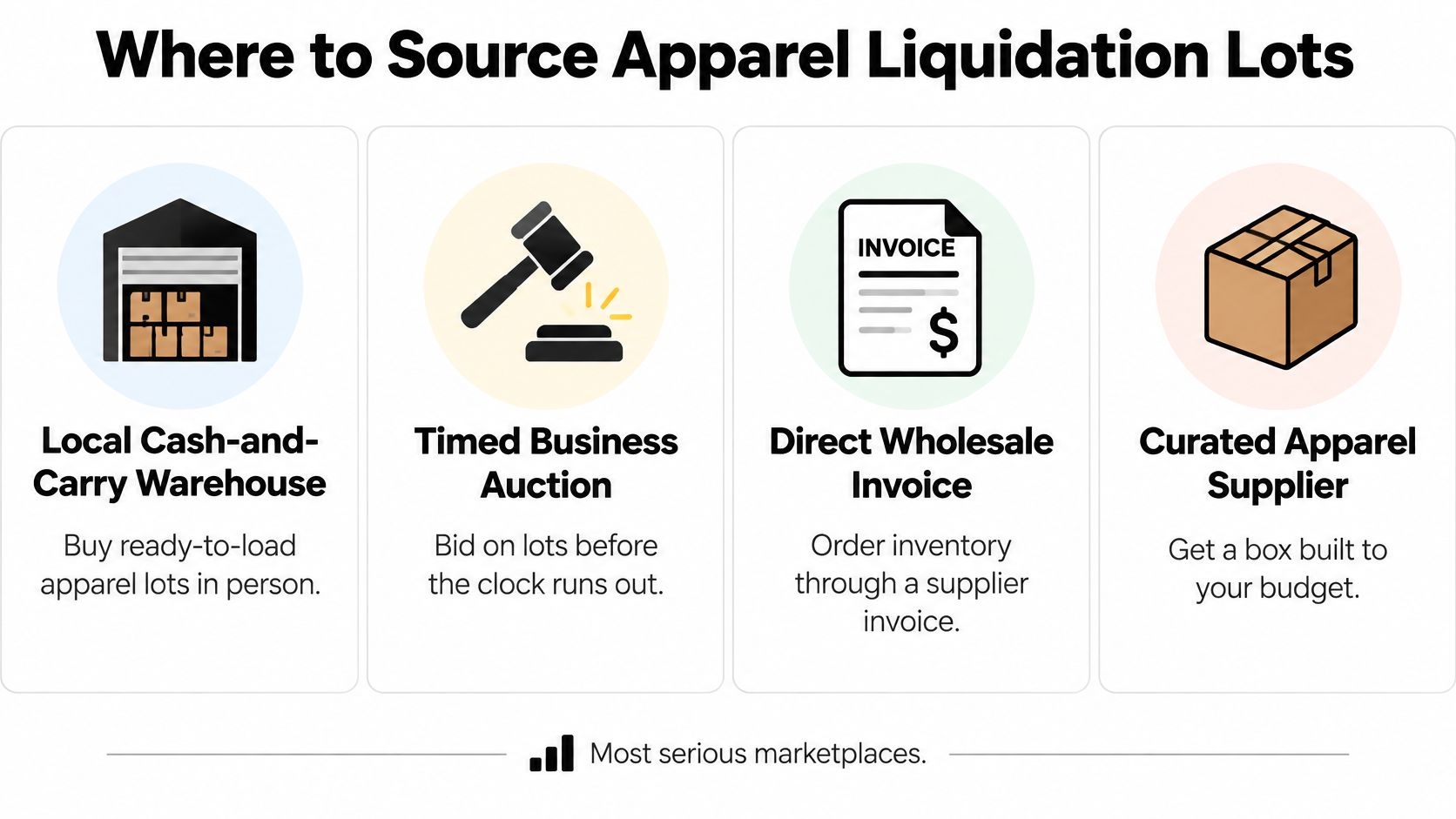
Four buying channels cover most apparel sourcing needs, but they don't offer the same visibility or pricing.
A local cash-and-carry warehouse lets you inspect what's available in person and may avoid long-distance freight. The trade-off is that the selection can be limited, and an attractive lot may not be available when you're ready to buy.
A timed business auction gives you a defined window to bid, but the winning price isn't your final cost. You may also owe a buyer premium, freight, handling, and tax. A direct wholesale invoice is a negotiated purchase rather than a timed competition. You know the quoted price before agreeing, but still need to establish exactly what the seller is promising.
A curated apparel supplier can build a box around a budget, brand preferences, or order size. You may pay more per piece than for a blind pallet, but a better-fitting mix can save sorting time and reduce unwanted stock.
Online auctions are now a structured route to liquidation inventory, not just an alternative to a local warehouse. A Retail Dive report on B-Stock describes marketplaces where retailers and manufacturers sell returned and excess goods directly to approved business buyers. Treat a marketplace auction, a negotiated wholesale quote, and an invoice from a supplier as different deals, even when the merchandise looks similar.
Before payment, get the seller's legal name, the lot's location, and clear terms for pickup or freight. Confirm whether you'll receive a manifest, how condition codes are defined, whether substitutions are allowed, and whether the sale is final. Ask for the complete amount due, including fees, tax, and delivery charges. If a shipment crosses a national border, account for possible customs paperwork, duties, brokerage, labeling requirements, and delays.
Most serious marketplaces require business-buyer approval, and some ask for a resale certificate. Don't assume one platform's rules apply everywhere. For a first order, choose a documented box or small lot from a seller you can identify. Move to a larger pallet only after the description and fulfillment match what you receive.
Buy a Test Box Then Bid Step by Step
A test order should answer one question: can you turn this kind of inventory into enough contribution to justify your money and labor? Keep the buying process narrow and write down your limits before you browse listings or enter an auction.
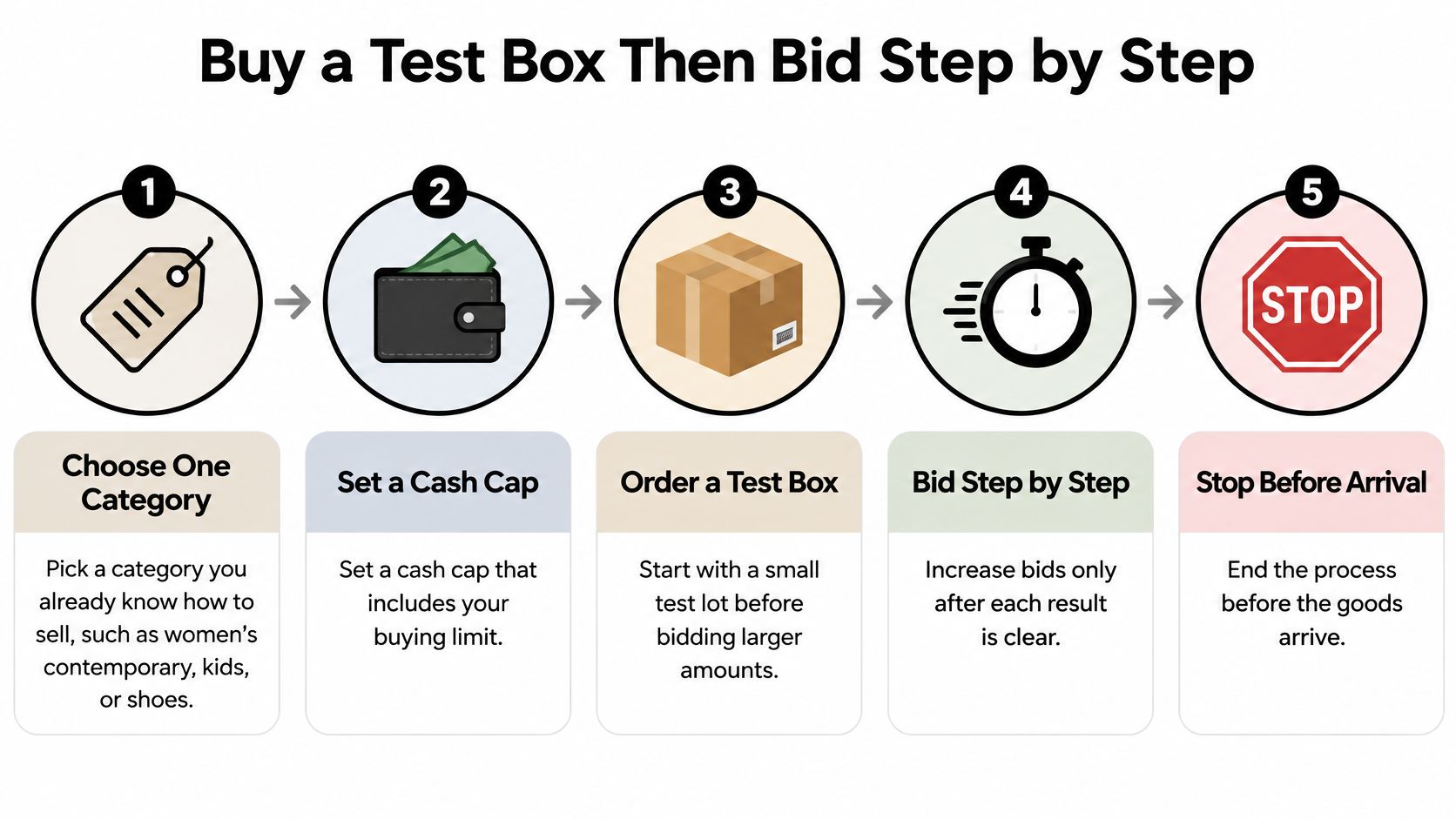
Choose a category you can already sell. Pick one lane, such as women's contemporary apparel, kids' clothing, or shoes. Familiarity helps you recognize realistic prices, workable size runs, and brands your buyers want.
Set a cash cap that includes freight. Keep money aside for the full delivered cost and the work after delivery. Don't set a purchase limit based on the auction bid alone.
Get your buying credentials in order. Apply for a resale certificate if the platform or seller requires one. Register with marketplaces where your chosen category is listed rather than opening accounts across every platform at once.
Filter for a documented lot. Look for an apparel manifest, a location you can receive freight from, and condition terms you can interpret. “Customer return,” “shelf pull,” and “salvage” don't describe interchangeable goods. If the seller won't disclose the brand mix, size distribution, and piece count, price that uncertainty as a serious risk or move on.
Build the downside cost and write your walk-away number. Estimate the landed cost per sellable unit, then test whether expected sale prices still cover fees and preparation. Decide what defect or unsellable rate you can absorb before the bidding starts. A price limit only works if you're willing to stop when the auction passes it.
Bid your limit or request a written quote. Don't chase a lot because the listing shows a dramatic retail value. For more context on the auction format, read this guide to auctions for clothes. A fixed wholesale quote and an auction bid can have different fees and terms, so compare the complete cost rather than just the displayed price.
Match the invoice and payment details. Make sure the invoice names the same business entity you've verified as the seller. Confirm who pays freight, how delivery is arranged, and which payment methods offer business-buyer protections. Follow the seller checks outlined in the sourcing section before transferring money.
Save the purchase file and book transport. Keep the listing, manifest, invoice, payment record, and shipping terms together. If you arrange freight, retain the bill of lading and any relevant confirmation. These records establish what you agreed to buy and how the shipment was supposed to arrive.
The right first purchase is usually a small manifested box within your cash cap, not a truckload or a blind pallet. A pallet can be the next step once you've tested a supplier; a truckload is a later decision for a business with enough storage, staff, and sales capacity to process the volume. If your shop or live sale needs particular brands rather than a surprise mix, request a quote for a box or pallet built around the budget, brands, and quantity you're looking for.
Give the test box 30 days to show how it performs. Track what sold, which sizes remained, which brands attracted interest, and how many items couldn't be listed. Scale only if actual contribution per labor hour still clears your target after real fees and defects.
Inspect and Authenticate the Pallet on Arrival
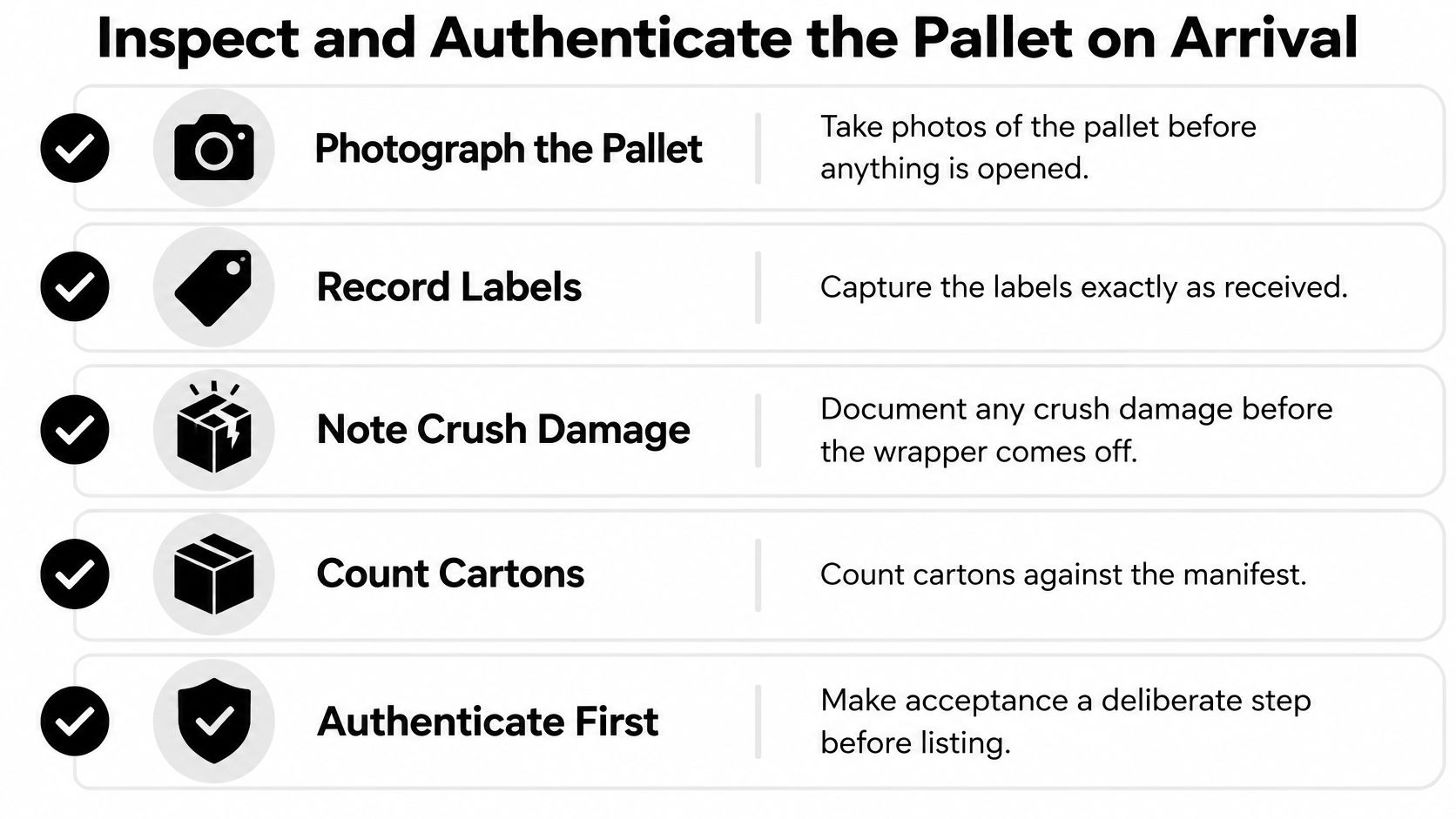
Treat acceptance as a deliberate business decision. Before opening the wrap, photograph the pallet from multiple angles, including the shipping labels and any visible crush damage. Count the cartons against the bill of lading, then sample garments from the top, middle, and bottom layers. An attractive top layer can conceal a very different mix underneath.
Record discrepancies promptly
Keep a simple log of carton counts, missing pieces, incorrect brands, and condition problems. Compare what you find with the manifest and the condition language in the purchase agreement. “New with tags,” “new without tags,” “shelf pull,” “customer return,” and “salvage” are not interchangeable grades; write down what each term meant in the deal.
If you find a shortage or damage beyond what you allowed for in your bid, document it and notify the seller promptly. Send a dated message with photos and specific details rather than a general complaint. Don't list several items and assume you can raise a dispute later: commercial sales rules can make timely notice important, and acceptance may limit your options.
Under Nebraska's UCC §2-513, a buyer generally has a right to inspect goods at a reasonable time and place before payment or acceptance. Inspection costs may be recoverable when nonconforming goods are rejected, but what applies depends on the circumstances and the governing terms. Put inspection, acceptance, and shortage procedures in the contract where possible, and get qualified legal advice if a significant dispute arises.
Authenticate before you list
Ask for the lot's source category, such as returns, overstock, shelf pulls, or customer-used merchandise, and request invoices or other provenance when available. For a questionable branded item, photograph the neck label, care tag, SKU information, stitching, hardware, and packaging. Compare those details with the brand's own product images, and quarantine the item while you check it.
U.S. Customs and Border Protection identifies apparel as a counterfeit-prone category. Its textile enforcement information describes risks including false invoices, incorrect country-of-origin labels, undervaluation, illegal transshipment, and misdescription. CBP trade data recorded 27,115 intellectual-property-rights seizures in one reported year. That enforcement figure isn't a measure of counterfeit rates in liquidation lots, but it shows why an unverified logo shouldn't be treated as harmless inventory.
Keep pieces with blurry logos, inconsistent tags, questionable construction, or brands absent from the manifest out of marketplace drafts and live-sale racks until you can authenticate them. A small number of suspect branded items can create refund, suspension, or trademark problems that outweigh their potential sale proceeds.
Sell only what you can reasonably defend as authentic. Donate or discard what you can't verify, and keep it out of your listings.
Price for Net Profit Not Retail Value
| Worked profit on a small apparel lot | Amount | What it assumes |
|---|---|---|
| Purchase price | $400 | Hammer price on a manifested lot, not a truckload |
| Buyer premium | $40 | 10% of the hammer price |
| Pieces received | 80 | Count from the manifest |
| Unsellable or unsold pieces | 20 | About 25% downside |
| Units actually sold | 60 | Resale channel only |
| Average sale price | $18 | After your own discounts |
| Gross sales | $1,080 | 60 units sold at $18 each |
| Freight | $180 | Domestic LTL, not local pickup |
| Supplies and prep | $50 | Steam, tags, mailers, photos |
| Marketplace and payment fees | $162 | 15% of gross sales |
| Contribution before your pay | $248 | Sales minus price, premium, freight, supplies and fees |
| Prep and listing time | 8 hours | Sort, photo, list, pack |
| Contribution per labor hour | $31 | $248 divided by 8 hours |
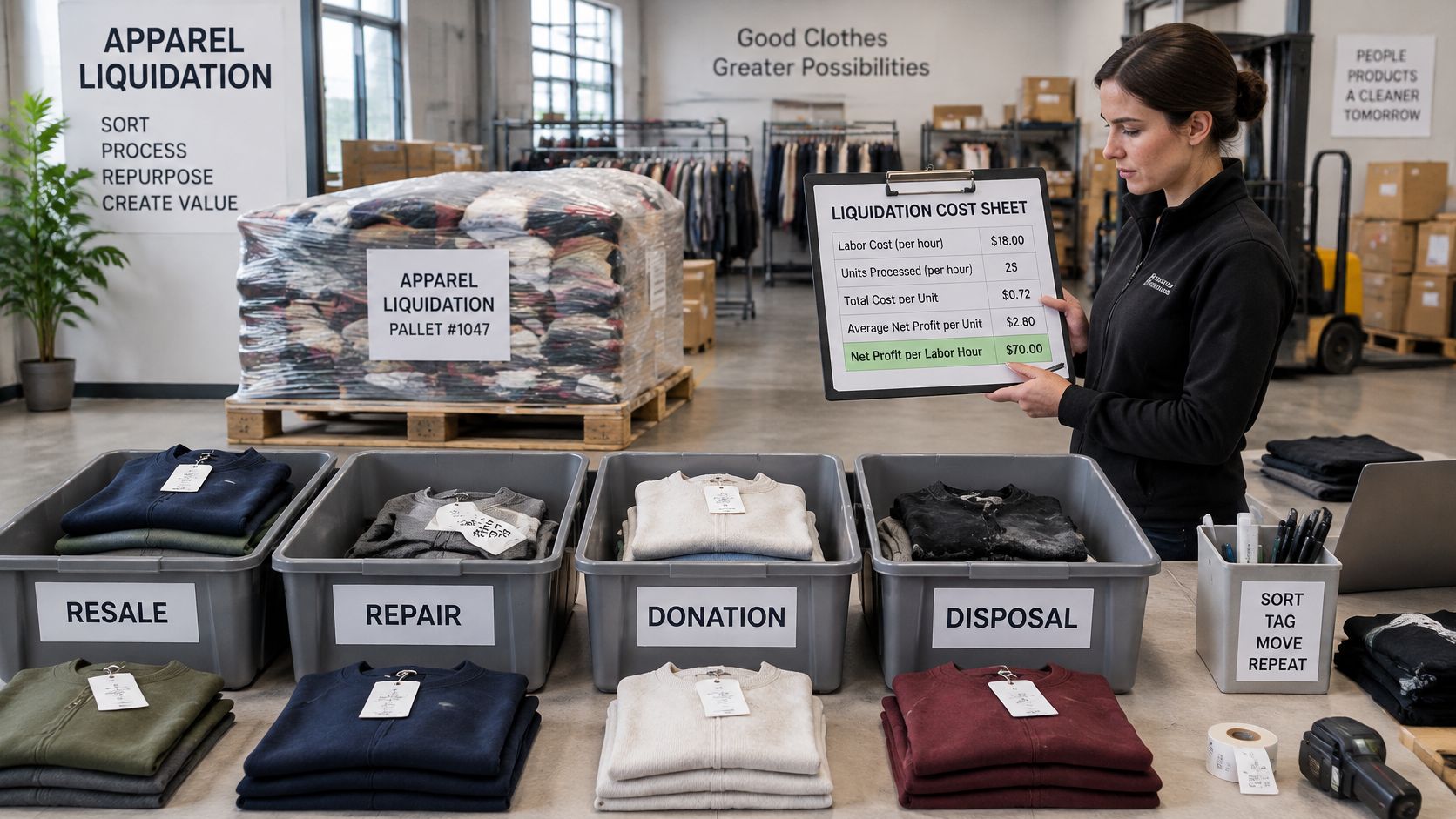
This example shows why cost per piece is a weak decision rule. The hypothetical lot brings in $1,080 from the pieces sold, but the $248 contribution is what remains before paying yourself. At eight hours of preparation and listing work, that's $31 per labor hour before accounting for storage, discounts, returns, or other operating costs.
Your actual prep time includes sorting sizes, steaming, measuring, photographing, writing listings, answering questions, packing orders, and handling returns. Track those tasks rather than treating them as free. A blind pallet that takes twice as long to sort can generate less value for each hour even if its initial per-piece price looks attractive.
Apparel lots also need a disposition plan. Sort units into resale, repair, donation, and disposal groups before you forecast revenue. Estimate sale prices and sell-through conservatively for each channel; don't count a stained or incomplete item as a sale just because it appears on the manifest. Include inbound freight, storage, packaging, payment fees, discounts, returns, and disposal costs in your worksheet.
The GlobalData apparel resale market analysis reported that apparel resale expanded 16.8% in 2024 and was forecast to grow another 13.7% in 2025. More resale activity doesn't make every lot profitable. It makes it more important to buy inventory you can process efficiently and sell to a defined audience.
A curated box can beat a cheaper blind pallet when its mix reduces unlistable pieces or hours spent sorting. Compare both on net contribution per labor hour, using the same assumptions for fees, prep, and unsold inventory. Track results by brand, size, condition, channel, and days to sale. Scale only when actual results, not the manifest's retail value, meet your target.
To see how the finished inventory moves through a sales process, watch the video below.
Resell Through the Right Channel
Choose the sales channel to fit the apparel you've sorted, not the one with the most exciting headline. Marketplace listings on Poshmark or eBay suit items you can photograph clearly, measure accurately, and ship promptly. Fees can take a noticeable share of a small order, so check the actual costs before setting a price. This guide to selling on Poshmark covers the basics of setting up a shop and listing inventory.
A boutique rack works for clean, ready-to-wear pieces local customers can examine and try on. You avoid marketplace fees, but turnover may be slower, and your store still needs to handle merchandising and customer service. A Whatnot live show can move multiple items in one session, but the host must prep the garments, call out sizes accurately, and answer questions in real time.
Set a realistic sales window for each channel. If a piece doesn't move, refresh the listing, try another channel, reduce the price, or donate it before it absorbs more storage and attention. For outbound orders, confirm shipping costs before pricing, weigh packages accurately, and use mailers suited to apparel. Record returns by reason; repeated fit or condition complaints may mean you need better descriptions or a different buying limit next time.
Keep sales and shipping records with the original purchase file. That makes it easier to trace a branded item back to its lot documentation if a buyer, marketplace, or rights holder raises a question.
Choose the category you know, set a cash cap that includes freight, and write down the defect rate you can tolerate before you bid. For curated brand-name apparel liquidation boxes and custom lots designed for budget, preferred brands, and quantity, visit OneTrendyCloset and compare the available options with your sell-through plan.