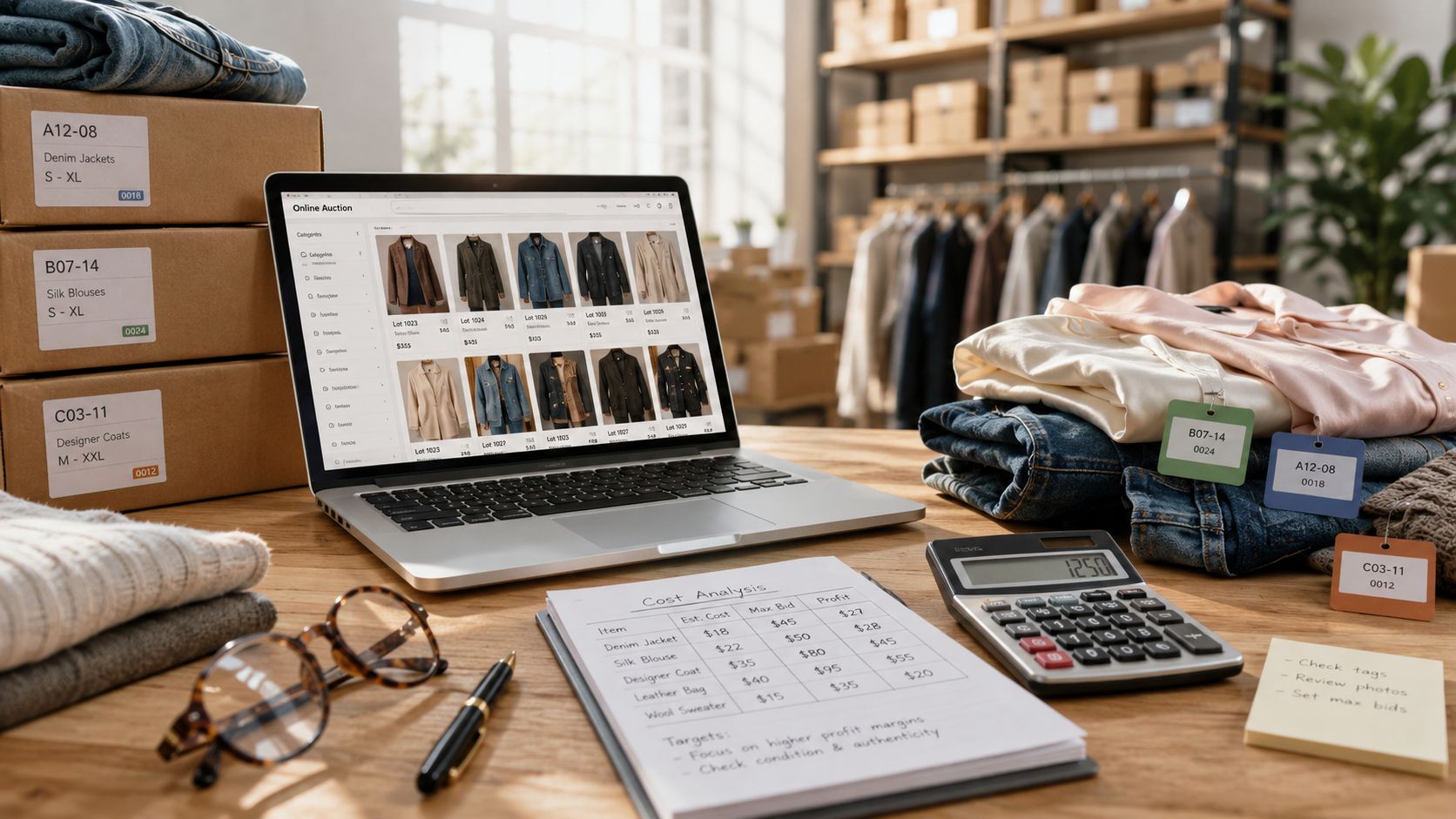
You're staring at three very different choices, and each one changes the business math. One listing might be a single vintage leather jacket, another might be a live stream with fast-moving streetwear bids, and a third might be a manifested apparel pallet that looks cheap until freight, fees, and condition problems show up. The best auctions for clothes depend on lot size, condition tolerance, selling channel, available labor, and shipping requirements.
The practical filter is simple. Before you bid, estimate landed cost, count sellable units, measure prep time, decide the likely sales format, and think through the downside risk if a lot arrives in worse condition than expected. That framework matters whether you're chasing one designer piece or trying to restock a whole storefront.
Live-selling platforms work best when you can host, engage, and move inventory fast. Established auction marketplaces are better for searchable one-off finds and curated drops. Bulk liquidation is the play for resellers who can process mixed lots and absorb some condition risk. Local estate and consignment portals are where vintage, boutique, and pickup-based opportunities tend to surface.
If you want a non-auction wholesale route, OneTrendyCloset fits the same sourcing conversation from a different angle. It offers brand-name apparel liquidation boxes, custom quotes, and mix-and-match brand selection for resellers who'd rather test curated lots than rely on auction volatility.
Table of Contents
- 1. Whatnot
- 2. Poshmark Posh Shows
- 3. TikTok Shop LIVE Auctions
- 4. eBay
- 5. Liquidation.com
- 6. B-Stock Marketplaces Macy's Liquidation Auctions
- 7. Direct Liquidation
- 8. ShopGoodwill.com
- 9. HiBid
- 10. AuctionNinja
- Top 10 Clothing Auction Platforms Comparison
- Turn Auction Finds Into a Repeatable Sourcing System
1. Whatnot
Whatnot works well when your sourcing strategy depends on speed and audience energy. It's a live video auction marketplace where sellers run real-time shows, buyers bid in-app, and clothing moves quickly when the host keeps the room active. For apparel resellers, that makes it a natural fit for volume vintage, streetwear, and boutique closeouts that benefit from live presentation rather than static listings.
The upside is the same thing that makes it hard. Live bidding can push prices up when the room is active, but weak traffic can also leave money on the table if you start too low. The seller has to prep inventory, stage the run of show, and stay on camera long enough to keep buyers engaged. That's labor, not just listing.
Best use case
Whatnot is strongest for sellers who already know how to host consistently and want to convert apparel quickly. It's also useful if you've got a repeatable format, such as themed racks, brand-specific pulls, or size-based bundles. The platform's live-auction format favors impulse bidding, which is useful when the items are visually strong and easy to explain in seconds.
Practical rule: If you can't describe a lot cleanly in one breath and show it clearly on camera, the room probably won't bid it up.
The platform's website is Whatnot, and that direct seller-facing setup is why it's often treated less like a marketplace and more like a selling channel. For sourcing, that means you're not just buying inventory, you're buying something you can perform with later. If your team is small, that hosting requirement is the trade-off.
2. Poshmark Posh Shows
Posh Shows make sense for sellers who want access to a fashion-first buyer base without building a separate live-commerce stack. Poshmark already has a huge apparel audience, so the live and silent show formats plug directly into an ecosystem where buyers are already comfortable with clothing, shoes, and accessories. For closet sellers and small resellers, that familiarity reduces friction.
The strongest operational advantage is shipping simplicity. Bundled shipping for multiple wins in a show keeps post-sale handling much cleaner than stitching together separate orders across several platforms. That matters when you're selling mixed closet inventory or trying to clear many small items without turning packing into a second job.
Where it works and where it doesn't
Posh Shows are a better fit for sellers with frequent apparel inventory than for one-off opportunists. If you're willing to learn the show format and keep up with platform changes, you can use it as a recurring outlet for tested brands, shoes, and seasonal basics. If you want a low-maintenance bidding environment, the show format can feel more demanding than standard listings.
The website is Poshmark Live, and the platform's own education and event support make that obvious. In practice, that support helps hosts ramp faster, but it also means serious sellers need to stay current as features evolve. A Posh Show that's poorly paced or poorly photographed usually underperforms, even if the inventory itself is decent.
A live room on Poshmark rewards clarity. Buyers want to know size, condition, brand, and whether the item is one-off or duplicated.
For sourcing decisions, think in terms of shipment flow rather than single-item margin. If you can group a rack into a themed show and move several pieces in one session, Poshmark becomes more efficient. If the lot needs heavy cleaning, ironing, and individual storytelling, your prep time can eat the advantage.
3. TikTok Shop LIVE Auctions
TikTok Shop's auction format is compelling because it sits inside a discovery engine. If you already make fashion content, Countdown Bidding lets you turn attention into transactions without sending viewers somewhere else. That's useful for sellers who know how to build an audience around styling, fit checks, or trend-driven drops.
The appeal here isn't just the live tool. It's the combination of creator content, product discovery, and commerce inside one app. For apparel, that can lower customer acquisition friction if your content already attracts people interested in outfits, brand names, or live shopping. The catch is that this only works if your production cadence is tight and your catalog is ready to sell.
Operational fit
TikTok Shop rewards sellers who can handle catalog setup, policy compliance, and live presentation without hesitation. If your live streams are disorganized, the platform doesn't forgive that very long. Buyers expect a fast pace, clear item IDs, and confident transitions between lots. That's excellent for a seller who already posts regularly, but it's a hard environment for someone testing live commerce for the first time.
The seller site is TikTok Shop Seller Center, and the platform's structure makes compliance part of the workflow, not an afterthought. That matters because auction rules and payment handling are strict. In return, you get a channel where the content and the sale happen together, which can be a real advantage for fashion sellers with strong visual instincts.
For sourcing, TikTok Shop is best when you know your inventory can create a story. A branded bundle, a trend-based edit, or a clean line of high-rotation basics usually does better than a random pile. If you need a channel that can absorb not only apparel, but personality, this is one of the more powerful options.
4. eBay
eBay is still one of the most practical auction marketplaces for clothing when you need buyer depth and search visibility. It works for single pieces, curated drops, and bulk lots, so you can move a Burberry coat, a run of Levi's jeans, or a mixed accessories box through the same channel. The platform's mature payments and dispute tools matter when returns, shipping issues, or condition complaints show up.
The advantage is flexibility. You can auction one item, list at fixed price, test a niche category, or run inventory through a store-based workflow. For apparel, that matters because not every garment belongs in a live show or a liquidation pallet.
How to evaluate it in real sourcing terms
eBay works best when buyers can search by brand, size, fabric, and style. That makes it useful for testing demand before you commit to larger lots. If a category moves cleanly, it gives you a signal to source more of it. If listings stall, that is a warning before you overbuy the same type of stock.
The website is eBay, and its fashion categories still draw a broad buyer base. The trade-off is competition. Common apparel niches can get crowded fast, and price pressure rises if your photos, titles, and item specifics are weak.
For resellers, eBay often works as a benchmark channel. Compare a live-auction hammer price with what the same item should sell for in a searchable listing. Then add fees, shipping, returns risk, and prep time before you bid. If those costs leave too little margin, the lot does not work. If the inventory is recognizable and easy to list, eBay can still be a dependable sourcing and selling option.
5. Liquidation.com
Liquidation.com is a strong option when your sourcing model depends on repeat bulk buying. Apparel pallets and mixed clothing lots flow through the marketplace regularly, and many listings include condition tiers and manifests that help you estimate recovery before bidding. That matters because the marketplace is built for buyers who are comfortable with as-is inventory and want a steady supply line.
The main advantage is predictability of supply, not predictability of condition. If you source often and know how to sort, clean, photo, and redistribute inventory, a platform like this can support a real restocking rhythm. The manifest is what gives you a fighting chance at calculating whether the lot fits your resale channel.
What to check before bidding
- Manifest quality: Look for enough detail to estimate how many pieces are sellable.
- Condition tier: New, returns, and salvage all imply different prep costs.
- Buyer rules: Payment timing and premium policies can change your true cost quickly.
- Freight fit: Make sure the lot size matches your storage and receiving capacity.
The website is Liquidation.com, and it's especially relevant for sellers who want a broad bulk sourcing stream rather than a one-off deal. OneTrendyCloset also points resellers toward pallet-based sourcing with its pallet guide, which is useful if you're comparing auction pallets against a more curated wholesale route.
The trade-off is simple. If you're good at processing mixed inventory, liquidation can be productive. If your business model depends on pristine condition or very low prep time, as-is pallets can become a labor sink fast.
6. B-Stock Marketplaces Macy's Liquidation Auctions
B-Stock's Macy's marketplace is a better fit when you want direct department-store supply instead of generic liquidation. For apparel buyers, that usually means branded overstock and returns with condition notes attached to the lot. The value here is that the supply is more transparent than a lot of open-market liquidation, which helps when you're trying to plan a resale calendar instead of gambling on whatever shows up.
This is not a casual buyer's platform. Registration and approval matter, and the terms are designed for businesses. That can be inconvenient, but it also filters out some noise. If you're trying to build a repeat sourcing relationship, the extra friction can be worth it.
Why resellers use it
Macy's lots are useful when you need consistent, high-volume apparel inventory and want the confidence that comes from a named retailer source. Manifested listings are the draw because they help you forecast whether the mix fits your store. For a reseller, that means fewer blind bets and fewer surprises during intake.
The marketplace is B-Stock Department Store Liquidation, and the terms are straightforward enough that the operational burden shows up early. Fast payment deadlines and final-sale conditions mean you need cash ready before you bid. If that timing doesn't fit your working capital, the lot can become a problem even when the hammer price looks right.
Bottom line: A lower bid doesn't matter if you can't pay on time, receive quickly, and resell into the right category mix.
OneTrendyCloset's brand-name clothing pallets guide is relevant here if you're comparing department-store liquidation against curated wholesale boxes. The difference is often less about price and more about how much control you want over the mix. If you'd rather reduce guesswork, a curated supplier can be a cleaner starting point than a very large auction lot.
7. Direct Liquidation
Direct Liquidation is useful when you want ongoing auction access with enough variety to keep sourcing flexible. Apparel lots appear regularly alongside other categories, and many listings include manifests that help you estimate what percentage of the lot may be usable for resale. That's valuable for sellers who can handle seasonal variation and mixed-condition stock.
The platform works best for buyers who already know how to evaluate the true landed cost of a lot. A low starting bid doesn't automatically mean a good buy if the buyer's premium, freight, and sort time are heavy. That's especially true with cross-border logistics, since some events are Canada-based and shipping needs to be planned carefully.
A practical sourcing lens
Think of Direct Liquidation as a place to buy opportunity plus uncertainty. The opportunity is that there are recurring apparel auctions with manifests, which makes forecasting easier than pure blind liquidation. The uncertainty is that condition risk still sits on your shoulders once the lot lands.
The site is Direct Liquidation, and it's a solid fit for buyers who need options across lot sizes. OneTrendyCloset's hoodie box guide pairs well with that mindset if you're comparing bulk auction buying against a smaller, more targeted wholesale test.
Use this platform when you can absorb sorting time and have a resale channel that tolerates mixed grades. It's less attractive if your margins depend on near-new condition or if you don't have a process for handling returns and exceptions. In bulk sourcing, the best lot is usually the one that matches your labor, not the one that looks cheapest on the screen.
8. ShopGoodwill.com
ShopGoodwill.com is one of the more interesting places to source clothes if your goal is unique, donated, or vintage apparel. The inventory changes constantly because listings come from many Goodwill locations, and that creates a wide spread of clothing, shoes, and boutique-style finds. For resellers who enjoy the treasure-hunt side of sourcing, that's a real advantage.
The platform also gives you access to lower-buy-in opportunities than many wholesale sites. That can be useful when you want to test a category without committing to a pallet. Because listings are location-based, though, shipping and combined-order policies can vary quite a bit from one store to another.
Where the hidden work shows up
ShopGoodwill is strongest when you're willing to read descriptions carefully and make decisions without expecting standardized manifests. The platform's auctions can surface one-off vintage pieces, branded casualwear, or unusual apparel lots that don't fit a conventional wholesale box. The downside is that the item descriptions can be inconsistent, and condition interpretation may differ by location.
The website is ShopGoodwill.com, and that central account system makes it easier to browse widely while still dealing with store-level shipping rules. The result is a useful middle ground between local estate sales and mass liquidation. You get more variety than a single seller, but less certainty than a fully manifested pallet.
For resellers, ShopGoodwill works best as a scouting platform. You can use it to find categories that convert well in your store, then decide whether to keep buying one-offs or move into larger lots elsewhere. If your business thrives on finding unusual inventory with a story, this is one of the better online auction options.
9. HiBid
HiBid is less a single marketplace than a national auction portal, which makes it valuable for clothing sourcing across local auctioneers. Estate sales, consignment auctions, and online-only local events often list racks of clothing, shoe lots, boutique closeouts, and mixed accessory groups there. That variety makes it useful for resellers who want regional inventory without being locked into one national liquidator.
The strongest advantage is flexibility. Because different auctioneers run their own sales, you can find a broad mix of apparel opportunities and occasionally lower competition than on the biggest marketplaces. The downside is the same decentralization. Every auctioneer sets its own premiums, shipping, pickup, and descriptions, so due diligence becomes part of the job.
What experienced buyers watch for
The smartest buyers on HiBid read the terms before they bid, not after. That means checking pickup windows, shipping availability, and whether the lot is apparel-focused or just mixed into a broader estate sale. A box that looks like a bargain can become inconvenient fast if the pickup window is narrow or the seller's descriptions are vague.
The platform is HiBid, and its national reach is exactly why it's useful for sourcing clothes from local operators. If you're already comfortable evaluating estate lots, it can be a productive place to hunt for regionally curated apparel that never shows up on a wholesale pallet site.
HiBid also fits sellers who want to consign locally. That matters if you have excess apparel and want a route back out without building a full live-show operation. For buyers, it's a good reminder that local auction ecosystems can be both sourcing channels and exit channels, depending on how you use them.
10. AuctionNinja
AuctionNinja is useful for apparel sourcing because it aggregates many local estate-sale and consignment sellers into one account. That makes it easier to browse clothing, shoes, and accessories from different operators without opening a separate account for every estate company. The inventory often feels more curated than mass liquidation, which is exactly why it appeals to boutique-focused resellers.
The lot sizes can be especially practical. You might see individual garments, small grouped lots, or occasional bulk racks and boxes, which gives you more flexibility than a pure pallet marketplace. That makes AuctionNinja a good fit when you want to stay close to the local resale ecosystem but still source online.
Best fit for boutique and vintage sourcing
AuctionNinja is strongest when you're hunting for curated vintage or boutique apparel from estate and consignment sellers. That usually means better uniqueness, but it also means more variation in shipping and fees from seller to seller. Some auctions are pickup only, so your geography matters more than it does on a national liquidation site.
The website is AuctionNinja, and the platform's seller tools make it useful on the consignor side as well. For a reseller, that can matter if you sometimes need to clear your own overflow inventory through a local auctioneer rather than source from one.
If the lot is local pickup only, the bid has to make sense before you factor in your drive, your time, and the chance that the pieces need extra cleaning.
Use AuctionNinja when you want more control than blind liquidation and more variety than a single thrift outlet. It's not the cleanest option for remote bulk buying, but it can be one of the better places to find quality apparel that still leaves room for margin.
Top 10 Clothing Auction Platforms Comparison
| Platform | Core features | Seller experience (★) | Best for (👥) | Unique edge (✨/🏆) | Fees/Cost (💰) |
|---|---|---|---|---|---|
| Whatnot | Live auctions, chat, giveaways, follower tools | ★★★★☆ fast sell‑through | 👥 live‑sale hosts, streetwear, volume apparel | ✨ high engagement; 🏆 rapid turnover | 💰Moderate; commission varies |
| Poshmark Posh Shows | Live/silent shows, bundled shipping, host education | ★★★★☆ stable conversions | 👥 Poshmark closet sellers, boutique resellers | ✨ built‑in bundled shipping & host support | 💰Flat fee model (can be higher) |
| TikTok Shop LIVE (Countdown Bidding) | Native LIVE auctions, discovery + commerce | ★★★★☆ huge reach, production effort | 👥 creators, seller‑creators, discovery‑driven brands | ✨ algorithmic reach; 🏆 low CAC potential | 💰Variable; commission‑based |
| eBay | Auction & fixed listings, analytics, cross‑listing | ★★★★☆ mature tools & trust | 👥 one‑offs, curated drops, wide audience | ✨ enormous buyer base; 🏆 robust payments/dispute tools | 💰Variable by category/store |
| Liquidation.com | Apparel pallets, manifests, condition tiers | ★★★☆☆ steady supply; as‑is risk | 👥 bulk buyers, repeat sourcers | ✨ manifested lots for forecasting | 💰Buyer's premium + fees |
| B‑Stock (Macy's) | Branded pallets, manifests, business verification | ★★★★☆ consistent high volume | 👥 registered B2B resellers, large buyers | ✨ direct retailer supply; 🏆 branded inventory | 💰B2B fees; approval & strict terms |
| Direct Liquidation | Live/timed auctions, manifests, pickup/shipping options | ★★★☆☆ recurring events; condition risk | 👥 seasonal/bulk buyers | ✨ frequent apparel lots with manifests | 💰Variable buyer's premium |
| ShopGoodwill.com | Daily local auctions, category filters, store‑run listings | ★★☆☆☆ unique finds; variable descriptions | 👥 vintage hunters, low‑cost flippers | ✨ steady vintage/unique rotation | 💰Low buy‑in; shipping varies by store |
| HiBid | Nationwide local auction listings, filters, consign options | ★★☆☆☆ variable auctioneer quality | 👥 regional sourcers, estate sale hunters | ✨ local bargains; consign ability | 💰Varies by auctioneer |
| AuctionNinja | Aggregated local estate/consignment auctions, central account | ★★★☆☆ curated estate lots; pickup common | 👥 estate/consignment buyers, boutiques | ✨ centralized access to many local sellers | 💰Variable; seller fees/premiums differ |
Turn Auction Finds Into a Repeatable Sourcing System
The right auctions for clothes depend on how your business runs. Live platforms like Whatnot, Poshmark Posh Shows, and TikTok Shop LIVE auctions fit sellers who can host consistently and keep attention high. eBay works best when you want searchable individual listings, category depth, and a place to test demand before scaling. Liquidation marketplaces, including Liquidation.com, B-Stock, and Direct Liquidation, make more sense when your process can handle manifests, freight, and mixed-condition inventory. Local portals like ShopGoodwill, HiBid, and AuctionNinja are strongest for vintage, boutique, and pickup-based opportunities that reward careful reading and selective bidding.
The pre-bid checklist should stay simple and strict. Check condition, manifest quality, buyer's premium, shipping or pickup, payment deadlines, sellable-unit assumptions, and preparation labor before you raise your hand. A lot that looks cheap can become expensive once you count missing sizes, cleaning time, and freight. A lot that looks messy can still be profitable if the item mix matches your sales channel and you already know how to process it.
Start with one manageable lot instead of chasing every promising listing. That first buy teaches you more about the seller's packing habits, lot quality, and actual prep burden than a dozen product photos ever will. Once you know what type of inventory your team can move cleanly, you can choose the right mix of live auctions, established marketplaces, and bulk liquidation without guessing.
OneTrendyCloset fits as a complementary sourcing route when you want curated brand-name apparel boxes, preferred brand mixes, and custom quotes without relying only on auction uncertainty. That can be especially useful for resellers who want a steadier restocking path while they keep testing auctions for selective wins.
If you want curated brand-name apparel boxes instead of relying only on auction timing and lot risk, visit OneTrendyCloset and compare its custom quotes, brand selection, and box sizes against the auction paths above. It's a practical next step for resellers who want a steadier way to restock while they keep using auctions for clothes as part of a broader sourcing plan.