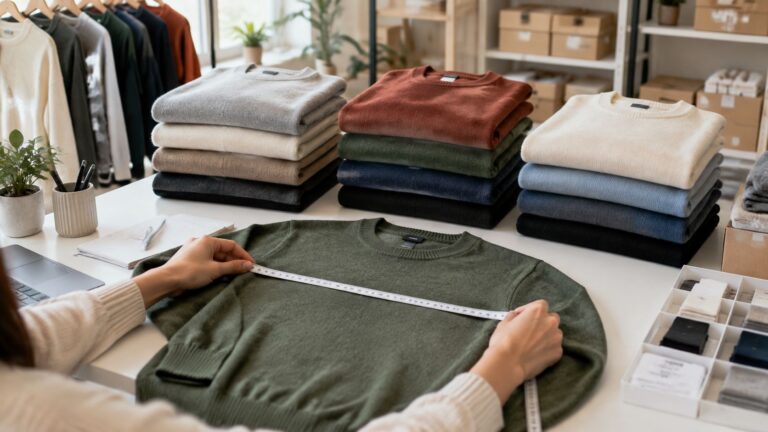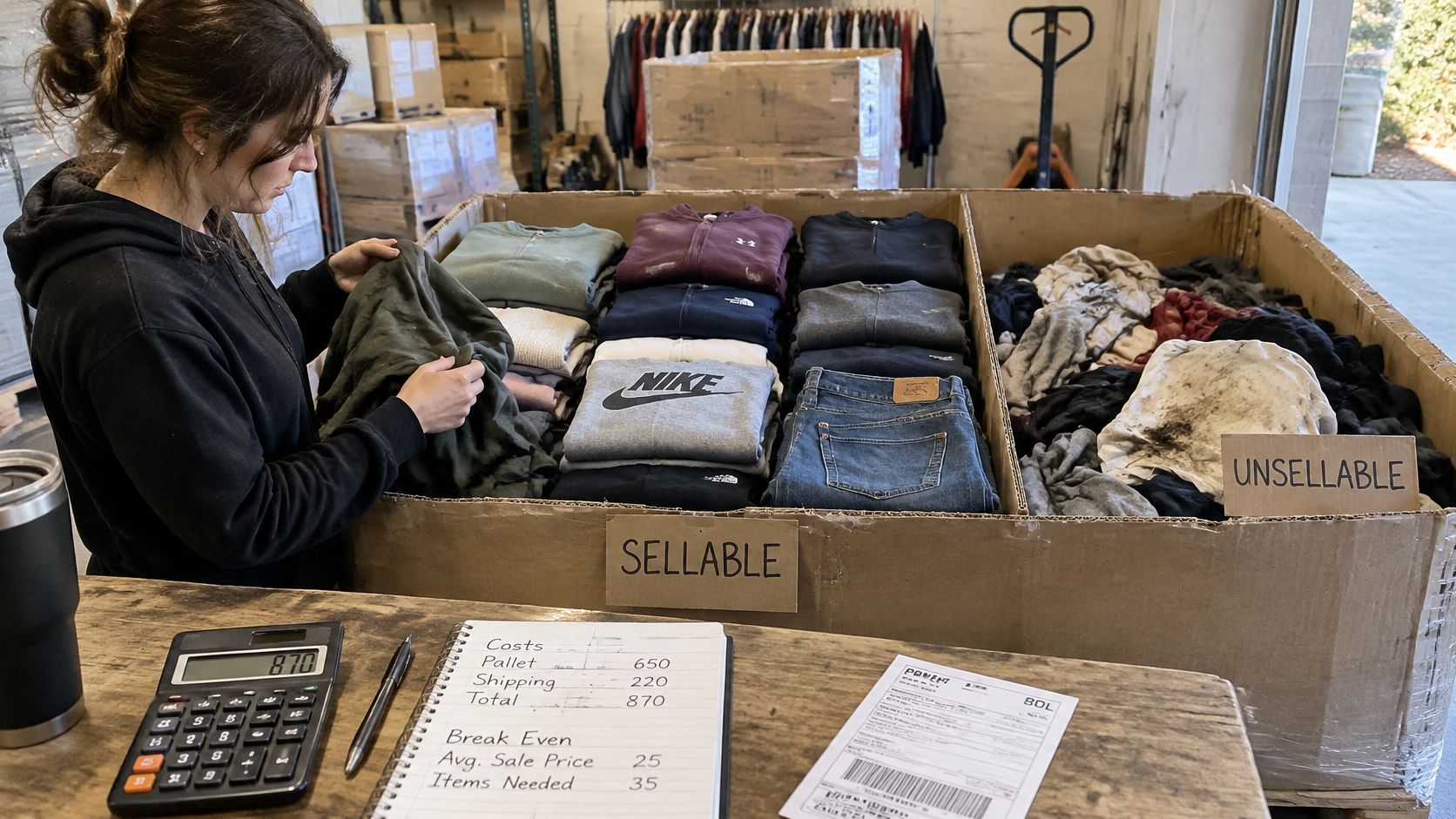
Work out the total landed cost of the lot, divide it by the number of units you can resell, and compare that figure with the net price your channel pays. A $2,000 pallet with $400 of inbound freight and handling carries a $2,400 break-even, so if 70 of its 100 units are saleable, each of those 70 has to clear about $34.29 in net revenue before you've earned a cent.
The most popular advice says a pallet is worth it when the printed retail value runs three or four times the asking price. That's the wrong denominator. Retail value counts the units you'll throw away at the same rate as the units you'll sell, and it ignores what the freight and the labor do to your margin. What decides the purchase is net recovery per saleable unit and how many weeks that stock holds your cash hostage.
The test I use: a lot earns its price on net recovery per sellable unit, never on the discount off MSRP.
The supply behind all of this is enormous, which is why the question keeps coming up. The National Retail Federation projected U.S. retailers would receive about $890 billion in returned merchandise during 2024, equal to an estimated 16.9% of annual retail sales. That explains why liquidation inventory exists at scale. It tells you nothing about whether the box in front of you contains wearable clothes.
Table of Contents
- Break-Even Price Every Liquidation Pallet Must Clear
- How to Grade a Pallet Before You Buy It
- Markdown Math Behind Realistic Recovery
- Hidden Costs and Return Risk Behind a Cheap Pallet
- Sell-Through Speed and Cash Tied Up in Stock
- Who Should Buy Pallets and Who Should Pass
- Test One Box Before You Commit to a Pallet
Break-Even Price Every Liquidation Pallet Must Clear
A liquidation pallet is worth buying when its total landed cost sits clearly below the net revenue you can recover from it. Everything else about the listing, the brand names, the story the seller tells, the sticker discount, is decoration. The calculation itself takes five minutes: add the pallet price to freight, handling, tax and any buyer premium, then divide by the units you can realistically sell.
A pallet here means a bulk lot of returned, overstock or shelf-pulled apparel, sold at a fraction of wholesale as a mixed assortment. Condition varies inside every lot because the returns stream feeding it varies. Apparel and footwear carry unusually high return exposure, and 56% of surveyed brands reported return rates at or above 30%, according to the Radial State of Returns 2025 report. That dispersion is the product you're buying, not a flaw in it.
Take a $2,000 pallet with $400 in freight and handling. Landed cost is $2,400, so your break-even is $2,400, not $2,000. Split the 100 units into saleable, markdown and non-saleable, and the requirement per unit moves sharply:
| Saleable share | Saleable units | Break-even revenue per saleable unit |
|---|---|---|
| 50% | 50 | $48.00 |
| 60% | 60 | $40.00 |
| 70% | 70 | $34.29 |
| 80% | 80 | $30.00 |
| 90% | 90 | $26.67 |
At a 70% saleable share, each of those 70 units must average $34.29 in net revenue to reach zero. Drop to a 50% share and the requirement climbs to $48.00 per unit, which is a different business entirely for a reseller selling mid-market tops at $30.
The exclusions matter more than the rows. None of those figures carry labor, marketplace or payment fees, storage, steaming, photography or packaging, so the break-even sits above every line in the table. If you're still mapping the cost side, this breakdown of what liquidation pallets cost covers the line items that belong in landed cost before you bid. Run your own numbers with your pallet price, your freight quote and a saleable share you've tested, not one you hope for.
How to Grade a Pallet Before You Buy It
A manifest tells you what the seller claims is in the box. Grading tells you what you can sell. Run this routine on the sample before money changes hands.
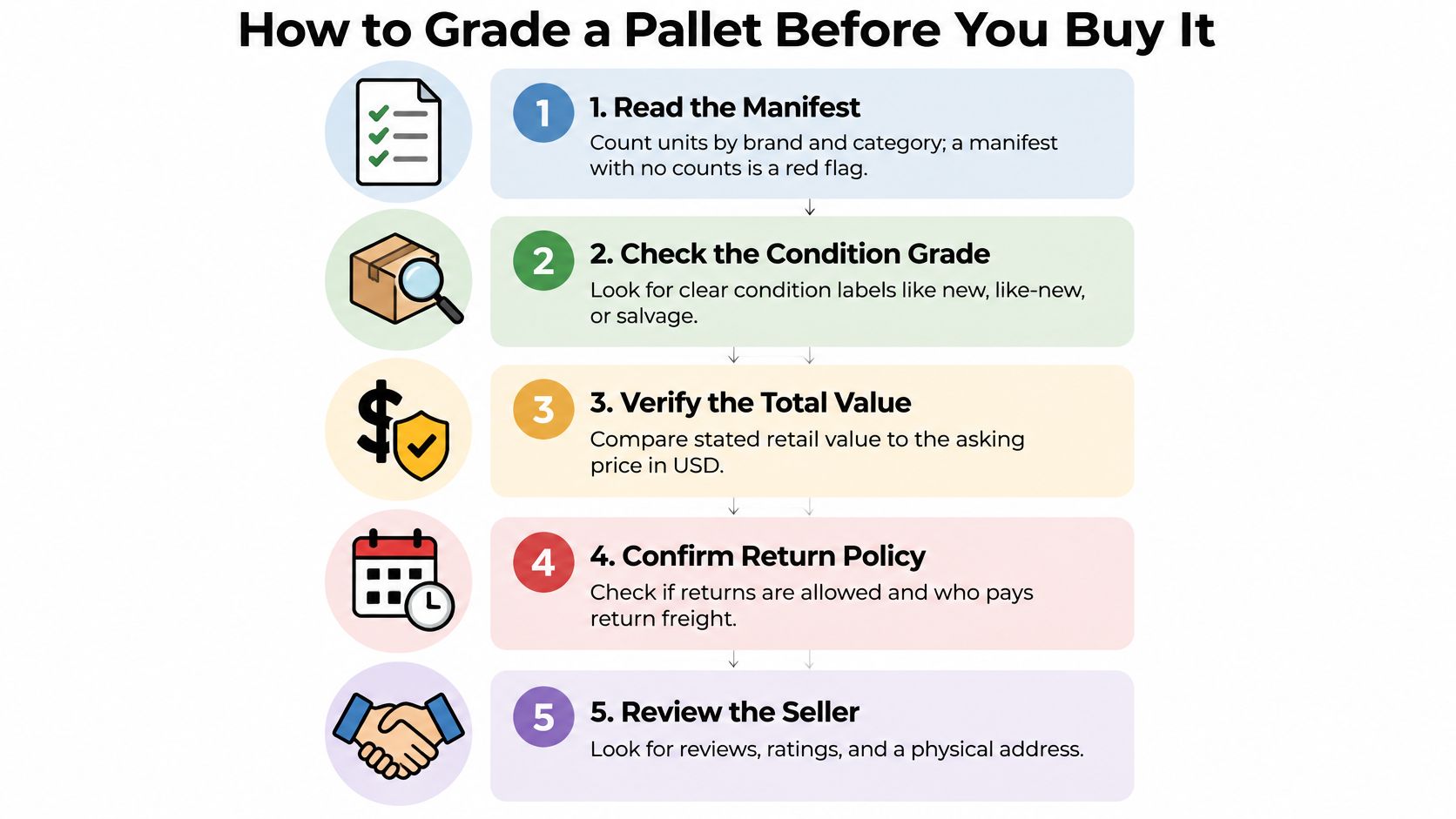
- Read the manifest and count units by brand and category. You can't compute cost per saleable unit without a unit count, and a manifest that lists categories without quantities gives you nothing to divide. The common slip is accepting a "mixed assortment, approximately 100 pieces" line as a count.
- Pull a sample of about 20 items from several layers, not just the top. Sellers load the display layer with the best pieces. Dig down and pull from the sides, where crushed and damp items collect. Sampling only the top is how buyers end up with a bottom layer of stained knitwear.
- Sort every sampled piece into three grades: saleable at full price, markdown or clearance, and non-saleable. This is the same split the break-even math needs, and the proportions you find in the sample are your best estimate for the lot.
- Inspect each piece for stains, odor, missing tags, pilling, seam damage and size-tag mismatch. Run your hand inside seams, check underarms and collars, and smell the garment. A size tag that doesn't match the cut is a strong signal of a mislabeled return.
- Compare the sample mix with the manifest claim. A wide gap between what's promised and what's in the box is not a reason to negotiate harder. It's a reason to lower your offer or pass.
- Price each grade at your own planned selling price, then decide. Buy the full lot, take a smaller box of returned apparel as a test, or walk away. Walking away is a result, not a failure.
The waste data explains why step three is unforgiving. The U.S. Environmental Protection Agency estimated that 17.03 million tons of textiles entered the municipal solid-waste stream in 2018, and only about 2.51 million tons were recycled, per the EPA's textiles material data. A garment that isn't clean, wearable, correctly sized and worth photographing has no resale value and becomes a disposal cost.
Confirm the grade definitions in writing before payment: what "like-new" means, whether accessories and sets arrive complete, and what happens when the lot misses the description. At OneTrendyCloset, if items don't match the grade descriptions or differ significantly from what was promised, we work to make it right when the customer contacts us within 48 hours of delivery. That window is only useful if you inspect on arrival day.
Markdown Math Behind Realistic Recovery
Planned retail value is a forecast, and it fails at three points: some units sell at full price, more sell at a markdown, and a slice never sells at all. Watch what survives on a 100-item lot planned at $40 an item, or $4,000 of planned value.
The shares come from the resale channel itself. A survey cited by Retail Brew found that only 47% of returned items were resold at full price, while 42% were sold at a reduced price with an average markdown of about 38%. Apply that to the lot:
- Full price, 47 units: 47 × $40 = $1,880.
- Markdown, 42 units: roughly 62% of plan, or about $24.80 each, which returns $1,041.60.
- Unsellable, 11 units: $0 in revenue, plus a disposal or donation cost.
Total recovery is $2,921.60, or 73% of the $4,000 plan, and that's before marketplace fees and labor. The 27% gap is the part sellers forget when they compare a pallet price to a manifest total.
Why the Recovery Lands Under Plan
Mixed condition forces price segmentation, and segmentation costs time. Every piece needs a decision, a price tier, a photo set and a storage location. Longer holding periods then add storage cost and fashion-obsolescence risk, so a spring lot graded in March is worth less by June even if nothing about it changes.
Practical rule: price the markdown tier into the purchase, not into the hope that everything sells at full.
The fix is record-keeping rather than forecasting skill. Track realized prices by SKU, condition, brand, size and channel. After forty or fifty sales you'll know your own markdown depth, your own unsellable rate and your own average days to sell, and those records become the benchmark for the next purchase instead of the seller's MSRP sheet.
Hidden Costs and Return Risk Behind a Cheap Pallet
A cheap pallet is expensive inventory. The purchase price is the tip of the iceberg, and the costs below the waterline decide whether the lot makes money.

The invoice doesn't show this:
- Inbound freight and LTL charges: a pallet is heavy, and residential or liftgate delivery adds to the base rate.
- Inspection and cleaning time: every unit gets handled, sorted, spot-cleaned or steamed before it can be photographed.
- Photography and listing hours: multiple shots per item, measurements, a description, and a listing that has to be found by a buyer.
- Marketplace and payment fees: commission plus payment processing on every sale, including the low-priced ones.
- Packaging and shipping supplies: mailers, tissue, tape and labels add up per unit, not per pallet.
- Storage: shelves, bins and floor space that could hold faster-moving stock.
- Customer service: sizing questions, condition complaints and the occasional return you eat to protect a rating.
- Markdown losses and disposal: the units that never sell and the ones that leave in a trash bag.
Return exposure is the other half. About 19.3% of online sales were returned in 2025, compared with 15.8% across all retail sales, according to Shopify's analysis of ecommerce returns. Apparel lots therefore contain customer returns, damaged pieces and incomplete sets, and the seller has usually priced that risk into the pallet rather than absorbed it.
So write the decision rule out in full: expected net profit equals realized sales revenue minus pallet cost, inbound freight, inspection and cleaning labor, marketplace fees, packaging, markdowns, disposal and customer-return losses. If the result is thin at your conservative recovery rate, the pallet isn't cheap. It's just cheap-looking.
The question to put to every seller isn't about MSRP. It's this: what percentage of units will be sellable through my channel, at which condition grade, and after how many labor hours?
Sell-Through Speed and Cash Tied Up in Stock
Resale demand is expanding, and that growth doesn't answer the question that decides your month: can you convert this lot into cash before the season turns? McKinsey's State of Fashion 2025 report projects secondhand apparel to represent 10% of the global apparel market in 2025 and reach $350 billion by 2028 at a 12% compound annual rate, and Deloitte projects the broader resale market at $73 billion by 2028. More buyers, yes. Also more sellers bidding on the same lots.
Storage punishes slow stock. Warehousing costs rose 10% in 2023 while brands pushed harder on inventory turnover, which means a pallet that sits for 90 days loses the margin the discount was supposed to create. A great buy with a bad sell-through rate is a bad buy.
Track three things on the first test lot, and keep tracking them:
- Sell-through at 30, 60 and 90 days: the share of units sold and the revenue they produced by each checkpoint.
- Contribution margin per labor hour: revenue minus all variable costs, divided by hours spent sorting, photographing, listing and packing.
- Cash locked in slow sizes and seasonal styles: the dollar value sitting in odd sizes and out-of-season pieces, because that money isn't available for the next lot.
Then separate branded demand from channel demand. A recognizable label doesn't guarantee sales on every marketplace, and a brand that moves fast in a live show can stall as a fixed-price listing. If your channel is fixed-price, selling clothes on eBay rewards a rhythm of steady new listings rather than a single dump, and the listing cadence you can sustain sets the pallet size you can justify.
That's the difference between a boutique with loyal local customers and a weekly live-show slot, and a new reseller who has to photograph, measure, list, store and eventually discount hundreds of units. The first can absorb variance. The second gets buried by it.
Who Should Buy Pallets and Who Should Pass
The honest answer to whether liquidation pallets are worth it depends on what you already have running. Pallet fit is a function of your channel, your storage and the hours you can put in, not of the pallet's contents.
| Seller type | Pallet fit | Main risk | What would change the verdict |
|---|---|---|---|
| Established boutique with steady local customers | Strong fit for mixed lots | Storage space and styling time | Slow sell-through in seasonal sizes |
| Marketplace seller on Poshmark, eBay or Mercari | Good fit with photography capacity | Listing labor per unit | Weak sales for the brands in the lot |
| Live-sale host on Whatnot | Fit when a regular show schedule exists | Sell-through must match show frequency | Too few hosting slots to move the stock |
| New reseller with no sales channel yet | Poor fit for a first purchase | Stock sits unsold and cash is tied up | A proven channel and a small test lot |
The cases that flip are usually about capacity rather than money. A boutique with a loyal customer profile and a low storage cost can carry a mixed lot and style it into the floor, so a lot that looks messy to a marketplace seller looks like good content to them. A marketplace seller with a clean photography workflow can make a mid-grade lot perform, but the same lot will sink someone who shoots on a phone in poor light and lists once a week.
For a live-sale host, the constraint is calendar. If you host one show a month, a 500-unit lot becomes a storage problem by week six. If you host twice a week with a returning audience, that same lot is inventory for four shows.
The one-line rule: buy only when you already have a channel that sells the brands in the lot, at a pace that fits your cash.
Pass when you have no photography or listing capacity, no dry storage, no proven route for clearance pieces, or a manifest that won't describe condition. Those are capacity problems, and no discount fixes them.
Test One Box Before You Commit to a Pallet
Test the math with real buyers before you test your nerve with a full pallet. The staged approach costs less than a badly chosen lot and produces numbers you can plan around.
- Set a maximum spend you can lose without hurting cash flow. Treat it as a research budget, not a bet you expect to double.
- Start at box size, not pallet size. A prebuilt liquidation box is a smaller commitment than a full pallet and it lets you see the actual condition mix that arrives from a supplier.
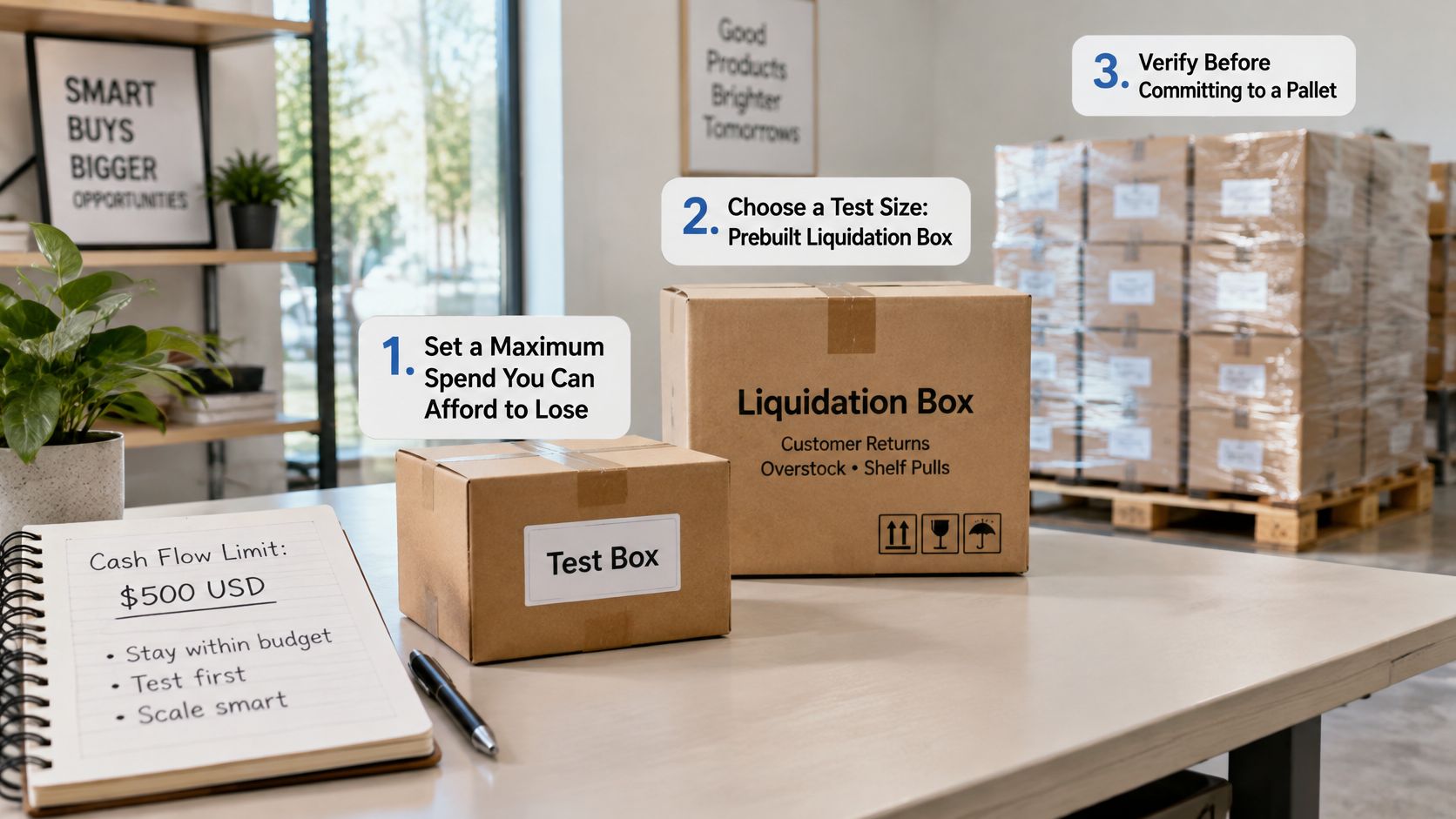
- Log every sale. Record realized price, days to sell, returns and labor minutes per unit, sorted by brand and condition. This log is the only forecast worth trusting.
- Compare against your break-even per saleable unit at 30, 60 and 90 days. If the log shows you clearing $28 a unit where the math needs $34.29, the lot was never viable and you found out cheaply.
- Scale only when contribution margin stays positive after every variable cost. Then move up in size, and only then.
Our prebuilt boxes come in sizes of 50, 100, 150, 200, 500, 750 and 1,000 items, and larger quantities typically receive better per-item pricing, so the economics improve as your sell-through data improves. If your customer base needs a specific brand mix, budget or quantity, tell us your budget and the brands you want and we'll tailor a box or pallet for you through a custom quote.
The video below walks through the buying sequence from a reseller's perspective.
The best pallet is the one whose numbers you've already checked. Start smaller than you want to, log the results, and let the log decide the next purchase.
OneTrendyCloset has been supplying wholesale brand-name apparel in liquidation boxes to boutiques, marketplace sellers and live-sale hosts since 2013, with curated lots you can size to a budget you've already tested. If your break-even math points to a 100-item test box rather than a full pallet, that's the right place to start, and we'll help you plan the next step once the numbers come in. Visit OneTrendyCloset to see box sizes and request a quote for your brand mix.