In an auction, the seller sets a starting price, buyers bid higher against each other, and the highest valid bid when the auction closes wins the item at that price. The winning bid, though, is only the first line on the bill.
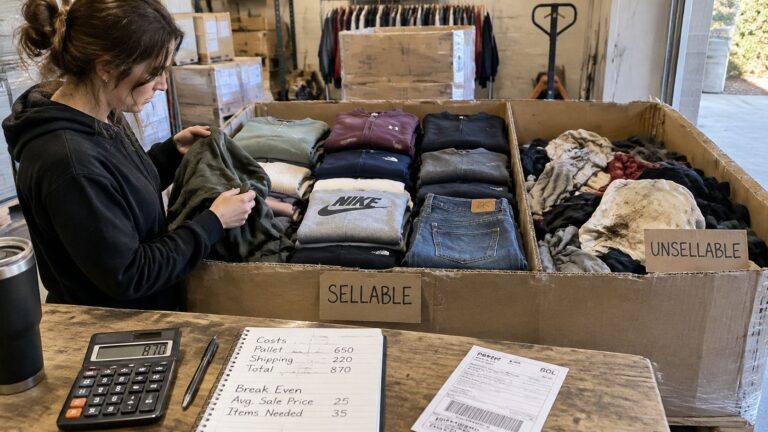
You've probably been in the moment. A mixed lot of 40 women's tops opens at $20, and within four minutes the price sits at $60 with the countdown running. Your thumb hovers. What gets you through that moment isn't a feel for the crowd. It's a number you wrote down before the auction started, one that already accounts for shipping, the buyer premium and the units in that box you'll never move.
Most answers to the question of how does bidding work stop at the mechanics of winning. The version that protects your money keeps going, into what the win costs once every fee is paid.
Table of Contents
- How a Bid Becomes a Purchase
- Setting Your Budget and Maximum Price
- Manual Bidding Versus Proxy Bidding
- How Auction Timing Changes Your Bid
- What Happens If Your Bid Wins
- Avoiding Overpaying With a Stop Rule
How a Bid Becomes a Purchase
Say you're watching that box of mixed tops. The seller opens it at $20. One bidder takes it to $24, another jumps straight to $35, and the final thirty seconds push it to $60. Nobody set that price in advance. The final number is what happens when several people who each want the same lot negotiate with their bids instead of their words.
That is the whole idea behind price discovery. A fixed wholesale list tells you what a supplier wants. An auction tells you what a room full of resellers will pay on a given Tuesday, which is a different number and often a more honest one.
Here's the sequence every auction follows, and what you should be doing at each stage.
| Stage | What Happens | What You Do |
|---|---|---|
| Listing opens | Seller posts an item or lot with a starting price | Read the description and condition grade |
| Bidding | Buyers submit higher bids against each other | Bid only up to your calculated maximum |
| Closing | Auction ends at the set time or when the host closes the item | Watch for the final bid and any extension |
| Award | Highest valid bidder wins the item at its final price | Confirm the win and prepare to pay |
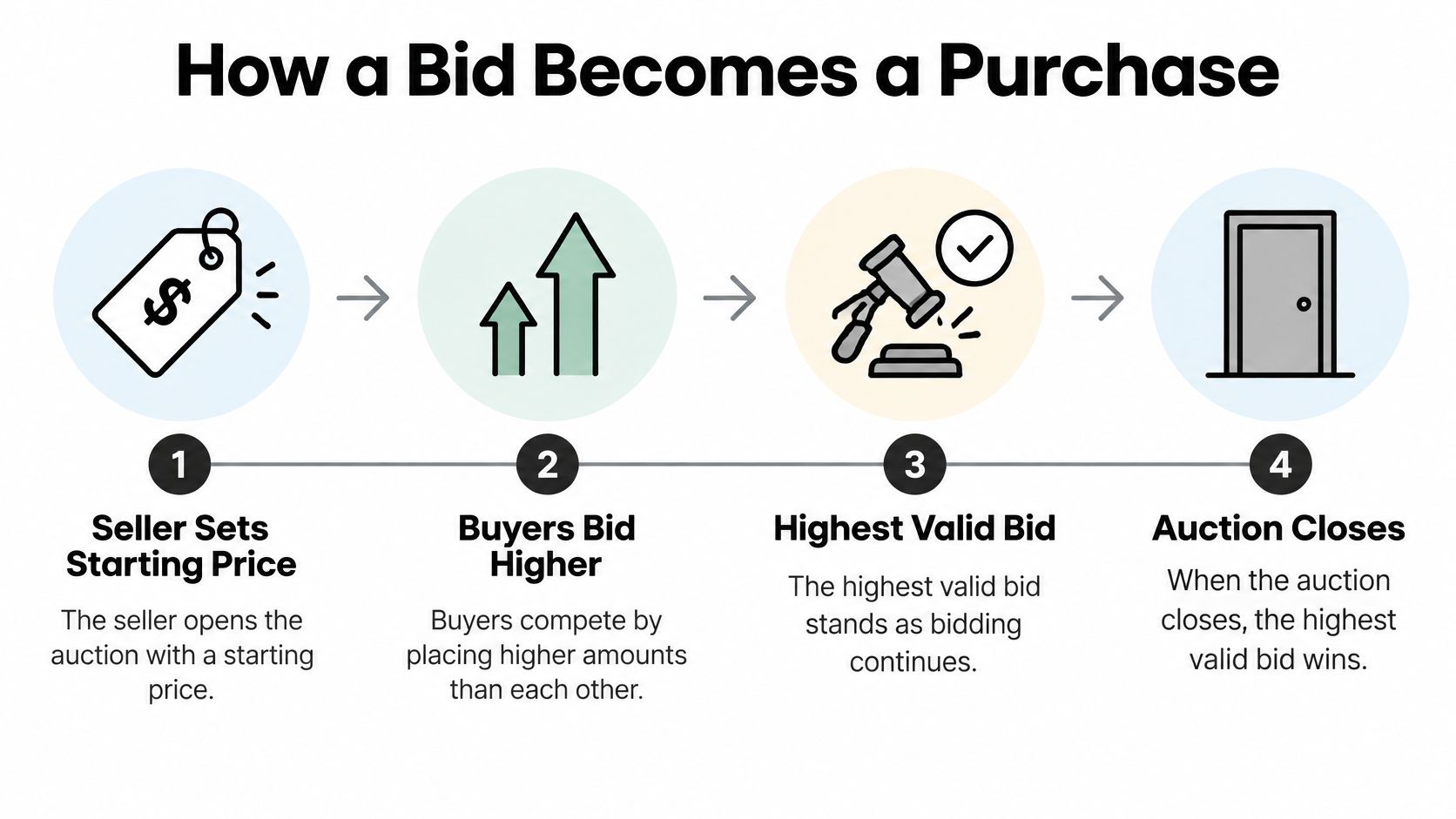
The stage beginners underweight is the first one. Reading the condition grade, the size range and the brand mix before a single bid goes in is where most of your margin is decided. A lot described as "assorted tops, good condition" and one described as "40 pieces, Grade A, sizes S to L" can look identical in a thumbnail and behave nothing alike when you resell them.
A bid is not a bookmark. It's an order you've already placed, conditional only on whether someone else outbids you.
Where your attention matters most is uneven. Spend your time before the listing opens and in the final few minutes. The middle of the auction is mostly noise.
Setting Your Budget and Maximum Price
Two different numbers live in your head when you bid. The first is the cash you have available. The second is the most you can pay for a specific lot and still make money. Only the second one belongs in the bidding window.
The eBay bidding help page lays out the format plainly: the seller names a starting price, buyers bid against one another, and the item goes to the highest valid bidder when the auction closes. The same page carries a line beginners skim. Placing a bid means agreeing to purchase the item if you win.
Building the Landed Cost Line by Line
Your winning bid is the headline. It is never the invoice. Between the hammer price and the boxes on your shelf sit the buyer premium, shipping, sales tax where it applies, payment or platform fees, and the dull reality that some units in any mixed lot will be unsellable.
| Cost Component | Amount |
|---|---|
| Winning bid | $500 |
| Buyer premium at 10% (illustrative) | $50 |
| Shipping | $40 |
| Sales tax | Charged at your location's rate, so add a line for it |
| Total landed cost | $590 before tax |
That gap between bid and invoice is not an accident. Platform service and transaction fees add a cost on top of every winning bid, and they are how most auction sites make their money. Check each platform's fee schedule before you bid, because a fee you discover after winning still gets paid.
Working Backward From Resale Value
Start with what the lot will sell for, not what it costs. Estimate the resale total from comparable sold listings, subtract your selling fees, the freight, a defect allowance for the pieces you will donate, and your target margin. What remains is your ceiling.
Say the comparable sales point to $900 in resale revenue. Subtract $120 in marketplace fees, $90 in outbound shipping, $80 for damaged or unsellable pieces, and a $150 margin target, and your ceiling lands at $460. Bid $500 and you have already lost money, even though you won the lot.
If you are still calibrating how much inventory should cost per unit before you can set that ceiling, our guide to what liquidation pallets cost breaks down the usual price ranges by category.
Write the ceiling down in dollars before the auction opens. Size your cash on hand to cover the landed cost, not the bid, so a win never leaves you short on the shipping bill.
Manual Bidding Versus Proxy Bidding
Two bidding styles cover nearly every platform you'll touch. Manual bidding is what happens in a live sale: you raise your hand or type each new amount yourself. Proxy bidding works like handing the auctioneer a sealed note with your highest acceptable number. You enter that maximum once, and the platform bids for you.

The eBay automatic bidding guidance describes the mechanics: the system bids in increments for you, but only up to your preset limit. Set a maximum of $80 while the current bid sits at $45, and your displayed price climbs only as far above $45 as the platform's increment requires. If nobody goes higher, you pay the final required amount rather than the $80. That figure stays invisible to other bidders the whole time.
Where Proxy Bidding Gets Misread
Beginners assume that entering a high maximum means paying that maximum. It doesn't, as long as the lot closes lower. The reverse assumption does real damage: a maximum is binding if it wins, so a number you'd regret paying is a number you shouldn't type.
Auctions also change how buyers feel about value. A visible competitor and a ticking clock can make the same goods seem worth more than a plain price tag would, which is why your maximum should come from the landed-cost ceiling you calculated before the auction opened, not from how the lot looks in the moment. The winning bid is only part of that ceiling. The premium, freight, and defect allowance attached to it are already counted inside the number, so what you type is the full amount you can afford to spend.
That gap between feeling and math is where overpayment happens.
| Feature | Manual Bidding | Proxy Bidding |
|---|---|---|
| How you bid | Enter each new amount yourself | Enter one private maximum once |
| What others see | Your current bid as you place it | Only the price the system raises to |
| Risk of overbidding | High during fast or emotional moments | Lower, because the ceiling is set first |
| Best for | Live sales where you react to the host | Online auctions with a fixed end time |
| Commitment | Each bid is binding | Your maximum is binding if it wins |
The difference between the two styles is when the decision gets made. Manual bidding puts it inside the auction, where each new amount is chosen under time pressure. Proxy bidding moves it earlier, to a calm moment before the first bid, when the ceiling you wrote down still controls the number.
Two platform rules make more sense once you know them. Bid increments are the minimum step a new bid must clear above the current price, set by the platform, so an amount below the step gets rejected outright. Reserve prices are a hidden seller minimum the final bid has to meet before the item is awarded, which is why a lot can close with "reserve not met" and sell to nobody.
Practical rule: Enter your proxy maximum once per lot, straight from the ceiling you calculated, and don't return to raise it mid-auction.
How Auction Timing Changes Your Bid
The same lot can close at noticeably different prices on different days. The closing format and the number of bidders active at that moment explain much of the difference, which is why your ceiling needs to come from the full landed cost before the auction starts, while the decision is still calm.
| Format | How It Ends | Timing Risk |
|---|---|---|
| Timed online auction | Fixed end time, highest bid at that moment wins | Last-second bids you cannot answer |
| Soft-close auction | End time extends when a bid lands in the final minutes | Bidding wars can run longer than planned |
| Live-stream auction | Host closes each item when the countdown ends or the host calls it | Fast pace and emotional bids on the host's cue |
Timing has shifted to the phone. Industry research on the auction market estimates that more than 72% of auction transactions were processed online in 2025, mobile bidding exceeded 58% globally, and livestream bidding events increased 32%. That means the reseller bidding from a couch is facing other buyers doing the same thing, often with only seconds to decide. Wider reach brings more competition for the lot you want, and speed makes it easier to mistake activity for value.
Treat each format as a different test of the same limit. In a timed auction, the danger is a final bid you cannot answer, so check the close time in your own time zone and place your proxy maximum at least an hour before the end. In a soft-close auction, assume an extension and give yourself a hard stop time as well as a price ceiling. In a live-stream sale, read each competing bid as demand information, then let your pre-set number decide when you are done. If you are newer to the format itself, this overview of auctions for clothes explains how apparel lots are typically structured and closed.
What Happens If Your Bid Wins
Winning starts a sequence. Treat it as a checklist rather than a surprise, and the whole thing takes about ten minutes of admin.
Take a shopper who wins a $500 mixed lot. The steps run in order.
- Confirm the win. Check your account or the host's message. The recorded auction result is what binds you, so screenshot it while the page is still live.
- Review the invoice total. Compare the number on the invoice, including premium, shipping and tax, against the landed-cost ceiling you wrote down. If they diverge, find out why before paying.
- Pay by the deadline. Unpaid wins can lead to cancellation, relisting or account restrictions, and losing buying privileges on a platform you rely on costs more than the lot did.
- Inspect against the listing inside the window. Count the pieces, check the size range and spot-check the grade. Claims usually have to be made quickly, and "I opened it three weeks later" is not a defense.
- Report mismatches fast, with photos and the order number. A clear photo of a stained item next to the listing's condition grade resolves more disputes than a paragraph of complaint.
- Track the shipment and plan the resale. The clock on your margin starts when the boxes land, so have the listing photos and pricing ready before delivery day.
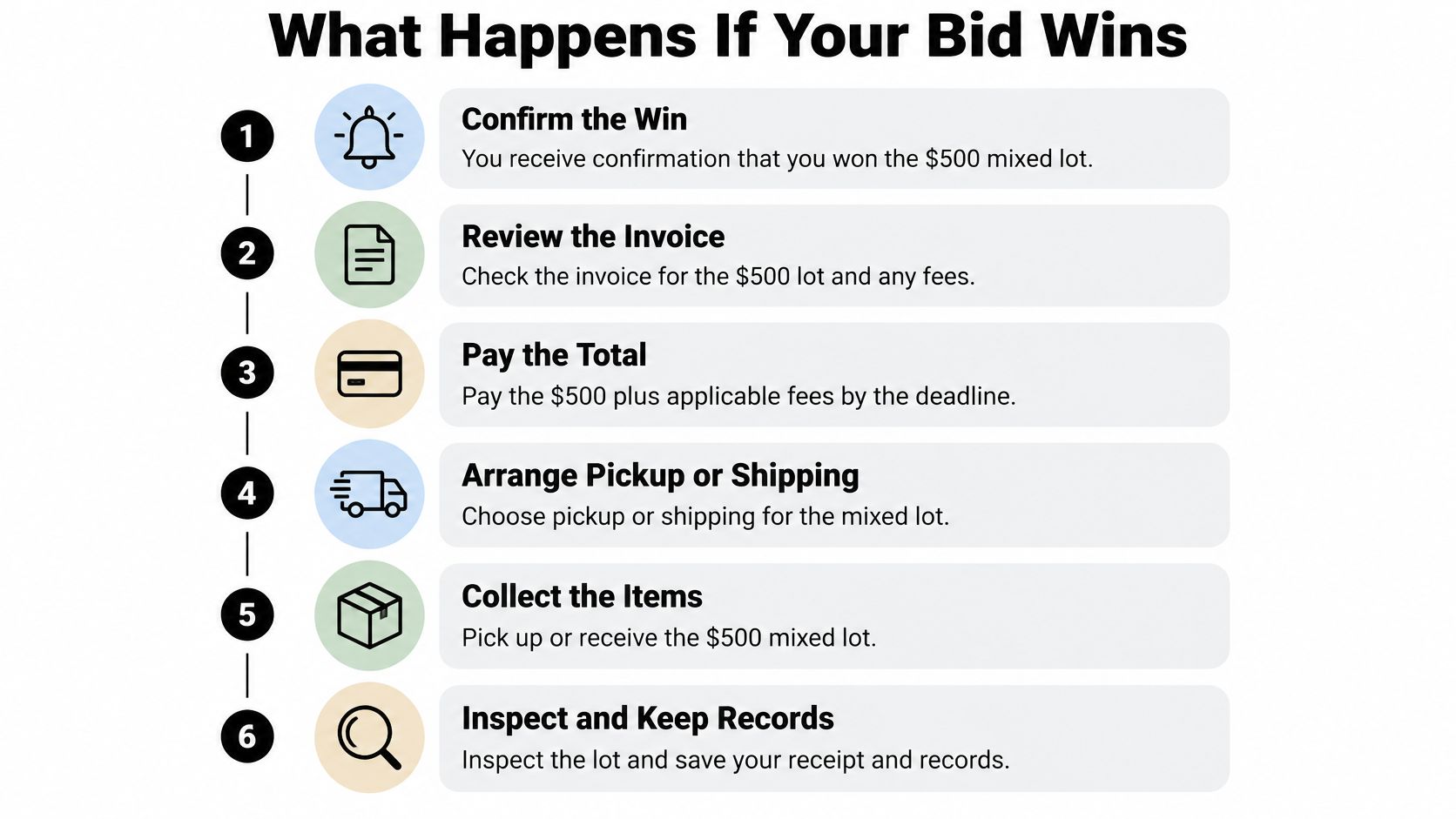
A clean win looks boring. The items arrive, the counts match the listing, the invoice was paid on time and the total landed cost came in under the ceiling you set before the auction opened.
Avoiding Overpaying With a Stop Rule
The most expensive habit in auction buying is bidding past your ceiling in a live sale. Competition is loud, the host is counting down, and the difference between $90 and $110 feels small in the moment. It isn't small. It's your entire margin on the lot.
The Mistakes That Cost the Most
- Ignoring the buyer premium and shipping when comparing lots. Calculate the landed cost for each lot, not the bid, before you rank them.
- Reading the lowest opening price as a bargain. Compare total cost per sellable unit instead, which is the only figure that matters after the unsellable pieces are pulled.
- Valuing inventory from wholesale price. Value it from comparable sold listings, because what you paid has no bearing on what a buyer will pay. If you're still deciding whether the lot math works at all, our breakdown of whether liquidation pallets are worth it runs the numbers.
- Bidding without verified brand, size or grade data. Check the lot list before the countdown starts, and skip the lot if the data isn't there.
- Guessing at shipping weight. Estimate it before you bid. Apparel lots get heavy, and freight on a dense box can undo a thin margin.
- Overlooking duplicates and dead stock. Deduct a defect allowance per lot rather than hoping this one is clean.
Here's the contrarian part. The highest bid is not automatically the worst deal, and the cheapest lot is not automatically the best. Say two mixed lots cross your screen. One closes at $620 with 90 documented pieces, clear grades and a shipping quote you can verify. The other closes at $480 with an unknown brand mix, an estimated piece count and no weight listed. On paper the second looks like the better buy. After the missing pieces, the freight surprise and the donation pile, the first one can easily return more on the money you tied up.
The stop rule: your ceiling is a decision you already made. The countdown is not new information.
That's why the ceiling has to exist before the auction, in writing. A stop rule you invent during the final thirty seconds isn't a rule, it's an emotional read dressed up as one.
The Stop Rule You Can Copy
- Calculate expected resale value from comparable sold items, not from list prices for new goods.
- Subtract selling fees, freight, a tax allowance, a defect allowance and your target margin.
- Convert what remains into a single maximum bid in dollars.
- Enter that figure as a proxy bid, or write it on paper for a live sale.
- Set alerts for the closing time and any extension.
- Stop when the ceiling is reached, even with the countdown still running.
- Record the result against your expected return so the next ceiling is built on real numbers.
Before you enter any auction room, you need three things ready: a sized budget that covers landed cost, a written ceiling per lot, and a verified lot list with brands, sizes and grades. Miss any one of them and you're bidding on hope.
Bidding gets much easier when you already know your number per unit. OneTrendyCloset has supplied brand-name apparel liquidation boxes to boutiques, marketplace sellers and live-sale hosts since 2013, and every order begins with a quote request so you can see your cost before you commit, with items packed as Grade A (new or like-new) or Grade B (minimal wear, still sellable). Tell us your budget, preferred brands and quantity, and head to OneTrendyCloset to request a quote and set a landed-cost ceiling you can bid against with a clear head.