Two of every five apparel items consumers purchased during the previous year were secondhand, according to ThredUp's 2024 Resale Report. That makes resale a meaningful sourcing opportunity, but consumer demand doesn't make every liquidation box a good buy. Learning how to buy clothes in bulk for resale starts with judging cost per sellable item and time to list, not the supplier's cheapest price per piece.
A bargain lot can tie up your cash in repairs, awkward sizes, and garments you never photograph. Buy inventory your customers want, in a condition your operation can process, at a total cost your selling prices can support.
Table of Contents
- Choose a Lot Type That Matches Your Channel
- Vet Suppliers and Negotiate Price Before You Pay
- How to Buy a Test Lot Step by Step
- Inspect Every Carton Before You Accept It
- Calculate Landed Cost and Sell-Through Targets
- Decide Whether to Scale and Prep Your Inventory
Choose a Lot Type That Matches Your Channel
| Lot type | Typical condition | Prep effort | Best channel |
|---|---|---|---|
| Secondhand graded bales | Mixed; sorted into Grades A to C under supplier-defined standards | High: sort, clean, repair | Bulk marketplace and thrift-style resale |
| NWT overstock or shelf pulls | New with tags; check for handling damage | Low: check tags and defects | Boutiques and marketplace listings |
| NWOT returns or samples | New without tags or described as like new; verify actual wear | Medium: photograph and verify | Marketplace and live sales |
| Curated mixed-brand box | Grade A or mixed, with requested brands and categories subject to availability | Low to medium: sizing and photos | Marketplace, live sales and boutiques |
Condition labels aren't interchangeable. NWT means new with tags, while NWOT means new without tags. Neither a returns designation nor a sample designation proves a garment is unworn, so match your listing description to the item you receive.
Match preparation to the selling format
Marketplace sellers on Poshmark, eBay, and Mercari need clear sizes, readable labels, and pieces worth photographing individually. A desirable jacket can justify measurements and detailed photos; a low-value basic with a stain may not justify the same work.
Live-sale hosts on Whatnot can use variety to build an engaging assortment. Still, you need sizes and conditions organized before going live, otherwise you're spending selling time searching through cartons.
Boutiques usually need retail-ready stock that fits their assortment. NWT overstock can reduce preparation, but an assortment of unrelated sizes and seasons can still leave gaps on the sales floor.
Buying rule: Choose the lot your operation can process, not the lot with the most impressive brand list.
OneTrendyCloset sells wholesale brand-name liquidation boxes for boutiques, online sellers, and resellers. Our wholesale clothing boxes guide can help you compare the format with your selling needs.
You can specify men's, women's, or kids items, seasonal preferences, categories, and size ranges, with requests accommodated according to available inventory. Brands include Nike, Adidas, Calvin Klein, Levi's, and others, but availability changes.
Before ordering, choose your main channel and lot type. Then estimate the preparation time you can spare for a test box, including cleaning, measuring, photography, and listing.
Vet Suppliers and Negotiate Price Before You Pay
Vet the merchandise before negotiating the discount. Request a recent sample manifest, representative photos, references from buyers of the same lot type, and written returns and shortage terms. Establish whether the goods are overstock, shelf pulls, customer returns, or used apparel.
A supplier's claimed retail value isn't evidence of your resale proceeds. Walk away when a seller won't show representative inventory or explain how the stated condition grade was determined.
The 2025 ThredUp Resale Report found that 59% of younger consumers said personalization, better search, and improved discovery make secondhand shopping as easy as buying new. For a buyer, the practical implication is to request identifiable, searchable inventory, not just recognizable logos.
Get the price and shipping terms in writing
Our larger quantities typically receive better per-item pricing, and repeat customers receive volume discounts that improve as they order more over time. That doesn't justify skipping a test purchase: a discount on unsuitable stock still leaves you with unsuitable stock.
Our prices can change without notice, so get the final amount in writing before payment. Use the wholesale clothing supplier evaluation guide to structure your comparison around merchandise, terms, and operational fit.
| Order size | Fulfillment time | Freight note |
|---|---|---|
| 50-200 items | 5-7 business days | Standard shipping |
| 500 items | 7-10 business days | LTL freight available; standard shipping often free |
| 1,000+ items | 10-14 business days | LTL freight available; standard shipping often free |
| Custom orders | 2-3 weeks | Quote-based boxes and pallets |
These are fulfillment windows, not guaranteed arrival dates. Add carrier transit time and your own receiving and preparation schedule before promising a restock.
Risk of loss and title pass to you when merchandise ships from our facility. Photograph cartons or pallets at pickup and delivery, and note visible carrier damage on delivery paperwork; local pickup is available where offered.
Compare quotes using expected sellable quantity and preparation workload. Send your budget, preferred brands, quantity, and destination so the quote reflects the order you are prepared to receive.
How to Buy a Test Lot Step by Step
A test order should answer a business question: can you turn this assortment into profitable sales without overwhelming your listing capacity? Use purchasing gates so a tempting discount can't expand your commitment.
Start with the budget and merchandise review.
Follow the purchasing gates
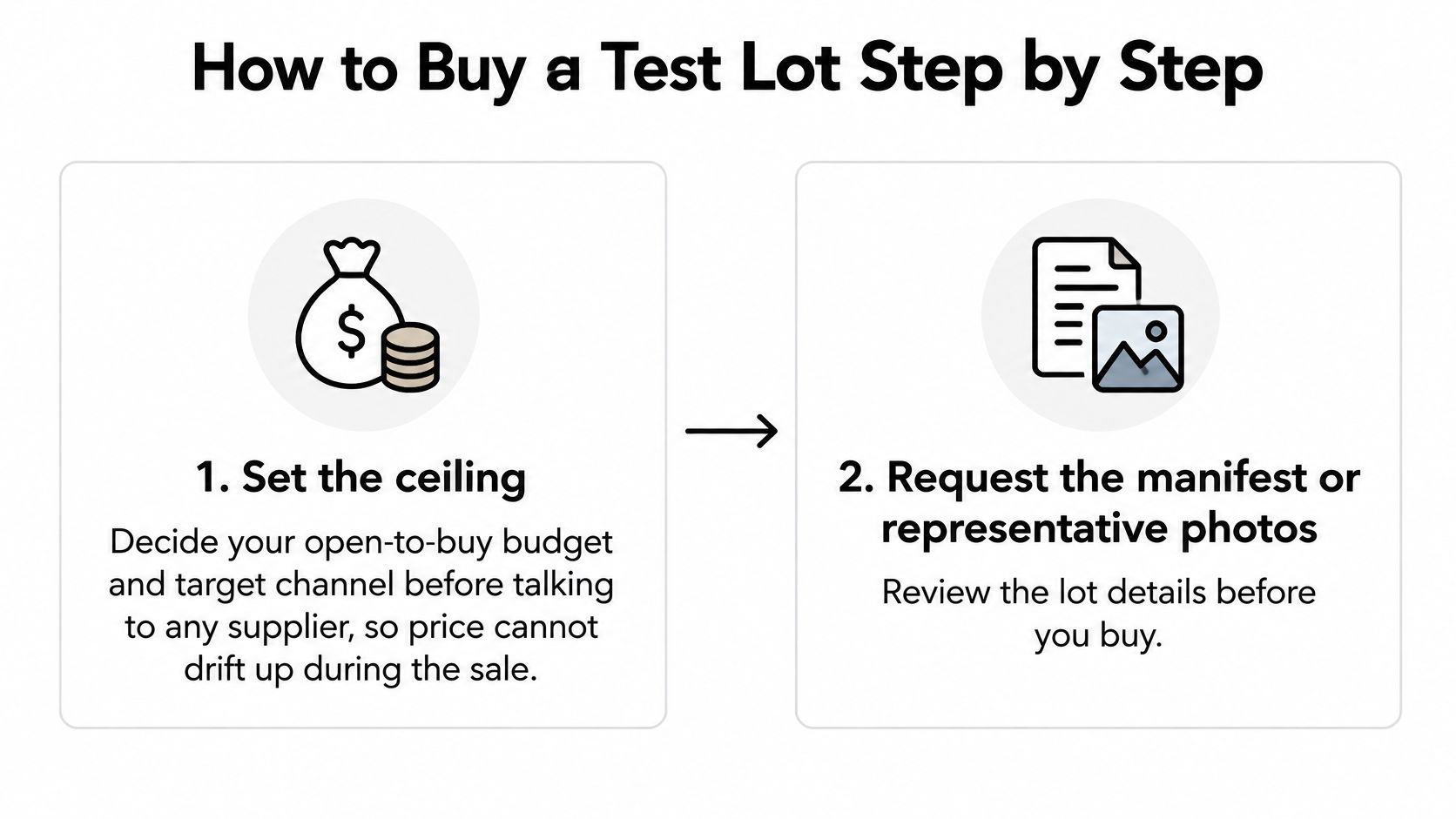
Set the ceiling before requesting offers. Your open-to-buy budget is the cash you can commit after reserving money for freight, preparation, and operating expenses. The common slip is raising that ceiling because a larger lot has a lower advertised unit cost.
Request the manifest or representative photos. Review brand, size, season, condition, and manufacturer's suggested retail price fields, then check whether the size distribution fits your buyers. Don't accept attractive close-ups as proof of the whole assortment, and save the listing and photos before paying.
Send a focused custom quote request. Give us your budget, preferred brands, and quantity so we can tailor a box or pallet. Our minimum order is 50 items, subject to adjustment for inventory availability and business conditions; the mistake is requesting broad variety without identifying what your channel can sell.
Order the test, not the future business you hope to build. Keep the assortment narrow enough to compare categories and diagnose weak results. Buying heavily into a social-media trend before testing your own customers can leave you discounting after interest fades.
Track the inventory from receipt onward. Use Google Sheets or Excel to record each SKU, receiving date, listing date, sale date, net proceeds, returns, and markdowns. If you track only sale dates, you can't distinguish weak demand from inventory that sat unlisted.
Reorder only after measuring performance. For seasonal fashion, Toolio's retail math guidance supports a 40-50% full-price sell-through checkpoint by week 6 of a 12-14-week season, with a markdown review below 40% and an end-of-season target of roughly 80% or higher. Don't treat those seasonal benchmarks as guarantees for every resale category, or replenish a brand merely because its best piece sold quickly.
For a manageable sample order, choose 50 items across two brands, consistent with our brand-selection ratio. Check the proposed size curve and prepare the tracking sheet before delivery, rather than trying to reconstruct costs after garments have been listed.
Use this video alongside your written purchasing checklist.
Inspect Every Carton Before You Accept It
A good-looking top layer doesn't establish the condition of the lot. The pieces that decide your margin sit underneath: the stained hoodie buried under clean outerwear, the short count hidden by a full first carton. Sample every carton and inspect below the visible pieces. Where delivery procedures don't allow a full inspection before signing, document external condition immediately and complete the merchandise review within the applicable claim window.
Use a receiving sheet rather than relying on memory. Keep each lot separate until its count and condition checks are complete.
Work through the receiving checks
- Identify the item. Record SKU, brand, style, size, color, condition grade, label presence, defects, and available source documents.
- Check construction and wear. Inspect seams, closures, underarms, hems, and pocket interiors. Separate questionable items before they reach your photography station. Every unsellable piece raises your true cost per accepted unit, and every defect caught at the receiving table is one you never photograph, list, and refund.
- Reconcile the count. Compare physical quantities with the order and manifest, and photograph shortages, substitutions, or damage immediately.
- Preserve claim evidence. Keep carton labels, packaging photos, and written communications together under the lot identifier. Title and risk of loss pass to you when the order leaves our facility, so condition photos taken at receipt are the evidence a claim stands on.
For U.S. resale, the Federal Trade Commission's clothing and textiles guidance covers the core garment labels: most textile and wool products need fiber content, country of origin, and responsible-business identification, with fibers present above 5% listed in descending order by weight. Children's products follow a separate regime. Tracking-label obligations for products primarily intended for children aged 12 or younger come from federal children's product safety rules, so verify those requirements before listing kids' inventory.
Don't assume a hangtag replaces required garment labeling. Quarantine items with missing or questionable information until you've established whether they can be sold compliantly.
A familiar brand and an intact price tag aren't substitutes for an inspection.
Separate condition from assortment expectations
Our Grade A merchandise is new with tags, like new, or has minimal wear. We guarantee the total item count and quality grade specified in the order, while specific items, styles, and brand distribution can vary with inventory; significant limitations are communicated before the order is finalized.
A lot can meet its grade and still miss your assortment hopes, so measure the inspection against the guaranteed terms, count and grade, before treating a style mix you dislike as a defect claim. For quality disputes, we may offer credit toward future orders at our discretion. Don't budget as though every disagreement automatically produces a cash refund.
Keep written terms covering grade definitions, manifest accuracy, counterfeit remedies, shortage tolerance, claim windows, and freight responsibility. Sort received goods into sellable, repairable, outlet, and unsellable groups before pricing, then set prices from completed comparable sales instead of the original tag.
Calculate Landed Cost and Sell-Through Targets
Landed cost per sellable unit = total acquisition and preparation costs ÷ accepted sellable units. Include purchase price, freight, duties where applicable, inspection, cleaning, and repairs. For a fully loaded profitability calculation, include platform fees and fulfillment costs too, but don't subtract those expenses again later.
Consider a hypothetical worked example: a lot costs $400, freight costs $60, cleaning and repairs cost $40, and anticipated platform fees total $30. That's $530 in fully loaded costs; if 80 of 100 shipped garments are sellable, the cost is approximately $6.63 per sellable item, not $5.30.
Dividing by the shipped quantity would understate cost by approximately $1.33 per sellable garment. Keep the cost of rejected pieces in the lot's total expense, but leave those pieces out of the sellable-unit denominator.
Use the lot's results to make decisions
The United Nations Environment Programme reports approximately 92 million tonnes of textile waste globally each year. Recovered apparel can become useful resale inventory, but buying it doesn't remove the need to account for damaged and commercially unsuitable units.
| Metric | Benchmark | Action if missed |
|---|---|---|
| Full-price sell-through at the seasonal checkpoint | Meet the seasonal target established before purchase | Start a markdown review |
| End-of-season sell-through | Meet your planned seasonal clearance target | Review the buying mix before reordering |
| Landed cost per sellable unit | Total applicable costs divided by accepted sellable units | Reject or renegotiate if profit requires unattainable selling prices |
| Single-brand share of inventory | Cap exposure at the level your test sales support | Pause expansion until demand is proven |
A sell-through target is useful only when you define the inventory cohort and measurement period consistently. Don't improve the apparent result by removing slow sellers from the denominator.
Test the achievable price before bidding
Find recent sold comparables on your intended marketplace, matching condition, style, size, and season as closely as possible. Active listings show what sellers want, not necessarily what buyers pay.
Use our guide to figuring out wholesale price to organize the buying calculation. Work backward from achievable proceeds to the maximum acquisition cost you can afford.
Margin safeguard: If the lot works only when every garment sells at the optimistic price, lower the bid or pass.
Add a downside case with more repairs, deeper markdowns, and slower sales. That's the practical meaning of risk-adjusted cost: the order should remain manageable when the assortment isn't perfect.
Record preparation time alongside financial results. If stock takes too long to list, reduce complexity or quantity before adding more inventory.
Decide Whether to Scale and Prep Your Inventory
Scale only when sales performance, realized margin, and received condition all pass your test. Strong sales won't rescue an order whose processing costs consumed the profit. Equally, a clean, accurate shipment doesn't justify reordering styles your customers ignored.
A failed test doesn't always mean abandoning the supplier. If the problem was an unsuitable category or size mix, narrow the next request; if the economics still don't work after that change, stop before committing more cash.
Prepare the stock you're keeping
Move accepted garments through a defined workflow: condition sorting, cleaning or repair, measurements, photos, listing, and labeled storage. Assign each piece a storage location so you can retrieve it without searching through unrelated stock.
Photograph defects clearly and describe actual condition, not just the supplier's grade. Price repairable and outlet stock according to what you're selling now, rather than what the item might have been worth when new.
- Keep the evidence. Save the receiving record and item photos with the SKU.
- Separate the channels. Route suitable stock to individual listings, live sales, or outlet selling rather than forcing every garment into the same format.
- Protect listing capacity. Finish processing the accepted cohort before ordering more than your workspace can handle.
Build the next order from what sold
- List the brands, categories, and sizes that met your contribution-margin requirements.
- Limit unproven brands and seasonal categories rather than expanding every part of the assortment.
- Send a custom quote request with your budget and preferred composition.
- Put the next performance-review date on your calendar before paying.
Our prebuilt boxes range from 50 to 1,000 items, with custom quotes and pallet-sized orders also available. Choose the next quantity from your demonstrated processing and selling capacity, not the largest discount.
Keep a supplier scorecard covering count accuracy, condition, preparation time, and realized proceeds. Send your next quote request with those results so you're buying against evidence instead of starting from a brand wish list.
OneTrendyCloset offers wholesale brand-name apparel liquidation boxes and custom boxes or pallets for boutiques, marketplace sellers, and live-sale hosts. Visit OneTrendyCloset to request a quote with your budget, preferred brands, sizes, and quantity, then choose an order your preparation capacity and sales results can support.