Secondhand apparel is projected to reach $367 billion by 2029, up from an estimated $227 billion in 2024, and U.S. secondhand is expected to hit $74 billion over the same span, according to ThredUp's 2025 resale report. U.S. secondhand grew five times faster than the broader clothing market in 2024, and 58% of U.S. consumers bought secondhand apparel that year. A market moving that fast rewrites sourcing decisions faster than most brand lists do.
Most lists of the best brands to resell rank fame. Fame is a demand signal, not a margin. A designer jacket that lists high and sits for six weeks can earn less per hour of your time than a clean performance hoodie that sells in nine days at a fifth of the price.
The shortlist worth building is the one that answers a narrower question. Which labels produce repeatable profit for a seller with limited cash, after platform fees, cleaning, shipping and returns? That's a category question first, a price-and-speed question second, and a brand-name question third.
Table of Contents
- Quick Picks for Brands That Resell Fastest
- Pricing Expectations by Brand Tier
- How to Score a Brand Before You Buy
- Athleisure and Performance Brands That Move Fast
- Luxury Labels and Why Authentication Changes the Math
- Matching Brands to Your Selling Platform
- Test a Small Brand Shortlist Before You Scale
Quick Picks for Brands That Resell Fastest
Five groups cover nearly everything a small apparel seller needs, and each behaves differently at the sorting table.
| Category | Example brands | Why it sells | Condition to buy |
|---|---|---|---|
| Athleisure and performance | Vuori, Lululemon, Alo Yoga, Under Armour, Nike | Clear product identity and functional fabrics | Grade A or B with no pilling or stretched waistbands |
| Outdoor and technical outerwear | Patagonia, Columbia | Peaks in cold months and holds value | Grade A with intact zips and seams |
| Contemporary and mall brands | Levi's, GAP, Old Navy, American Eagle, Calvin Klein, Tommy Hilfiger | Steady year-round demand and easier sizing | Grade B acceptable with minimal wear |
| Heritage sportswear | Champion, Adidas, Nike | Retro and streetwear demand | Grade A preferred |
| Designer and luxury | Chanel, Louis Vuitton, Hermès, Dior | Highest ticket and strong awareness | Grade A, authenticity verified before listing |
Athleisure leads because buyers already know what they're looking at. Vuori was the most-thrifted brand in ThredUp's 2025 resale data reported with GlobalData, Lululemon came next, and Alo Yoga entered the top 10 alongside Quince, Reformation, Sézane and Patagonia, as MediaPost's summary of the ranking sets out. Brands with a distinct product identity and strong direct-to-consumer recognition do two useful things for a reseller: they shorten buyer education and they improve listing discoverability in search.
The condition rule: a worn premium piece loses to a clean mid-priced one. Grade beats logo, every time you have to choose.
Recognition creates the demand. Condition and item specificity decide what you collect. A Nike windbreaker with a blown zipper and a faded print isn't the same inventory as the same jacket in Grade A, and both aren't the same as a Champion Reverse Weave crewneck in a size buyers ask for.
Start with the row that matches the buyers you already have. A live-sale audience that responds to logos will move heritage sportswear and athleisure. A boutique with a curated, contemporary look should stay in the mall and contemporary row and skip the luxury gamble. Pick two or three categories, then score individual brands inside them.
Pricing Expectations by Brand Tier
Tier is a cash-cycle label, not a prestige label. The table below describes how each tier tends to behave once the item is listed and priced fairly.
| Brand tier | Typical sell-through | Main margin driver | Main risk |
|---|---|---|---|
| Mall and contemporary | Fast and steady at lower price points | Cost per piece and cleaning time | Thin margin when lots include worn pieces |
| Athleisure and performance | Fast when size and logo are clear | Grading accuracy and photos | Pilling or stretched fabric cuts price |
| Outdoor and outerwear | Peaks in cold months | Buying ahead of season | Unsold off-season stock ties up cash |
| Luxury and designer | Slower, higher ticket | Verified authenticity and sale price | Authentication cost and fraud risk |
Mall and contemporary brands are the volume tier. They sell steadily because sizing is familiar and the buyer pool is wide, which means your profit comes from cost per piece and from how fast you can clean, photograph and list. Every minute spent steaming a $9 GAP shirt is margin you won't get back.
Athleisure is the speed tier. It moves when the listing shows a clear size, a readable logo and honest condition notes. Photograph the waistband tag, the size tag and any pilling in raking light. A returned legging costs you the sale plus shipping both ways.
Outdoor and outerwear is the timing tier. Buy six to eight weeks before cold weather arrives, not after coats have already sat unsold for a month. Off-season stock doesn't lose value overnight, but it does hold cash that could be turning in a faster category.
Timing rule: outdoor and outerwear buys get a hard seasonal window. If a brand only clears your margin target in one season, cap the buy to that window and leave it off your evergreen reorder list.
Turning the table into a price floor
Set the floor as a multiple of landed cost plus a days-to-sale ceiling, and write both down before you shop. Say your rule is twice landed cost inside 21 days. A $12 piece then has to clear $24 in three weeks, and anything that can't gets passed over regardless of the label inside the collar.
Grade moves that floor. Grade A stock, which is new with tags, like new or barely worn, supports the top of the range for its tier. Grade B stock with minimal wear belongs lower and needs flaw photos in the listing. Larger quantities usually lower your per-item cost, but only when the brand genuinely sells through at your price.
Why seasonality outranks the brand name
Mall, contemporary, denim and heritage sportswear can be reordered year-round because demand doesn't collapse between seasons. Workwear follows the same rule when the pieces are durable and the sizes are common: judge it on cost per piece and days to sale, not on how recognizable the logo is. Anything that only works in one quarter belongs in a capped seasonal buy.
The same brand can sit in two tiers depending on category. A designer coat and a designer t-shirt are not the same business, so price each category against its own tier rather than against the brand's average.
How to Score a Brand Before You Buy
A brand earns a place in your buy list only when it clears the floor you set for its tier. The runway justifies the testing. Online resale is expected to nearly double over the five years covered by the 2025 ThredUp resale report, reaching $40 billion by 2029, and 94% of retail executives surveyed said their customers already participate in resale, an all-time high in that report. Resale isn't a liquidation side channel any more. It's where a chunk of ordinary shopping happens.
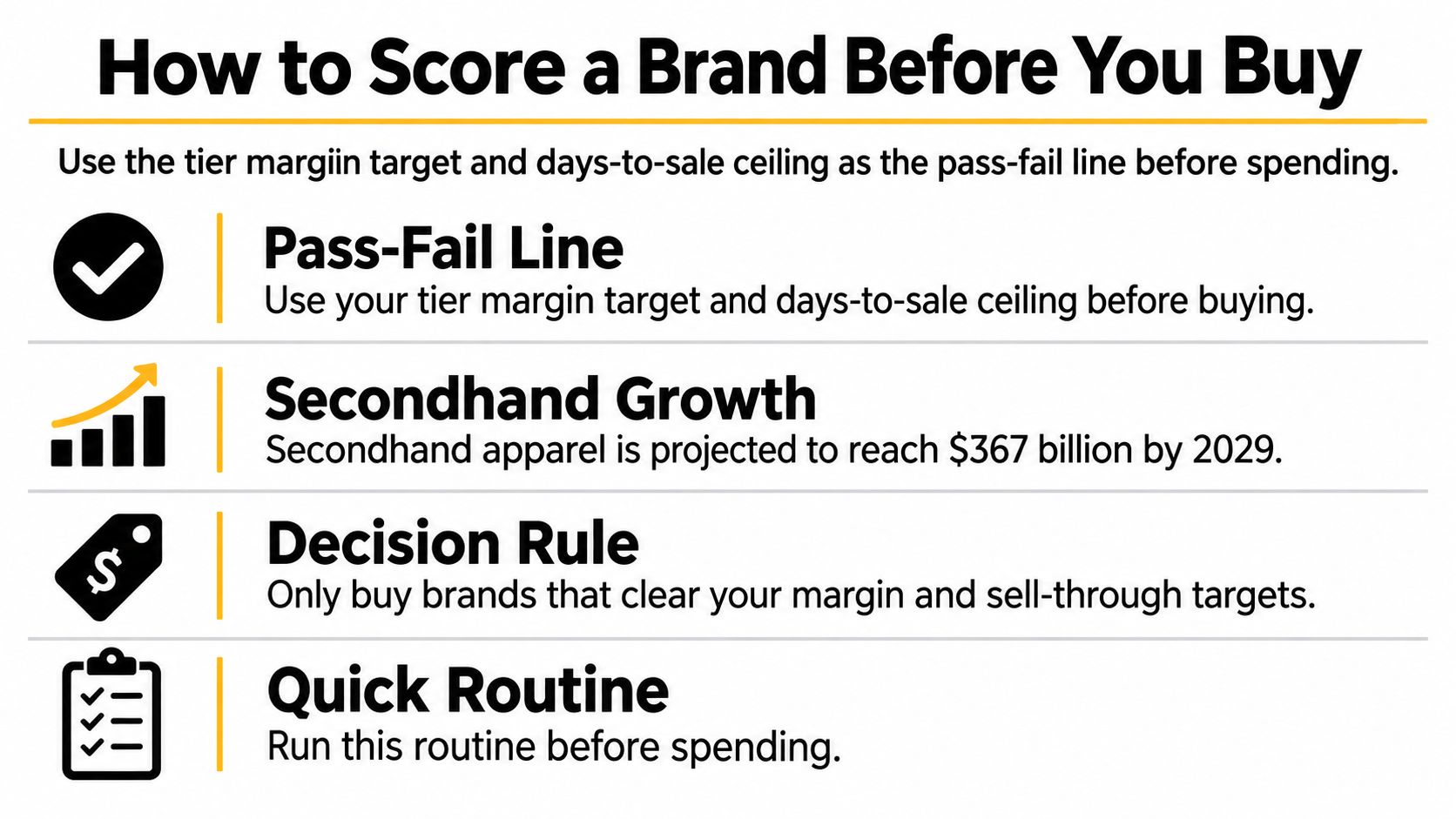
That shift shows up in buying behavior, not just seller activity. In the same report, 41% of younger consumers said they're less likely to purchase apparel that lacks good resale value, which means the people buying from you are already pricing the second life of the garment. If you're working the women's side of the market, the brand-name clothes for women range is where the athleisure and contemporary rows overlap most often.
The seven checks
Run these in order and stop at the first failure. Each check is judged against the tier targets you already set.
- Confirm current demand. The brand should appear in live resale rankings, and comparable sold listings should clear inside 30 days in your category.
- Estimate sell-through. Count sold listings against active listings for that brand and category in the same window. A brand with 200 active listings and three sales is a pricing problem, not an opportunity.
- Run the contribution math. Resale price minus acquisition cost, marketplace fees, shipping, cleaning, and an allowance for returns or defects. Compare the result with your tier target.
- Segment by category. Leggings, technical tops, outerwear, denim and dresses carry different average selling prices and different sell-through, so a blended brand average will hide your worst performer.
- Grade against the row. Athleisure needs unstretched waistbands; outerwear needs working zips and intact seams. If the item fails the row's condition standard, it fails the brand.
- Check size and season. Record which sizes and which months sell, and don't stock off-season outerwear just because the label is famous.
- Keep only double winners. A brand stays when margin and days to sale both beat the tier line. Mark each name yes, maybe or no, and carry only the yes column into a test buy.
A quick walkthrough of the same filtering logic, from a seller's side of the table:
The scoring discipline matters more than any single name on a list. A brand that clears every check this quarter can fail next quarter when the trend cycle turns, which is why the checks get rerun rather than remembered.
Athleisure and Performance Brands That Move Fast
Performance labels sell reliably for one structural reason: the product is legible. A logo reads in a photo thumbnail, a fabric reads as technical, and a buyer knows within two seconds whether it's their style. That's the shortest buyer-education path in apparel resale, and it's why Vuori, Lululemon, Alo Yoga, Nike, Adidas, Under Armour and Champion deserve first tests.
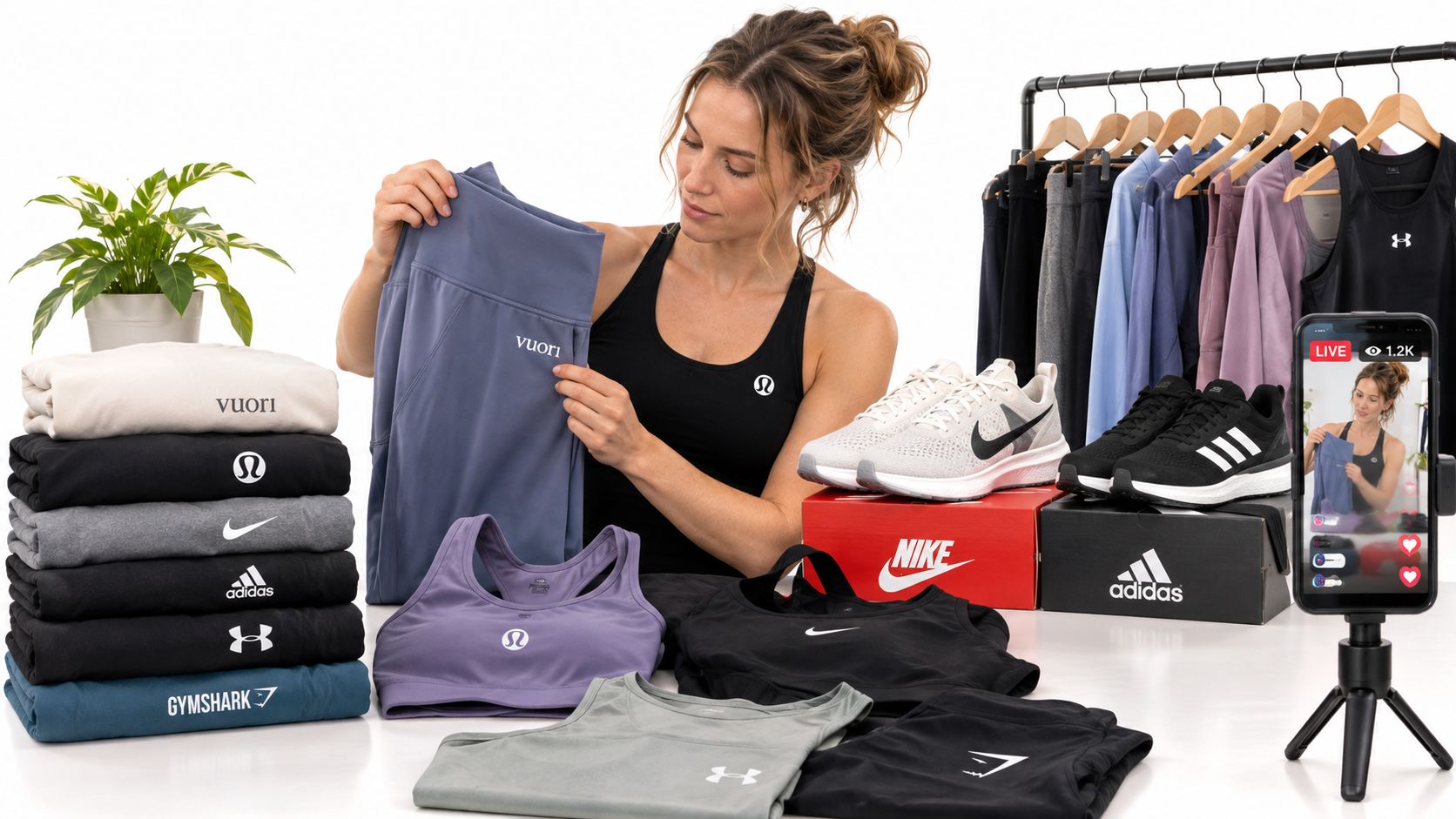
Price the subcategories separately. Leggings and technical tops have their own buyer and their own price band, and hoodies and jackets sit in another. Blending them into one "athleisure" average tells you nothing you can act on.
Condition drives the spread more than brand does. Pilling on the inner thigh, a stretched waistband, a cracked logo print, dye bleeding from a dark wash into a light panel, deodorant staining at the pit: each one drops the item a grade and pulls the price down with it. Sort under a bright light and check the crotch seam and underarms before anything else.
Authenticity is rarely the issue in athleisure. Legibility is. If a buyer can't read the size or see the logo in your first photo, the listing stalls.
Why verifiable lots list faster
Buy only lots where style, size, condition and material can be confirmed. Missing detail is expensive: an unlabeled pair of leggings needs manual measuring, guessing and a longer listing description, and it still sells below a labeled equivalent because the buyer carries the risk.
Compare two lots of similar-looking leggings. One arrives with size tags and fabric content intact; the other has faded or missing tags. The tagged lot photographs in one pass, lists with a two-line description, and prices near your target. The untagged lot needs a tape measure, a size guess, and a paragraph of caveats, and it will sell at a discount to a buyer who'd rather not gamble.
Channel changes the presentation, not the standard. Live-sale hosts win with a logo held to camera and a five-second stretch test, because the audience buys on sight. Marketplace sellers win with flat measurements, a close-up of the size tag and honest flaw photos, because their buyer can't ask in real time.
Three checks at the sorting table
- Tag or trash: if there's no readable size tag and no brand mark on the garment, it goes into a discount pile, not your main inventory.
- Waistband and underarm test: stretch the waistband once and turn the sleeve inside out. If it doesn't spring back or the fabric pills on contact, the grade drops.
- Logo integrity: cracked, peeling or faded prints halve the price of an otherwise clean piece. Check before you photograph, not after.
Only pieces passing all three go into the test box. Everything else waits for a bundle lot or a lower price band.
Luxury Labels and Why Authentication Changes the Math
Awareness is not profit. Brand Finance's 2025 apparel ranking put the combined value of the world's 50 most valuable apparel brands above $366 billion, with Nike third at $29.428 billion and an AAA+ rating, Adidas sixth at $18.484 billion up from $14.448 billion, and Zara seventh at $18.086 billion, an 11% rise from $16.291 billion, per the Brand Finance 2025 apparel ranking. Chanel led at $37.913 billion and Louis Vuitton followed at $32.917 billion.
Those numbers measure recognition across markets. They say nothing about the cash left in your hand after a sale.
Most brand lists stop at the famous name. They skip whether you can source it consistently, price it after fees, and move it inside a category and a market. On the demand side, affordability dominates: nearly 80% of surveyed consumers named affordability as a top reason for buying secondhand fashion and luxury, according to BCG and Vestiaire Collective's 2025 resale report. Prestige is not the purchase driver that a headline brand value implies.
That gap is where luxury turns expensive. Authentication, professional photography, insured shipping and marketplace fees are the costs that erase a big ticket. A designer bag that lists at a strong price and sits for weeks, then sells to a buyer who opens a return request, nets less than an athleisure jacket that sold in a week at a fraction of the price.
Treat designer stock as a capped test, not a core category. Buy verified pieces only, only when your existing buyers already ask for them, and only when your sourcing cost stays low enough that a slow sale doesn't hurt.
Luxury stays on your shortlist on one condition: expected margin after authentication, photography, shipping and fees beats your portfolio median. If it doesn't, the brand belongs in a saved shopping list for later, not in your inventory. For sellers building a designer-adjacent offer without the authentication exposure, wholesale designer bags are a different transaction with different risk, and worth pricing on their own before committing cash.
Matching Brands to Your Selling Platform
The same label can be the right pick on one channel and dead weight on another. Before you score a brand, answer where it will be listed, because that answer changes which signals matter.
| Channel | Brands that tend to move | What to prepare | Selection focus |
|---|---|---|---|
| Marketplace resale (Poshmark, eBay, Mercari) | Athleisure, outdoor and contemporary labels | Measurements and condition grading | Brands with strong search demand |
| Live-sale hosts (Whatnot) | Recognizable logos and silhouettes | Quick demo and clear size labels | Visible branding that reads on camera |
| Boutique retail | Brands local customers already ask for | Styled display and full size run | Brands that fit the store's identity |
Marketplace selling rewards search demand and detail. Buyers arrive with a query, so the brand name does the discovery work and your listing has to close it: pit-to-pit, length, rise, inseam, fabric content, and a plain description of any flaw. A brand with steady search volume and a thin description underperforms a slightly less famous brand with a complete one. If you're new to that channel, this walkthrough of how to start selling on Poshmark covers the listing mechanics in more depth.
Live selling runs on a different clock. The host has seconds per item, so the brand has to be visible from three feet away: a chest logo, a recognizable silhouette, a colorway the audience knows. Clear size labels matter more here than anywhere else, because a viewer can't zoom. Anything that needs a paragraph of explanation doesn't belong in a live show.
Boutiques buy differently again. The question isn't "does this sell online" but "does this fit the rack and the customer who walks in." A full size run in a brand your regulars already ask for will outsell a trendier label in one size.
OneTrendyCloset serves boutique owners, online resellers on Poshmark, eBay and Mercari, Whatnot sellers and live auction hosts, and entrepreneurs starting a fashion business, which is why the stock list reads like a menu rather than a single recommendation. The range includes Nike, Adidas, Calvin Klein, Tommy Hilfiger, Levi's, Champion, Under Armour, Columbia, GAP, Old Navy and American Eagle, and brand availability varies with current inventory. Match the menu to your channel, then confirm the brand sells there before you size up the order.
Test a Small Brand Shortlist Before You Scale
Three to five brands is the right size for a first test. Choose names that cleared your seven checks in at least two categories, because a single-category winner is usually a season, not a strategy.
- Shortlist three to five brands that scored yes in two or more categories.
- Build a test box with your preferred mix. With OneTrendyCloset you choose a mix-and-match brand selection within the quantity limits for your box size, so the composition of the test reflects the audience you're selling to rather than a blind assortment.
- Log five numbers per brand: listing impressions, conversion rate, days to sale, realized gross margin and return rate. Anything you don't measure will get rationalized later.
- Compare after 30 days. Put each brand against your portfolio median rather than against your hopes for it.
- Expand the winners and cut the losers. Drop a brand that misses in two categories, even if you like the label.
If your range needs something the standard box doesn't cover, tell the supplier your budget and preferred brands and a custom box or pallet can be quoted around them. Larger quantities typically receive better per-item pricing, which is the point at which the test becomes a reorder.
The decision: scale the brands that beat your median, rotate one new category into the next order, and pause anything that missed twice. No brand earns a permanent slot on reputation alone.
Keep the safety net in view too. If items don't match the grade descriptions or differ significantly from what was promised, contact the supplier within 48 hours of delivery so the issue can be resolved while the order is still fresh. That window is short, so open and check the box the day it lands.
The brands above only pay off when the box behind them matches the channel you're selling into. OneTrendyCloset has supplied wholesale brand-name liquidation boxes to resellers since 2013, with mixed-brand and custom lots built for boutiques, marketplace sellers and live-sale hosts, and mix-and-match brand selection within each box size. Tell the team your budget and the brands your buyers ask for, and they'll quote a box or pallet around them. Start with a small test at OneTrendyCloset and let the sell-through numbers decide what you reorder.