You have a supplier's quote open in your inbox: 60 hoodies, USD 900 for the box, brand names in the mix, and a per-unit figure that looks like an easy yes. Before you reply, run one more calculation, because the number in that quote isn't what the hoodies cost you. Freight, prep hours and the pieces nobody will buy all sit outside it.
Hoodies are worth getting right. North America held the largest regional share of the global hoodies and sweatshirts market in 2025 at 40.42%, according to Fortune Business Insights, which means U.S. buyers are working in the deepest, most competitive part of the category. Competition rewards the reseller who knows their true cost per sellable piece and their size curve, not the one who chased the lowest unit price.
Table of Contents
- Choose the Hoodie Grade and Box Size
- Find Suppliers for Each Lot Type
- Work Out Your Landed Cost Per Hoodie
- Build a Size Curve That Cuts Returns
- Negotiate Minimums and Payment Terms
- Inspect Quality and Compliance Before You Pay
- List Hoodies So Buyers Keep Them
- Place a Test Order and Scale to Pallets
Choose the Hoodie Grade and Box Size
The table below is the buying decision in one view. Read your own constraints against it rather than against the per-unit price, because the cheapest row costs the most in hours.
| Lot type | Condition | Best buyer | Price position |
|---|---|---|---|
| New with tags overstock | Unworn with original tags | Boutiques and brand-focused listings | Highest per-unit cost, least prep |
| New without tags returns or samples | Unworn, no tags, minor handling marks | Marketplace sellers on a budget | Mid cost, light inspection needed |
| Shelf pulls | Display wear, may need steaming | Boutiques and live-sale hosts | Mid cost, check for handling marks |
| Secondhand Grade A | Looks as new, minor wear possible | Thrift and vintage resellers | Low cost, moderate prep |
| Secondhand Grade B or C | Visible wear, stains possible | Discount resellers and bulk buyers | Lowest cost, heavy sorting and prep |
Match the row to your week, not your ambition. If storage is a spare bedroom and prep hours are two evenings a week, pay more for new with tags and list the same day the box lands. If you can sort, steam and photograph quickly, Grade A gives the widest margin per dollar. Grade B or C belongs with discount resellers who have labor to spare, because every stained piece is a decision you have to make twice.
Size the box in three tiers. A test box of about 50 pieces teaches you one supplier and one brand mix. A mixed box of 150 to 300 pieces fits a boutique or marketplace shop with a weekly listing rhythm. A pallet comes only after sell-through is proven.
Hoodies justify the attention. Hooded sweatshirts accounted for 38.2% of global sweatshirt-market revenue in 2025, equivalent to approximately USD 16.3 billion, according to Dataintelo.
Before you order, answer three questions. How many hoodies can you list each week, where will they be stored, and do your buyers expect brand names? Those three answers set your box tier and your grade together.
Find Suppliers for Each Lot Type
Each lot type lives in a different channel, so start where that channel sells. New with tags overstock comes from brand closeouts and wholesale distributors, which quote a fixed count and grade. Returns, samples and shelf pulls come from retailer liquidation programs and manufacturer sample rooms, where counts are small and irregular. Secondhand Grade A through C comes from textile graders and bale suppliers, which sell by bale or by weight with a stated grade. Custom or private-label hoodies come from manufacturers that accept brand-mix orders, which is your route to controlling both brand and size mix.
Shortlist three suppliers per lot type and send every one of them the same request: lot type, target count, grade, preferred brands, gender cut and destination country. Compare replies on that common basis instead of on the first price quoted. The guide to choosing a wholesale supplier for clothing walks through the vetting questions worth asking before money moves.
For a first order, ask what the minimum is and whether it flexes. OneTrendyCloset sets a 50-item minimum and may adjust minimum order requirements based on inventory availability and business conditions, and we build custom quotes from a stated budget and brand list when a standard box doesn't fit. Treat any supplier's terms as claims to confirm in a written quote before you pay.
Work Out Your Landed Cost Per Hoodie
Here's one lot, run line by line. USD 900 for 60 hoodies, USD 120 freight, five minutes of prep per piece at USD 15 per hour, no sales tax or duty on this purchase.
Step 1, the raw price. USD 900 divided by 60 pieces is USD 15.00, which is the figure the supplier quotes you.
Step 2, add freight. (USD 900 plus USD 120) divided by 60 is USD 17.00. The hoodie already costs two dollars more than the quote suggests.
Step 3, add prep labor. 60 pieces at five minutes each is 300 minutes, or five hours. At USD 15 per hour that's USD 75, so your total outlay is USD 1,095, or USD 18.25 per hoodie if all 60 sell.
Step 4, apply a 10% loss. Six pieces turn out unsellable. That leaves 54 sellable, and USD 1,095 divided by 54 is about USD 20.28 per hoodie.
Why the Divisor Matters More Than the Quote
The true cost isn't the lot price divided by the box count. Freight, tax and prep add to the numerator while damaged pieces shrink the denominator, and the second effect is the one that ambushes new buyers. A lot with a lower per-unit quote but heavy wear can land higher per sellable hoodie than a pricier clean lot. That's why I compare two offers on landed cost and never on list price.
Practical rule: keep landed cost below half your planned average selling price. The remainder has to cover platform fees, outbound shipping, occasional discounts and the pieces you eventually clearance out.
A lower quote doesn't survive a high freight charge or a mixed grade. Build this calculation in a spreadsheet with one column per cost item, add your state's sales tax or the origin country's duty rate, and rerun it on every quote. The breakdown of how wholesale pricing works helps you sanity-check a supplier's numbers before you commit.
Build a Size Curve That Cuts Returns
Start with an assumed curve, then correct it with your own sales. Equal quantities per size is the fastest way to finish a box with a rack of XS and XXL and no medium left.
| Size | Starting share of order | Watch for |
|---|---|---|
| XS | 5% | Low demand, sell in bundles |
| S | 15% | Fit varies most across brands |
| M | 25% | Usually the fastest seller |
| L | 25% | Check body length on unisex cuts |
| XL | 20% | Confirm chest width against the label |
| XXL | 10% | Slowest sell-through, discount early |
The curve is a margin issue, not a housekeeping one. Online apparel returns are estimated at 24.4%, and size or fit is cited as the leading reason by 53% of apparel sellers, according to Size.ly's ecommerce return statistics.
Mixed brands break any simple S-to-XL assumption. One brand's large is another brand's medium, and unisex cuts run wide in the body while falling short in the sleeve. Ask for garment-level measurements, namely chest width, body length, sleeve length and fabric composition, instead of trusting a letter on a neck tag. Sort the lot into men's, women's and unisex before you price anything, because the same hoodie deserves different prices in each group.
After the first sales, track sell-through per size for 30 days and shift the next order toward what moved. For imperfect assortments, discount the extremes early, bundle the sizes that sell together, and never hand an XXL out as a free add-on. That cheaper mixed-brand lot gets expensive once markdowns, exchanges and dead extreme sizes are counted.
Negotiate Minimums and Payment Terms
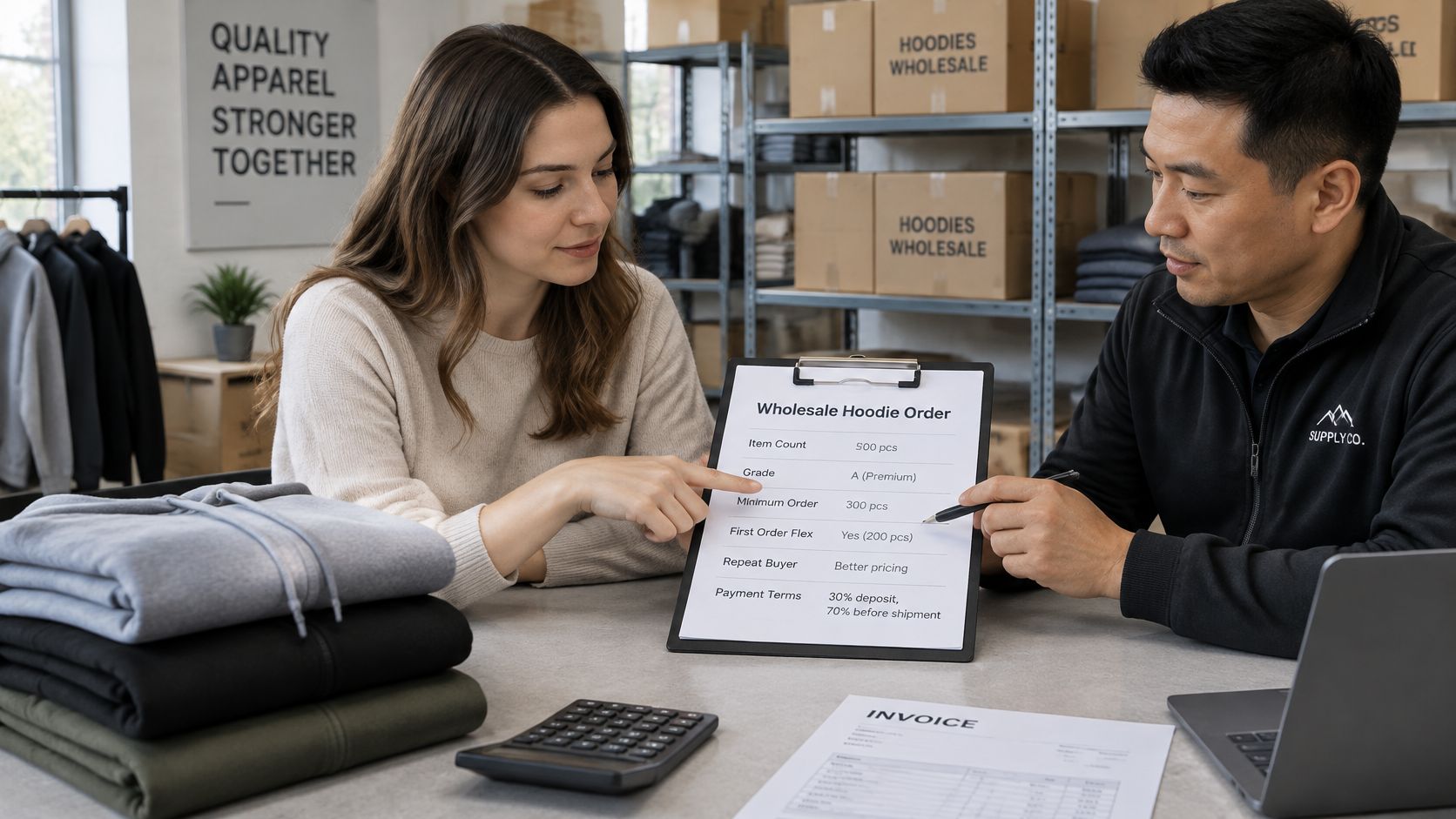
Terms decide who absorbs the loss when a box arrives short or a grade looks generous in the listing. Work through these in order, and get each answer in writing before you pay.
- Item count and grade in writing. A verbal estimate protects nobody when six pieces arrive stained.
- The minimum order quantity, and whether it flexes. Ask whether a first order or a repeat buyer gets different terms. Many suppliers will split or adjust a lot rather than lose the account.
- Photos or a sample from the actual lot. Five to ten pieces, not a stock image. Wear that a grade label hides shows up in a phone photo.
- A standard box versus a custom quote. A custom quote built on your budget, brands and gender cut usually gives more control over the mix than a fixed assortment does.
- Responsibility for damaged and wrong items. Ask who pays, whether you get a credit, and at what point risk of loss moves to you. Risk passes to the buyer on shipment from the supplier's facility in most wholesale deals.
- Freight, in detail. Confirm whether it's included, whether freight shipping suits a large order, and whether local pickup is an option where the supplier offers it.
Offering a larger order or a repeat commitment for a lower per-unit rate is a good trade. Offering a vague promise of future volume is not, and experienced sellers see through it.
Inspect Quality and Compliance Before You Pay
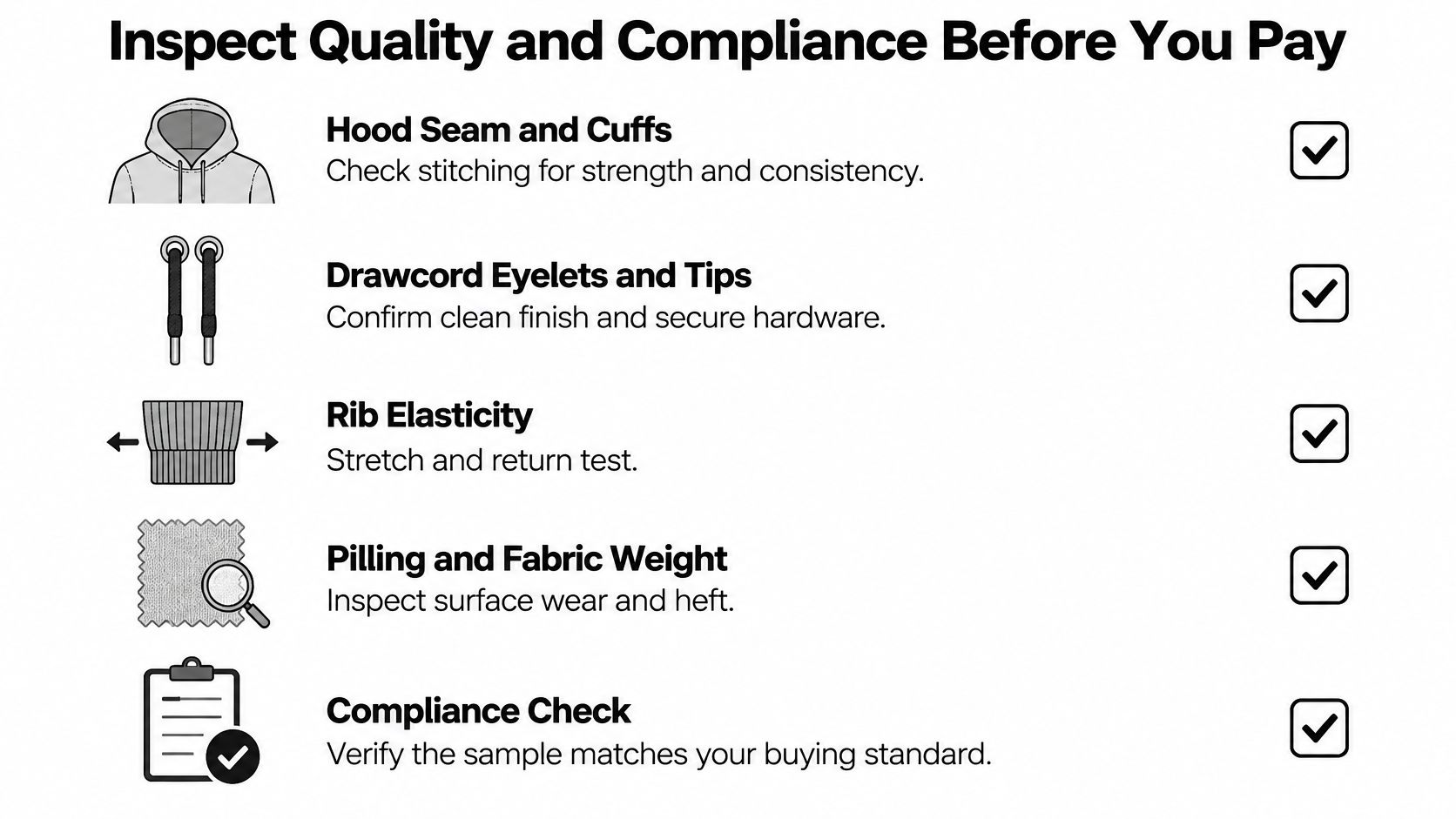
A cheap lot stops being cheap once part of it won't list. Every hoodie that fails inspection raises the landed cost of the ones that sell, so run this check on one sample before you pay for the rest.
- Hood seam and cuffs. Pull the stitching. Loose or skipped lines mean the piece won't survive a season.
- Drawcord eyelets and tips. Confirm the hardware is seated and the tips are intact, because replacements are a listing annoyance.
- Rib elasticity. Stretch the cuff and hem and watch whether it returns or stays stretched out.
- Pilling and fabric weight. Check the underarm and the pocket edge, where wear shows first, and judge the heft in your hand.
- Print and embroidery. Look for cracking, edge lift and puckering around the design.
- Tags. Ask whether brand tags look authentic or have been cut out.
Wash and dry the sample once before you judge it. Shrinkage is the flaw photos never catch, and it turns a clean size run into a returns problem.
The Paperwork That Makes a Lot Resellable
Ask for fiber-composition and country-of-origin labeling, a written condition grade, and packaging fit for resale. Construction standards have a long history worth knowing: Champion developed hooded sweatshirts as sideline wear for athletes and patented Reverse Weave construction in 1938, rotating the fabric's knit direction to reduce vertical shrinkage, per Champion's company history. That same shrinkage is what the wash test above is checking for.
Why Fiber Content Is Now a Business Detail
Since 1 January 2025, EU countries have had to run separate textile-collection systems for reuse, preparation for reuse and recycling, and the Global Fashion Agenda mapping of textile EPR rules notes that California and New York are developing textile EPR rules at state level. A lot you can't describe by fiber content or origin becomes hard to sell or dispose of in those markets.
Decide before you order which damaged pieces go to a discount channel and which go to textile recycling. If a supplier can't state fiber content, grade and origin in writing, pass, even when the price looks low. A discount on a lot you can't document is rarely a discount at all.
List Hoodies So Buyers Keep Them
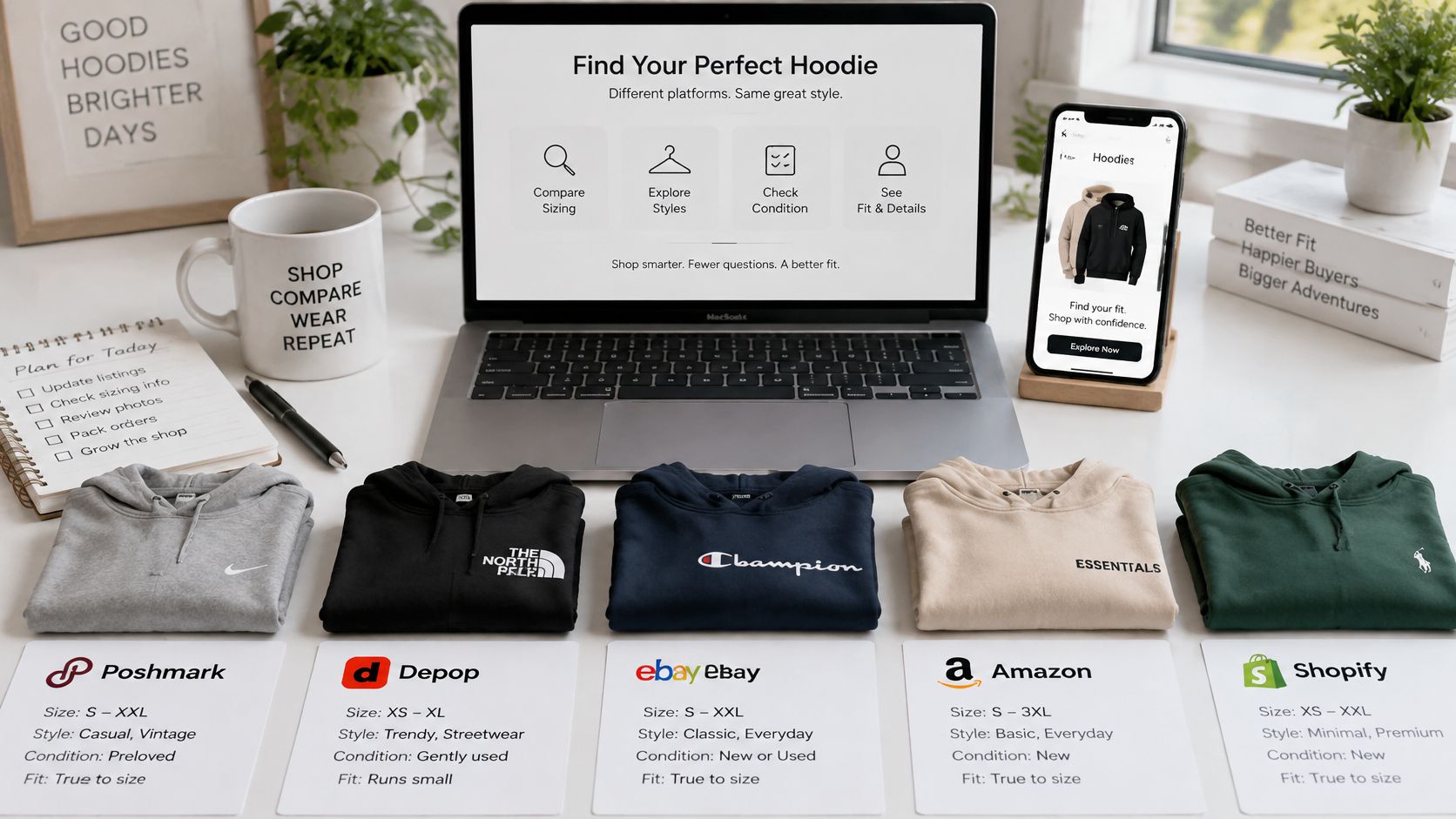
Most of your buyers will judge the hoodie from the listing alone, so the listing has to answer the fit question before it's asked. Global online retail accounted for approximately 43.7% of hoodies and sweatshirts category sales in 2025, according to Dataintelo, which means the photo and measurements carry the sale.
Each channel rewards something different. Poshmark and Depop shoppers scroll for style and respond to a model shot or a clean flat lay. eBay buyers filter by brand, size and condition, so those fields must be complete or you never appear in the results. Mercari buyers weigh price against shipping speed. Whatnot buyers purchase from a host who holds the hoodie to camera and reads the measurements aloud.
For the eBay side specifically, the guide to selling clothes on eBay covers the item specifics that drive search placement.
One Template That Travels
Write a title with brand, cut and size. Photograph the care tag and fiber label. Post a flat lay with chest width and body length in inches. Put the condition grade in the first line of the description, and state whether the hoodie shrank after washing. That single template works across all four channels with minor edits.
Here's how a live-sale host can use the same details on camera:
Bundle two hoodies at a set price, group by color or season, and relist with a fresh photo before you cut the price. Then pick two channels, write one template, and test it on ten hoodies from your first box.
Place a Test Order and Scale to Pallets
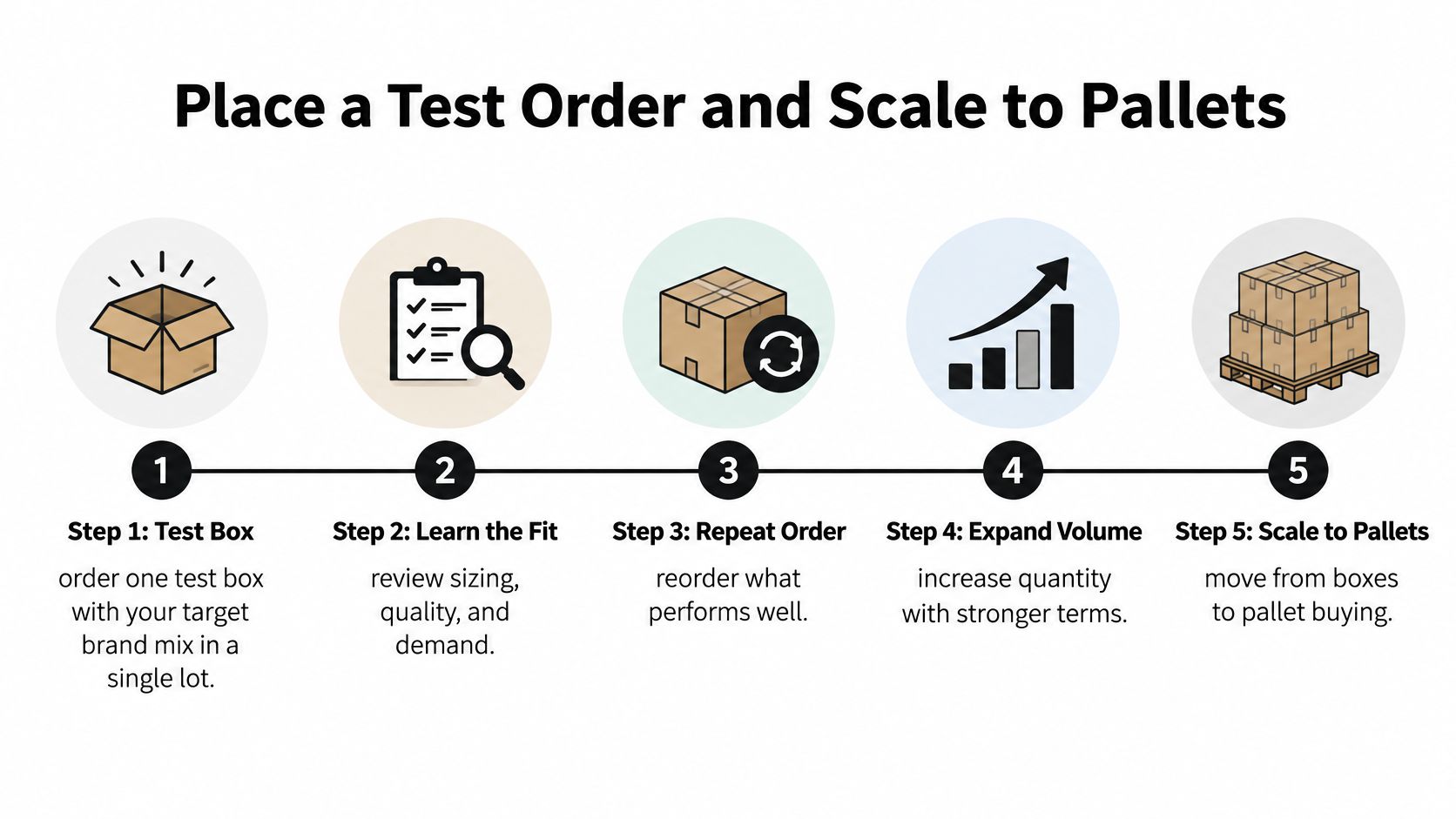
Scale in five steps, and let sell-through rather than storage space decide when you move up.
- Order one test box with your target brand mix in a single lot. The goal is learning, not filling a shelf.
- Track every hoodie from listing to sale with its landed cost, size and days to sell.
- Review at 30 to 45 days for which sizes moved, which grade returned the most, and landed cost per sold hoodie.
- Reorder from the same supplier and grade, changing only the sizes and brands that sold.
- Step up a box tier only after two or three orders show stable sell-through. A pallet is the last step, never the first.
The decision rule is simple. If the test box sold through and listings held without return spikes, ask for a custom quote for the next box using your budget, brand list and size curve. If sell-through lagged, change the grade or brand mix before adding volume, and keep the box size where it is.
One thing to pin down before scaling: our orders guarantee the total item count and quality grade as specified, while specific items, styles and brand distribution can vary with inventory, and any significant limitations are communicated before the order is final. That's the right structure to ask any supplier for, in writing, on a larger commitment.
When the quote in your inbox is a mixed lot rather than a single style, the buying decision comes down to who assembled it and whether the count and grade hold up on arrival. OneTrendyCloset has supplied wholesale hoodie sweatshirts and brand-name apparel in liquidation boxes to resellers since 2013, with a 50-item minimum that can flex with inventory and custom quotes built from your budget and brand list. Send us your size curve and target brands, and we'll price a box or pallet that matches the buyers you have, so you can start at OneTrendyCloset with a test order instead of a gamble.