An Amazon pallet sale is a bulk liquidation of returned, overstock, or unsold inventory sold by pallet or truckload through authorized marketplaces, and recovered value may be only about 5% to 20% of the sale price under liquidation. Buyers may pay anywhere from the hundreds to thousands of dollars, depending on category, condition, and lot size.
You may be looking at a marketplace listing right now, comparing nearly identical pallet photos and wondering whether the promised retail value represents real resale potential. The difficult part isn't understanding that the merchandise is discounted. The difficult part is deciding what portion will still be sellable after inspection, missing parts, stains, repairs, freight, platform fees, and your own time at the sorting table.
That's why the useful answer to what is Amazon pallet sale isn't just “cheap inventory.” It's a grading, sorting, and waste-management operation. The pallet price is only the entry point. Your result depends on how accurately you read the lot, how efficiently you process it, and whether the category fits your resale channel.
Table of Contents
- What an Amazon Pallet Sale Actually Is
- How Pallets Move From Amazon Fulfillment to Buyer
- Condition Grades and What Each Tier Really Contains
- The Real Economics Behind the Headline Discount
- Amazon Pallets vs Apparel Liquidation Boxes
- The Risk Profile Most Beginners Underestimate
- A Reseller Decision Checklist Before You Bid
What an Amazon Pallet Sale Actually Is
A first-time bidder often sees a listing with a manifest, a few pallet thumbnails, and a large estimated retail value. The images look polished, the categories sound familiar, and the auction price seems detached from the merchandise value. That presentation can make a pallet feel like a discounted retail cart, but it isn't one.
An Amazon pallet sale is a bulk lot of customer returns, overstock, shelf-pulls, cancelled orders, damaged-box products, or unsold inventory. The merchandise is consolidated and sold by pallet or truckload through business liquidation channels, rather than offered as individual retail units. Amazon's own bulk liquidation storefront describes lots involving overstock and customer-return inventory, while Amazon's auction ecosystem also routes bulk inventory through platforms such as B-Stock.
The reason for the channel is practical. Amazon can't economically return every opened, seasonal, damaged, or low-demand product to normal retail stock. A liquidation marketplace lets the seller recover part of the inventory's value while transferring inspection, sorting, repair, and resale responsibility to the buyer.
What's physically on the pallet
The contents can vary by listing. A clothing-focused lot may include returned dresses, cancelled apparel orders, end-of-season items, and pieces with damaged packaging. A mixed-goods pallet can combine home products, toys, electronics, tools, or kitchen merchandise. The word Amazon describes the inventory channel, not a guarantee that every unit will be pristine or even suitable for your preferred marketplace.
This differs from general wholesale. A conventional wholesale order usually gives you clearer control over brand, style, size, quantity, or condition. An Amazon liquidation pallet gives you a bulk assortment with more uncertainty. It also differs from a single-lot return, which may contain one product line or one customer's returned shipment rather than a consolidated pallet.
For apparel sellers, the difference matters immediately. A mixed pallet can contain attractive pieces, but it can also create inconsistent sizing, scattered brands, slow-moving styles, and garments that need cleaning or repackaging. A focused guide to pallets for sale can help you compare the broader pallet model with more controlled sourcing options.
Anchor the value before bidding
Industry guidance places liquidation recovery at roughly 5% to 20% of sale price under liquidation, while another liquidation marketplace describes recovery values often landing around 20% to 30% of original retail value depending on the lot and condition. Those ranges come from different parts of the liquidation market, so treat them as planning context rather than a promise. Review the Amazon liquidation marketplace guidance and the liquidation-channel overview before treating a manifest's retail total as revenue.
The stable mental model is simple: you aren't buying retail merchandise at a discount. You're buying a bundle of potential resale units, uncertain units, and processing work.
How Pallets Move From Amazon Fulfillment to Buyer
Consider one returned shoe inside a batch of mixed apparel. A customer sends it back because the size didn't work. At an Amazon fulfillment center, the return enters a scanning and triage process alongside thousands of other units. The shoe may be suitable for restock, marked for another disposition, or grouped with inventory that will be liquidated.
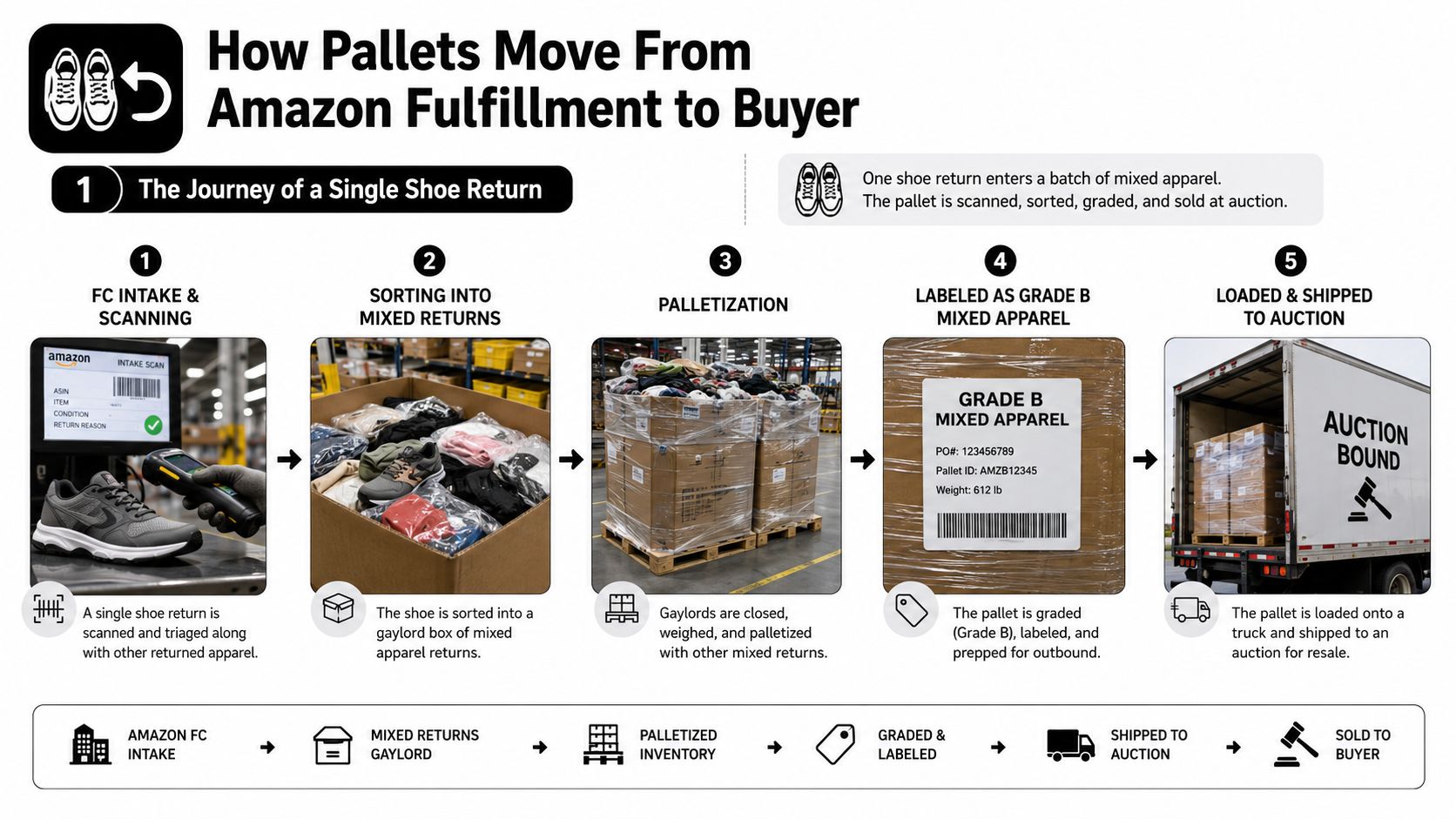
If the shoe isn't returned to normal inventory, it can move into a larger collection of returns. A third-party liquidation operation may aggregate the shoe with apparel from other fulfillment locations, then organize the lot by category, weight, condition information, and manifest availability. At this point, the shoe is no longer treated as an individual customer return. It becomes one unit inside a commercial lot.
From bulk inventory to listing
The liquidation operator may create a listing with a manifest, photographs, category description, condition grade, and shipping details. Some lots are highly itemized. Others have limited information, especially where the inventory is described as uninspected returns. A pallet labeled Grade B Mixed Apparel may communicate a broad condition expectation, but it doesn't promise that each garment is wearable, complete, clean, or correctly sized.
Buyers usually register on the marketplace and may need to provide resale credentials. On official or established B2B channels, registration requirements can include business information or resale documentation. The buyer then either bids through an auction or purchases a fixed-price lot, depending on the listing format.
Payment and freight create a second stage of uncertainty. After the auction closes, you may still need a freight quote, a delivery appointment, and a receiving plan. A standard pallet can weigh about 400 to 1,000 pounds, and one industry guide places shipping costs around $150 to $400. Review the freight and pallet-weight guidance before you assume the auction price is your landed cost.
The dock is where the business starts
A pallet that arrives at your warehouse or garage isn't finished inventory. It's a work order. You'll need a receiving area, a camera or phone for documentation, bins for condition groups, and a system for separating ready-to-list pieces from repairable and unsellable goods.
The shoe may be clean and complete, or it may be missing its pair. The manifest may help you identify the expected item, but your sorting table determines its actual resale grade. That gap between listed condition and observed condition is where much of the business risk lives.
Condition Grades and What Each Tier Really Contains
Liquidation grades are useful only when you understand what they describe. A grade usually applies to the lot or manifest, not to every individual unit inside it. Treating “Grade B” as a guarantee for every item is one of the fastest ways for a new buyer to overestimate recoverable inventory.
A practical reading of common grades
New generally suggests sealed, unused inventory. It's the tier most compatible with normal retail-style listings, although packaging damage can still appear once you open the pallet.
New Other often describes merchandise that hasn't been used but may have a damaged carton, altered packaging, or presentation that differs from a standard retail unit. A sealed shelf-pull can fit here. The product may be new, but the buyer still needs to assess whether the packaging supports the intended sales channel.
Grade A or Open Box usually indicates opened merchandise with stronger resale potential than ordinary customer returns. The product may be complete and functional, but the outer packaging, accessories, or presentation can vary.
Grade B or Customer Returns is where the sorting work becomes central. A returned item may function normally after inspection, yet apparel can include stains, odor, stretched fabric, missing tags, or an inconsistent size run. You should expect variation within the same pallet.
Grade C, Used, Tested, or Salvage requires a different operating model. These goods may need cleaning, repair, parts replacement, testing, recycling, donation, or disposal. Words such as “tested” and “refurbished” are meaningful only when the listing explains the testing or refurbishment process.
Practical rule: Buy the grade that matches your resale outlet, not the grade that sounds most exciting in the listing.
| Grade | Typical Contents | Best Fit Resale Channel |
|---|---|---|
| New | Sealed or unused products, with packaging quality still requiring verification | Standard retail listings, boutiques, marketplace resale |
| New Other | Unused shelf-pulls or goods with damaged outer packaging | Discount retail, online resale, outlet-style selling |
| Grade A or Open Box | Opened products with comparatively strong resale potential | Online marketplaces, direct retail, curated resale |
| Grade B or Customer Returns | Mixed returns requiring inspection, cleaning, or repackaging | General marketplaces, wholesale, live sales |
| Grade C, Used, or Tested | Used or uncertain goods that may need repair or deeper testing | Repair routes, discount channels, local resale |
| Salvage | Defective, incomplete, heavily damaged, or uneconomical inventory | Parts, recycling, donation, recovery projects |
For apparel sellers, the brand-name clothing pallet guide provides a more category-specific way to think about brand mix and garment condition. The key distinction is between condition language and inspection evidence. A listing can tell you what the seller believes the lot represents, but your own intake process decides which units deserve a price tag.
The Real Economics Behind the Headline Discount
A pallet's advertised retail value is not the same as the money you'll collect. Retail value may reflect the original price, a suggested price, or a manifest estimate. Your business receives revenue only after you sell the recoverable units through a channel that accepts their condition.
Industry guidance describes liquidation recovery values often landing around 20% to 30% of original retail value, while the market can vary substantially by category, grade, and inspection quality. Pallet pricing may begin in the low hundreds, while truckload lots can reach five figures. See the Amazon B-Stock marketplace information for the relationship between lot scale, category, and liquidation pricing.
Build the landed-cost view
Start with the bid, then add every cost that follows it:
- Winning price: The auction amount or fixed price for the lot.
- Freight: Pallet weight, origin, destination, liftgate needs, and delivery terms affect the final charge.
- Marketplace fees: The liquidation platform may add buyer premiums or transaction costs.
- Preparation: Cleaning, steaming, testing, photographing, repackaging, and labeling consume labor.
- Selling fees: Your resale marketplace takes its own fee, and some items need individual shipping materials.
- Shrink: Missing parts, damage, counterfeit flags, stains, and items outside your category reduce the sellable count.
Suppose a clothing manifest lists a large original retail value and you bid at a quarter of that figure. You still haven't recovered a quarter of the original value. Freight can materially change the per-unit cost, especially for a heavy pallet. A standard liquidation pallet may weigh about 400 to 1,000 pounds, with shipping described at roughly $150 to $400 in one industry guide. Those figures should be checked against an actual quote, not copied into a forecast without adjustment. The supporting pallet shipping reference explains why freight belongs in the first calculation.
| Line Item | Amount | Note |
|---|---|---|
| Auction or lot price | Your maximum bid | Set this before the auction starts |
| Freight | Carrier quote | Confirm residential, liftgate, and appointment terms |
| Platform charges | Listing-specific | Check buyer premiums and payment terms |
| Processing | Your internal estimate | Include sorting, cleaning, testing, and photography |
| Sellable recovery | Conservative estimate | Exclude units you can't confidently list |
| Net proceeds | Actual sales revenue less selling costs | This is the number that matters |
For apparel, use expected selling prices rather than MSRP. A branded jacket with a missing tag may still sell, but your channel, photos, measurements, and return policy determine the result. A low bid can be profitable if your processing system is efficient. The same bid can lose money if the pallet creates weeks of slow listings and unsellable stock.
Amazon Pallets vs Apparel Liquidation Boxes
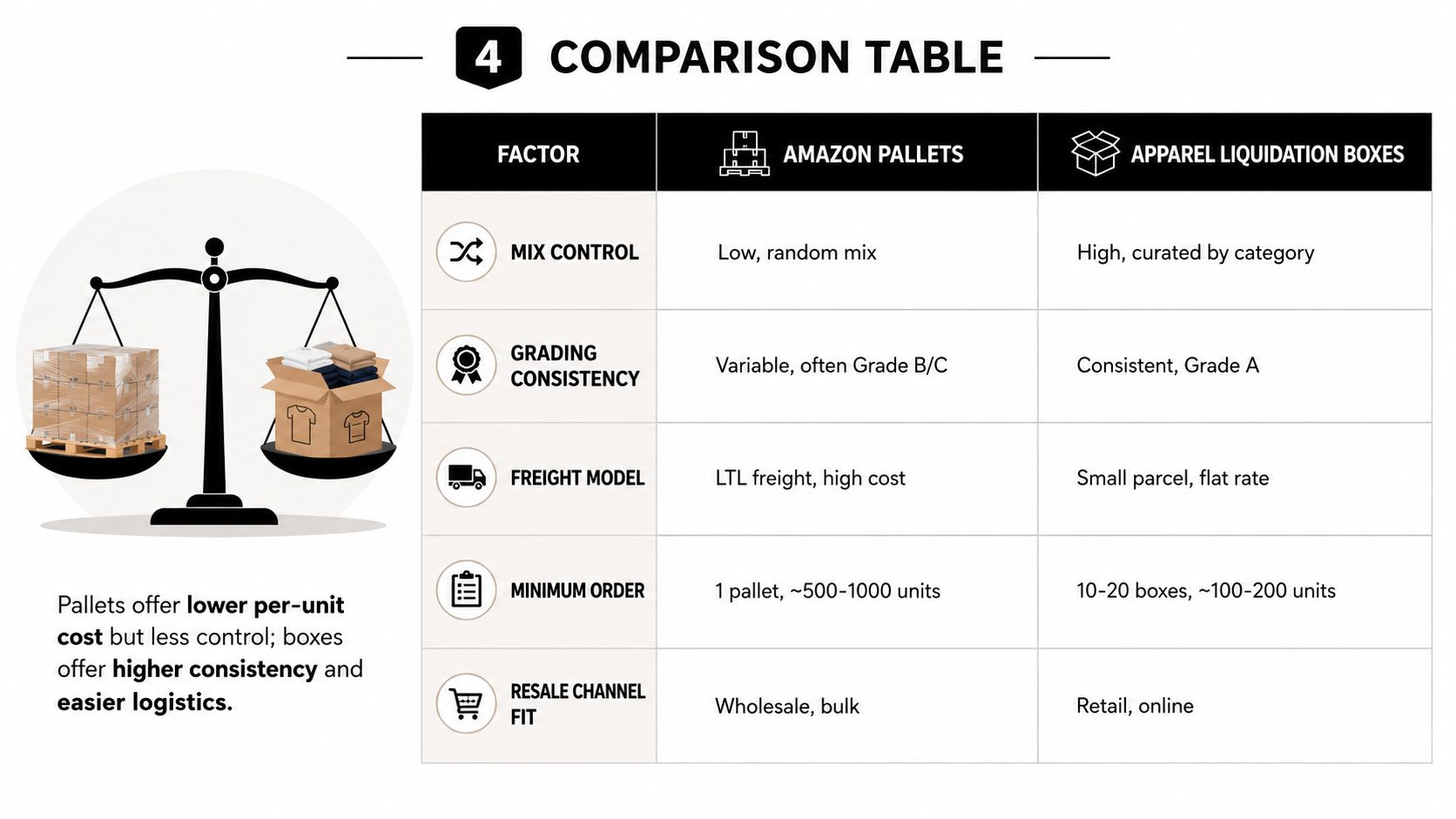
Amazon pallets and curated apparel liquidation boxes solve different sourcing problems. A pallet gives you volume and variety, but it can force you to accept a category mix that doesn't match your customers. An apparel box gives you less surprise and more control over the products you can photograph, measure, and list.
The operational difference
Amazon pallets are commonly sold as bulk lots through auction or liquidation marketplaces. They may contain mixed categories, mixed conditions, and incomplete information. Their freight model is usually pallet or LTL delivery, so you need space and a receiving plan before the truck arrives.
Curated apparel boxes organize the inventory around a category and often a more defined quality expectation. They can fit sellers who work from a home office, list on Poshmark or eBay, or run live sales where consistent styles and sizes matter more than the lowest possible unit cost. Small-parcel shipping is also easier to manage than a freight appointment.
| Decision Factor | Amazon Pallet | Curated Apparel Liquidation Box |
|---|---|---|
| Mix control | Lower, often a random or broad category mix | Higher, organized around apparel and selected preferences |
| Grading consistency | Variable, often dependent on return condition | More consistent when the supplier curates the box |
| Freight model | LTL or pallet freight | Small parcel or box-based shipping |
| Minimum order | Usually a pallet or larger lot | Often available in smaller test quantities |
| Resale fit | Wholesale, discount, bin, and bulk channels | Boutique, online marketplace, and live-sale channels |
| Main advantage | Volume and low potential unit cost | Predictability and easier processing |
| Main trade-off | More sorting and disposal work | Less extreme upside from unexpected high-value goods |
A box of hoodies, for example, gives a clothing seller a clearer listing workflow than a mixed pallet containing apparel, kitchenware, and damaged electronics. The box of hoodies option illustrates the kind of category-specific sourcing that can reduce assortment risk.
Match the lot to your workspace
Choose a pallet when you can receive freight, store bulky inventory, separate condition groups, and move a broad assortment through several sales channels. Choose a curated apparel box when you need manageable quantities, consistent product photography, and a closer match to a clothing audience.
Neither format is automatically safer or more profitable. Pallets reward sorting capacity. Boxes reward predictability. Your available space, selling speed, and willingness to handle non-sellable units should determine the choice.
The Risk Profile Most Beginners Underestimate
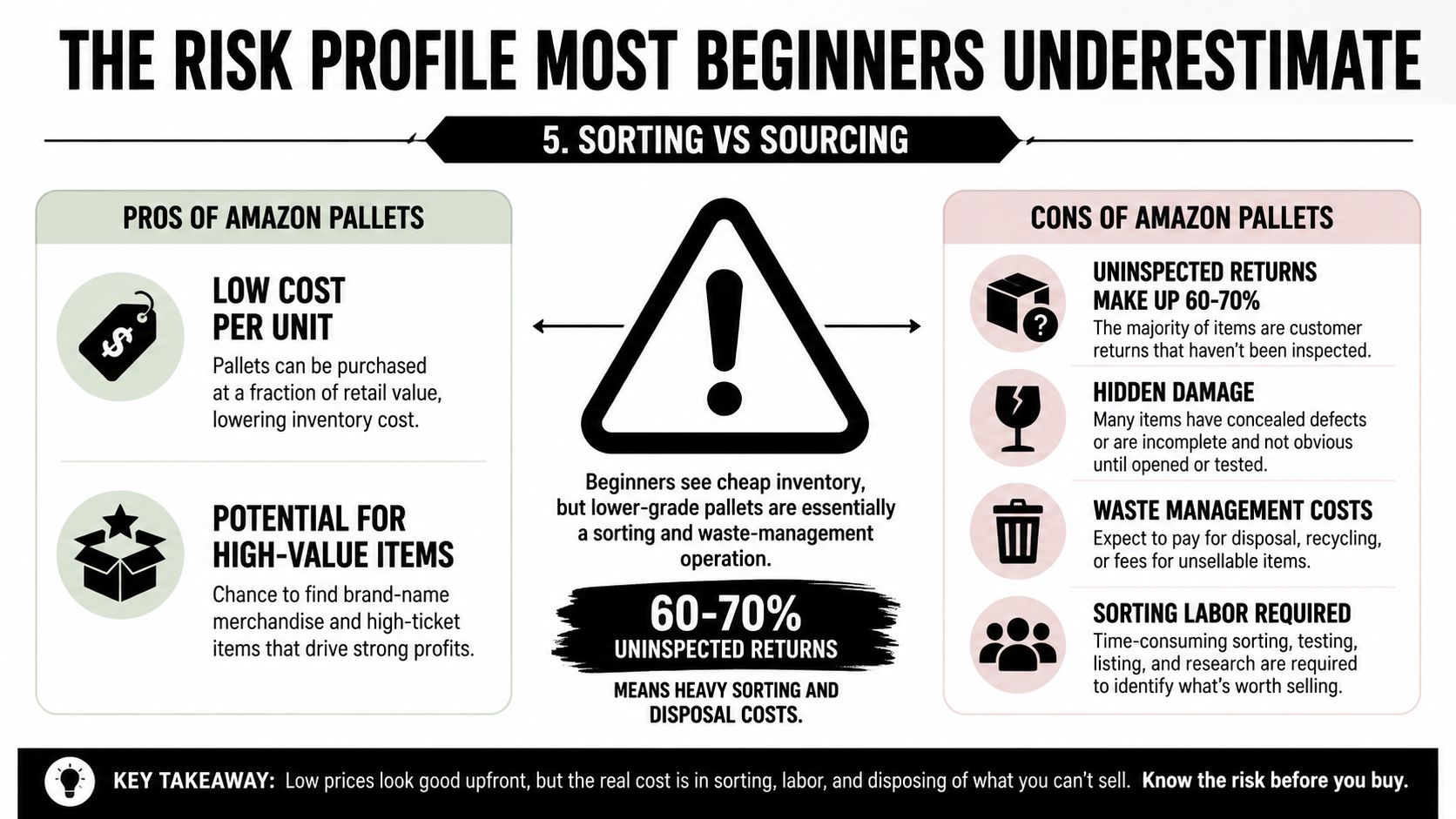
The “cheap inventory” story leaves out the work that makes liquidation profitable. A lower-grade pallet is closer to a sorting and waste-management operation than a ready-to-list wholesale order. You're paid for making hundreds of small decisions, including what to clean, what to test, what to repair, what to discount, and what to remove from the resale stream.
One neutral buying guide describes liquidation pallets as often involving uninspected returns with no substitutions, no guarantees, and no returns. That point matters more than a large retail estimate because it changes who carries the risk. Once the pallet reaches you, you may own the cost of discovery.
What can consume your margin
A mixed-condition pallet can include garments with stains, products missing accessories, items that cannot be authenticated, and goods that don't fit your customer base. Even a unit that works may be uneconomical after cleaning, testing, listing, storage, and shipping.
The risk also extends beyond the merchandise:
- Hazmat restrictions: Some products may require handling or shipping rules that limit your resale options.
- Locked or weak manifests: A limited manifest makes it harder to forecast category fit and unit recovery.
- Receiving costs: Freight delivery may require equipment, an appointment, or a suitable loading area.
- No return path: If the pallet is worse than expected, the seller may not accept it back.
- Storage pressure: Slow-moving apparel occupies space that could hold more predictable inventory.
- Channel restrictions: Certain branded or electronic items may create authenticity, warranty, or listing issues.
Sorting is not a side task. It's the product you're delivering to your own resale business.
The buyer who enjoys unboxing but dislikes inspection will struggle with lower-grade pallets. The buyer who has a repeatable intake process, several outlets, and a way to dispose of damaged goods can turn uncertainty into a workable operating model.
The market's framing is also changing. Instead of treating liquidation as a shortcut to cheap stock, buyers increasingly need to view it as a waste-management business with a resale layer. The buyer-risk discussion of Amazon liquidation pallets emphasizes the gap between headline discount and recoverable value.
The following video can help new buyers visualize the broader return-pallet model before they commit to a lot.
A Reseller Decision Checklist Before You Bid
A disciplined bid starts before the auction timer becomes urgent. Open the listing, create a landed-cost worksheet, and force every assumption into writing. If the numbers work only when every item sells at the highest possible price, the lot doesn't work.
Run the listing through six checks
Confirm the channel. Use an established liquidation marketplace and verify the seller relationship, terms, and buyer requirements. A vague social listing with no business information should stop the process.
Read the category and weight. Confirm whether the pallet is apparel, electronics, home goods, or mixed merchandise. Check dimensions and weight, then compare them with your storage and receiving capacity.
Classify the manifest. A manifested lot gives you more information than an unmanifested lot, but neither removes inspection risk. Note whether the manifest lists individual products, broad categories, or only estimated retail value.
Calculate landed cost. Add the bid, freight, platform charges, preparation, selling fees, and a conservative allowance for units you won't list. Use an actual freight quote whenever possible. A standard pallet can weigh about 400 to 1,000 pounds, and published guidance places freight around $150 to $400, so ignoring delivery can distort the entire bid. Review the pallet freight guidance before you submit.
Set a unit-level recovery target. Decide what you need to recover from each realistically sellable item. Don't base the target on MSRP. Base it on recent comparable listings, your channel's fees, and the time required to prepare the product.
Define the exit rule. If arrival condition is materially worse than the listing, document the discrepancy, follow the marketplace process, and stop buying from that source until you understand the outcome. Never respond to one bad pallet by chasing a larger pallet.
Red flags that should end the bid
- Vague contents: No meaningful category, condition, or manifest information.
- Stock-only photos: Images show ideal products but not the actual lot.
- Unclear freight terms: The seller won't explain pickup, delivery, or appointment requirements.
- Unworkable category mix: The listing includes products you can't test, clean, authenticate, or sell.
- Pressure to pay quickly: Urgency replaces documentation and inspection evidence.
- No receiving plan: You don't have space, equipment, or labor ready for arrival.
For an apparel reseller, the final question is not “How cheap is this pallet?” Ask whether your customer base wants the inventory, whether your workspace can process it, and whether you can handle the units that don't make it to a listing.
The checklist only protects you if you honor it during the auction. Set the maximum bid while the lot is calm, then walk away when competition pushes the price beyond your recovery model.
OneTrendyCloset offers curated brand-name apparel liquidation boxes, mix-and-match sourcing, and custom quotes for larger orders based on your preferred brands, budget, and quantity needs. If you want a more controlled alternative to a blind Amazon pallet, visit OneTrendyCloset to review apparel sourcing options for boutiques, online marketplaces, and live sales.