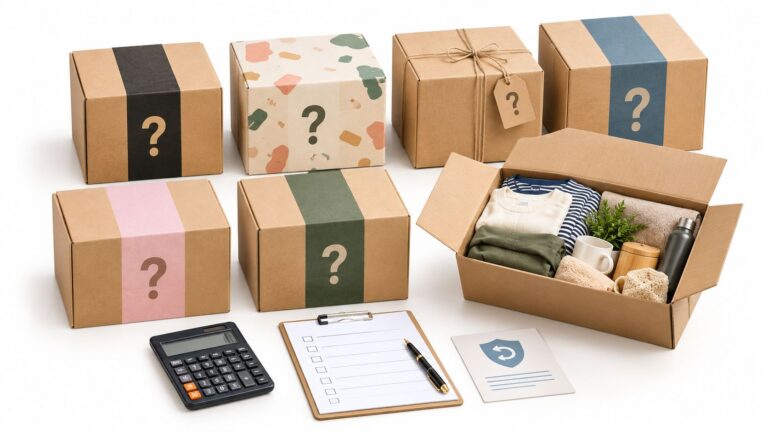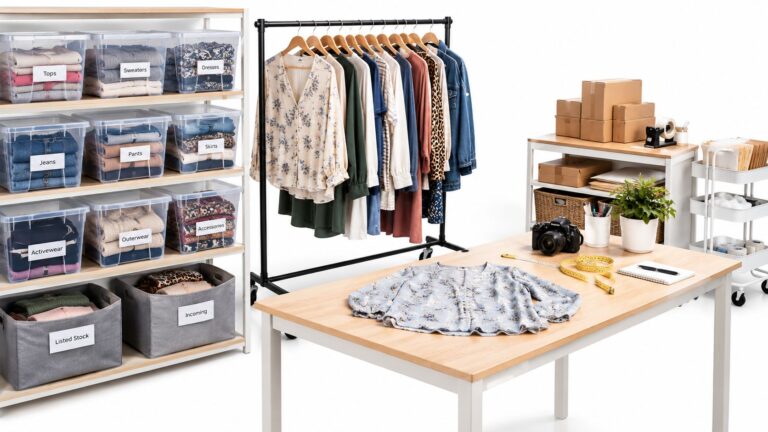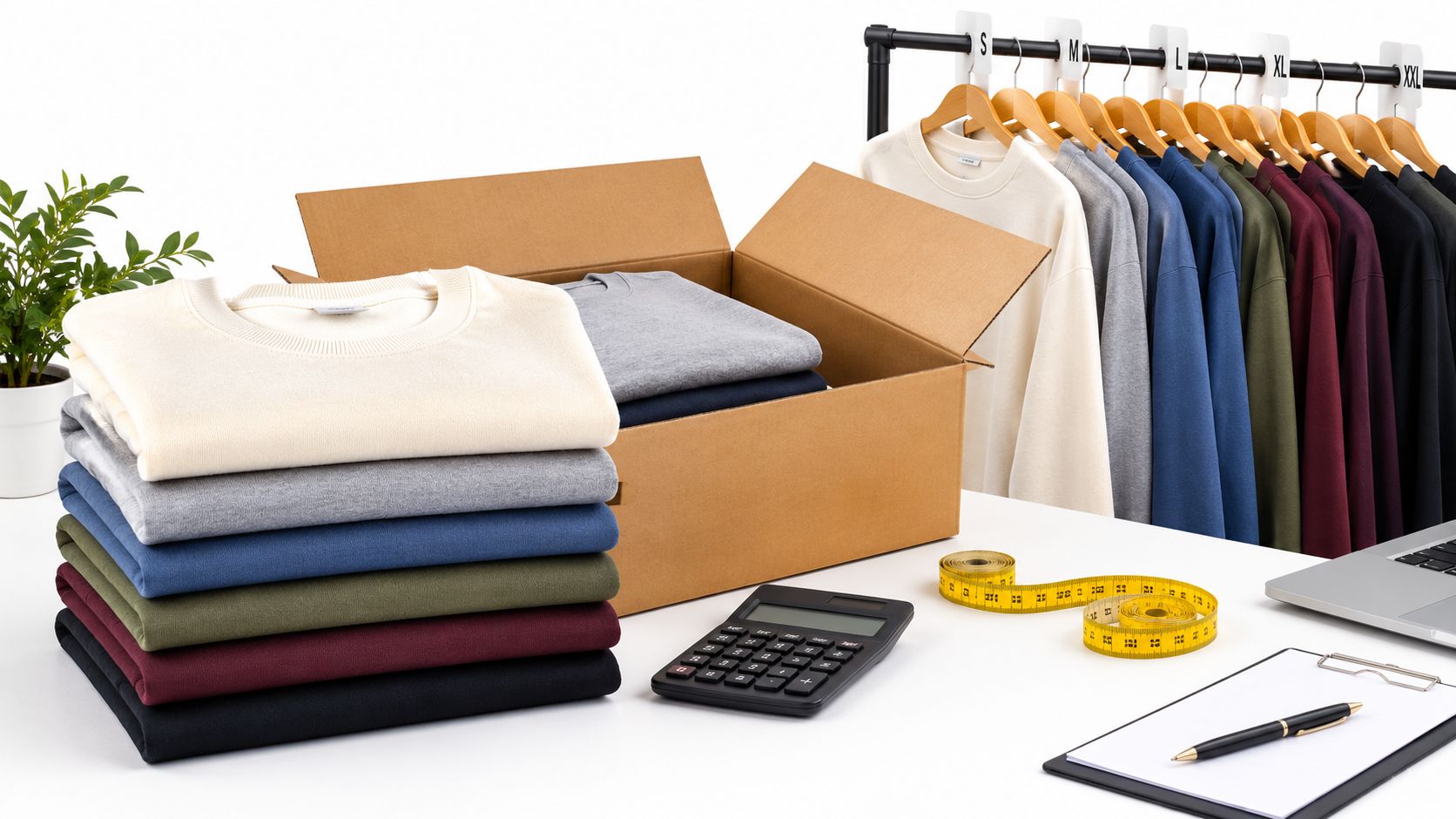
The quote in your inbox looks clean. Forty crew necks, a low unit price, and a supplier who wants a deposit today. What you don't have yet is the number that decides the buy: how much each sweater really costs after freight, rejects, and the fees on the channel where it will sell.
That gap is where crew neck sweater wholesale lots go wrong. Two boxes can share a style name and a colour and still produce completely different margins once you grade them, measure them, and count only the pieces a buyer will pay for.
Table of Contents
- Crew Neck Sweater Wholesale Costs by Sourcing Format
- Which Crew Neck Fibers Hold Resale Value
- Vetting Suppliers and Documentation to Request
- Grading Condition and Inspecting Before You Buy
- Sizing Mix and Measurements to Check
- Calculating Margin From Cost per Sellable Unit
- Listing Crew Neck Sweaters to Protect Your Margin
- Place a Test Order Before Scaling Up
Crew Neck Sweater Wholesale Costs by Sourcing Format
The table is the working answer. Each format has its own per-unit cost shape and its own stock commitment.
| Format | Typical minimum order | Price basis | Condition | Best fit |
|---|---|---|---|---|
| New overstock, single style | 50-100 units per style | Per unit, roughly $4-$10 | New with tags | Boutiques with a set size run |
| Curated mixed-brand box | Set by box size, from a smaller test box up | Flat price per box | Mostly new or like-new | Marketplace sellers and live-sale hosts |
| Custom brand lot or pallet | Quoted per order | Flat price per lot, quoted | Mostly new | Sellers with a planned brand mix |
| Secondhand bales | Large bale by weight | Per pound, quote-based | Graded, worn | Thrift and vintage sellers |
| Unsorted liquidation pallet | One pallet | Per pallet, fixed or bid | Mixed, including returns and shelf pulls | Experienced sorters with time to inspect |
Price ranges are indicative. Confirm every line on a written quote.
What the minimum and the quote include
New overstock is the tightest lock-in. The minimum usually applies per style, so 50 to 100 units means one size curve and one colour story. Shipping is often extra. Replacements for damaged pieces happen only when the quote says they do.
A curated mixed-brand box is a flat box price. You test brands in a smaller order instead of funding a full colour run. Ask whether the flat price already includes freight.
A custom brand lot is quoted per order around a brand mix you name. Treat freight, damaged units, and mislabels as separate lines until the supplier writes them in.
Secondhand bales are sold by the pound. You accept graded, worn stock and you price wear, not retail fantasy.
An unsorted liquidation pallet is one pallet, fixed price or bid. Returns and shelf pulls sit in the same stack. It suits someone who already blocks time to open every bag.
Demand sits in a wide category, not in crew necks alone. A market estimate reported U.S. revenue of US$14.17 billion in 2024 for jerseys, sweatshirts, and pullovers, with projected annual growth of 1.79% from 2024 through 2028, in coverage from Textile Today. The same estimate put global knitwear at US$732.5 billion in 2024.
Say two sellers both take the same 40-unit lot. One wires the sticker price. The other checks the style minimum, the condition, and the freight line before paying. Only the second seller knows what the sellable sweaters cost.
Practical rule: If freight, damage policy, and minimum are not on the quote, the unit price on the invoice is not your cost.
Which Crew Neck Fibers Hold Resale Value
Fiber sets the price ceiling. Construction and condition decide where a sweater lands under it. A soft hand feel does not raise that ceiling by itself.
| Fiber or blend | Typical buying position | Resale and care notes | Main risk |
|---|---|---|---|
| 100% cotton | Mid-range, year-round | Easy care; weight and neck stretch vary | Shrinkage and neck stretch |
| Acrylic or polyester blend | Low-cost basics | Machine washable; lower perceived value | Pilling and heat damage |
| Cotton-acrylic blend | Budget to mid-range | Common in mixed boxes; care labels matter | Pilling in underarms |
| Lambswool or wool blend | Mid to premium | Needs gentle care; strongest in cold-season demand | Felting and moth damage |
| Merino | Premium | Holds value well when clean and well graded | Wrong care method causes damage |
| Cashmere or cashmere blend | Premium | Highest value per unit; blend percentage must be verified | Pilling and misdescribed content |
Sweaters represented about 10.3% of apparel resale market share in 2025, and cashmere and merino products can retain roughly 50–65% of original retail value in managed resale environments, according to figures cited via the DataIntelo apparel resale market report. Those retention figures are not a promise for your next box.
Where a wool-is-best rule fails
Cotton is the year-round workhorse. It sells without a care lecture, and a heavy, even knit often outlasts a thin luxury yarn.
Acrylic and polyester blends are the live-sale engine. They wash in a machine and they rarely support a boutique price. Heat from a dryer flattens the hand and makes pills look worse in photos.
Cotton-acrylic blends fill mixed boxes. Read the care label before you promise machine wash in the listing.
Lambswool and wool blends earn their keep in cold months. Felt them once in a hot wash and the piece is a loss.
Merino holds a premium only when the knit is dense, the grade is honest, and the buyer gets the right wash method.
Cashmere has the highest ceiling per unit, and a blend is still a blend. Resale follows the percentage printed on the label, not the word cashmere in your title.
A loose, thin cashmere crew can pill faster than a dense cotton crew that sells for less. Premium fiber with weak recovery, missing care labels, or a colour that dies after January is a slow unit, not a trophy.
Match the fiber to the channel. Basics and acrylic blends belong in high-volume live sales. Clean merino and verified cashmere, with tight photos and an honest grade, belong with boutique and marketplace buyers who will wait for the right person.
A low unit cost is a trap when the lot pills, shrinks, or sits until spring.
Vetting Suppliers and Documentation to Request
A sharp price with no paperwork leaves you with listings you cannot defend. If a buyer disputes fiber, origin, or care, the label is your evidence, not the supplier's email.
The FTC clothing and textiles guidance requires most covered textile products to disclose fiber content, country of origin, and the identity of the manufacturer, importer, or responsible marketer. Fiber percentages must generally be listed by generic fiber name and in descending order of predominance.
| Document | What it must show | What you may say in a listing |
|---|---|---|
| Fiber content | Generic names, percentages, highest fiber first | Only the blend on the label |
| Country of origin | Where the garment was made | The origin printed, not a guess |
| Responsible business | Manufacturer, importer, or marketer | Don't invent a maker |
| Care instructions | A real cleaning method, including hand or machine and water temperature | The method on the label |
Care instructions must be available when the garment is offered for sale, and they must state an appropriate cleaning method. Washing directions generally include whether washing is by hand or machine and the permitted water temperature.
How you use each document
Fiber content changes the price band and the return risk. Call a piece wool, cotton, or cashmere only when the label says so. A cashmere claim has to show the blend. Implying a higher cashmere share than the garment contains is how disputes start.
Country of origin and the responsible business name matter when a marketplace asks who stands behind the goods. Keep the original neck label and care label on the sweater. Inventory fiber, origin, care method, and label condition before you write a title.
Sample, then scale
Order a small sample from the lot you intend to buy. Check fibers and sizes against what was promised. Scale only after that sample matches.
Put these questions in writing:
- Trading history: How long has the company sold apparel this way, and can they point you to a wholesale clothing supplier process you can compare?
- Freight: Does the custom quote include shipping, or is freight billed later?
- Damage and mislabels: Are damaged or mislabelled pieces replaced, credited, or your problem?
- Brand mix: Can you choose brands, or is the assortment blind?
If you may sell into Europe, expect more detailed physical or digital textile labelling around durability, recyclability, and sustainability. In June 2025 the European Commission introduced a science-based method for measuring clothing and footwear environmental impact across the full lifecycle, as described in the European Commission announcement. A recycled claim alone does not prove a lower total impact. Keep evidence before you print any eco line.
Grading Condition and Inspecting Before You Buy
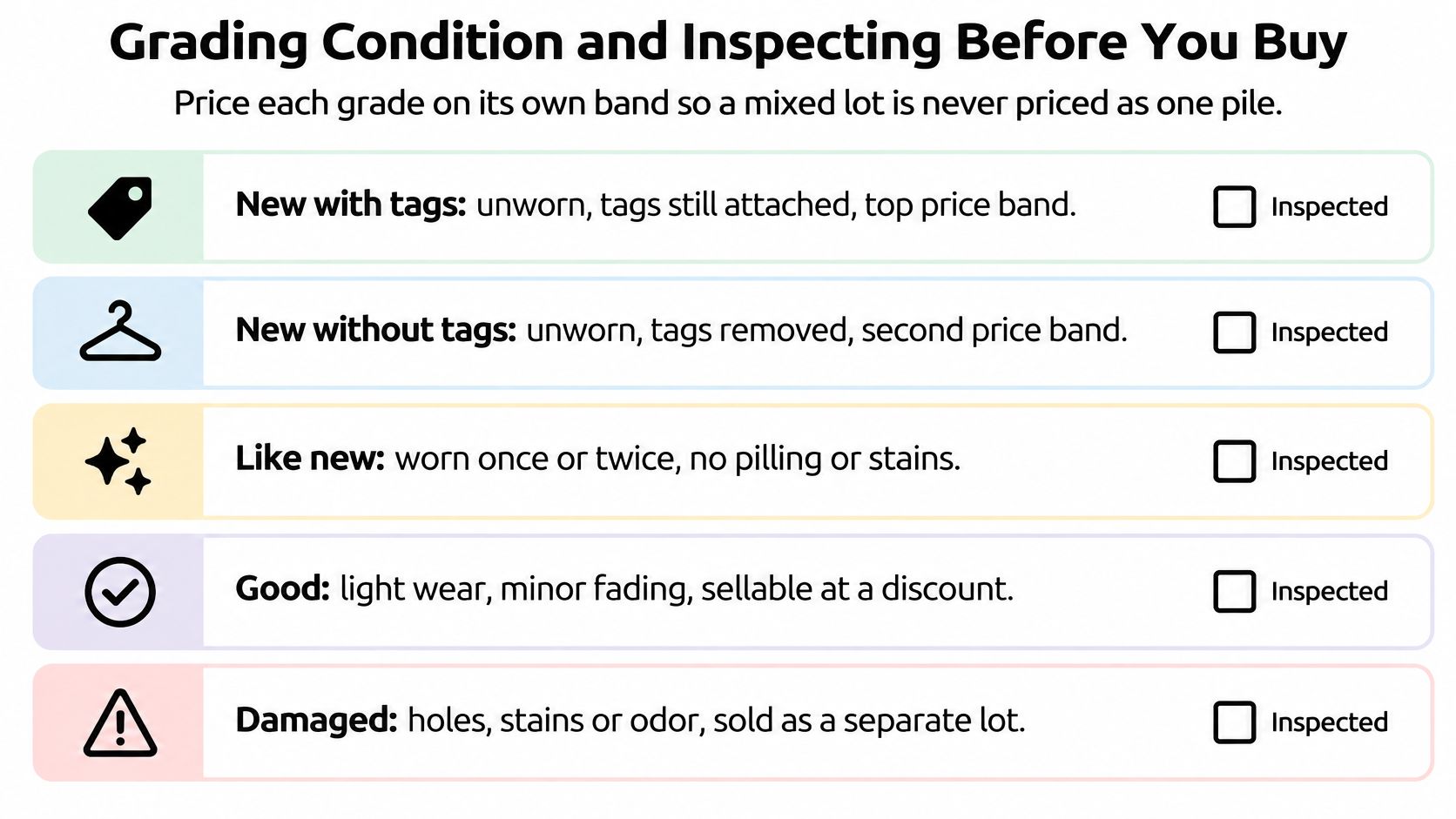
Price each grade on its own band. A mixed lot is never one pile with one price.
| Grade | What the sweater looks like | Typical use | Pricing approach |
|---|---|---|---|
| New with tags | Unworn, tags attached | Full-price retail | Closest to retail resale value |
| New without tags | Unworn, tags removed or missing | Full or near-full price with clear listing | Priced below new with tags |
| Grade A, like-new | Lightly worn or sample; no visible pilling | Retail or near retail | Priced to sell; photos must show detail |
| Grade B | Light pilling or minor marks; shape intact | Discount or bundle | Priced for fast turnover |
| Grade C or reject | Holes, heavy pilling, odour, stretched neck | Rework or donation | Excluded from full-price lots |
These names are internal shorthand. Every public listing still needs the actual condition in plain words.
New with tags carries the top band because the buyer can see the garment was never worn. New without tags is still unworn, and it sits a step under tagged goods because you cannot prove the tag story. Grade A needs photos that show the underarms, not a single glamour shot. Grade B is a discount or a bundle, built to move. Grade C stays out of full-price lots. Holes, heavy pilling, odour, or a blown neck do not average out against a clean piece in the same box.
Inspection sequence
Run the same order on every unit you sample:
- Labels: Confirm fiber and care labels are present and readable.
- High-friction zones: Lay the sweater flat. Check underarms and side seams for pills.
- Edges: Check neckline rib for stretch and cuffs for moth holes.
- Odour: Smell test. Perfume and storage smell both kill a sale.
- Photos: Shoot each high-friction zone before you forget which unit it was.
- Call: Mark the piece acceptable, watch, or reject. That maps to Grade A, Grade B, and Grade C.
A repeatable call beats a perfect eye. You and a helper should land on the same grade from the same notes.
ASTM D4970/D4970M specifies the Martindale method for pilling and related surface changes on knitted fabrics. Material thickness can affect whether the test fits, so lab results should be compared only among fabrics of similar construction and weight. Most resellers will not lab-test every crew neck. Keep a small retained sample from each brand and fabric, and use the same internal rub-and-photo check.
Inspect several units from every brand and fabric in the lot. One clean sweater says almost nothing about the other forty.
Sizing Mix and Measurements to Check
The measurement that settles a fit argument is flat pit-to-pit width. Body circumference is roughly double that flat width. A crew neck that measures 20 inches flat fits a chest of about 40 inches. Buyers compare that number faster than they trust a letter on a label.
| Size | Typical share of a balanced size run |
|---|---|
| XS | 5-10% |
| S | 15-20% |
| M | 20-25% |
| L | 20-25% |
| XL | 15-20% |
| XXL | 5-10% |
Treat those shares as a planning mix, not a promise from any one brand. Label sizes drift. A size M from one maker can measure like an L from another. A ribbed neckline also stretches with wear, so a crew that was snug on the hanger can hang loose after a season of try-ons.
How to check a lot
Ask the supplier for the size breakdown in writing before you pay. When the box arrives, measure three units per size, flat, on a table, pit to pit and shoulder to hem. Record any size that falls outside the run you expected. If two of three mediums miss the width you use for that letter, the label is not your listing size.
Then look at the mix against your buyer.
- Heavy XS or XXL: Fine for a shop that already sells those sizes. Painful for a general marketplace account that lives on S through L.
- Concentrated S through L: The default fit for most marketplace listings and live sales.
- One size only: Works for a boutique with a known customer. It strands everyone else.
On every listing, state the flat measurement in centimetres and inches. Shoppers who ignore the letter size still understand a number.
Measure three units per size yourself. A brand size chart is not the garment in the box.
Calculating Margin From Cost per Sellable Unit
Cost per sellable unit equals total landed cost divided by the units you can sell at an acceptable price. Rejects stay in the cost. They do not stay in the count.
The five steps below are the whole job. The picture is the short version. The numbers are a worked example, not a market rate.
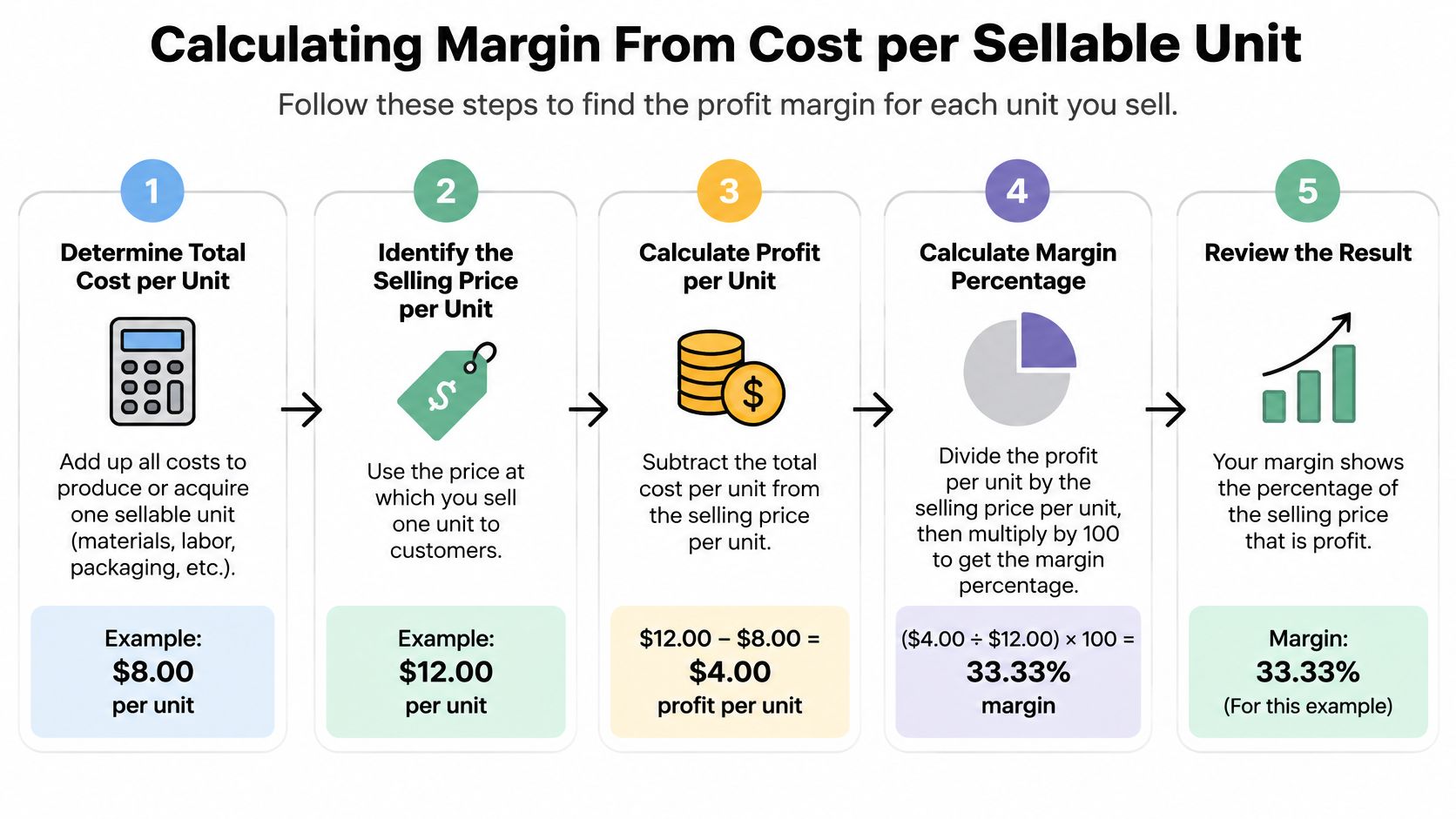
Say a 40-unit lot costs $400 and shipping adds $40. Sorting time is tracked separately, so it is not inside the $440.
- Add the money out. Lot price, freight, duties, and fees. Here that is $400 plus $40, so $440.
- Count sellable units after inspection. If 4 units are unsellable, 36 remain.
- Divide. $440 divided by 36 is about $12.22 per sellable crew neck.
- Net the sale. If the average sale is $28 and the platform takes 15% in this example, net is about $23.80.
- Compare with the channel target. $23.80 minus $12.22 leaves about $11.58 before labour. If that misses your target, the lot is too expensive for that channel.
A fuller walk-through of quote math sits in this guide to how to figure a wholesale price.
Same sweater, different channel
| Channel | Pricing approach | Costs to subtract | Sell-through risk |
|---|---|---|---|
| Boutique in-store | Near retail for new; discount for graded pieces | Rent and staff time; no platform fee | Seasonal; slow outside fall and winter |
| Marketplace, such as Poshmark, eBay, Mercari or Depop | Listing price with buyer offers | Platform commission and shipping | Competitive; photos and sizing drive results |
| Live sale, such as Whatnot | Bundles and starting prices | Platform fee and payment processing | Fast turnover; needs an audience and bundling |
| Wholesale to other shops | Below retail per unit | Shipping and pack-out time | Lower price, lower effort |
Check current fee schedules before you set a target. A boutique sale has no platform cut, and it still carries rent and staff time. A marketplace sale gives the fee back in reach, then shipping and offers eat the rest. A live sale moves units when you bundle, and it needs an audience that shows up. Wholesale to other shops is the lowest price and the least listing work.
The same crew neck can clear your number in one channel and miss it in another. A per-unit margin only matters if those units sell inside the season you bought them for.
This short walk-through shows the same cost-to-price path in motion.
Listing Crew Neck Sweaters to Protect Your Margin
Write the title in the order buyers search: brand, crew neck, fiber, size with the flat measurement, and condition in plain words. "Navy merino crew, size M, 20 in / 51 cm pit to pit, light wear" beats a pile of adjectives.
Shoot the set in natural light.
- Front and back: Full garment, flat, no heavy filter.
- Neck label and care label: Close enough to read the fiber line.
- Knit: A tight crop of the stitch.
- Underarm: Required when your internal call is watch, not only when you feel like it.
Honest condition notes protect margin better than the word excellent. Light pilling, stated clearly, cuts returns. A vague excellent on a Grade B sweater creates the return, the refund fee, and a buyer who does not come back. The public note should match the internal grade. If you would not put it in a full-price lot, do not describe it as full price.
Set a price band per grade instead of guessing sweater by sweater. Check recent sold listings for comparable crew necks, then leave room for offers. Guessing item by item is how a Grade B sneaks up to a Grade A price and sits.
List heavier fall and winter crews in late summer. Move lighter cotton crews toward spring. Knit demand bunches in colder months, and a January-only drop leaves you discounting in April.
Bundles and multipacks fit marketplaces and live sales. A single high-value merino piece needs the full photo set, not a bundle thumbnail.
State the blend percentages printed on the label. Never type a higher cashmere or wool figure than that label shows.
Place a Test Order Before Scaling Up
I would not scale a pallet until a small lot clears the number you already use for that channel.
- Pick the lane. One channel and one grade mix you can sell this season.
- Buy small. A test box or sample lot, not a full pallet.
- Run the math on real units. Inspection, flat measurements, and cost per sellable unit.
- Scale only if it holds. Cost per sellable unit stays under your target, and sell-through holds for several weeks.
Before you pay, get fiber, condition, and the size breakdown in writing. Match those pages to the documents you already require from a supplier. Run the same test on every supplier so the comparison stays fair. The ordering steps in this how to order wholesale walkthrough are a useful checklist for that first box.
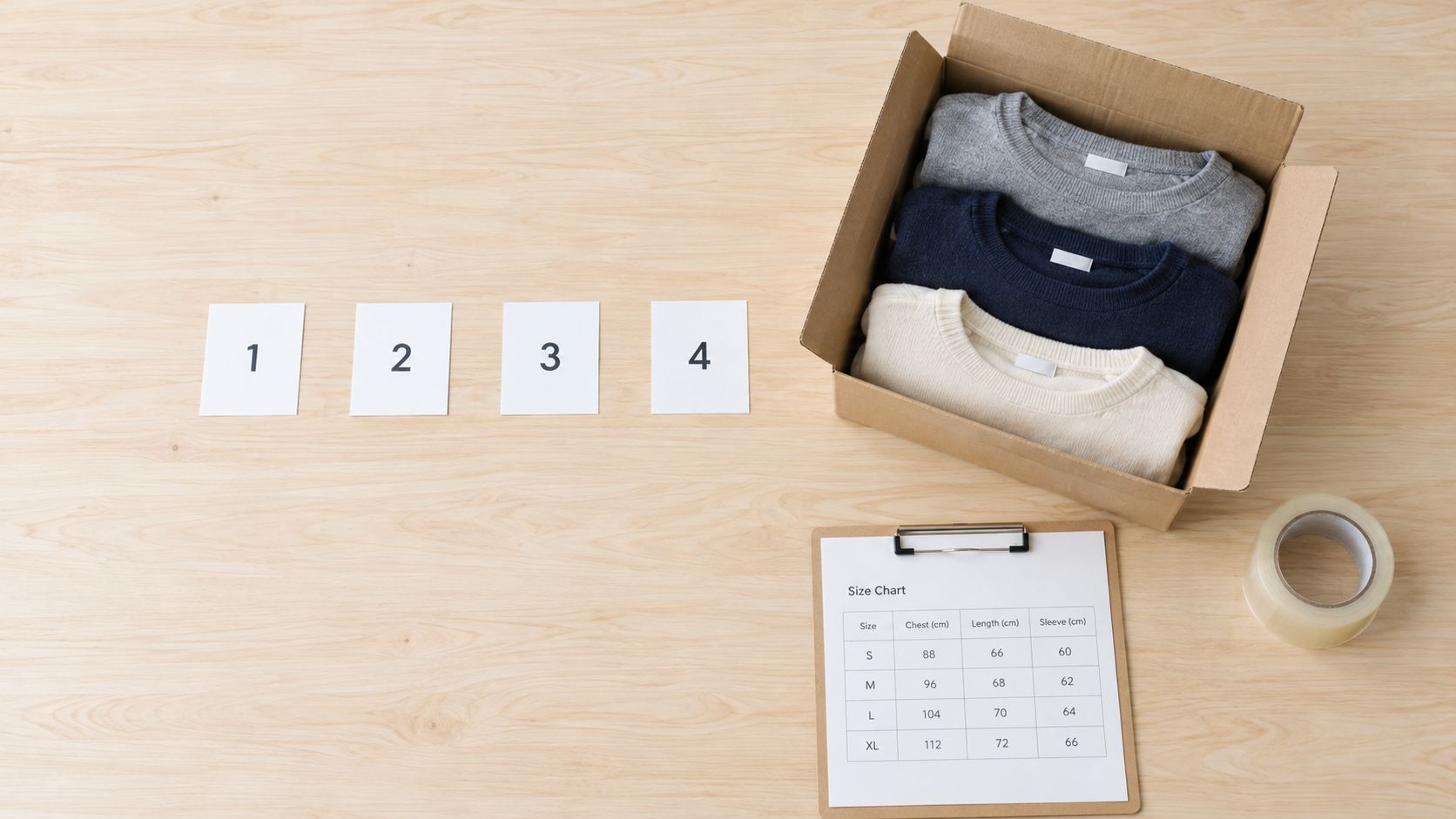
If the test passes and you want a curated option, OneTrendyCloset sells curated liquidation boxes of brand-name apparel in several box sizes, lets buyers influence the brand mix through a build-your-box approach, and offers custom quotes for made-to-order boxes or pallets as volume grows. The company states that it works with 24+ brand partners and serves boutiques, marketplace sellers, and live-sale hosts. Policy details sit in the company's FAQ.
If your next crew neck buy should be a measured test instead of a blind pallet, OneTrendyCloset builds brand-name liquidation boxes you can size to a first order and later expand with a custom quote. Use that box to run grades, flat measurements, and cost per sellable unit before you commit to a pallet. Start with one channel, one grade mix, and a written size breakdown, then scale only if the number still works.