You're staring at the same New York vendor names again. The addresses look familiar, the photos look polished, and the prices seem close enough, but you still can't tell which suppliers fit your business and which ones are just good at looking busy online.
That's the core problem with new york wholesalers clothing. The city still matters, but directories alone won't tell you who ships fast, who answers reliably, who sells genuine wholesale, or who's just recycling the same showroom listing with a different phone number.
Table of Contents
- Why New York Still Matters for Clothing Resellers
- Understanding the New York Wholesale Market Structure
- Finding Suppliers Beyond Directory Listings
- Verification Criteria That Actually Protect Your Business
- Choosing Between Showroom Visits and Remote Sourcing
- Building Sustainable Supplier Relationships
Why New York Still Matters for Clothing Resellers
New York still comes up in sourcing searches for a simple reason, the market is still large enough to reward careful buyers. IBISWorld estimates New York's Piece Goods, Notions & Other Apparel Wholesaling industry at $2.6 billion in 2026, with 1,313 businesses and 4,315 employees. The same IBISWorld report also shows the market declining at an average annual rate of -1.2% in market size from 2021 to 2026, which makes one point clear, New York is still a major sourcing hub, but it is not a place to shop casually.
Resellers do not buy from a map, they buy from a supply chain. New York's fashion economy has been built around wholesale trade for a long time, and the city's wholesale market still matters because it connects brands, showrooms, and buyers at scale. An NYCEDC fashion study says the city's wholesale market accounts for 27% of the U.S. wholesale market and draws more than 578,000 domestic and international visits each year through its 75 major trade shows and thousands of showrooms.
The practical advantage is access to inventory, price comparison, and vendor density in one place. Boutiques, marketplace sellers, and live-sale hosts still source there because the city gives them more options to verify a supplier before they place real money behind an order. The core fashion industries employed 130,170 workers in 2022 and paid nearly $8.8 billion in wages, with roughly one-fifth of those workers in wholesale, according to the same NYCEDC study.
That scale does not make a vendor trustworthy. It just means there are enough legitimate operators to make verification worth the time.
Practical rule: New York is still worth sourcing from, but every vendor should stay unproven until they show you terms, structure, and consistent communication.
The city also runs on two buying models now. Some suppliers still depend on appointment-only showroom traffic, while others use hybrid ordering, off-site fulfillment, and remote communication. For resellers outside NYC, that shift changes the job from visiting showrooms to checking whether a vendor can handle remote buying without drifting on quality, timing, or follow-through.
Understanding the New York Wholesale Market Structure
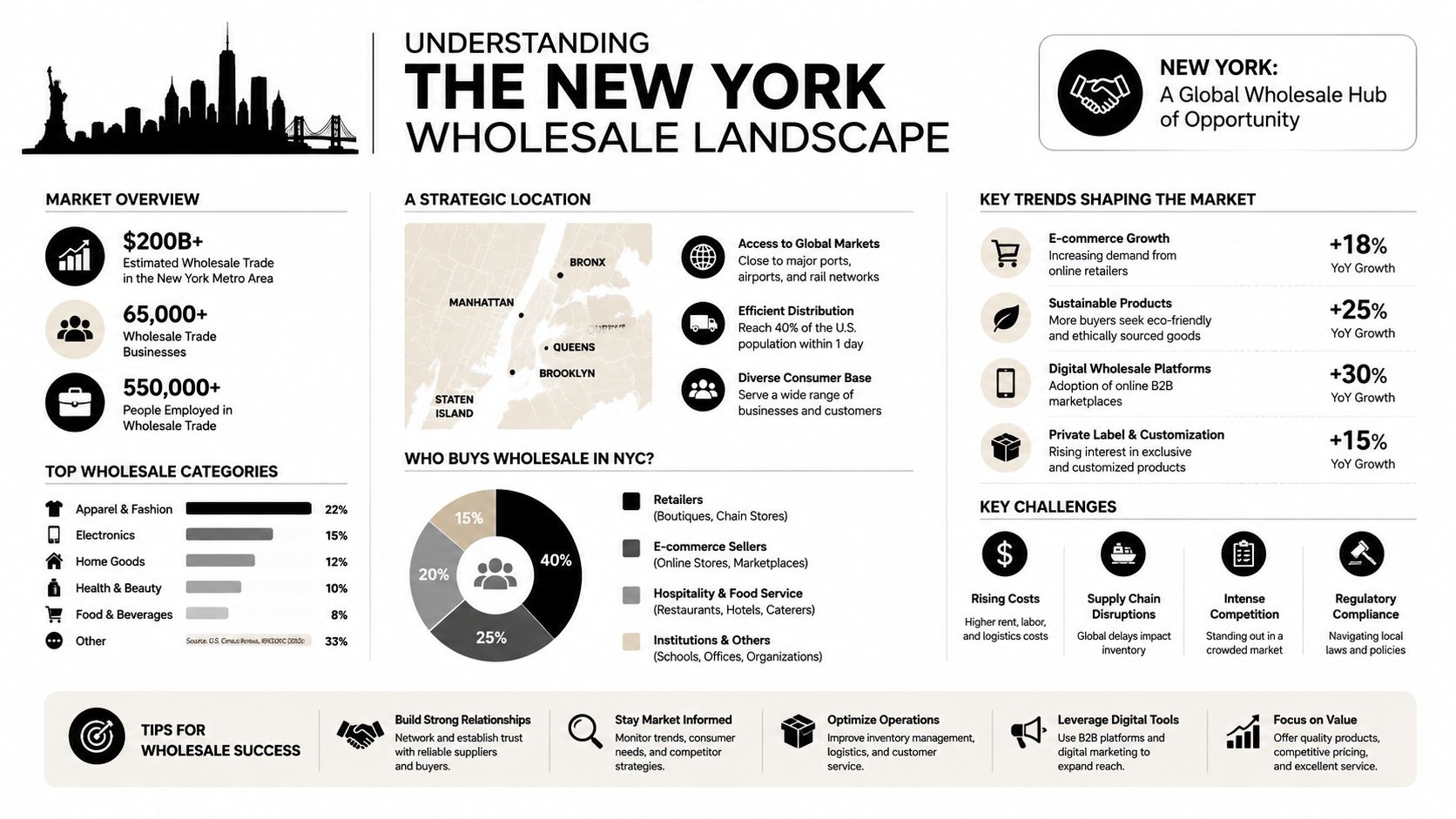
New York's wholesale clothing market is still large, but the essential story is how tightly it is being shaped by consolidation and tighter seller discipline. A buyer can still find plenty of options, but the room for casual ordering has narrowed. That matters because weak vetting gets expensive fast when margins are already thin.
What the market structure tells you
The old Garment District showroom model still exists, but it is only one part of the buying mix. Some suppliers work from borough warehouses, and others combine showroom appointments, remote quoting, and shipping into a hybrid setup. For resellers outside NYC, that hybrid model often matters more than a polished address or a busy lobby.
McKinsey's look at New York fashion says the city generated more than $50 billion in direct sales, $45 billion in indirect sales, and more than 130,000 jobs in 2022, while the local industry's inflation-adjusted gross regional product has been declining since 2014 and fell 19.6% from 2019 to 2020 (McKinsey). That mix of size and pressure is exactly why sourcing discipline matters. There is still depth in the market, but stability is not something a reseller should assume.
Product specs need to be set before a buyer asks for quotes or samples. Brand tier, seasonality, size ratio, and defect tolerance should all be clear up front. If those standards are fuzzy, New York suppliers will still sell something, and the order may be wrong for your margin, your customer, or your channel.
What consolidation means for small buyers
Consolidation can work in a disciplined buyer's favor. The suppliers that remain tend to be more process-driven, more brand-aware, and more selective about who they serve. That helps if your goal is repeat inventory instead of one-off opportunistic buys.
It also means minimums, turnaround, and communication style can vary a lot from one vendor to the next. Some are built for boutique accounts, some want larger wholesale relationships, and many sit somewhere in between. The safe assumption is that “New York wholesale” describes a sourcing area, not a uniform seller profile.
Buyer takeaway: Treat New York as a dense sourcing field, not a single market. The supplier's business model matters more than the borough on the address.
That mindset keeps you from paying a premium just for proximity. It also helps you decide whether a supplier fits a test order, a seasonal replenishment plan, or a longer-term buying relationship.
Finding Suppliers Beyond Directory Listings
Most directory pages stop at the phone number, and that is where a lot of bad sourcing starts. A supplier can look legitimate on paper and still be a broker, a lead list, or a showroom that does not really serve your order size. Use directories as a lead source, not a decision tool.
Where to look first
Trade shows still matter because they let you compare vendors quickly and see how they present inventory in person. New York's fashion ecosystem still pulls serious buyer traffic through showrooms and trade events, which makes those settings useful for checking whether a vendor has real product depth and active accounts, as noted earlier in the previously mentioned NYCEDC study. If a supplier only looks convincing in a directory but gets vague at a show, that tells you plenty.
Reseller communities are useful too. Search how Poshmark, eBay, Mercari, and live-sale sellers describe suppliers they reorder from. Do not chase hype. Look for repeated mentions of consistent packing, predictable grading, and realistic issue resolution.
Vendor pages also reveal a lot when they are written with enough care. You want to see whether they handle mixed lots, brand-name overstock, liquidation boxes, or showroom-only appointments. A site that hides the business model is harder to trust than one that explains it clearly.
Search in ways directories do not
Use search phrases that match the buying model you need, not just the city name. Terms like liquidation boxes, mixed lots, overstock apparel, and hybrid wholesale ordering help separate resellers' suppliers from fashion-industry showrooms that may not fit your workflow. That habit saves time because it filters out vendors who do not serve smaller buyers.
When a supplier offers remote support, look for specifics. Do they answer by email, let you request quotes, or post box composition details? Do they show current hours, multiple locations, or shipping coverage? Those small details matter because they tell you whether the company is built for actual order flow or just for appearance.
One option in the market is OneTrendyCloset, a wholesale supplier of brand-name apparel liquidation boxes that offers mixed-brand boxes and custom lots for boutiques, online marketplace sellers, and live-sale hosts. That does not replace due diligence, but it does show the kind of hybrid sourcing model many resellers now look for.
Verification Criteria That Actually Protect Your Business
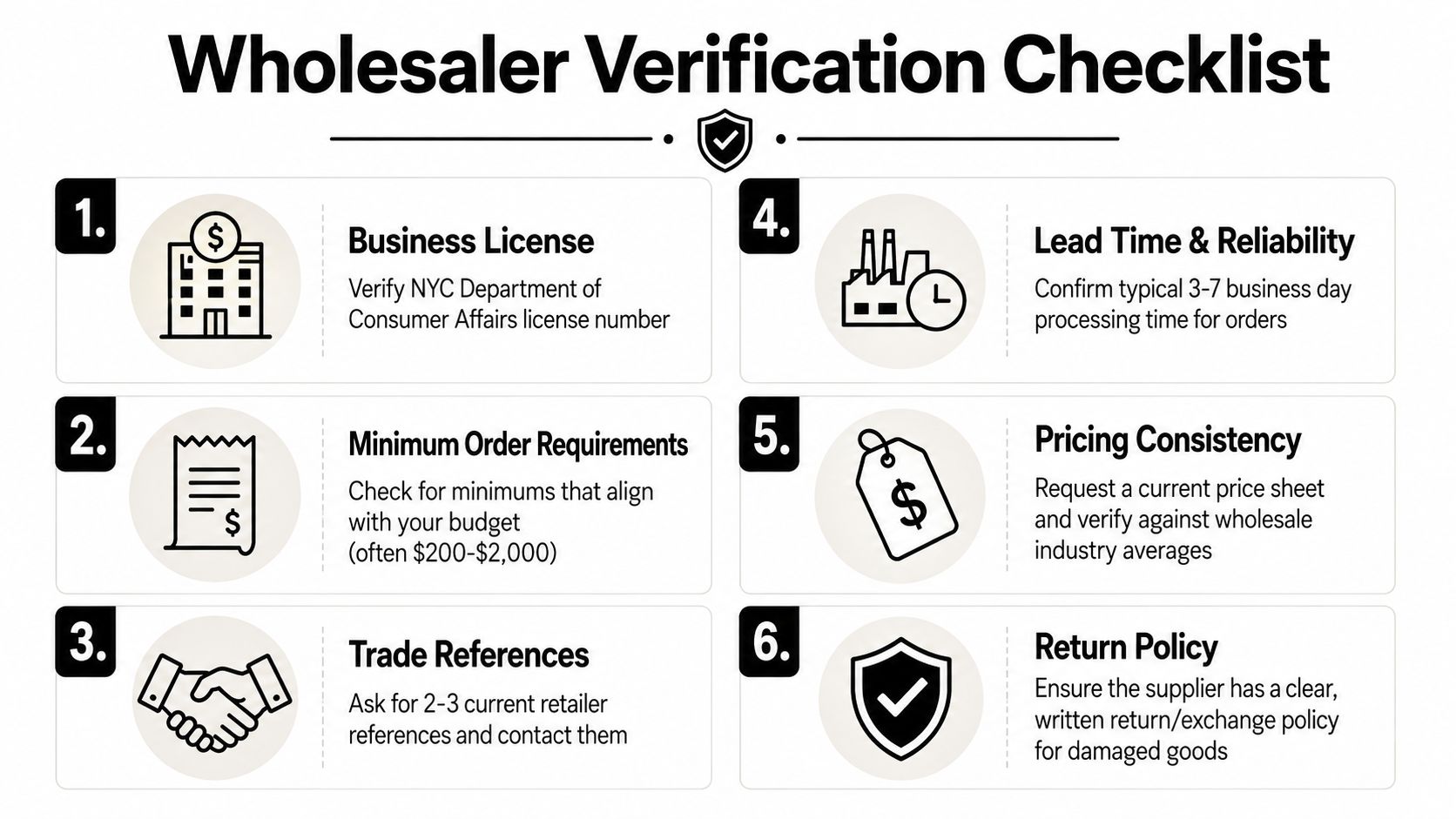
Most buyers get hurt at this stage. A supplier can sound professional, answer fast, and still be wrong for your business if they can't prove they're real, reliable, and clear about terms. The first filter is simple: ask for the business name, resale process, and a written policy before you send money.
What to verify before ordering
Check whether the supplier can state its business identity clearly. If the company won't give you a proper business name, a current contact channel, or a straightforward explanation of how orders are fulfilled, move on. Vague descriptions are one of the fastest signs that you're dealing with a middle layer rather than a real source.
Ask how they handle returns, especially for damaged goods. If that policy lives only in a rushed phone conversation, it's not good enough. You want something written, even if it's brief.
A strong vetting list should also include references. Ask for two or three current retailer references and contact them. You're looking for answers about packing accuracy, response time, and whether the supplier's grading matches the lot received.
Practical rule: If a vendor pressures you to buy immediately, they're trying to shortcut your judgment. Legitimate wholesalers can usually wait long enough for a basic verification check.
Red flags that save money when you notice them early
Watch for vague product descriptions. “Assorted brand-name apparel” sounds fine until you realize there's no mention of condition, size spread, seasonality, or whether items are first quality, shelf pulls, or mixed-grade stock. The more generic the lot description, the more carefully you need to inspect the sample.
Minimum order requirements matter too. A minimum that's too high can trap cash flow, while a minimum that's suspiciously low can indicate a broker, a dropshipper, or a lead broker trying to close fast. You want a minimum that fits your budget and your selling channel.
Fulfillment timing matters just as much. If a supplier can't tell you how long processing usually takes, you're the one carrying the inventory risk. Start with a smaller order, check the packing and communication, then scale only if the experience matches the pitch.
A practical test is to compare what they say on the phone with what arrives in writing. The best wholesalers don't force that comparison because they're already organized. The weak ones rely on hope and urgency.
Choosing Between Showroom Visits and Remote Sourcing
Some buyers still need to touch the fabric before they commit. Others need faster replenishment and can't afford to spend days in transit. The best sourcing model depends on your stage, your location, and how much inventory risk you can carry at once.
What in-person buying does well
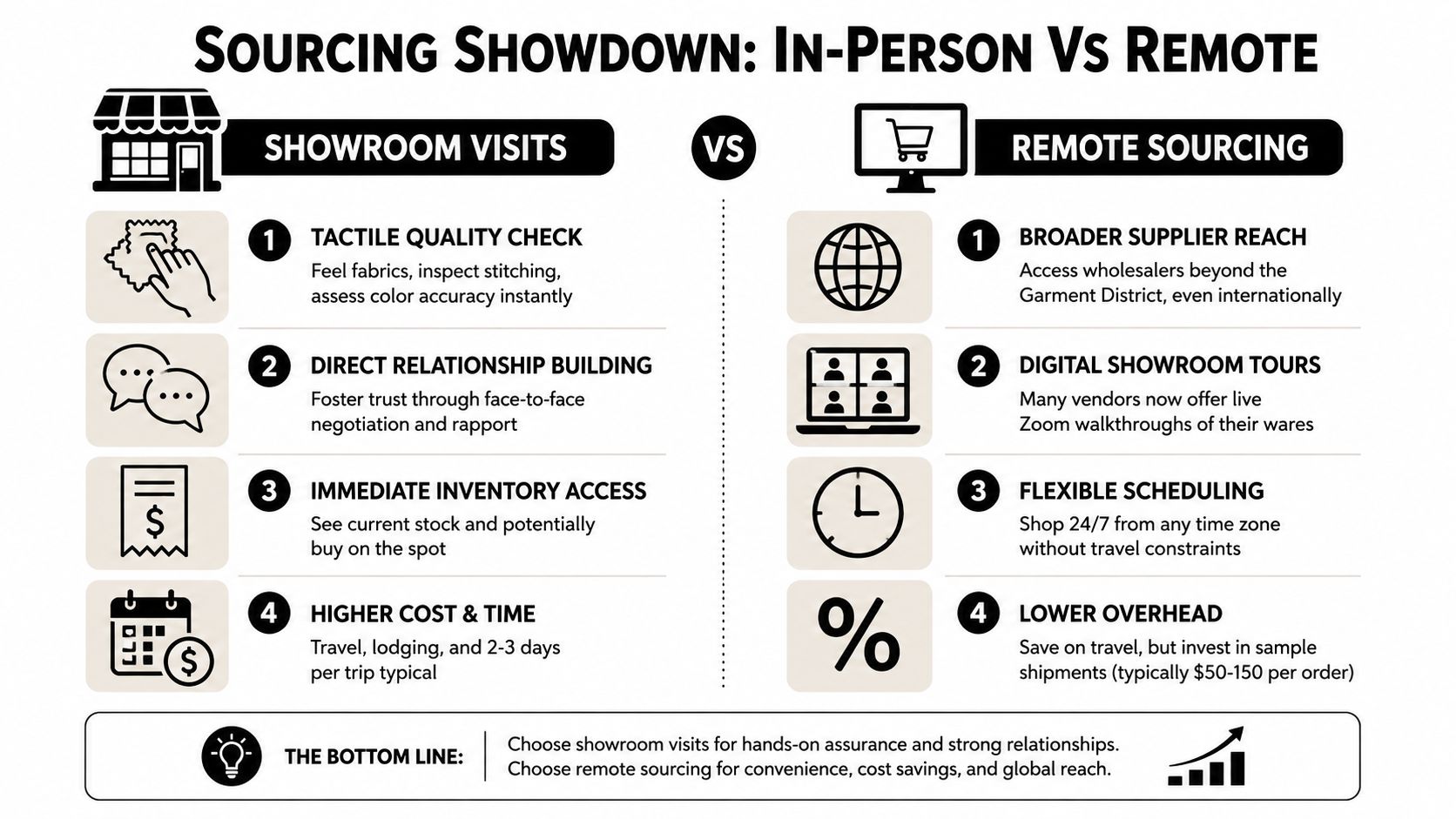
Showroom visits still have real advantages. You can feel fabrics, inspect stitching, and spot color issues immediately, which is hard to replicate through photos. Face-to-face conversations also make it easier to judge whether a supplier understands your category and your margin targets.
The downside is overhead. Travel, lodging, and lost selling time add up quickly, and a trip can make sense only if you're able to see enough product to justify the expense. If you're buying for a boutique or need to inspect a high-value lot, the trip can be worth it. If you're restocking a fast-moving resale business, the calendar cost may be too high.
Why remote sourcing keeps growing
Remote sourcing fits buyers who care more about speed and flexibility than about standing in a showroom. Hybrid suppliers now use digital walkthroughs, email quotes, shipping, and mixed offline-online ordering to serve sellers outside New York. That model is especially useful for marketplace sellers and live-sale hosts who need repeat access without traveling every time.
Remote buying does come with a trade-off. You lose tactile inspection, so you need to compensate with samples, clear photos, and tighter written terms. Small test orders are the cleanest way to do that. The sample cost is easier to absorb than a bad pallet.
How to choose your model
Use showroom visits for category validation, relationship-building, and larger commitments. Use remote sourcing for replenishment, rapid testing, and geographic flexibility. Use a hybrid approach when you want the confidence of a real supplier relationship without the overhead of constant travel.
The right model is usually the one that keeps your inventory moving. For some sellers, that means a few in-person buys per year and remote reorders in between. For others, it means never stepping foot in a showroom at all, but still verifying every supplier as if they were next door.
Building Sustainable Supplier Relationships
The first order only proves that a supplier can take your money. The second and third orders prove whether they can support your business. If you want reliable sourcing, you need communication habits that make repeat buying easier for both sides.
How to become a buyer suppliers want to keep
Be specific in your requests. Say what category you need, what condition level you'll accept, what sizes matter most, and what your budget range looks like. Suppliers reply better when they don't have to decode your intent.
When a lot lands, send usable feedback. If the size spread was off, say so. If the packing held up, say that too. Good suppliers use that information to refine future pulls, and bad suppliers often reveal themselves the moment they have to respond to a concrete issue.
Payment terms usually improve after trust is established. That doesn't mean you should push for favors too early. It means you should show consistency, pay on time, and reorder in a way that makes your account worth serving.
How to scale without making sourcing chaotic
Diversify your supplier base slowly. A single source can be fine when you're testing a category, but you don't want your whole operation dependent on one vendor's inventory cycle. Spread risk by keeping one primary source and one backup in each category you sell.
Seasonal planning matters too. If you know your channel moves certain items faster, reserve your best lots for the periods when demand supports them. New York's scale can tempt buyers into overbuying, but disciplined inventory rotation usually protects margin better than chasing volume.
A solid supplier relationship also saves time when problems happen. If a shipment is short, damaged, or misgraded, a vendor who knows your account is more likely to resolve it cleanly. That's worth more than a flashy one-time deal.
Buyers who keep records, reorder thoughtfully, and ask direct questions usually get better treatment over time.
That's the key advantage of treating wholesale as a relationship business. You stop hunting every week, and you start building a supply chain that behaves more like an asset than a gamble.
If you want brand-name apparel liquidation boxes, mixed-brand lots, and a sourcing option built for resellers who need fast replies and clear order flow, visit OneTrendyCloset. It's a practical place to compare box sizes, custom lots, and replenishment options if you're building a clothing resale business around dependable inventory.
Prepared with Outrank tool