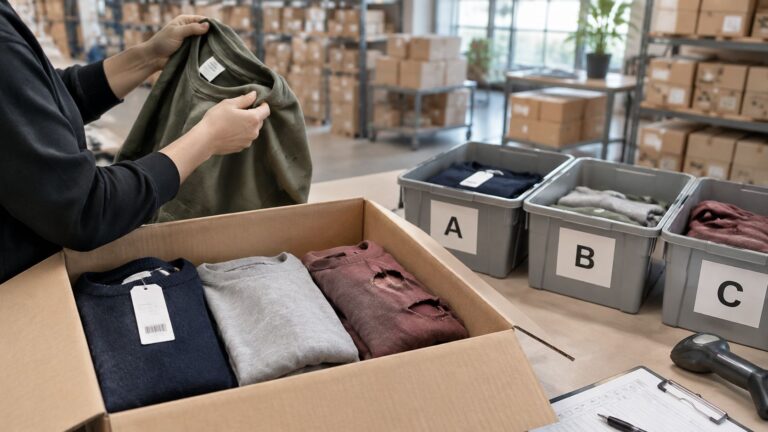
You can see the pallet photo, the shiny retail total, and the promise of easy margin, and it's tempting to jump fast. That's usually the moment new buyers overpay, because a return pallet isn't a neat box of ready-to-sell inventory, it's a mixed recovery problem with freight, labor, defects, and resale friction baked in.
The buyers who stay profitable treat the first pallet like a supplier test, not a windfall. They verify the source, read the manifest like an underwriter, and decide whether the lot can clear through their actual channels at a net margin they can defend.
Table of Contents
- Why Amazon Return Pallets Look Like a Deal
- Sourcing Channels and How to Verify Them
- Reading the Manifest Like a Buyer
- Condition Grades and What They Mean in Practice
- Shipping and Logistics Costs That Quietly Drain Margin
- Resale Strategies by Channel and Lot Type
- A Buyer's Checklist and Common Pitfalls
Why Amazon Return Pallets Look Like a Deal
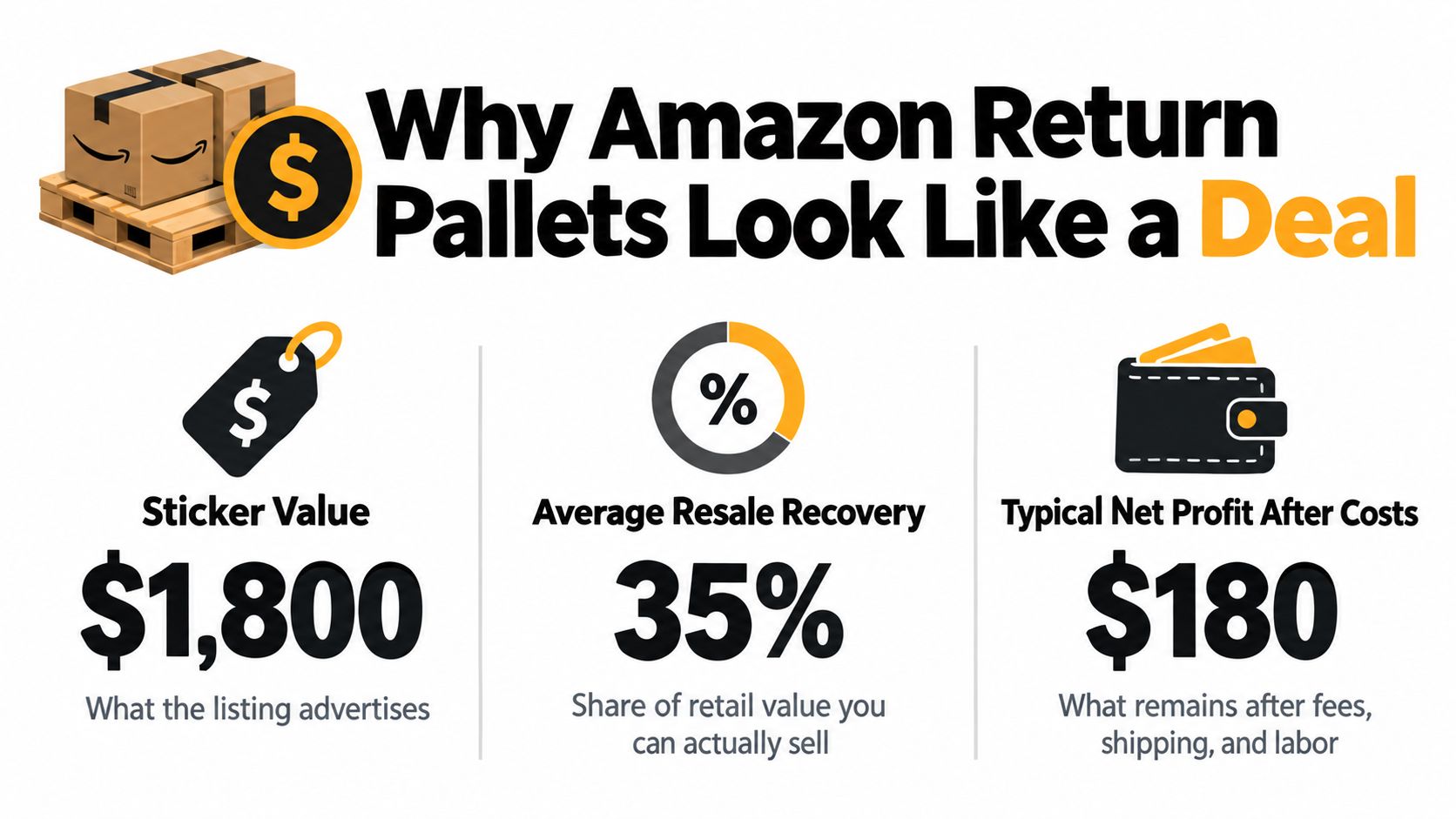
A pallet listing can make almost anything look like easy margin. The Amazon name, stacked cartons, and a big retail total create that impression fast, but liquidation only works if the units can be recovered and resold.
The scale of returns explains why these pallets keep showing up. The National Retail Federation and Happy Returns estimated that U.S. retailers would receive approximately $890 billion in returned merchandise during 2024, equal to 16.9% of annual retail sales, up from 8.1% in 2019, which shows how much larger the returns burden became over five years (Statista summary of NRF and Happy Returns data). Online orders also come back more often than general retail sales, with a separate October 2024 analysis finding that retailers' online return rates were, on average, 21% higher than their overall return rates. That is a big reason Amazon return pallets keep moving through liquidation instead of staying in a warehouse.
What's actually inside the pallet
A returned pallet is not the same as new wholesale stock. Depending on the lot, it can include customer returns, overstock, damaged packaging, incomplete units, or products that need inspection and grading before resale. Clothing and shoes matter here because they are among the most frequently returned online categories, and apparel lots can look clean on paper while still carrying size issues, hygiene concerns, and a lot of labor.
Practical rule: never bid on the headline retail value alone. A pallet only works if the sellable units can absorb freight, sorting, testing, storage, and the items you'll end up scrapping.
That shift in thinking saves money. The listing's retail number is the loudest number on the page, but it is usually the least useful one for profit planning.
Sourcing Channels and How to Verify Them
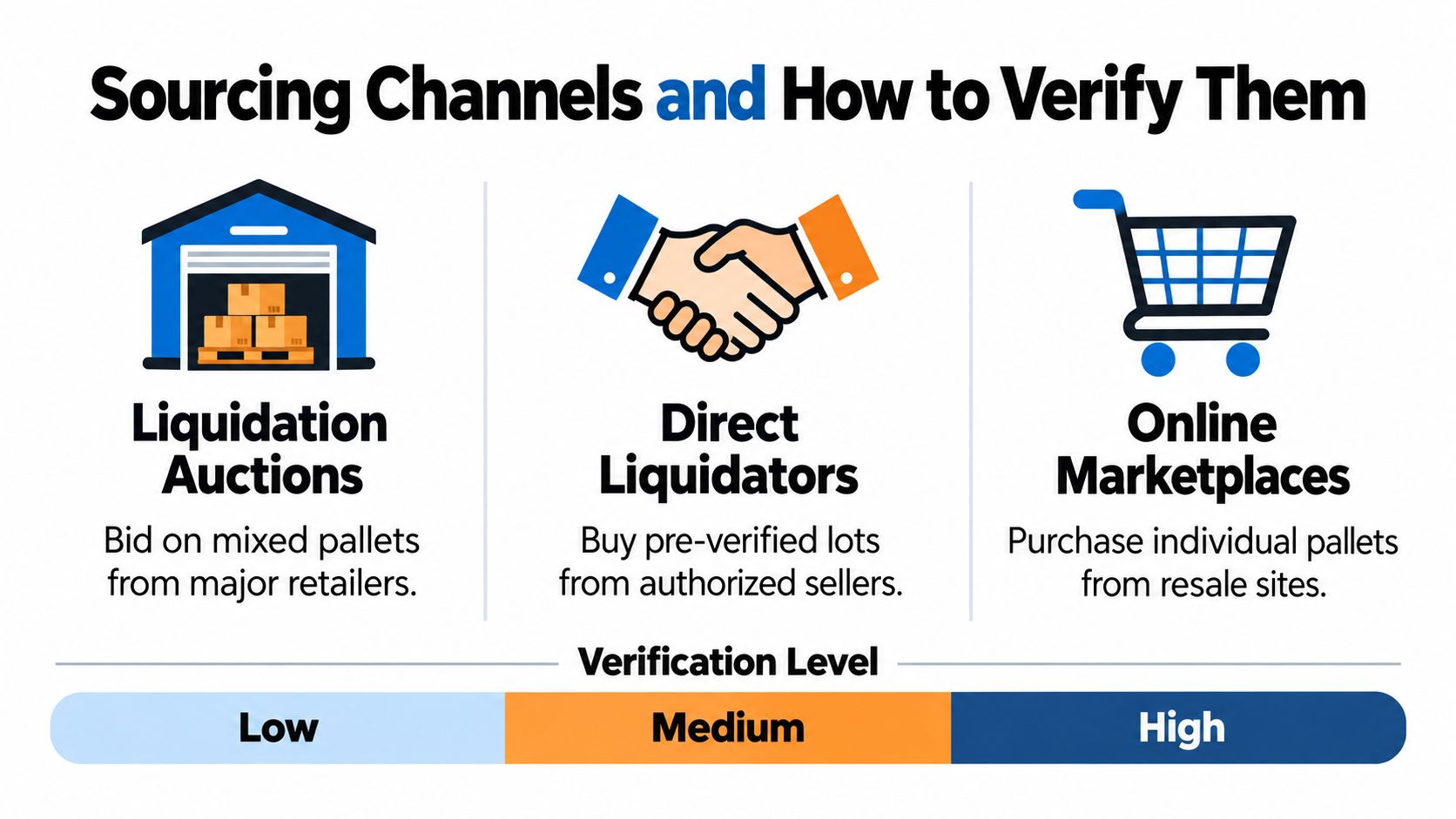
A pallet that mentions Amazon is not automatically a clean buy. Some channels are formal liquidation auctions, some are brokered lots, and some are mystery-box ads using Amazon's name to borrow trust they have not earned.
Amazon's formal liquidation-auction channel became more visible in October 2018, when Amazon and B-Stock announced Amazon Liquidation Auctions. The marketplace was built for qualified business buyers and offered bulk lots that included home goods, apparel, books, consumer electronics, and groceries, sold in truckload quantities rather than as consumer parcels. The launch also listed shipping origins in Arizona, California, and Indiana, which tells you this was a logistics channel, not a local reselling side hustle (B-Stock announcement).
What to ask before paying
The safer question is whether the seller can prove where the lot came from, how it was graded, and what recourse you have if it arrives wrong. The FTC tells auction buyers to investigate the seller and feedback, understand sale and return terms, establish a maximum price, and prefer payment methods with protection. It also warns about late or missing shipments, merchandise that differs from its description, and wire requests from sellers you do not personally know or independently verify (FTC auction guidance).
Use this check before you send money:
- Legal identity: Ask for the registered business name and match it to the platform profile.
- Warehouse proof: Confirm pickup or storage details with a real address and a specific contact.
- Manifest method: Ask whether the lot is itemized, category-level, or only estimated.
- Freight terms: Get written clarity on who pays shipping, accessorial charges, and rejected-load costs.
- Lot photos: Make sure the photos match the actual inventory, not stock imagery.
- Payment protection: Use a method that gives you dispute rights when possible.
A real pallet can still be a weak buy if the seller gives you no inspection window and hides behind vague “manifested” language. If the seller will not answer basic provenance questions, keep your cash.
For apparel buyers, the sourcing conversation gets easier to judge because the lot type should match the sales channel. A mixed clothing pallet that makes sense for marketplace sellers will not look the same as a truckload geared toward a physical boutique, and a useful way to compare that trade-off is this guide on auctions for clothes.
Reading the Manifest Like a Buyer
A manifest can be either a planning tool or a sales pitch dressed up as paperwork. The difference shows up when you use it to calculate net cost per sellable unit instead of assuming every line item will resell at retail.
Break the lot into three buckets
Start by separating the lot into sellable, repairable, and disposal categories. On a 200-unit apparel manifest, treating every line as sellable turns 40 Used–Acceptable units into phantom stock and pushes your bid above the actual recovery gap. Some units will move quickly, some need cleaning or testing, and some are only worth parts, salvage, or disposal.
Amazon's own condition framework matters here because it distinguishes Original, Used–Like New, Used–Very Good, Used–Good, and Used–Acceptable. Lower grades can include damaged or repackaged packaging, cosmetic wear, or missing accessories, so a returned item should never be valued as if it were unopened inventory.
Buyer filter: if you can't tell where each SKU belongs, you don't have a manifest yet. You have a guess.
Underwrite the lot before you bid
A practical worksheet should subtract purchase price, inbound freight, platform fees, testing labor, storage, returns, and a contingency reserve from expected recovery value. If the lot is mixed electronics, home goods, or apparel, build the model SKU by SKU and do not let a few clean items hide a stack of weak ones. The goal is not to win the auction. The goal is to buy at a price that still works after the hidden costs show up.
I treat every low-information lot as a test lot first, then scale only after I see the defect rate, the labor burden, and the sell-through. That keeps cash out of a truckload that looks strong on the manifest and drags for months once it hits the floor.
Condition Grades and What They Mean in Practice
Condition labels only matter once they change how you buy, process, and price the unit. A product can be resellable and still be a bad fit for your channel if it needs cleaning, missing accessories, or too much explanation.
What each grade feels like on the bench
Original is the cleanest category, but it still needs inspection. Packaging damage and shipping wear can show up even when the item itself is intact. Used–Like New usually moves well if the box is tidy and the item is complete, while Used–Very Good and Used–Good call for stronger photos, clearer disclosures, and more patience on price.
Used–Acceptable is where many buyers overestimate recovery. The unit may still sell, but the markdown is often sharp, and the handling time can wipe out more margin than expected. In apparel, that may mean light wear, tagging issues, or packaging that no longer looks retail-ready. In small electronics, it can mean missing cables, a scratched shell, or a unit that powers on but still looks too rough for fast resale.
What belongs in salvage, not normal inventory
Amazon's published condition standards exclude items that are dirty, moldy, materially damaged, missing essential parts, or in need of repair from acceptable resale condition, so those units belong in salvage math, not normal stock (Amazon condition guidance). That distinction matters because a dirty hoodie and a dead tablet create very different recovery paths. The hoodie may clean up and sell on a marketplace. The tablet may only justify parts pricing or a write-off.
In real buying, discipline beats optimism. I have seen lots with decent-looking top lines fail because the lower-grade units took too much labor. Buyers who last do not ask only what the retail total looks like. They ask how many units will move, and how much effort each one will take.
Bench rules for grading before you list
Check completeness first. Cords, accessories, tags, and manuals should all be accounted for before you treat a unit as normal inventory. Apply a stricter hygiene standard to apparel and soft goods, because odors, stains, and wear are harder to hide than cosmetic box damage. Verify authenticity through brand restrictions and serial checks before listing anything as-is. If a unit needs repair, heavy cleaning, or long explanation, price that labor into the bid before you buy.
Shipping and Logistics Costs That Quietly Drain Margin
A strong bid can still turn into a bad buy once freight lands. I've seen plenty of first-time buyers blame the pallet when the simple problem was this, they never built shipping into the ceiling.
Freight options change the math
LTL freight works for many pallet purchases, but it is only one piece of the landed cost. Regional carriers can fit shorter routes, and self-pickup can protect margin when the warehouse is close enough to make that practical. The key question is total cost, not the lot price. Get accessorials in writing before payment, including liftgate service, residential delivery, limited-access fees, and rejected-load handling, because those charges can add up fast on a single shipment. For a grounded view of pallet pricing and freight trade-offs, this guide on what liquidation pallets cost is a useful reference.
Receipt day is part of the deal
Photograph the pallet before you open it. Count cartons, keep the labels visible, note damage, and compare what arrived with the manifest while the condition is still fresh. If a shipment needs a claim, those photos matter more than anyone wishes they did.
Storage can quietly eat margin too. Pallets take floor space, and questionable units should stay quarantined until testing and authenticity checks are finished. In a home warehouse or small unit, I always want to know whether the lot will crowd the processing area before the last carton is even cut open.
Resale Strategies by Channel and Lot Type
A pallet can look strong on paper and still be wrong for your outlet. Mixed apparel, tested electronics, and salvage-heavy lots do not recover value the same way, and the first job is matching the item mix to the channel that can absorb its defects without crushing margin.
Match the lot to the outlet
Marketplace rules shape how you disclose condition. Amazon's marketplace guidance allows returns when products do not match the described condition within the standard return window for many items, which is a reminder to write clean listings and use honest photos instead of vague claims (Amazon condition guidance). Apparel, especially branded apparel, usually moves better through visual-first channels. Tested small electronics tend to do better where buyers expect more detail and accept used-condition disclosure.
I break mixed clothing lots by size, season, and brand family before I list anything. That gives me a cleaner run at Poshmark, eBay, Mercari, Depop, Vinted, ThredUp, or live-sale formats like Whatnot. When the lot is more generic, the better move is often a channel with lower listing friction and fewer condition arguments. For a deeper walkthrough of how to sell liquidation pallets by channel, see this guide on how to sell pallets.
OneTrendyCloset is a separate fit for apparel resellers who want curated brand-name liquidation boxes instead of Amazon-return-style mixed pallets, especially when the goal is a more controlled brand mix for boutiques or marketplace restocking.
| Lot Type | Typical Grade | Best-Fit Channel | Key Risk |
|---|---|---|---|
| Mixed apparel | Used–Like New to Used–Good | Poshmark, Depop, Whatnot, boutique restock | Size scatter, seasonality, high sorting time |
| Tested small electronics | Used–Like New to Used–Acceptable | eBay, Mercari, Facebook Marketplace | Returns, missing accessories, function claims |
| Home goods | Original to Used–Good | eBay, Amazon-appropriate secondary channels, local resale | Breakage, shipping cost, condition disputes |
| Salvage-heavy mixed lot | Used–Acceptable and below | Parts buyers, liquidation breakers, local bulk sale | Low recovery, slow cash conversion |
Don't let the channel outrun the lot
The wrong outlet can kill a decent purchase. If your lot needs photos, measurements, grading, and returns handling, send it to a channel that can support that work. If your lot is mostly clean and brandable, do not bury it in a bulk sale just because it is fast.
The best buyers route inventory where the item type naturally fits. They also treat the first order as a supplier test, then watch recovery before scaling up. A mixed pallet that looks awkward in one channel may still be profitable in another, but only if the condition work and selling fees still leave room after freight, labor, and returns.
A Buyer's Checklist and Common Pitfalls
The simplest profitable routine is also the hardest one to stick to when a “good deal” shows up. Successful buyers slow down long enough to verify source, model the land cost, and decide whether the lot fits their resale lanes before money leaves the account.
Keep this checklist in front of you
- Verify the seller: Confirm the business identity, warehouse location, and platform history.
- Demand lot detail: Ask for a manifest, item count, condition breakdown, and real photos.
- Model your costs: Include purchase price, freight, platform fees, labor, storage, and a reserve.
- Sort by recovery: Split expected units into sellable, repairable, and disposal buckets.
- Match the outlet: Choose a resale channel before the pallet lands.
- Start small: Make the first order a validation buy, not a scale-up buy.
The common mistakes are repetitive because they're seductive. Buyers chase headline retail value, skip the test lot, wire money to unverified sellers, ignore accessorial charges, and assume the word “Amazon” guarantees official channel inventory. None of that protects margin. It only speeds up the loss.
A simple 30-day approach keeps the risk controlled. Register with the channel, request the manifest, build the worksheet, place one small order, measure sell-through and defect rate, then decide whether the source deserves a second buy. If the lot teaches you something useful and still clears profit after costs, scale carefully. If it doesn't, cut it off early and move on.
If you want cleaner apparel inventory instead of gambling on mixed return pallets, visit OneTrendyCloset and compare curated brand-name boxes, custom lot quotes, and reseller-friendly sourcing for boutiques, marketplace sellers, and live-sale hosts. For apparel businesses that need predictable grading, faster turnaround, and less sorting chaos, it's a practical place to source the next buy.