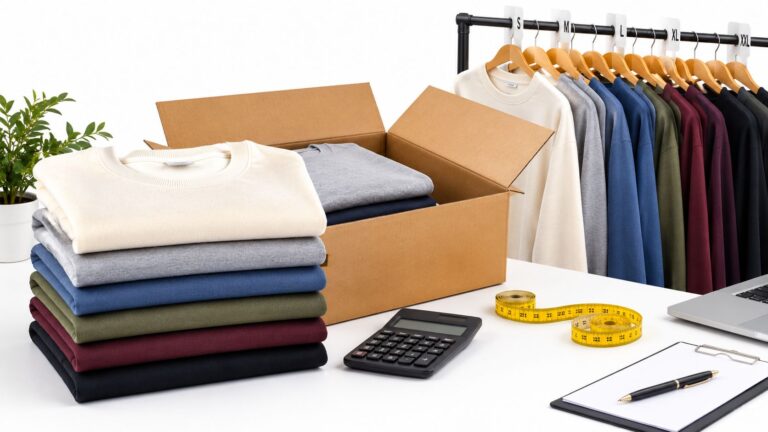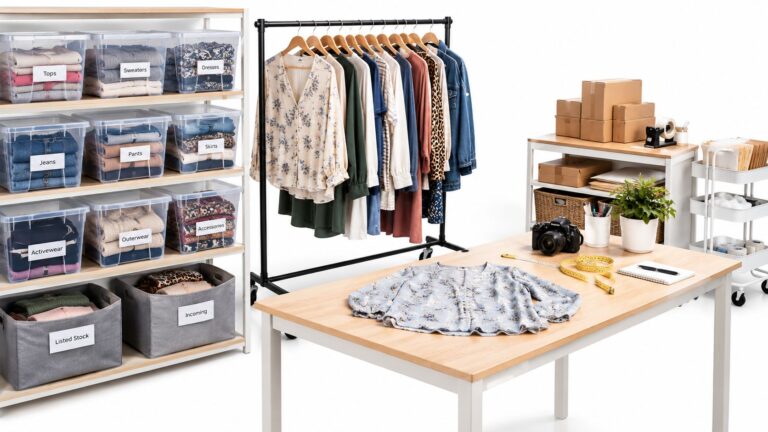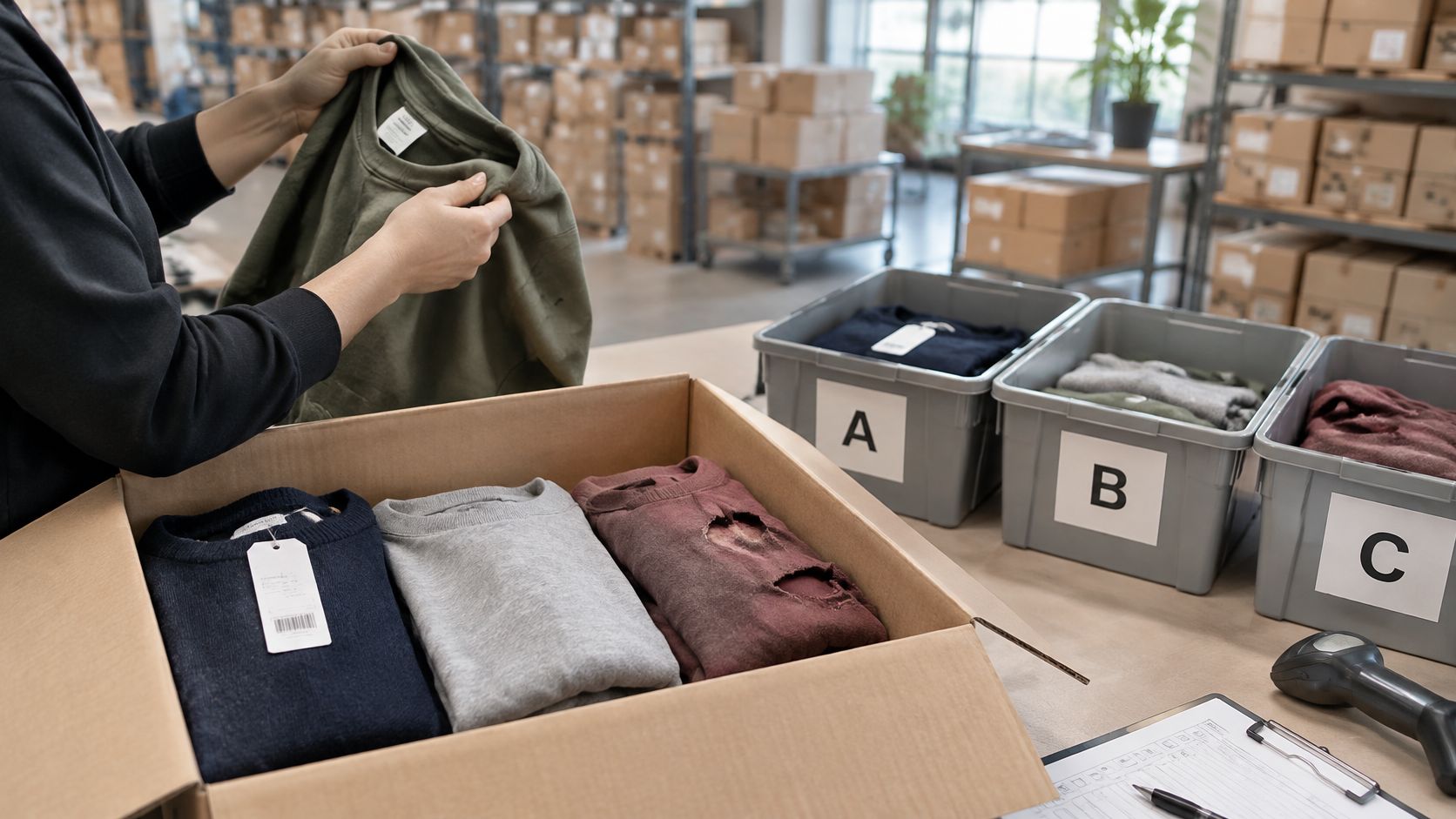
You're looking at a return box with recognizable labels on top and a price that seems easy to recover. Once it's opened, though, the tagged jacket may sit beside a worn sweater, an incomplete outfit, and a stained shirt you can't list. The buying decision isn't whether the box contains good merchandise. It's whether enough of it can become profitable inventory after sorting, preparation, and selling costs.
Boxes for returns are the start of a sorting process, not a finished assortment. Buy with that distinction in mind, and you'll judge the listing by recoverable value rather than the best item in the photograph.
Table of Contents
- Return Box Types and How Returns Reach Resale
- Condition Grades From Like-New to Salvage
- How to Inspect a Return Lot Before You Bid
- Working Out Whether a Return Box Pays
- Sourcing Return Boxes Through the Right Channel
- Packaging Your Own Returns Without Damage or Waste
Return Box Types and How Returns Reach Resale
A return box is a lot of merchandise that came back from customers, was removed from shelves, or was cleared as unsold inventory. Sellers sometimes group these sources together under liquidation, but they don't create the same workload. A carton of overstock shirts needs a different inspection process from a mixed customer-return lot.
The label should tell you where the goods originated. It doesn't guarantee what you'll find inside.
Return box types at a glance
| Box type | Where it comes from | Typical contents | Usual condition |
|---|---|---|---|
| Customer returns | Retail and online returns processed by sellers | Mixed sizes, brands and categories | Mixed; some unused, some worn |
| Shelf-pulls | Items removed from store displays or shelves | Current-season stock, often missing packaging | Near-new with light handling marks |
| Overstock | Unsold new inventory cleared by brands or retailers | Brand-new items, often with tags and sealed packaging | New with tags |
| Open-box returns | Opened units from store or warehouse returns | Mixed items, sometimes incomplete | Opened, some may need functional checks |
| Damaged or salvage | Items with torn packaging, stains or broken parts | Bulk or mixed damaged goods | Poor, often unusable as new |
Treat these descriptions as starting points for questions. Overstock can arrive with damaged packaging, while a customer-return box can contain apparently untouched garments. Ask whether the supplier separates these streams or combines them before packing.
The volume moving through this system is substantial. U.S. retailers recorded approximately $743 billion in returned merchandise during 2023, equal to 14.5% of total retail sales, according to the National Retail Federation's consumer returns report. That scale explains the need for organized inspection, storage, repacking, and resale routes, but it doesn't establish the quality of any particular lot.
Follow the item through the warehouse
Consider a hypothetical jacket bought online, worn, and returned without its tags. A warehouse worker checks its identity and condition, then decides whether it can return to ordinary stock, move through a secondary resale channel, enter liquidation, or leave the resale stream.
If the jacket goes into liquidation, the supplier might assign it a B grade and pack it alongside other apparel. That grade reflects the supplier's definition, not a universal standard. The next reseller still has to check the lining, cuffs, zipper, pockets, and care label before advertising it.
Not every item takes that route. An untouched return may be restocked, while a garment with contamination may need disposal rather than another sales attempt. A liquidation box is what remains after the upstream seller's routing decisions, not necessarily a representative sample of everything customers returned.
If you're comparing cartons with larger marketplace loads, this guide to buying Amazon return pallets provides useful purchasing context. Keep the actual lot description and contractual terms ahead of any general channel description.
Before buying: Read the condition terms before studying the hero photograph.
Terms such as as-is, untested, and sold without inspection signal uncertainty and may restrict your remedies. They aren't interchangeable legal guarantees or blanket exemptions, so check exactly what the seller promises about count, authenticity, condition, shortages, and claims.
Condition Grades From Like-New to Salvage
Grade letters aren't standardized. A supplier's A grade might permit storage odor or missing packaging, while another seller reserves that letter for virtually untouched goods. The written definition matters more than the letter printed on the carton.
Use the following ladder as a practical comparison tool, not a certification system.
Condition grades and typical resale use
| Grade | What it looks like | What to expect inside | Typical resale use |
|---|---|---|---|
| New or sealed | Unopened, tags attached | Brand-new items in factory packaging | Sell as new, potentially near full value if demand supports it |
| A | Like-new with minor handling marks | Few or no flaws, possible light odor | List as like-new with clear photos, where the platform permits |
| B | Visible wear or small flaws | Minor stains, loose threads, missing hangers | Price lower and disclose each defect |
| C | Heavy wear or incomplete items | Stains, pilling, missing parts or accessories | Bundles, lower-price channels or parts |
| Salvage | Damaged or unusable as sold | Torn, broken or contaminated items | Suitable parts, bulk resale or disposal |
The practical gap between grades is preparation time and disclosure, not just appearance. A new shirt may need only identity checks and measurements. A worn knit may need depilling, seam inspection, odor assessment, and photographs that show its remaining flaws.
Inspect beyond the obvious mark
Check pale fabrics under neutral lighting and examine collars, underarms, cuffs, and crotch seams. Faint makeup, loose stitching, light wrinkling, and missing tags can be easy to miss when garments are folded tightly.
A-grade clothing can still carry a light storage scent. Don't conceal it with fragrance or assume airing will solve it before you've tested that assumption. Missing belts, detachable straps, or matching pieces also change what you can sell, even when the main garment looks clean.
For larger used-clothing assortments, the considerations in buying used clothing by the bale help distinguish bulk purchasing from buying individually assessed stock.
Buy the grade you can describe honestly, at a price that still works after every defect is disclosed.
A bundle isn't permission to hide flaws. Buyers still need to know whether they're purchasing wearable clothing, repair projects, or material for reuse.
How to Inspect a Return Lot Before You Bid
Inspect the evidence behind the listing, not just the visible merchandise. A polished top layer can show you that desirable items exist without showing how much of the lot they represent.
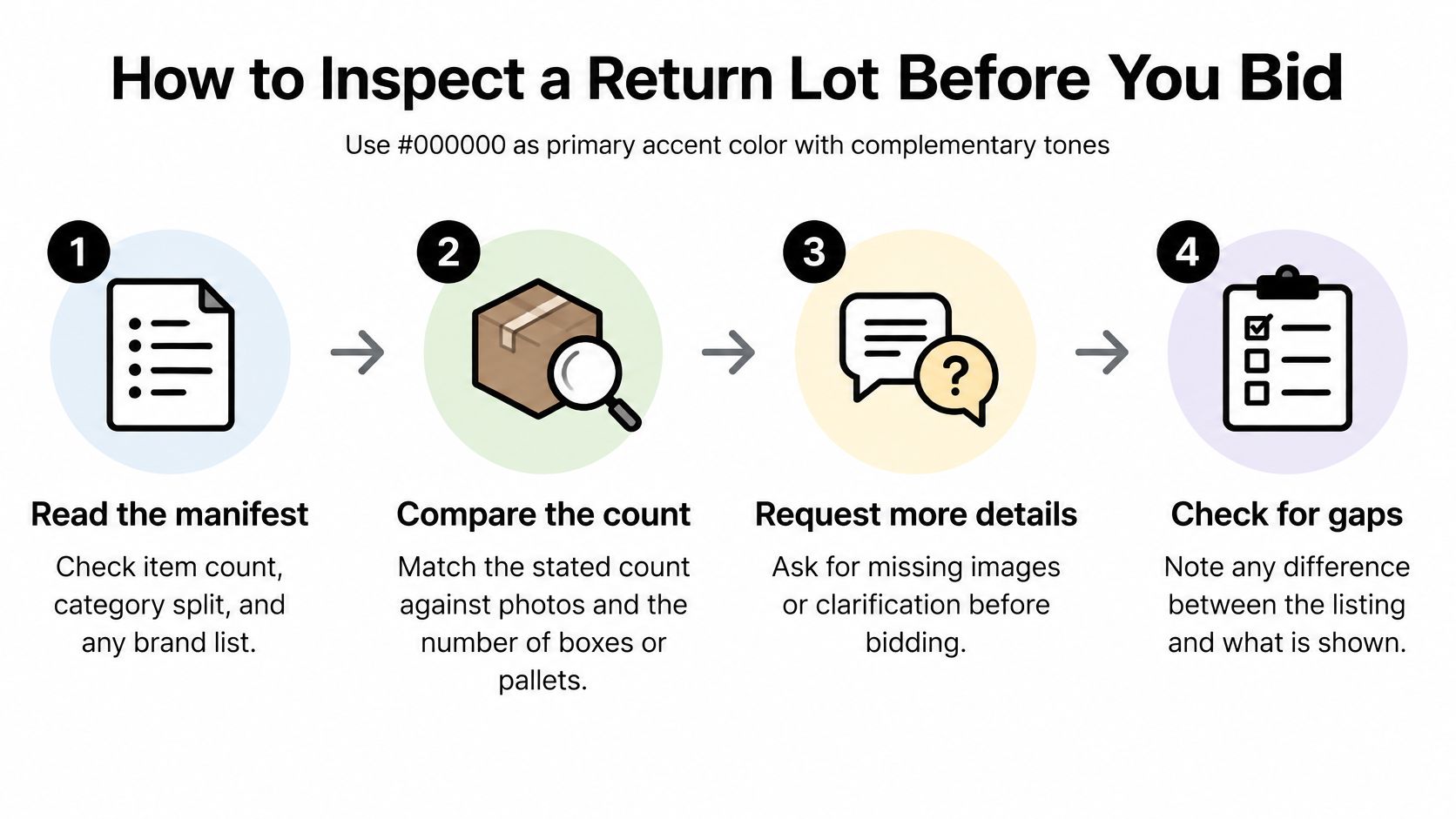
Build a record you can check on arrival
Read the manifest and its limitations. Check item count, category split, sizes, and any brand list, then ask whether the document describes the actual lot or an estimated assortment. The common mistake is treating a general stock list as an item-level packing record.
Compare the count with the physical load. Match the stated quantity against the photographs and number of cartons or pallets, allowing for how the garments are packed. Don't infer completeness from sealed boxes alone, and record any unexplained gap before bidding.
Request useful close-ups. Ask for labels, care tags, seams, collars, cuffs, and examples from beneath the top layer. A wide photograph can establish volume, but it won't show a split seam or makeup along a neckline.
Assess the brands you can sell. Mark recognizable, channel-appropriate brands on the manifest and check completed sales for comparable garments, not just asking prices. Don't assign premium-brand pricing to unknown labels because they share a carton with a desirable jacket.
Get the grade definitions in writing. Ask for the condition split and what the supplier allows within each grade, including odor, missing tags, wear, and incomplete sets. A condition label without a definition gives you little basis for a later complaint.
Read return reasons as clues. A fit-related return may deserve a different inspection priority from one marked damaged or used, but neither code replaces a physical check. The slip is assuming that a customer's stated reason rules out unrelated flaws.
Confirm collection, delivery, and remedies. Establish freight or pickup responsibilities, unloading needs, claim deadlines, and whether sampling is allowed before payment. An attractive hammer price can become unworkable if you haven't arranged suitable transport or understood the shortage policy.
Create a lot record before purchasing. Use Excel or Google Sheets to capture the advertised count, condition mix, brand suitability, unanswered questions, and expected sellable inventory. After opening, replace estimates with actual findings rather than relying on memory.
Know when uncertainty should lower the bid
A supplier may reasonably limit access to sealed stock. That doesn't automatically make the lot unsuitable, but it leaves you carrying more uncertainty.
Price missing information as risk. If the seller can't clarify condition or show representative contents, lower your valuation rather than filling the gaps with optimistic assumptions. Keep screenshots of the listing and written answers so your receiving inspection has something concrete to compare against.
Working Out Whether a Return Box Pays
Decide where rejected garments will go before calculating profit. Otherwise, the repair pile becomes unpaid work in storage, and your apparent inventory value includes pieces you have no realistic plan to sell.
Give each garment a destination based on its recoverable value after preparation, not its original ticket price.
Route the merchandise before valuing it
- Resell individually: Keep complete, presentable garments that suit your buyers and justify their own listing.
- Repair selectively: Fix a loose button or open seam only when the expected selling-price improvement covers the work and materials.
- Bundle transparently: Group suitable lower-grade garments by size, category, or use, with defects disclosed.
- Liquidate again: Move usable inventory that doesn't fit your channel, season, or customer base, without assuming another buyer will pay your original cost.
- Donate or recycle appropriately: Check what the recipient accepts. Don't send contaminated or unusable garments to a charity as a substitute for disposal.
Keep garments with moisture, pests, or suspected contamination separate from clean stock. Missing retail packaging is a presentation problem; contamination is an isolation problem.
Calculate the cost of what you can sell
Total landed cost ÷ expected sellable units = acquisition cost per sellable unit.
Landed cost includes the purchase, inbound shipping or collection, buyer fees, and applicable taxes. Then account separately for cleaning, repair materials, replacement accessories, selling fees, outbound shipping you absorb, and your labor.
Your comparison should be against the expected net sale proceeds, not the retail value printed on a manifest. Use comparable sold listings that match condition and completeness. A tagged item with weak demand can be less useful than a desirable used garment.
For a hypothetical mixed box, remove the garments you expect to reject before dividing the landed cost. Then reduce the expected proceeds for defects, preparation, and selling expenses. If the purchase only looks profitable when you count every garment as sellable, the bid is too optimistic.
A broader explanation of liquidation pallet costs can help you identify expenses outside the purchase price.
Margin check: Charge the box for your time even when you're doing the work yourself.
Photographing, measuring, answering messages, storing, and packing are real tasks. Track their duration during your test purchase so you can compare a high-preparation assortment with stock that lists quickly.
The apparel return stream also contains different reasons for rejection. In Radial's 2025 State of Returns report, 56% of apparel and footwear brands reported return rates of at least 30%, while 38% of surveyed consumers said they often return clothes because they don't fit. Those findings help explain why inspection must distinguish wearable fit returns from garments with condition problems.
Dense packing isn't automatically efficient. It can save space while leaving you more wrinkling, transferred odors, and preparation work, so judge the final saleable output rather than the apparent quantity.
Run a controlled buying test
- Choose a suitable category: Buy stock you already know how to inspect and sell.
- Set your ceiling: Decide the maximum acceptable acquisition cost per sellable unit before bidding.
- Inspect the entire test lot: Record every garment, including rejects and repair candidates.
- List promptly: Use a firm listing deadline and record actual prices, fees, preparation, and sales.
- Revise before reordering: Base the next bid on realized results, not the strongest item you found.
Sourcing Return Boxes Through the Right Channel
Choose a purchasing channel that matches your inspection skill, available space, and tolerance for uncertainty. An experienced buyer with freight access can assess an open-ended load differently from a boutique owner who needs garments ready for the sales floor.
The channel determines how you buy. The specific supplier and listing determine what you're promised.
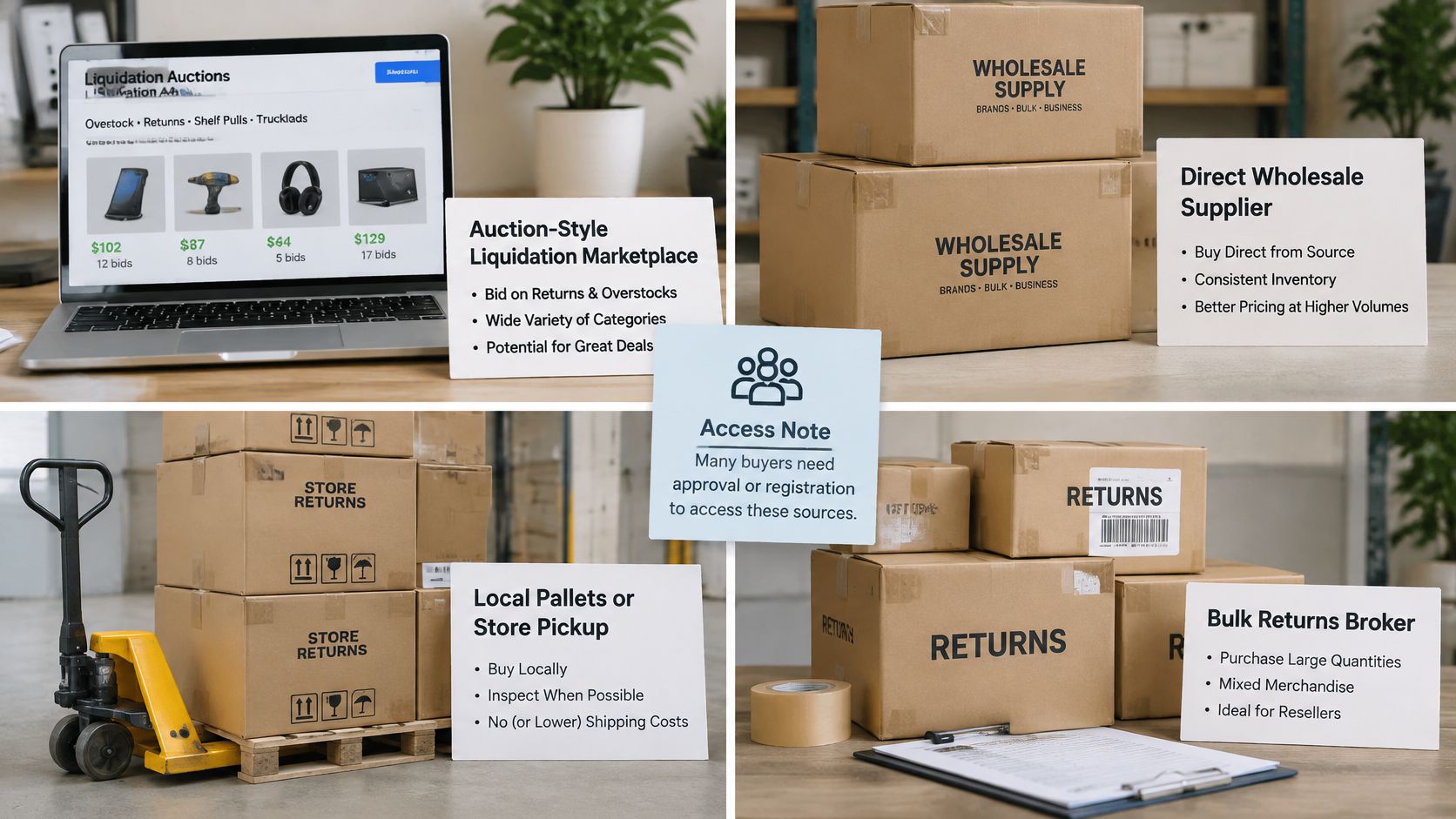
Return box sourcing channels compared
| Channel | Access requirement | Main advantage | Main risk |
|---|---|---|---|
| Liquidation auction marketplaces | Business registration and resale certificate where required | Wide selection and visible bidding | Competitive bidding and limited item detail |
| Direct wholesale supplier | Account and order request, custom quotes for larger lots | Opportunity for a curated brand mix and predictable quoted pricing | Box composition must still be verified on arrival |
| Local pallets or store pickup | Pickup labor and suitable transport | Avoiding delivery charges and arranging direct collection | Restricted inspection and labor-heavy handling |
| Bulk returns brokers | Account approval and stated minimum order | Access to larger volumes and recurring offers | Manifest accuracy and grade consistency require verification |
Check registration requirements before preparing a bid. Some marketplaces request business documentation and resale credentials, while others have different buyer rules. Don't assume approval, tax treatment, or purchase eligibility transfers between platforms.
A direct wholesaler is worth considering when you need to discuss categories, brand preferences, and order size before paying. Ask what curation means: requested brands aren't necessarily guaranteed brands, and a representative assortment isn't an exact manifest.
Match the channel to your operating capacity
Auction lots suit buyers who can value uncertainty and stop bidding at a predetermined limit. They're less forgiving when you need a narrow size range or specific labels for an upcoming event.
Local collection can be practical when you have room, loading equipment, and a suitable vehicle. Check access conditions, collection windows, and whether the goods are floor-loaded or palletized before committing.
Brokers can help source volume, but establish who owns the goods, who issues the invoice, and who handles discrepancies. Extra intermediaries shouldn't leave you uncertain about responsibility.
Start with a manageable test order, then deepen the supplier relationship only after the receiving results support it. Keep communications factual: document shortages, photograph unexpected condition problems, and ask how the supplier proposes to resolve them.
The lowest purchase price isn't necessarily the strongest buy. Prefer inventory that consistently produces worthwhile net proceeds for the work your business can perform.
Packaging Your Own Returns Without Damage or Waste
For sellers shipping their own returns, the carton is only part of the product–package system. Fit, closures, internal protection, identification, and the condition of the reused box all affect whether garments arrive ready for inspection or resale.
Start with folded-garment volume rather than choosing a large carton and filling the gaps. Carriers commonly charge using the greater of actual or dimensional weight, making right-sizing important for lightweight apparel, as explained in Packaging Corporation of America's testing and optimization guidance.
Check fit and protection
Measure the packed assortment. Leave enough clearance to insert and remove garments without crushing them, but don't leave space for the contents to tumble. A folded knit sweater should sit comfortably without being forced against the carton walls.
Standardize practical carton choices. Maintain a small, medium, and large carton family matched to your usual assortments. Give staff a packing reference showing the folded configuration, protective materials, closure method, and packed weight.
Test the filled configuration. The ISTA 3L overview describes testing for individual products fulfilled through e-commerce parcel and less-than-truckload distribution, including transport hazards such as vibration, drops, impacts, and atmospheric conditioning. Test representative products and packaging together rather than judging an empty carton by feel.
Use a resealable closure where the packaging is intended for a customer's return journey. Protect delicate surfaces and separate hardware that could snag adjacent garments, without adding unnecessary bulk.
Set clear reuse rules
- Inspect before repacking: Reuse only clean, dry cartons with sound seams, corners, and closures. Retire boxes with crushed walls, punctures, dampness, or weakening folds.
- Clear old identification: Remove or fully obscure obsolete shipping labels and barcodes. Don't reuse packaging carrying inappropriate hazardous-material markings.
- Store correctly: Keep empty cartons away from damp floors, strong odors, and pests. Keep reusable packaging separate from incoming stock awaiting inspection.
- Evaluate the whole process: Consider storage space, cleaning, transport, and failure risk rather than treating reuse as automatically preferable.
The E-commerce Europe summary of Sustainable E-commerce 2025 highlights consumer attention to packaging and the environmental consequences of returns. For your operation, the useful test is whether a package can complete its intended journey without avoidable replacement, extra handling, or damage.
OneTrendyCloset offers brand-name apparel liquidation boxes with flexible box sizes, mix-and-match brand preferences, and custom quotes for larger orders. Visit OneTrendyCloset to discuss an assortment that fits your selling channel, then assess the proposed mix against your cost-per-sellable-unit limit before ordering.