Most buying advice tells you to chase the biggest box, the longest brand list, and the highest claimed retail value. That's backwards for a reseller. You don't get paid on claimed value. You get paid on items that fit your channel, arrive in sellable condition, and sell before markdowns eat the margin. The best clothing mystery boxes are the ones you can forecast, grade, and reorder with confidence, not the ones with the loudest unboxing pitch.
Table of Contents
- Why the Best Mystery Box Is Not the Largest One
- Build a Supplier Evaluation Checklist
- Estimate Profit by Item and Condition
- Match Boxes to Resale Channels
- Audit Every Delivery Before Ordering Again
- Spot Risk Before the Invoice Arrives
- Build a Repeatable Box Buying Decision
Why the Best Mystery Box Is Not the Largest One
A larger assortment only helps if most of it matches your buyers. A box packed with premium labels can still lose money when sizes skew to the ends of the range, seasons don't match your selling window, or half the units need steaming, repair, and discounting. Item count hides that. Contribution margin per received unit exposes it.
Buyers already understand value in practical terms. In survey data reported by FashionUnited, 79% of surveyed consumers cited saving money as a reason to buy secondhand, and 34% wanted premium brands at lower prices, while 60% said secondhand apparel offers the best value for money FashionUnited reporting on consumer resale motivations. Your customer may want a deal, but you still need room for fees, shipping, returns, and dead stock.
Judge by channel fit and net recovery
A boutique owner needs cohesive racks and presentation ready pieces. A marketplace seller needs accurate sizes, brands, and defect notes for listings. A live sale host needs visible variety and enough depth to keep bids moving. Those are different boxes, even when the price looks similar.
Mystery is acceptable for assortment. It is not acceptable for condition, authenticity, size distribution, or material disclosures.
Quick Clothing Mystery Box Decision Matrix
| Evaluation area | Question to ask | Healthy sign | Warning sign |
|---|---|---|---|
| Landed cost | What's freight included in the price? | Delivered cost stated upfront | Shipping revealed after payment |
| Condition | How do you define new, like new, and damaged? | Written grades with examples | Vague terms like great quality |
| Assortment | What categories, seasons, and sizes should I expect? | Ranges disclosed before ordering | Random mix, no ranges |
| Authenticity | How are branded items verified? | Process described in writing | Trust us, no documentation |
| Claims | What happens with missing or unsellable units? | Clear window and remedy | No claims policy |
Use this matrix before you compare prices. A smaller, preference based box that produces less dead stock can outperform a larger blind box, even if its advertised retail value looks weaker on paper.
Build a Supplier Evaluation Checklist
Don't start by asking which brands might appear. Start by asking what the supplier will put in writing. Brand mix can vary. Counts, size ranges, condition definitions, fulfillment terms, and claims rules shouldn't.
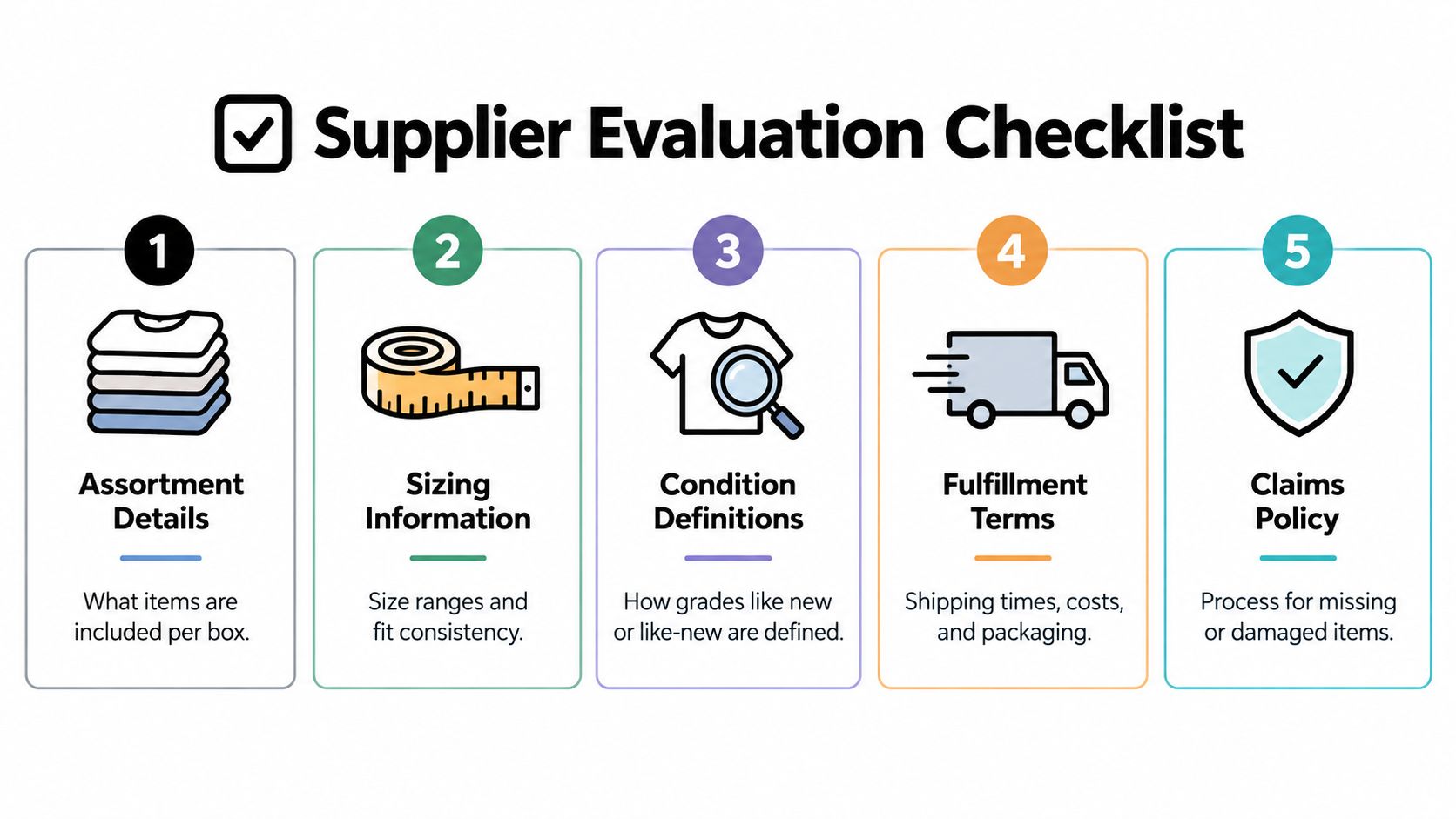
Run every supplier through the same five checks so answers stay comparable.
Ask in this order
- Assortment details: Request item count, category mix, season, and whether units are new, overstock, returns, or mixed sources. If a seller can't describe the source category, you can't forecast grade or resale price.
- Sizing information: Ask for the expected size distribution, not just a size range. A range from XS to XXL means little if most units sit at one end your buyers rarely purchase.
- Condition definitions: Get written definitions for each grade and ask how stains, odor, missing labels, and seam damage are handled. You're looking for binary standards you can audit later.
- Fulfillment terms: Confirm packing, shipping cost, delivery estimate, and whether boxes are curated in house or drop shipped from another lot. Delivered cost is the only cost that matters.
- Claims policy: Ask for the claims window, required photos, and remedy for short counts or units that don't match the stated condition. Get it before you pay, not after delivery.
Weight answers by your channel
Marketplace sellers should push hardest on size, category, and defect granularity because listings live or die on specifics. Boutiques should push on cohesion, seasonality, and presentation. Live hosts should push on count, visible variety, and replenishment speed.
If you're building a broader sourcing shortlist, compare these answers alongside the criteria you'd use for any wholesale supplier for clothing, since a mystery box is still a wholesale purchase. One option in this market is OneTrendyCloset, which offers curated brand name liquidation boxes where buyers can select box sizes and influence brand mix rather than receiving a fully blind assortment. Evaluate it with the same five questions you'd ask anyone else.
Stop condition: If a supplier won't define condition or disclose size distribution, stop. You can't price risk you can't see.
Estimate Profit by Item and Condition
Model the box at the SKU level. Treating a mixed lot as one average hides the units that will never sell and inflates the value of the few strong pieces.
The visual below shows the sequence. Unpack and list, assign values, subtract costs, then total.
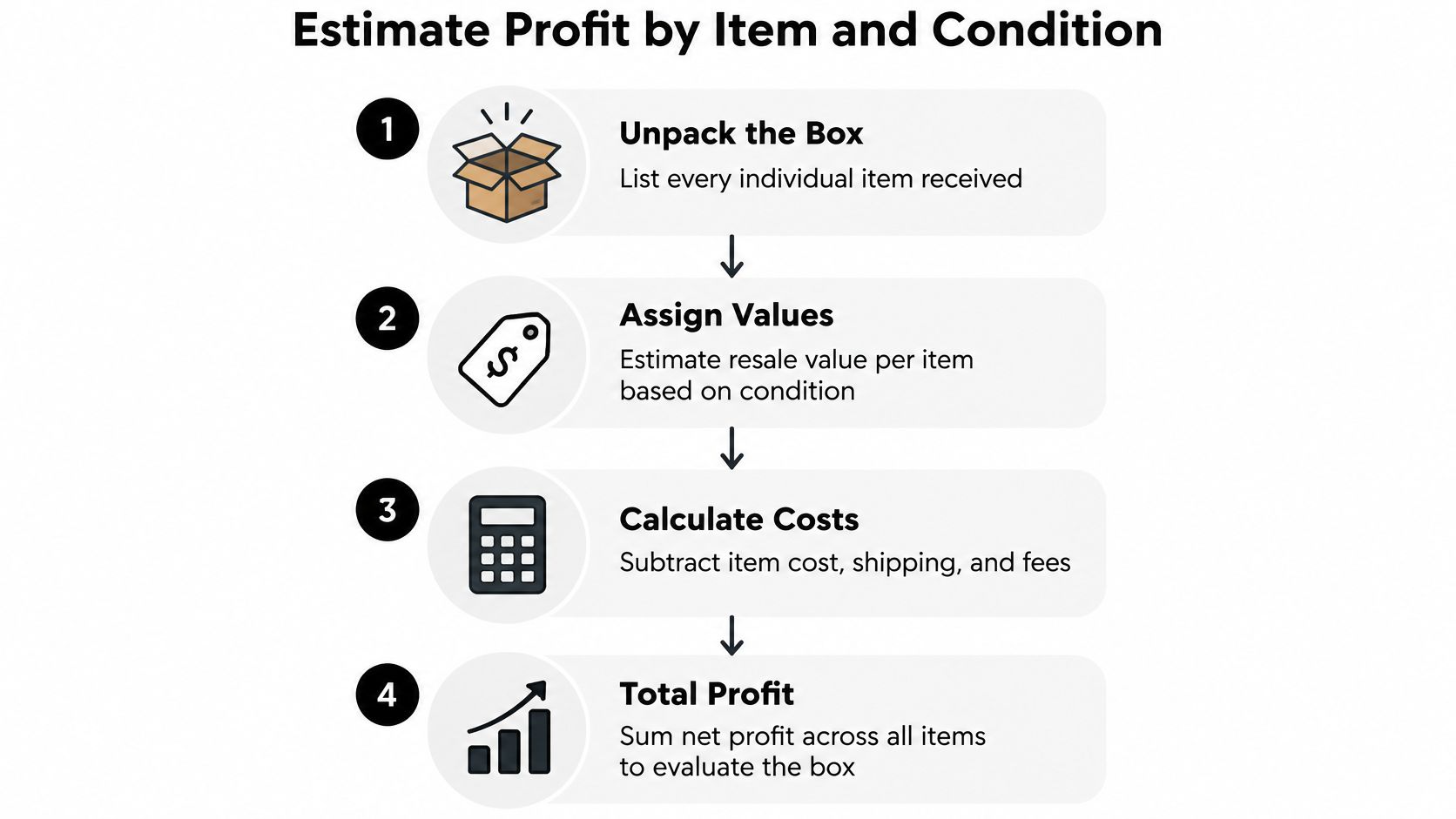
Build the cost stack first
Record purchase price, inbound freight, marketplace fees, cleaning or steaming labor, packaging, expected selling price, and a reserve for defects. Then grade each expected unit as sellable as received, refurbishable, liquidation only, or unsellable. Apparel carries high return exposure online, with fashion returns estimated around 20–40% and apparel commonly near 25%, and markdowns reported at 20–30% during the season and 30–50% by season end apparel supply chain statistics on returns and markdowns. Your model should survive those pressures, not ignore them.
If you're unsure how to back into a workable purchase price, review the basics of how to figure out wholesale price before you set a maximum bid for the box.
Work the example honestly
Take a 40 piece box costing $400 delivered. Assume a conservative outcome. You get 32 sellable units, 5 discounted units, and 3 unsellable units. Realized prices average $28, $12, and $0 respectively, producing $956 in gross resale revenue. Subtract the $400 inventory cost and $160 in labor, packaging, and marketplace costs, and contribution is approximately $396, or $9.90 per received item.
That $9.90 is the benchmark. It's more useful than any MSRP total printed on a sales page because it already accounts for the units that fail.
Use recent completed sales for your channel, not active asking prices, when you set expected values. Active listings show what sellers hope to get. Completed sales show what buyers paid, and that distinction decides whether your forecast is real.
The short walkthrough below is a useful companion before you build your first spreadsheet.
Fields to capture for every test box include brand, size, condition grade, cost allocation, repair minutes, list price, realized price, platform fee, days to sale, and return outcome. Test at least two boxes, then compare forecast against realized sell through, days to sale, defect rate, and return rate before you scale.
Match Boxes to Resale Channels
The same box can be profitable in one channel and a headache in another. Don't ask if a box is good in the abstract. Ask where you'll sell it, how fast you need it to move, and what information that channel rewards.
Boutique racks need cohesion
Boutique buyers shop an edited experience. They expect pieces that hang well together, match the season, and look ready to try on. Presentation ready inventory matters more here than sheer count, because a stained or heavily wrinkled premium piece can't go straight to the rack.
Buy for cohesion, condition, and size depth in your core customer range. A mixed lot with scattered categories may give you inventory, but it won't give you a rack story. You'll spend the margin on steaming, re tagging, and explaining why one corner of the store feels like a clearance bin.
Marketplaces reward specificity
On Poshmark, eBay, Mercari, Depop, or Vinted, buyers search by brand, size, color, and condition. Detailed supplier information creates accurate listings and fewer returns. Vague lots create extra measuring, photography, and guesswork for every unit.
If eBay is part of your plan, align your purchase specs with what you know about how to sell clothes on eBay, especially the need for clear sizing and honest condition notes. Marketplace boxes should give you enough recognizable demand in searchable categories, not just random labels.
There's real depth behind that channel choice. GlobalData reported the worldwide resale apparel market grew 17.6% in 2024 to $204.7 billion, while traditional apparel grew only 0.1%, with resale projected to grow 13.3% in 2025 GlobalData reporting on global resale apparel market growth. In the US, online resale grew 23% in 2024 according to industry reporting based on GlobalData research. That momentum gives you options, but it doesn't rescue a bad assortment.
Live sales need pace and visible variety
Whatnot and similar live formats reward hosts who can keep showing something new. You need a clear count, portable lots, and pieces that read well on camera. Heavy repair needs kill pace because you can't steam and inspect while you're trying to run bids.
- Boutique fit: cohesive colors, current season, core sizes, minimal restoration.
- Marketplace fit: searchable brands, documented sizes, honest defects, listing ready detail.
- Live sale fit: clear counts, camera friendly variety, fast sorting, low prep time.
Choose the channel first, then buy the box that matches it. Reversing that order is how resellers end up forcing live sale inventory onto boutique racks.
Audit Every Delivery Before Ordering Again
Your reorder decision should come from the delivery audit, not from how exciting the first brand name looks on top of the box. Audit on arrival, while photos and counts can still support a claim.
Start with the unopened carton.
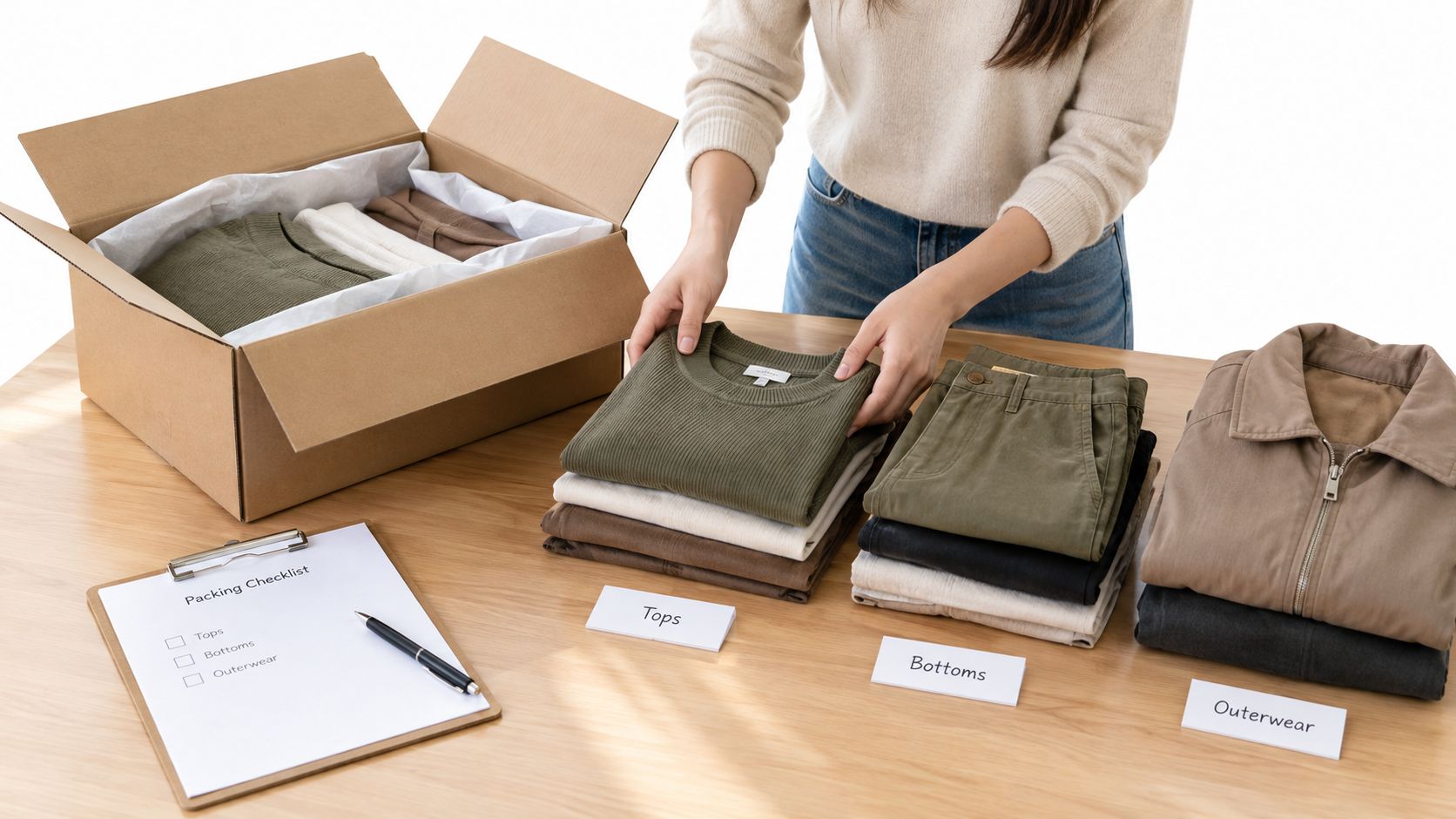
Grade every unit the day it arrives
Photograph the sealed carton, then count every item. Record brand, style, size, color, condition, and your channel specific price estimate. Sort into four groups. A grade is ready to list. B grade needs minor restoration like steaming or lint removal. C grade goes to discount or bundle. D grade is non sellable.
Use a fixed defect rubric so optimism doesn't inflate value. Mark stains, odor, tears, missing labels, seam damage, counterfeit indicators, and outdated seasonality as yes or no for each unit. Binary records beat impressions when you compare suppliers later.
A practical operating threshold is to require at least 80% of units to be listable or recoverable and to cap D grade units at 5–10%. Those aren't universal industry standards. They're discipline lines that keep a weak box from looking acceptable because it contained two strong labels.
Measure sell through, not excitement
Calculate sell through as units sold divided by units received at 30, 60, and 90 days. Track realized price against your estimate for each grade. If A grade units sell but B grade units sit after repair, your restoration assumption is wrong, not your marketing.
Returns belong in the audit too. Processing a return can cost approximately $10–$65 when transportation, inspection, repackaging, and restocking are counted Cart.com analysis of apparel returns and reverse logistics costs. A box that creates preventable returns through bad sizing information can destroy contribution even with decent gross sales.
Common audit failures are predictable. Sellers value at MSRP, ignore size skew, mix seasons, assume every branded item is authentic, and forget to log labor. Avoid those five and your second order will be based on evidence.
Only escalate to larger lots when two consecutive test boxes meet your defect, sell through, and contribution thresholds. One good box can be luck. Two is a pattern worth funding.
Spot Risk Before the Invoice Arrives
Most bad boxes announce themselves before payment. The warning is usually in what the supplier won't say.
Refusing to provide item counts, size ranges, category mix, condition definitions, fulfillment timelines, or a written claims window is not part of the mystery format. That's opacity. Accept variability in labels if your model can handle it. Don't accept unknown authenticity, removed care labels without explanation, or damaged goods with no remedy.
Separate legitimate mystery from dangerous gaps
Consumer expectations support that line. In a 2025 survey, authentication and verification were the most valued digital product passport features for 70% of buyers and 67% of sellers, while product specifications were valued by 68% and 64% respectively, as reported in industry coverage of resale growth Business of Fashion reporting on resale consumer behaviour. Buyers want proof and specifications. If your supplier can't give you either, you'll struggle to give them to your customer.
Other red flags include pressure to pay before questions are answered, retail value claims with no assumptions, return promises that sound impossible for mixed liquidation, and totals that only work when labor, returns, and unsellable stock are left out.
- Correctable issue: A short count documented with photos, acknowledged quickly, and credited under the stated policy.
- Walk away issue: Condition grades change after delivery, authenticity questions get dismissed, or the claims process appears only after you complain.
- Negotiate harder: Size distribution is disclosed but skewed, so you lower your offer or request a smaller test.
If the supplier's math only works at full retail value, it doesn't work.
Document before you argue
Keep your pre purchase questions, the supplier's written answers, invoice, carton photos, and item level audit in one file. Note discrepancies against the promised count, grade, or category on delivery day. Send a concise claim with photos and your rubric, not a general complaint about quality.
Decide in advance what outcome keeps the relationship alive. A credit for D grade units above your cap may be enough. Repeated misgrading isn't. Suppliers who fix documented exceptions are operational partners. Suppliers who hide behind the word mystery are transferring their risk to you.
The waste angle matters here too. The Geneva Environment Network, citing Textile Exchange, reported global fiber production rose from 58 million metric tonnes in 2000 to 116 million tonnes in 2022, and that consumers lose approximately $460 billion in value each year discarding clothing that could still be worn Geneva Environment Network overview of sustainable fashion impacts. A mystery box only helps that problem when buyers can sell or use the garments. Unsellable inventory doesn't become sustainable because it changed warehouses.
Build a Repeatable Box Buying Decision
You don't need a perfect supplier. You need a repeatable sequence that stops you from scaling a lucky box or rejecting a workable one for the wrong reason.
Define your target channel first. Request comparable information from each supplier using identical questions. Calculate conservative unit economics by condition grade. Place a controlled test order you can afford to learn from. Grade the delivery the day it arrives. Review realized sell through and contribution at set intervals.
The summary below keeps that sequence tight.
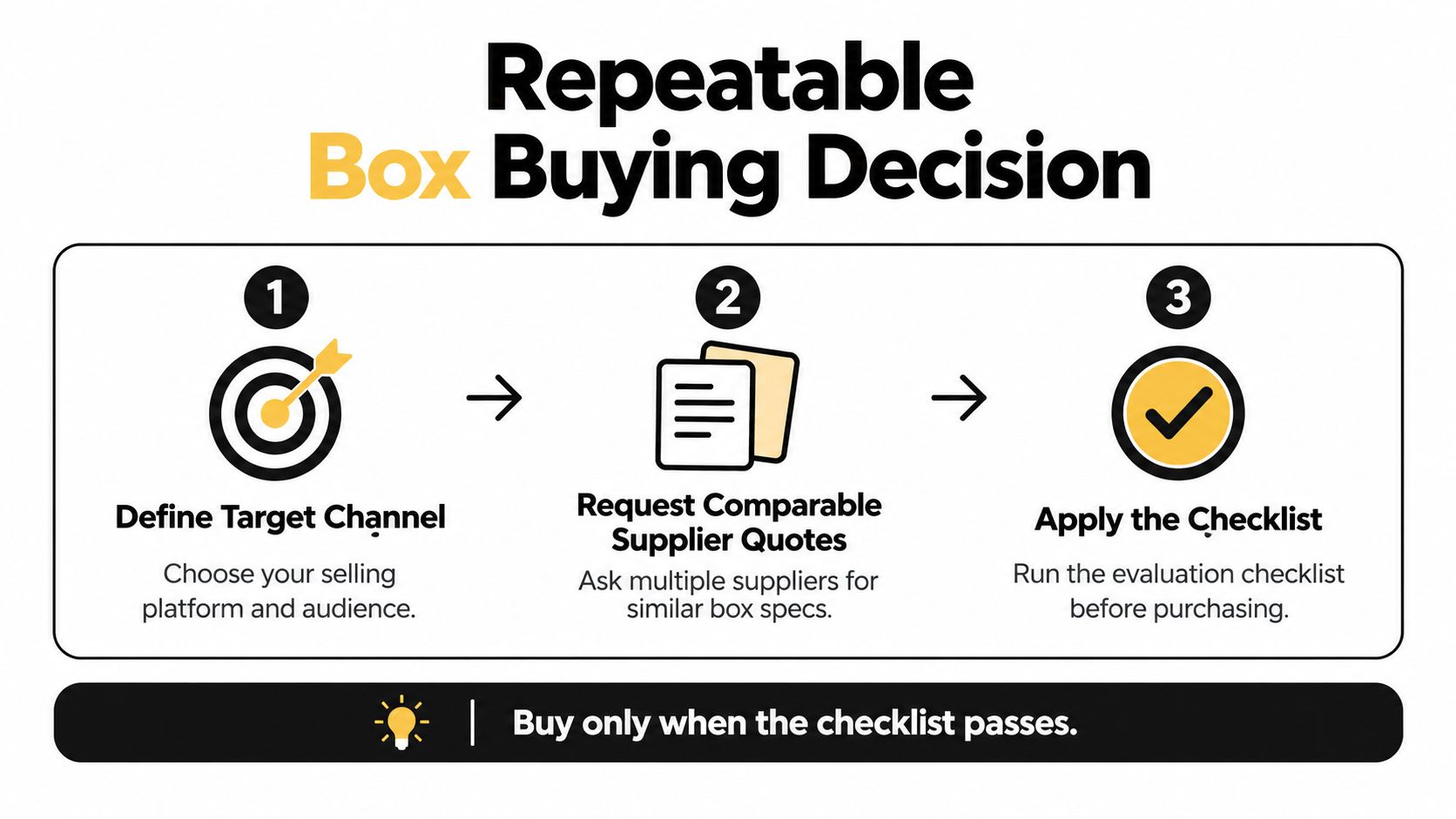
Your final buying checklist
- Channel named: Boutique, marketplace, or live sale requirements are written before you request quotes.
- Disclosures secured: Count, size distribution, condition grades, source type, authenticity process, and claims window are in writing.
- Economics tested: Contribution stays positive after freight, fees, labor, markdowns, returns, and unsellable units.
- Test repeated: Two boxes meet the same defect and sell through thresholds before you increase order size.
- Exit planned: Discount, bundle, donation, or textile recycling route exists for units that won't sell at full effort.
That exit plan matters. Global textile waste is estimated at 92 million tonnes annually, with more than 73% landfilled or incinerated, based on figures in the verified research summary for this guide. I'm not citing that to make every box sound virtuous. I'm citing it because responsible buying includes knowing where your failures go.
Scale on repeated results, not on one impressive brand or one fast selling lot. Keep your preferred brands and budget in the request, but don't let either override grade and size evidence. The best clothing mystery boxes for your business are the ones that pass the same checklist twice and still leave contribution after every real cost.
Treat assortment as mystery. Treat condition, authenticity, economics, and accountability as due diligence.
Visit OneTrendyCloset to explore curated brand name apparel liquidation boxes in multiple sizes, with mix and match brand selection and custom quotes for boxes or pallets built around your budget and preferred brands. Bring the supplier questions and unit economics from this guide to your quote request, start with a controlled test box, and reorder only when your audit proves the assortment works for your channel.