You're probably staring at a late-night sourcing tab, a spreadsheet open in one window, a liquidation lot in another, and a search result for “all time trading” that doesn't seem to fit apparel at all. That confusion is normal. In finance, the phrase points to markets that keep extending access beyond the old daytime session. In resale, it matters because the sellers, shippers, and wholesalers you depend on are tied to trade cycles that never really pause, and your buying decisions get better when you understand that rhythm.
For apparel resellers, all time trading is less about staring at charts and more about knowing when the market around you is open, volatile, and worth acting on. The businesses that treat timing as a real input, not a guessing game, protect margin better than the ones that buy whenever a lot looks cheap. If you source liquidation, run live sales, or keep seasonal inventory moving, this isn't a theory. It's a practical edge.
Table of Contents
- What All Time Trading Actually Means for Resellers
- Breaking Down the Core Concepts
- How Global Trade Cycles Affect Your Inventory Costs
- What Different Reseller Types Need to Know
- Strategic Sourcing in Always-On Markets
- Building Resilient Supply Chains with Curated Partners
- Your Action Plan for Smarter Inventory Decisions
What All Time Trading Actually Means for Resellers
A boutique owner can hear the phrase all time trading and assume it only belongs to stock traders, crypto speculators, or people glued to trading screens. That's too narrow. In practice, it describes a market environment where access, pricing, and reaction speed don't stop when your workday ends, and that affects wholesale buyers whether they trade securities or not.
A reseller feels this most when a supplier updates inventory at odd hours, freight disruptions change landed cost, or competitors list the same brand faster than expected. You don't need to be placing orders at 3 AM to be affected by those conditions. You just need to understand that your sourcing window is tied to a broader market that moves on extended schedules, and those schedules shape availability, price pressure, and buyer behavior.
The phrase has two meanings
First, there's the financial market meaning, where trading can move toward extended-hours or near-continuous access. That's the version many find when they search the term. Recent commentary says major U.S. exchanges are pushing toward 23-hours-a-day, five-days-a-week trading, and broader market commentary says 24/7 trading is becoming more normal for institutions, which forces firms to rethink margining, staffing, and settlement timing. Traders Magazine's coverage of capital markets trends makes that shift clear.
Second, there's the operational meaning for resellers. Apparel sourcing already sits inside a global trade system that doesn't run on one clock. The WTO's statistical series, maintained since 1952, gives analysts a long historical frame for trade cycles, from postwar expansion to modern globalization, and its tools now cover merchandise trade, services, and tariff indicators across annual, quarterly, and monthly formats. The WTO statistics portal matters because it shows how long trade has been tracked and how much visibility buyers now have into the system.
Practical rule: if a supplier, platform, or freight lane can move without waiting for your local business hours, your buying process has to be ready too.
That's the reseller takeaway. All time trading isn't a call to trade more. It's a warning that the market won't wait for you to catch up.
Breaking Down the Core Concepts
A reseller dealing with all time trading has to separate access, liquidity, and timing. Access is whether the market is open when you need it. Liquidity is whether you can buy or sell without taking a bad price. Timing is the part you control, and it is the part that gets wasted fastest.
Constantly open markets create real pressure. Good inventory can disappear before you finish reviewing it, prices can change while you hesitate, and demand can show up at odd hours. Apparel resale works the same way when a supplier drops fresh boxes, a pallet goes live, or a competitor clears out a category first.
Why this matters to wholesale buyers
The broader trade system moves in cycles. Analysts and trade institutions track those cycles through long-running data on tariffs, merchandise trade, and international flows across many economies. The WTO's official data tools, along with historical trade statistics, give buyers a cleaner way to connect sourcing decisions to shifting trade conditions. The WTO's data portal is useful because it shows how trade information is organized and monitored over time.
For apparel buyers, the lesson is direct. A cheap lot is only a win if the timing, supply mix, and category demand fit the market you are selling into.
A reseller who buys only on price usually ends up paying for it in slow sell-through, weak presentation, or dead stock.
Use this framework:
- Access: Can you act fast enough when good inventory appears?
- Liquidity: Is there enough demand in your sales channel to move the mix?
- Timing: Are you buying into a strong category window or chasing leftovers?
If you want a practical buying reference for pallet-style sourcing, this guide to pallets for sale helps frame how bulk inventory choices affect resale outcomes. Prepared buyers make better inventory calls in always-on markets.
How Global Trade Cycles Affect Your Inventory Costs
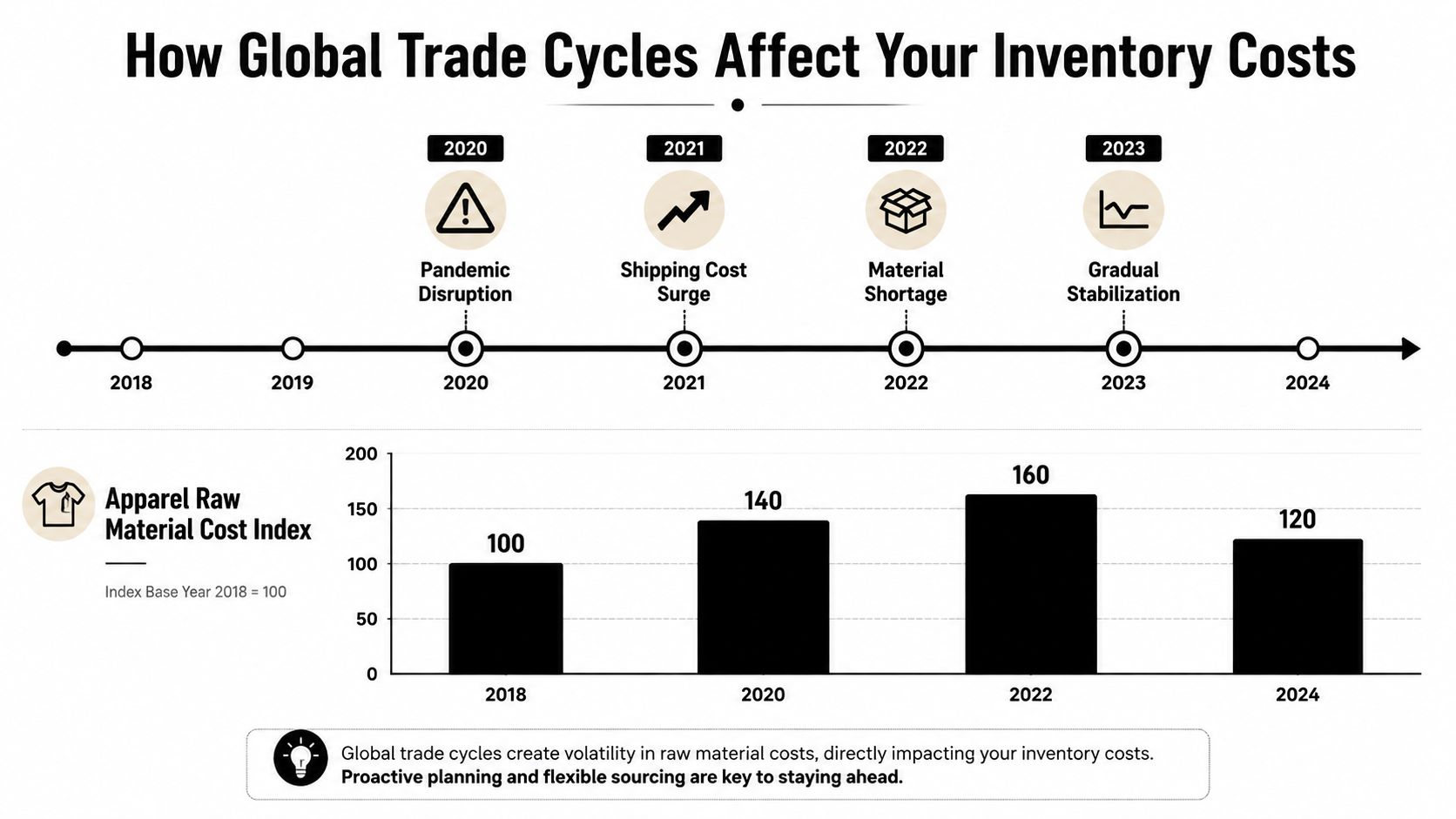
Trade cycles are not abstract. They show up in your purchase price, your sourcing options, and how fast inventory moves once it reaches your shelf or listing page. Long-run trade records help buyers see that sourcing conditions change in patterns, not in a straight line.
The practical takeaway is simple. A cheap lot is only a good buy if the timing, supply mix, and category demand fit the market you are selling into.
The historical pattern is clear. Trade expands, contracts, then expands again. That means the market you buy in now is just one point in a larger sequence of disruptions and recoveries. For resellers, that should change how you judge inventory cost, because the sticker price is only part of the bill.
Cost pressure starts before the box arrives
A liquidation lot does not exist in a vacuum. It reflects sourcing conditions, freight friction, and the broader pace of trade. The WTO data platform gives buyers a cleaner way to compare periods instead of relying on memory or old anecdotes.
That matters because your margin depends on more than the purchase price. It depends on how quickly you can turn the inventory, how predictable the assortment is, and whether your buyers still want that mix when it lands. A box that looks inexpensive can still be a poor buy if it arrives in the wrong demand window.
What the market signal means for your business
The global secondhand apparel market is projected to reach $393 billion by 2030, and the cited forecast says it is growing more than 2x faster than the overall apparel market. That forecast matters because faster growth changes what sells quickly and what gets stuck. Brand recognition and condition carry more weight, while generic inventory gets harder to move.
That is why tighter curation pays off. Mixed-brand boxes with recognizable names usually perform better than random assortments, especially on marketplaces where search and conversion react fast to brand signals.
- Buy cleaner mixes first: Stronger brand recognition usually beats a lower sticker price on messy inventory.
- Watch timing windows: A good lot bought at the wrong time can sit longer than expected.
- Treat cost as landed cost: Sort, freight, and contamination risk all belong in the math.
If you buy pallets or boxes for resale, use a practical buying reference like this guide to pallets for sale. Inventory cost is a timing problem as much as a pricing problem.
What Different Reseller Types Need to Know
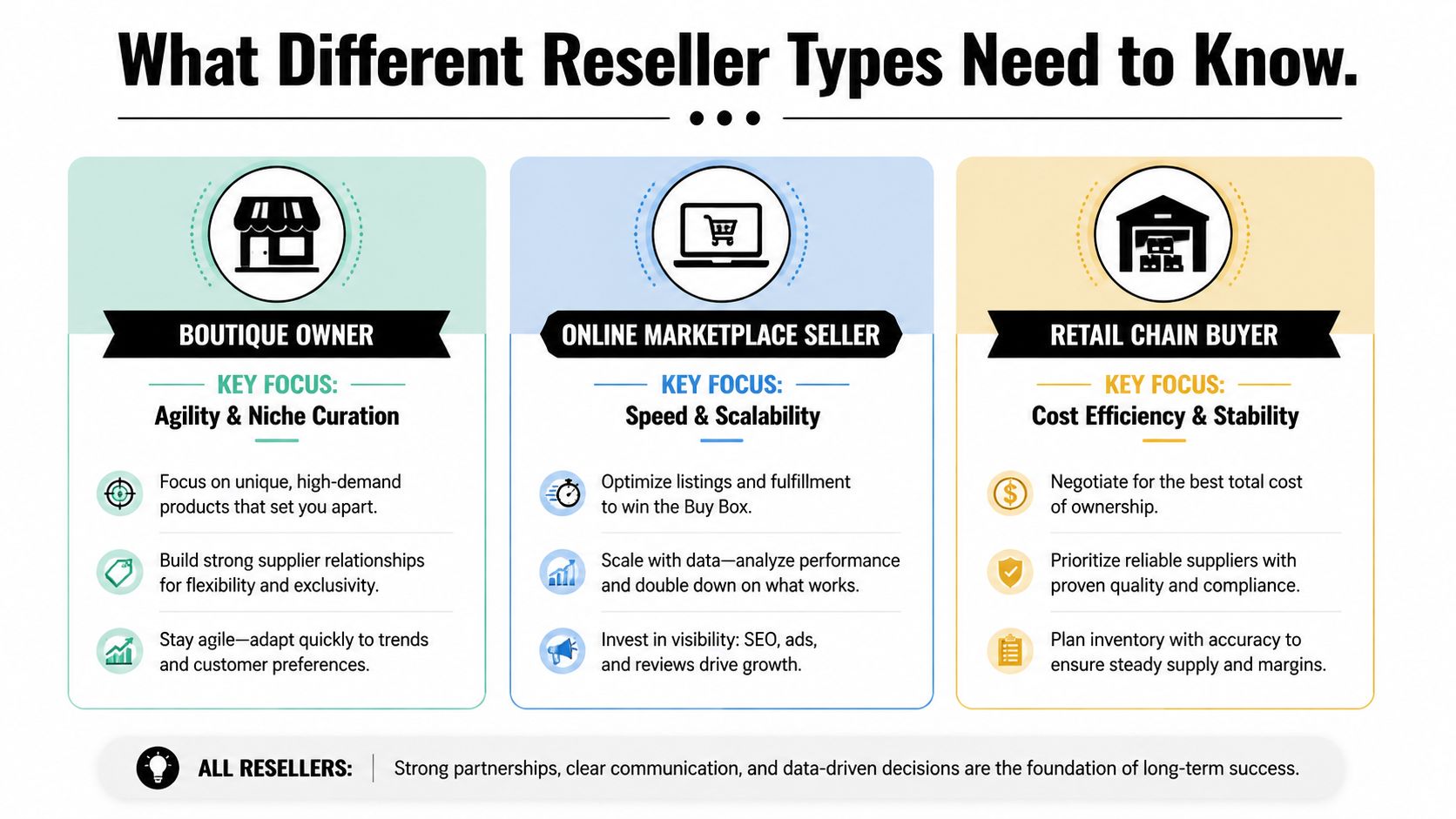
A boutique owner, an eBay seller, and a live-sale host do not experience all time trading the same way. That's the mistake too many generic sourcing guides make. They give everybody the same advice, then wonder why the advice fails in practice.
Boutique operators need consistency. They care about seasonal coherence, brand fit, and whether a delivery can support a curated floor without creating sorting chaos. Online marketplace sellers care about speed and listing flow, because inventory that sits unsorted blocks revenue. Live-sale hosts need fast-turning, presentable pieces that can be shown and sold with minimal prep. Those are different businesses, so the buying rules should be different too.
Match the buying style to the channel
Boutique owners should prioritize assortment control. If the mix doesn't align with the store's look, the lot is a distraction, even if the cost seems attractive.
Marketplace sellers should focus on listing velocity. A fast-moving box with strong names can beat a larger lot that needs too much grading.
Live-sale operators need flexibility. Inventory has to be show-ready and easy to segment into compelling live sets.
Consignment-style businesses need predictability. The less time you spend reworking incoming product, the more time you spend selling.
Timing rules by business model
The practical difference is simple. A boutique can hold inventory longer if the product supports the brand. A marketplace seller usually can't afford that luxury. A live host can sell quickly, but only if the product is easy to present. That's why the same lot can be strong for one seller and weak for another.
Buy the lot that matches your sell-through model, not the lot that looks cheapest in a moment of urgency.
If you're comparing sourcing paths, this article on box of hoodies is a useful reminder that category-specific curation can outperform random bulk buying. Different sellers need different levels of control, and that's exactly where many sourcing decisions go wrong.
The right question isn't “Is this inventory good?” It's “Is this inventory good for my channel, my prep time, and my selling cadence?”
Strategic Sourcing in Always-On Markets
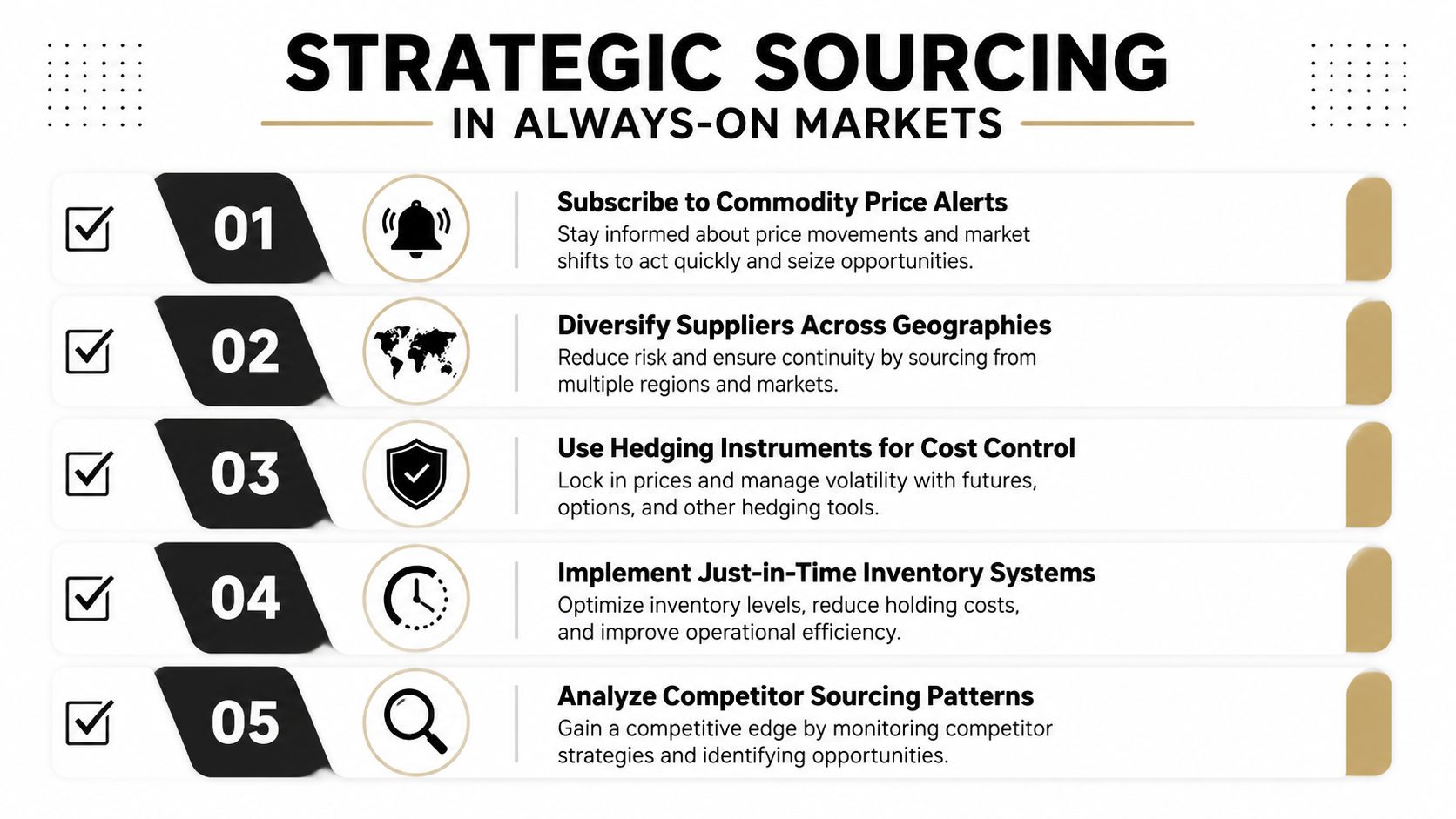
The best resellers don't chase every opportunity. They build a sourcing system that lets them move fast when the right lot appears and stay out of trouble when the market gets noisy. That is the whole game in an always-on environment.
Start with supplier discipline. A reseller who works with one reliable source, then learns how that source prices, ships, and curates, usually makes better decisions than a buyer bouncing between unknown vendors. Your goal is not to create more activity. Your goal is to create better buys.
Build a calendar, not a reaction habit
Seasonality still matters, even when markets never fully sleep. The right categories move better at certain times, but procurement should account for global trade disruption, freight delays, and fast inventory turnover at the same time. That's why a sourcing calendar should include reorder windows, cash reserves, and backup supplier options.
Use this approach:
- Track your fastest categories: Know which brands and styles recover cash first.
- Pre-approve spend ranges: Don't wait until a lot appears to decide your budget.
- Ask for curation, not just boxes: Better mix control lowers sorting waste.
- Keep one alternate supply path ready: If your main source is slow, you need a fallback.
- Review sell-through by lot type: Cheap inventory that lingers is still expensive.
The big error is assuming constant access means constant opportunity. It doesn't. It means your discipline gets tested more often.
Use the clock like a tool, not a trap
Extended access can help you move early, but it can also tempt you into bad buying. If a supplier is responsive after business hours, that's useful. If you're making decisions without a clear target margin, that's dangerous. Market speed should improve your buying process, not replace it.
For buyers comparing wholesale paths, New York wholesalers clothing is a helpful example of why supplier responsiveness and category fit matter as much as raw price. In always-on markets, the fastest reply isn't automatically the best deal. The best deal is the one that fits your channel and turns.
Building Resilient Supply Chains with Curated Partners
Resellers do better when they stop treating suppliers like interchangeable vendors. In volatile markets, the supplier relationship is part of your operating system. A curated partner with brand focus, fast communication, and flexible order sizing gives you something generic sourcing can't, a cleaner path from cash out to cash back.
That matters because apparel liquidation is logistics-heavy and margin-sensitive. The trade side of the business is not just about what you buy, it's about how much sorting, grading, and inconsistency you're willing to absorb. The more structured the supplier, the more control you keep over the outcome.
What to look for in a supplier
The strongest wholesale partners tend to do a few things well. They offer mix control instead of forcing blind buying. They respond fast enough that you can act on a good lot. They also understand that a small test order and a larger pallet are both part of the same relationship.
That combination is powerful because it lets a reseller scale without rebuilding the entire procurement workflow every time demand changes. It also reduces the chance that one bad lot wrecks a month of cash flow.
Best practice: choose suppliers who help you narrow risk before the inventory reaches your floor, not after.
The right partner should also make it easier to stay consistent across seasons. That doesn't mean every box looks identical. It means you know what kind of mix you're likely to get, how much work it will take to prep, and how it fits your customer base.
When you connect that to all time trading, the lesson gets sharper. Constant market access rewards businesses that can make fast, clean decisions. Curated partners make those decisions easier by removing noise from the supply side.
Your Action Plan for Smarter Inventory Decisions
Stop thinking about all time trading as a finance-only phrase. For apparel resellers, it's a reminder that market access, supply timing, and inventory velocity are all linked. The businesses that win aren't the ones that buy the most. They're the ones that buy with the best timing and the cleanest supplier structure.
Tighten your sourcing calendar, define the brands and categories you want, and work only with partners who can communicate clearly when the market moves fast. If a lot looks cheap but doesn't fit your sell-through model, pass. If a supplier can't help you control mix, keep looking.
If you want a supplier that understands brand-name liquidation, mixed-brand curation, and the reality of fast-moving resale inventory, visit OneTrendyCloset. They offer curated apparel boxes and custom lots that fit the way boutiques, online sellers, and live-sale hosts buy. Use that to make your next inventory decision faster, cleaner, and more profitable.