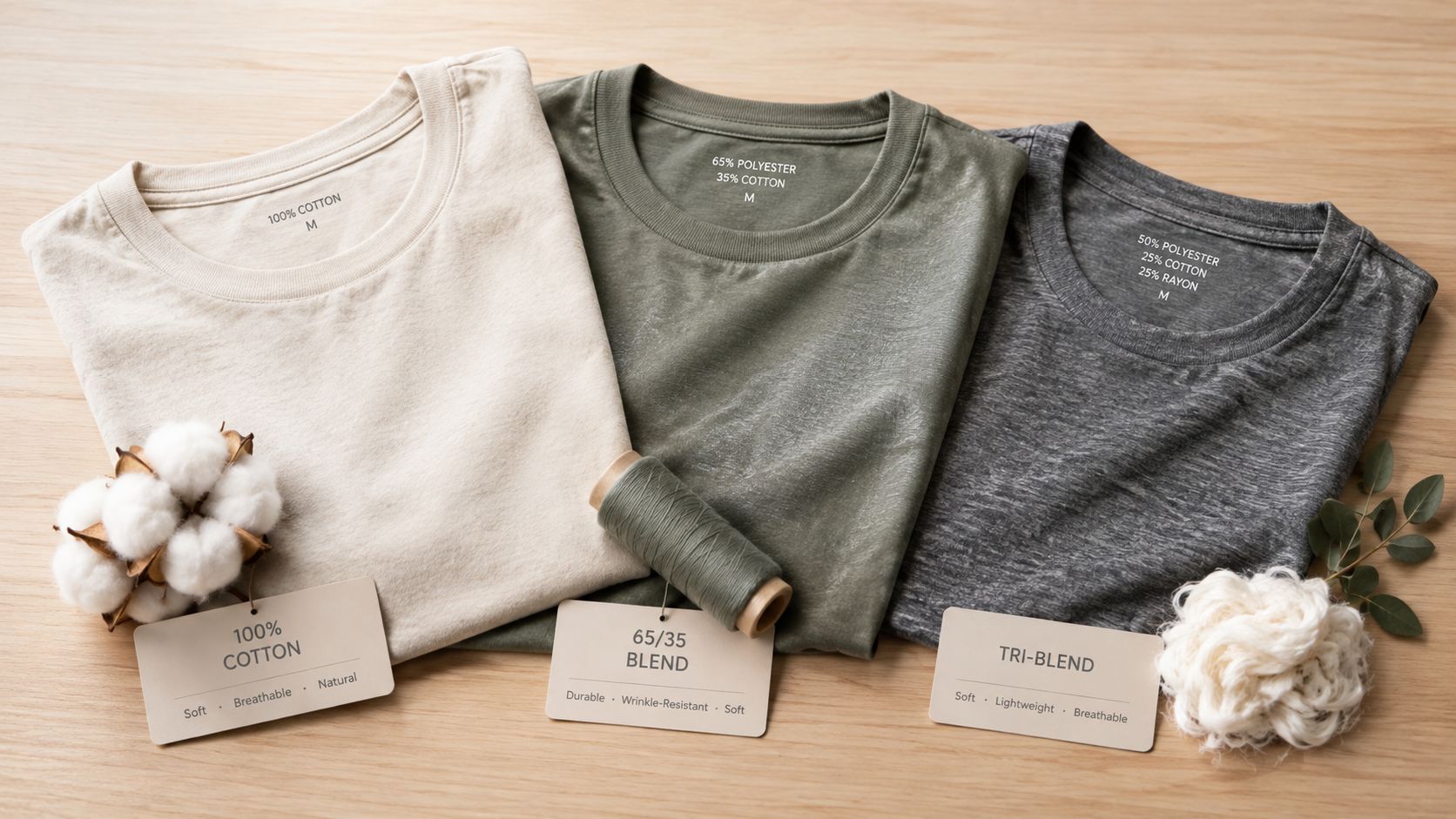
A 50/50 cotton-polyester T-shirt recorded air permeability of 151.8 ft³/ft²/min, compared with 107.4 ft³/ft²/min for a 100% cotton shirt. Its bursting strength was also 10,646.74 psi, versus 5,161.59 psi for cotton in the same fabric-testing research (independent T-shirt fabric testing). Those figures challenge the familiar “best of both worlds” description. Cotton and polyester blend T-shirts can offer a useful balance, but they also create tradeoffs in odor, moisture handling, care, and end-of-life recycling.
For a reseller, the fiber percentage on the label is only the starting point. Yarn construction, knitting, finishing, decoration, expected wear, and customer use all influence whether a shirt feels premium, performs well, and earns repeat sales.
Table of Contents
- What Cotton and Polyester Blend T Shirts Actually Are
- Why Cotton and Polyester Got Mixed in the First Place
- Common Blend Ratios and How They Behave
- Moisture, Drying, and the Odor Tradeoff
- Washing and Caring for Cotton and Polyester Blend T Shirts
- Sustainability, Microfibers, and Recycling Reality
- Choosing the Right Blend for Your Needs
What Cotton and Polyester Blend T Shirts Actually Are
A cotton and polyester blend T-shirt is usually a knitted fabric made from yarn that combines cotton and polyester fibers. The fibers are spun together before the yarn is knitted, so the shirt isn't cotton fabric placed over polyester fabric. This construction gives the finished material a shared surface and a blended response to washing, sweat, abrasion, and decoration.
The fabric test above offers a useful reality check. A 50/50 shirt measured 151.8 ft³/ft²/min in air permeability and 10,646.74 psi in bursting strength, while the tested 100% cotton shirt measured 107.4 ft³/ft²/min and 5,161.59 psi, respectively (fabric-test results for blended and cotton T-shirts). These results don't mean every 50/50 tee will perform identically. Knit structure, yarn size, fabric weight, finishing, and manufacturing quality still matter.
Read the label beyond the ratio
Poly-cotton, often shortened to PC, generally means a polyester and cotton blend, with the exact ratio listed separately. A cotton-rich construction contains more cotton than polyester and usually feels closer to a traditional cotton tee. CVC, or chief value cotton, is commonly used for cotton-dominant blends, although the precise composition depends on the manufacturer.
Yarn construction changes hand feel. Ring-spun yarn is generally smoother because the fibers are twisted into a finer, more uniform yarn. Open-end yarn is produced differently and may feel more basic or textured. Cotton may be carded or combed, while polyester usually appears as staple fiber made from PET, either conventional or recycled depending on the product specification.
Reseller rule: Don't buy from the ratio alone. Request the full fiber composition, yarn construction, fabric weight, finishing details, and care label before ordering inventory.
A 50/50 shirt made with a smooth ring-spun yarn can feel very different from a rougher open-end blank with the same percentages. That difference affects customer expectations, print appearance, photography, and the price a reseller can reasonably ask.
Why Cotton and Polyester Got Mixed in the First Place
Cotton-polyester blending became a major textile development after polyester was commercialized in the 1940s and 1950s. Mills adopted blended fabrics widely during the 1950s because polyester could reduce cotton's tendency to wrinkle and shrink, while cotton helped improve polyester's breathability and static behavior (textile industry history of polyester-cotton yarn).
The logic was practical. Cotton feels natural and absorbs moisture readily, but it can dry slowly and change dimensions in laundering. Polyester absorbs less moisture, dries faster, and helps a knitted garment hold its shape. Combining the fibers gave manufacturers a way to tune the fabric rather than accept every weakness of either fiber.
The engineering compromise
Independent textile literature describes cotton as highly absorbent and slow-drying, while polyester is lower-absorbency, faster-drying, and more hydrophobic. A blend moderates those extremes, which is why it often suits sweat-heavy use better than 100% cotton without feeling as low-absorbency as pure polyester (textile literature on cotton, polyester, and moisture behavior).
| Property | Cotton | Polyester |
|---|---|---|
| Moisture behavior | Absorbs moisture readily | Absorbs less moisture and dries faster |
| Hand feel | Often soft and natural | Can feel smooth or technical |
| Dimensional stability | More vulnerable to swelling and shrinkage | Helps resist shrinkage and shape change |
| Activity performance | Can become damp during sustained sweat | Moves moisture away from the skin more effectively |
| Static behavior | Generally less associated with synthetic static | Can create more static, especially in dry conditions |
The blend's historical success also came from scale. Industry summaries identify 65/35 and 52/48 constructions as especially common in uniforms and T-shirts during the 1970s and 1980s, showing that blended fabric moved from an innovation into mass-market apparel within roughly two decades of polyester's introduction (history and common polyester-cotton constructions).
For buyers, the important point is that blending wasn't only a cost-cutting exercise. It was a response to competing fiber behaviors. Brands still use the same basic principle today, although modern finishes and yarn systems can shift the result substantially.
Common Blend Ratios and How They Behave
Blend ratios change the shirt's priorities. More cotton usually moves the fabric toward a softer, more absorbent, familiar hand feel. More polyester generally supports faster drying, shape retention, and lower shrinkage, although it can also increase the risk of odor retention.
The strongest published comparison in the supplied evidence is between 100% cotton and 50/50 fabric. In that test, the 50/50 shirt measured 151.8 ft³/ft²/min in air permeability and 10,646.74 psi in bursting strength, compared with 107.4 ft³/ft²/min and 5,161.59 psi for 100% cotton (T-shirt air-permeability and bursting-strength testing). The same study reported blended-shirt shrinkage from 2.32% at the sleeve opening to 10.25% at the neck opening, a reminder that dimensional change can vary across one garment.
A practical ratio guide
| Ratio | Shrinkage | Bursting strength | Air permeability | Typical use |
|---|---|---|---|---|
| 50/50 cotton-polyester | The tested shirt ranged from 2.32% to 10.25% depending on location | 10,646.74 psi in the cited test | 151.8 ft³/ft²/min in the cited test | Uniforms, casual retail, general-purpose tees |
| 65/35 cotton-polyester | Higher polyester content generally lowers shrinkage | Check the supplier's test sheet | Depends on knit and finishing | Cotton-rich retail and workwear |
| 80/20 cotton-polyester | Usually feels closer to cotton | Depends on construction | Depends on construction | Casual wear and decoration |
| 90/10 cotton-polyester | Primarily cotton in hand feel | Polyester can support durability | Usually closer to cotton behavior | Cotton-style tees with added stability |
| Cotton-polyester-rayon tri-blend | Rayon can add drape, while strength depends on construction | Must be checked by product | Must be checked by product | Fashion fits and soft retail merchandise |
The ratio isn't the whole garment. A 65/35 cotton-rich tee may be more comfortable for customers who dislike a technical feel, while a higher-polyester performance knit may dry more quickly. A tri-blend can drape attractively, but rayon changes the fabric's behavior and makes direct comparisons with a two-fiber tee unreliable.
For resellers evaluating adjacent categories, a guide to wholesale Gildan sweatshirts can also help separate fiber composition from garment weight and construction. The same lesson applies to T-shirts: compare the specification sheet, not just the product title.
Buying shortcut: Choose the highest polyester share your customer actually needs, then stop. Extra synthetic content isn't automatically an upgrade if softness, odor, or natural hand feel drives the sale.
Moisture, Drying, and the Odor Tradeoff
Cotton-polyester blend T-shirts sit between two very different moisture strategies. Cotton absorbs sweat into the fiber, which can make the shirt feel comfortable at first but damp during prolonged activity. Polyester absorbs less and can move moisture away from the skin faster, yet that performance advantage can come with stronger post-wear odor.
The supplied textile literature describes the blend as a balance between cotton's high moisture absorption and polyester's faster drying and wicking behavior (research on moisture uptake and drying in cotton-polyester textiles). Another blended-fabric study reported a wetting time of 5.4 seconds and a moisture-spreading width of 23.25 mm for a cotton-polyester knit classified as suitable for moisture management (cotton-polyester wetting and moisture-spreading results).
Why odor changes the buying decision
A controlled cycling study found that polyester clothing received a mean hedonic odor score of -2.04, compared with -0.61 for cotton, with a statistically significant difference reported as P = 5.72×10⁻⁶ (controlled study of clothing odor after exercise). The same research area indicates that odor-associated bacteria colonize polyester more readily, helping explain why a shirt can feel drier during exercise yet smell worse afterward.
A 50/50 blend has a reported moisture regain of about 4.45%, placing it between the two fiber extremes (review of odor and moisture behavior in textile fibers). That middle position is useful, but it isn't universally superior.
| Fabric | Moisture behavior | Drying tendency | Post-wear odor tendency |
|---|---|---|---|
| 100% cotton | Higher absorption | Slower after heavy sweating | Lower odor intensity than polyester in the cited study |
| 50/50 blend | Intermediate moisture regain, about 4.45% | Faster than cotton in many constructions | Often a compromise between cotton and polyester |
| 100% polyester | Low absorption and strong moisture transport | Fast | Higher odor concern in the cited exercise research |
For hot climates and intense workouts, customers may value quick drying but dislike odor buildup after repeated use. For casual layering, cotton-rich blends may feel more natural. Resellers should describe the shirt as balanced, not claim that it eliminates the weaknesses of both fibers. A focused polyester apparel guide can support product education, but the care label and actual fabric specification should remain the final authority.
Washing and Caring for Cotton and Polyester Blend T Shirts
Blended tees have three common trouble points: dimensional change, pilling, and print wear. Cotton can swell during washing, while polyester fibers can contribute to surface pilling when abrasion pulls loose fibers into small pills. Printed areas face their own friction and heat risks.
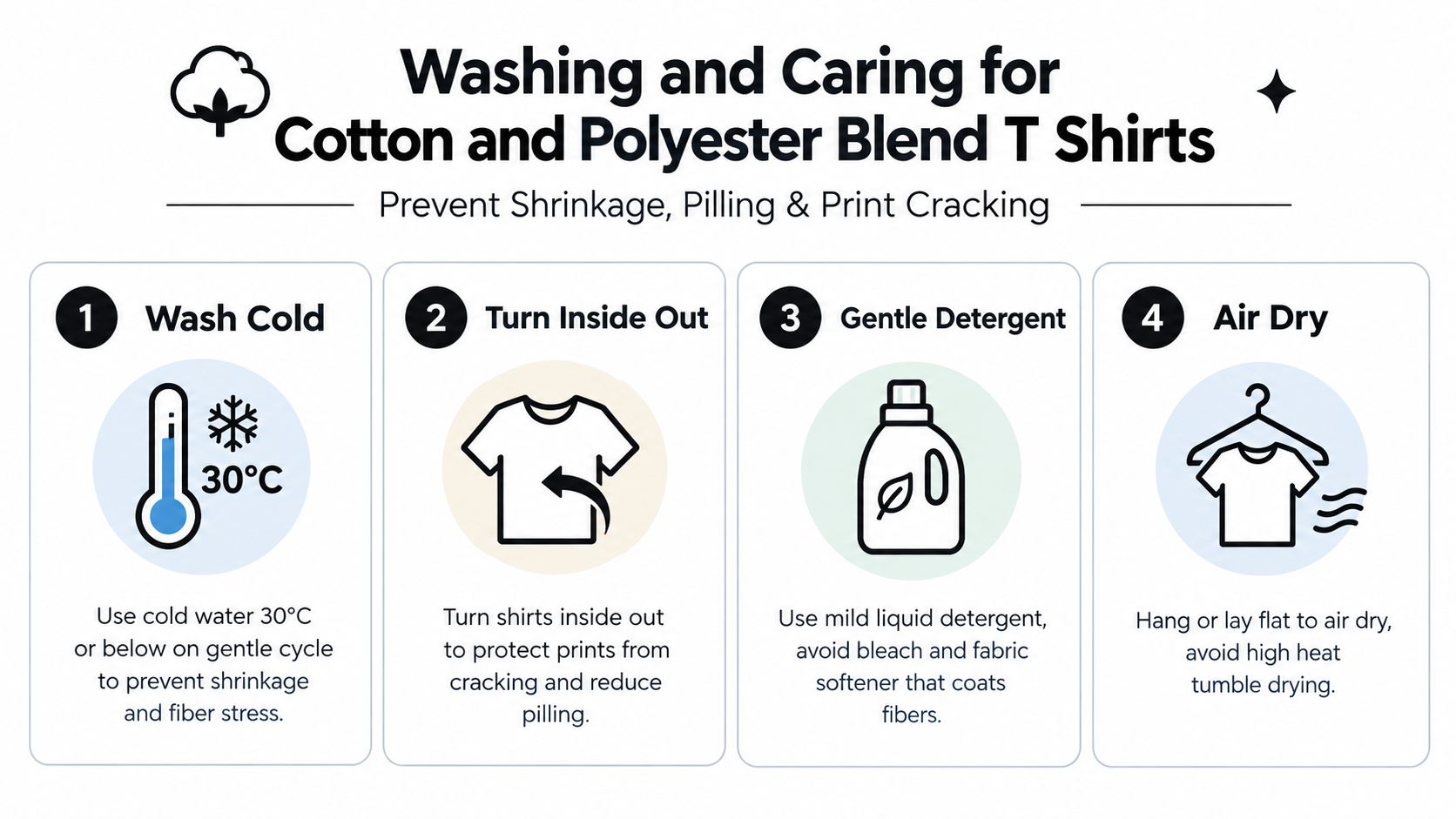
Use a cool, gentle wash and turn the shirt inside out before laundering. The inside-out step reduces direct abrasion against the printed face and can limit friction on the outer knit.
A low-stress care routine
- Wash cool: Follow the care label, and use cold or cool water when the label permits. Avoid aggressive cycles that stress the knit.
- Protect the surface: Turn graphic tees inside out and wash them with similar fabrics rather than rough items that can scrape the face.
- Choose a mild detergent: Skip bleach unless the care label specifically permits it. Avoid fabric softener when moisture performance matters, because coatings can interfere with the fabric's intended surface behavior.
- Dry gently: Lay the shirt flat or use low heat. High heat can encourage cotton-side dimensional change even when polyester helps stabilize the garment.
- Store with care: Fold lightweight or soft tees when possible. Hanging can place stress on shoulder areas over time.
The supplied fabric research shows why care instructions deserve attention. A tested 50/50 shirt displayed shrinkage from 2.32% at the sleeve opening to 10.25% at the neck opening, so a garment can remain broadly wearable while still changing noticeably in specific areas (tested dimensional changes in a blended T-shirt).
For printed inventory, photograph the care label and describe the fabric accurately in listings. Customers often forgive normal wear, but they react badly when a “no-shrink” claim conflicts with the garment's actual behavior. A careful wash routine won't make every blend permanent, but it can reduce avoidable damage from heat, abrasion, and harsh chemicals.
Sustainability, Microfibers, and Recycling Reality
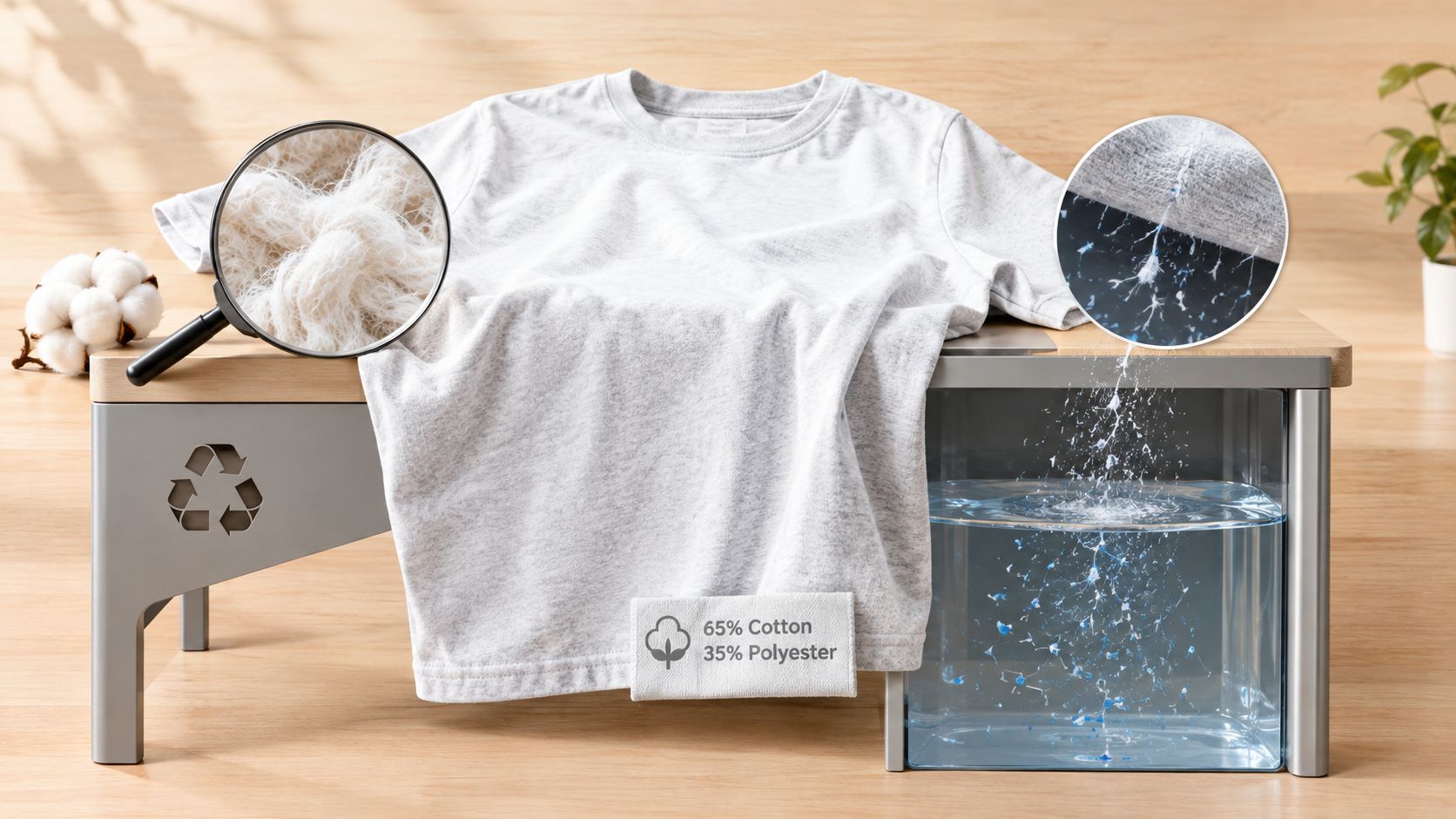
A longer-lasting shirt isn't automatically a circular shirt. Cotton-polyester blends are difficult to recycle because the two fiber types need different treatment, and separating them cleanly adds technical complexity. A 2025 review identifies cotton-polyester blends as common targets for dissolution recycling, but also notes that selective separation is generally required, so the pathway remains technically possible rather than simple and broadly circular (2025 review of blended textile recycling).
Laundering adds another complication. The same review reported that, in a 50/50 cotton-polyester blend, the cotton fraction represented 86% ± 3% of the microplastic-like release, while the polyester fraction represented 14% ± 3% (review of microfiber release from blended textiles). Other work discussed in that review found polyester-cotton blends can shed into both water and air.
What this means for a reseller
Durability is still useful. A shirt that remains wearable for longer can reduce the need for an immediate replacement, but that benefit doesn't erase the fiber-separation problem at disposal. Likewise, reducing polyester content doesn't automatically mean fewer laundering impacts, because blended fabrics can release fibers from both components.
Sustainability check: Ask whether the garment can be collected, identified, separated, and processed after use. “Contains cotton” and “lasts longer” don't answer those questions.
For inventory decisions, prioritize garments customers will wear repeatedly, provide accurate fiber information, and avoid presenting a blend as an uncomplicated environmental solution. The most honest description is a tradeoff: blends can improve use-phase performance while making end-of-life processing more difficult.
Choosing the Right Blend for Your Needs
The right cotton-polyester blend depends on which weakness would hurt the customer most. A casual buyer may care about natural softness, while a gym customer may prioritize sweat transport. A print buyer may value a stable, absorbent surface more than quick drying.
| Use case | Recommended ratio | Key reason |
|---|---|---|
| Daily casual wear | Cotton-rich blend or 50/50 | Familiar feel with added shape stability |
| Gym and high-sweat sessions | Polyester-rich blend with a verified moisture finish | Faster moisture movement, with greater odor risk |
| Screen printing or DTG decoration | 100% cotton or cotton-rich blend | More absorbent decoration surface and familiar print behavior |
| Fashion retail fit | Cotton-polyester-rayon tri-blend | Softer drape and a lighter fashion hand |
| General reseller inventory | 50/50 or cotton-rich blend | Broad appeal across casual and uniform buyers |
Match the shirt to the customer
For everyday retail, a 50/50 shirt is a practical middle ground. It can feel less prone to shape change than a cotton-only tee while retaining some natural softness. For workouts, move toward a polyester-rich construction only when the product specification confirms moisture-management finishing. Customers should know that faster drying may come with more persistent odor after wear.
For screen printing and DTG, cotton-rich surfaces are often easier to position because cotton accepts decoration differently from polyester. A reseller should still check the decorator's process, color requirements, and any dye-migration guidance before buying a large lot.
Tri-blends make sense when the buyer values drape, softness, and fashion styling more than maximum structure. The Next Level shirts guide is relevant when comparing cotton-rich and tri-blend constructions, including examples built around polyester, combed ring-spun cotton, and rayon.
OneTrendyCloset offers mixed-brand liquidation boxes and custom lots for boutiques, marketplace sellers, and live-sale hosts, so resellers can use fiber composition, garment condition, brand, and customer fit as sorting criteria when evaluating apparel inventory.
Decision rule: Pick the ratio whose weakest property matters least in your use case. Don't choose the shirt with the longest marketing list. Choose the one that matches how your customer will wear, wash, decorate, and eventually replace it.
If you're sourcing branded apparel for a boutique, marketplace store, or live sale, visit OneTrendyCloset to review curated liquidation boxes and custom lot options. Use the fiber, construction, and care principles above to ask for inventory that fits your customers rather than accepting an unfocused assortment.