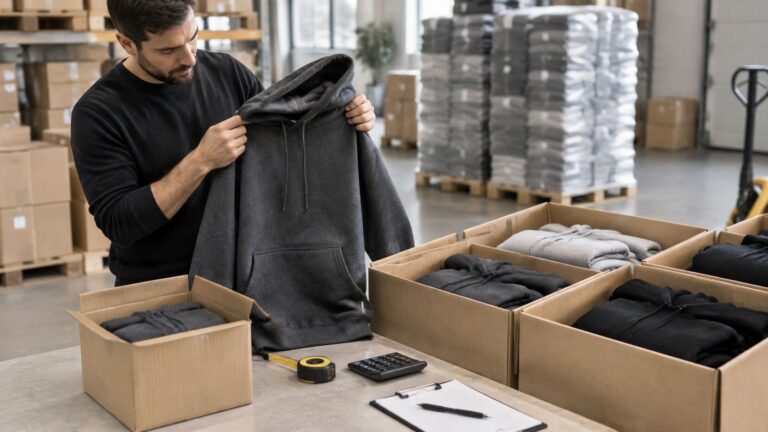
A boutique owner has a supplier's invoice open, a box of brand-name clothing in mind, and a decision to make before sending payment. The price per piece looks low. But what if some garments are damaged, several sizes won't sell locally, or freight and processing push the cost far above the invoice? That first order isn't just a sourcing decision. It's a bet on how many units you can sell, at what price, and how quickly.
Before buying wholesale clothing lots, answer four questions: Does the lot format suit your business? What condition is the inventory really in? What will each sellable unit cost after freight and labor? Which sales channel can move the pieces at a realistic price? If you can't answer those questions, the headline discount doesn't tell you whether the lot is worth buying.
The cheapest cost per piece can turn into the most expensive purchase once you count defects, cleaning, photography, platform fees, and slow movers. Start with the sell-through math, then choose the lot.
Table of Contents
- What Every Reseller Needs to Know Before Buying a Lot
- Curated Boxes, Mixed Lots, and Pallets Compared
- How to Grade a Wholesale Clothing Lot on Arrival
- Landed-Cost Math and Profit Realization
- Negotiating Terms With a Wholesale Supplier
- Sustainability, Ethics, and Responsible Lot Sourcing
- Your 30-60-90 Day Plan and Common Questions
What Every Reseller Needs to Know Before Buying a Lot
A wholesale lot only makes sense if the merchandise matches your operation. A boutique owner who needs a coherent rack has different needs from a live-sale host who can move varied pieces in a fast show, or an online seller who can photograph and list each item individually. Don't buy a lot just because the brands look familiar. Check whether its categories, sizes, condition, and likely selling prices fit the customers you already reach.
Condition deserves the same scrutiny as brand mix. New overstock, shelf pulls, customer returns, and used clothing aren't interchangeable. Ask what the supplier means by each label, whether a manifest is available, and how the supplier handles goods that arrive damaged or materially different from the description. A box that's described as ready to resell may still require inspection, cleaning, repairs, or claims follow-up.
Ask these questions before paying
- What am I buying? Confirm the format, categories, brand preferences, size range, and condition expectations in writing.
- What will a sellable unit cost? Add invoice cost, freight, processing labor, cleaning, and repairs, then divide by units you can list and sell.
- Where will it sell? Decide whether the strongest pieces belong on your boutique floor, a marketplace, or a live-sale channel before the shipment arrives.
- How quickly can I list it? A lot you can't sort, photograph, and price promptly may tie up cash while its selling opportunity fades.
Buying rule: If the purchase only looks profitable when every piece sells at an optimistic price, don't buy it.
Treat the first order as a test of the supplier, the inventory, and your workflow. Your target isn't the biggest box or the lowest nominal unit cost. It's a lot you can inspect, process, and sell without putting too much cash at risk.
Curated Boxes, Mixed Lots, and Pallets Compared
Choose the format that matches your selling capacity, not the one with the most attractive per-piece number. Curated boxes usually reduce sorting because the supplier has assembled a more focused assortment. Mixed lots give you variety, but you'll need to do more triage. Pallets can lower the apparent unit cost, yet they demand more space, handling, and cash before you know how much inventory is sellable.
A curated box suits a first-time boutique buyer or live-sale host who needs a manageable assortment and can list or present the goods soon after delivery. It's often the sensible test format when you're still learning a supplier's grading and brand mix. The tradeoff is that a curated assortment may offer less breadth than a mixed lot.
A mixed lot works for marketplace sellers who already have a routine for sorting by brand, size, condition, and category. The variety can give you more options for individual listings and bundles, but only if you're ready to photograph and describe each item accurately. If your listing queue is already backed up, more variety can mean more unfinished inventory.
A full pallet is for an operator with storage, sorting space, and multiple selling channels. It can make sense after smaller purchases have shown that your process handles the condition and mix reliably. It's a poor first order if you don't know your sellable-unit rate or how much labor each piece takes.
| Format | Typical capital | Labor to list | Best-fit channel |
|---|---|---|---|
| Curated box | Lower commitment than a pallet; confirm the supplier's actual quote | Lower sorting burden, though every piece still needs checking | Boutique floor or live sale |
| Mixed lot | Varies with size and composition | Moderate to high, depending on condition and assortment | Poshmark, eBay, or other marketplaces |
| Pallet | Highest cash and storage commitment | High, including sorting, processing, and routing | Multi-channel operation |
For a boutique, start with a curated box that fits the store's customer and price range. For a live-sale host, favor a focused box of recognizable, presentable pieces. For a marketplace seller, a mixed lot can work if you have the capacity to list it. Don't step up to a pallet until your records show that the smaller format sells through at an acceptable return.
How to Grade a Wholesale Clothing Lot on Arrival
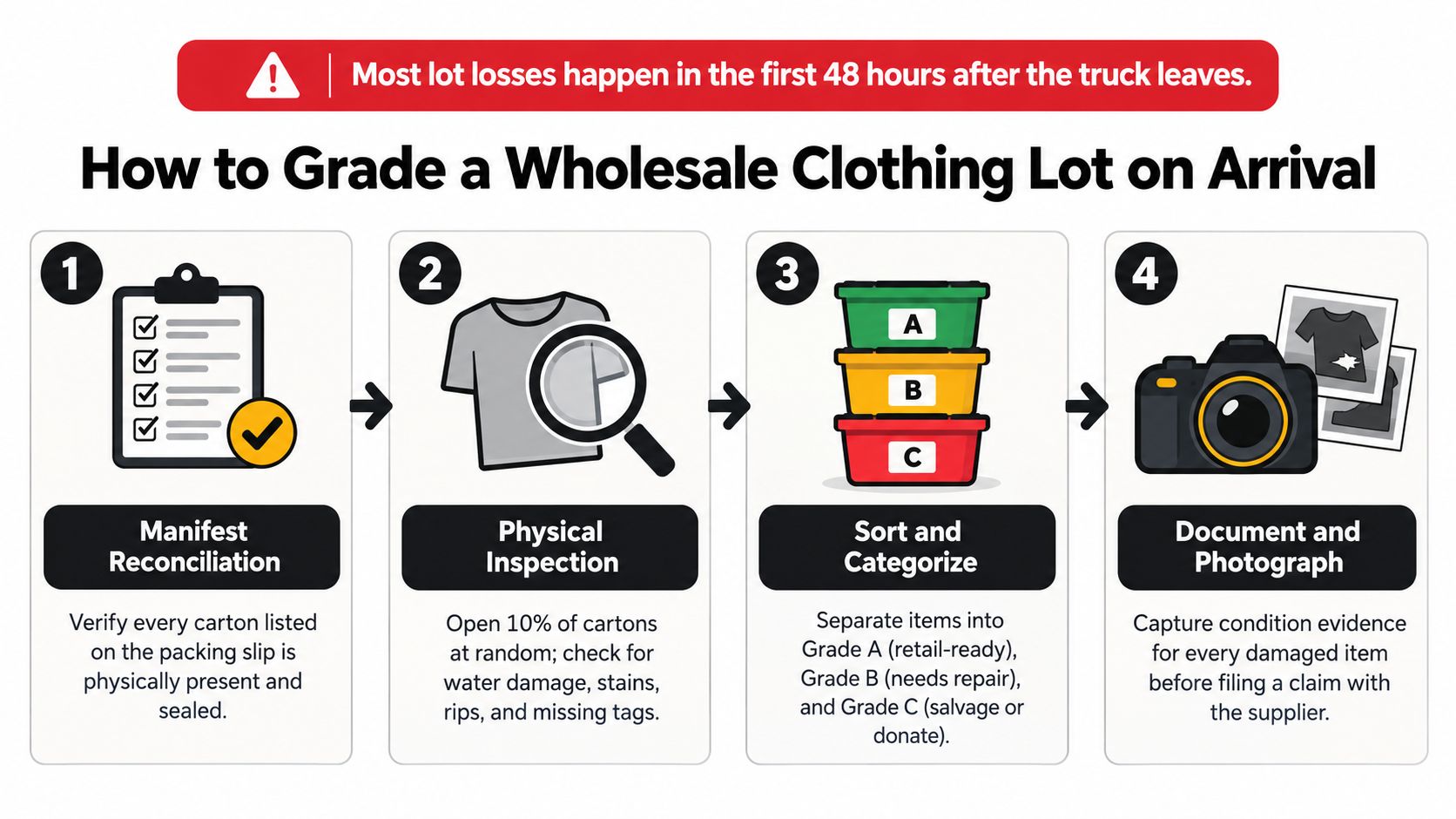
A box-level description can't tell you which individual garments are ready to list. Treat every unit as an inventory decision, and document what you find before you start pricing. The workflow is straightforward: reconcile, inspect, grade, and route.
Reconcile the manifest. Compare the packing list with what physically arrived. Record counts by SKU, brand, size, category, and stated condition. Note missing items or mismatches while the shipment is still fresh in your records.
Inspect each garment. Check for stains, odor, tears, missing labels, broken closures, and other functional defects. If an item is branded, look for authenticity concerns or signs that the description doesn't match the garment. Don't list questionable goods as genuine while you wait for an answer.
Grade and photograph exceptions. Use consistent labels: new with tags, new without tags, excellent, repairable, and unsellable. Photograph defects and anything that doesn't match the manifest. Separate grades rather than blending them into a single average; a repairable piece shouldn't carry the same expected recovery as a retail-ready one.
Route every unit. Send clean, desirable pieces to full-price resale or a suitable marketplace. Bundle lower-value items for a live sale, route repairable garments to cleaning or repair, and keep unsellable goods out of sellable inventory. Consider donation or textile recycling where appropriate.
Recalculate cost after grading
Say you buy a 100-piece box and find 18 pieces that can't be sold. Your sellable count is 82, not 100. Divide the lot's invoice, freight, and processing costs by 82 to find the adjusted cost per sellable unit. The effective unit cost is higher than the number you'd get by dividing by the advertised quantity, so your break-even price must rise or your expected profit must fall.
Set acceptance terms before opening the shipment. Agree on how defects, missing units, and material misdescriptions will be documented and reported. Keep timestamped photos and quarantine suspected counterfeits or goods that differ materially from the description. A garment that needs a disclosed discount may still sell; a suspected counterfeit shouldn't be routed into a listing.
Landed-Cost Math and Profit Realization
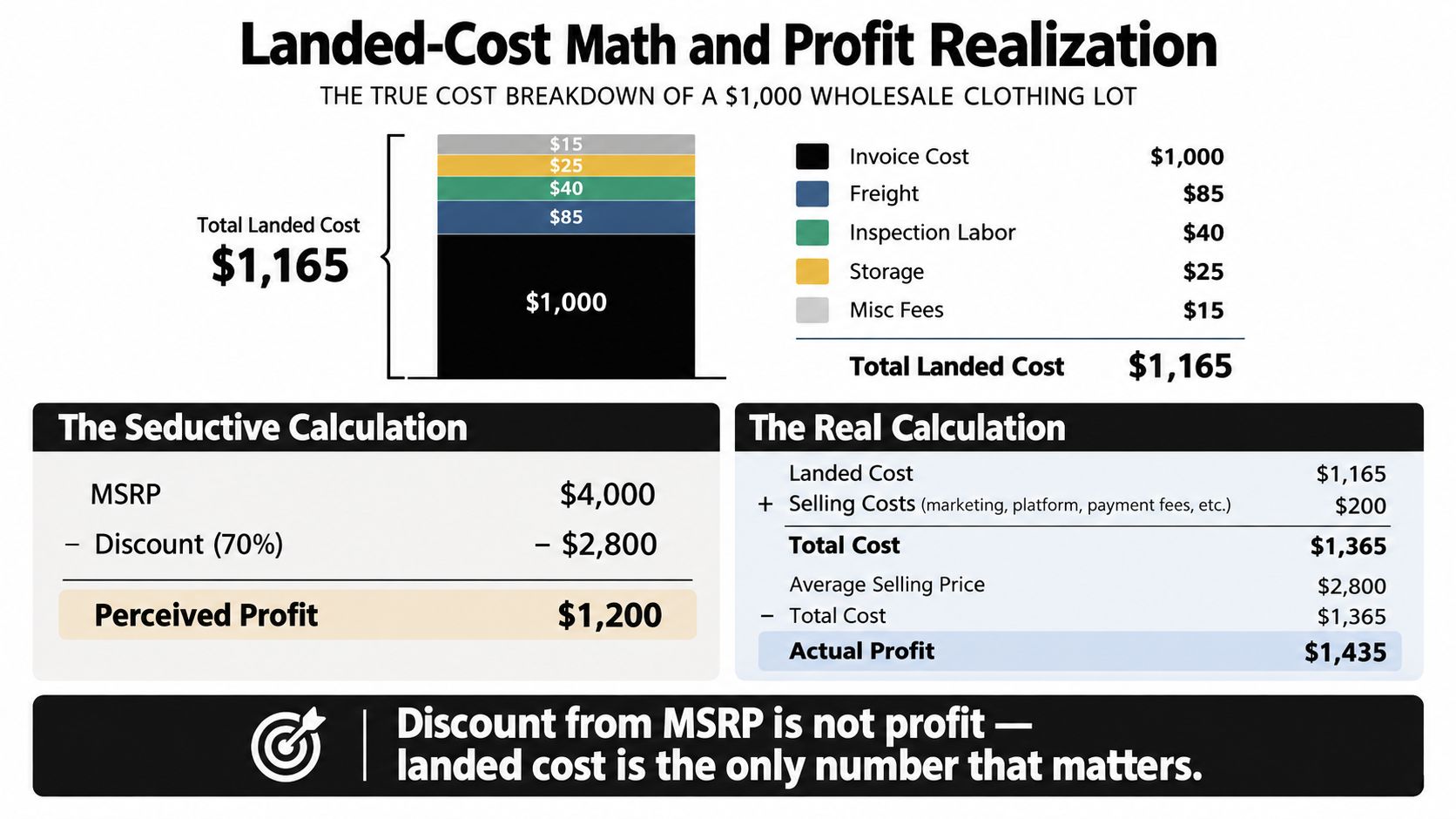
MSRP is not a profit forecast. A label's original retail price doesn't tell you what a customer will pay, how long the item will sit, or what you'll spend to prepare and sell it. Build the estimate from your costs and the price you realistically expect to collect.
Start with the purchase and delivery costs, then account for the work required to turn a shipment into sellable listings. Use this formula:
Adjusted landed cost per sellable unit = (invoice cost + freight + processing labor + cleaning and repair costs) ÷ sellable units
Then estimate your contribution margin using the expected realized price, not the listing price:
Expected contribution per unit = expected selling price × probability of sale within your target period − variable costs
Variable costs can include marketplace and payment fees, shipping subsidies, photography, storage, returns, cleaning, and labor. If your return allowance is only a guess, make the assumption visible in your worksheet and test a less favorable version before you commit. A detailed guide to how liquidation pallet costs affect a purchase can help you identify expenses beyond the invoice.
Run three outcomes before you buy
Build optimistic, base, and clearance cases. In the optimistic case, assume strong sell-through and realistic top-end prices for the pieces you can identify. In the base case, use the prices you expect to realize after ordinary discounts and account for returns, labor, and unsold units. In the clearance case, assume slower sales and lower recovery, with some items bundled or marked down. Don't invent a “typical margin” to make the model work. Use the prices and costs you can defend.
A useful test is whether the base case still justifies the cash and labor. If the purchase only works under the optimistic assumptions, pass or negotiate a smaller trial order. For a broader cost walkthrough, use this video on liquidation purchase costs.
Time matters because slow fashion inventory can lose resale value as it ages. One returns-management guide reports that each additional day of delay can reduce fashion resale value by about 1–2%; treat that as a cited benchmark, not a guaranteed outcome for your lot, and plan to manage apparel returns and resale timing. Inspect and photograph items promptly. At 30 days, review listings and correct weak photos or descriptions. At 60 days, reprice slow movers or bundle low-demand pieces. At 90 days, decide whether to move remaining stock through a lower-cost channel rather than continue storing it.
Track units received, sellable units, units listed, units sold, gross and net revenue, days to sale, returns, defects, and residual inventory. A real post-sale reconciliation shows whether your assumptions held. Gross revenue divided by purchase cost doesn't.
Negotiating Terms With a Wholesale Supplier
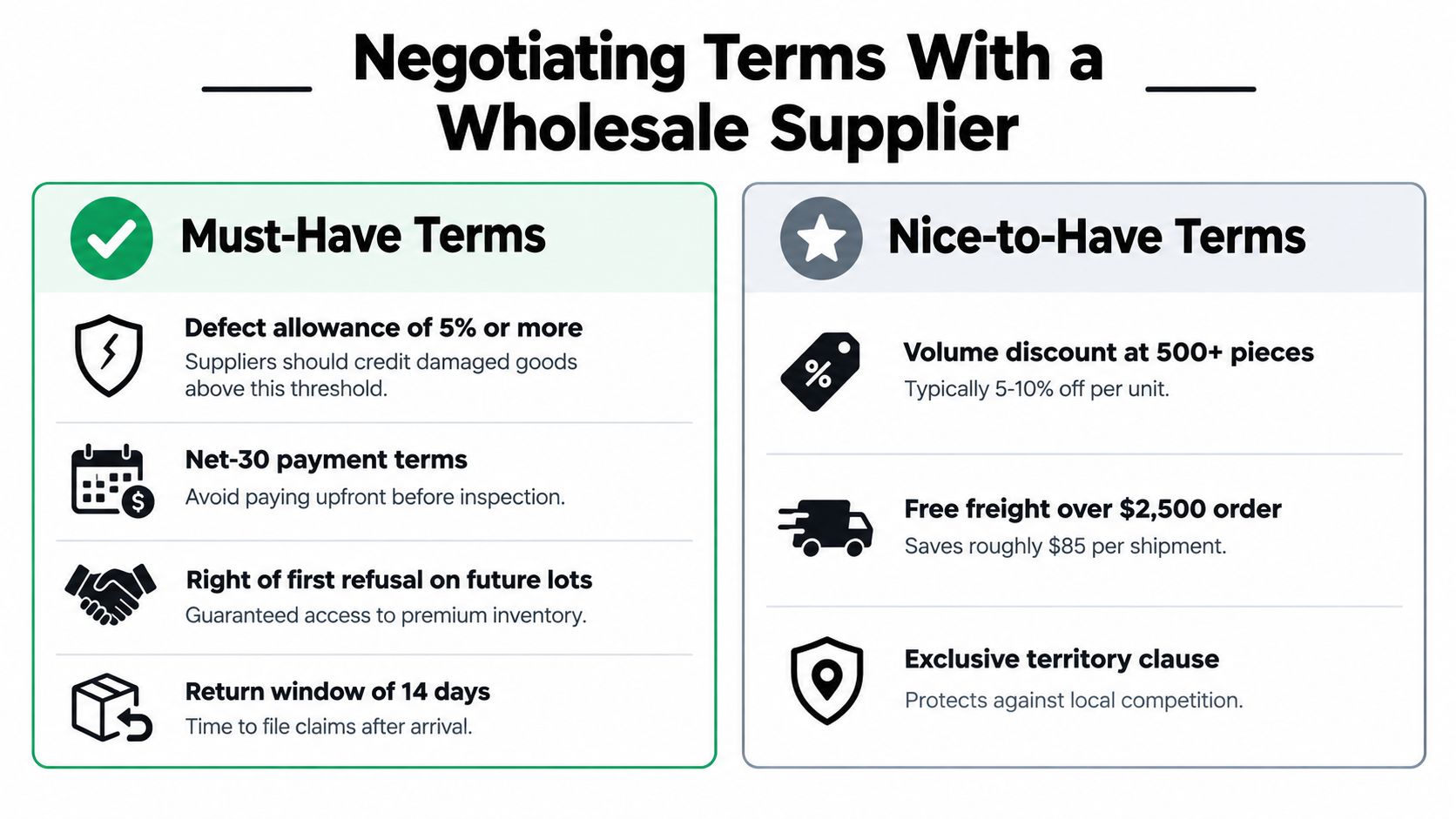
A supplier relationship is more useful when expectations are written down. Ask direct questions without treating every conversation like a dispute. You're trying to confirm what the supplier is selling, what happens when the shipment differs from the description, and whether the payment schedule fits your cash flow.
Must-have terms
- Manifest accuracy: Ask what the manifest covers and how the supplier handles material mismatches. You can write, “Could you confirm that the manifest reflects the expected brands, categories, and quantities, and explain how discrepancies are reviewed?”
- Defect disclosure: Ask for the grading definitions and any known defect patterns. Try, “Please share how you classify returns and damaged goods so I can plan the right selling channels.”
- Claim process: Get the reporting window and evidence requirements in writing before ordering. Say, “If items arrive damaged or materially different from the description, what's the process for submitting photos and requesting a review?”
- Payment terms: Make sure the due date and payment method are clear, and don't assume you can inspect before paying. Ask, “Can you confirm when payment is due and whether any inspection or claim period applies after delivery?”
Nice-to-have terms and what can wait
Brand preferences and mix-and-match options can make the lot more useful for your customers. Ask, “If available, could you prioritize these brands or categories within the box?” Also ask whether substitutions are allowed and how the supplier will disclose them. Photography assistance or advance inventory previews may help, but don't treat them as guaranteed unless the supplier agrees.
Regional exclusivity and volume rebates may matter once you're buying consistently. They're usually distractions on a starter box. Custom crating and white-glove delivery can also wait unless your receiving setup requires them. Focus first on clear grading, accurate descriptions, delivery requirements, and an order size your business can process.
Match the inventory to the sales channel
The channel affects how much work each item needs and what price you can reasonably expect. Boutique floors favor cohesive assortments, recognizable labels, and sizes that suit the store's shoppers. Poshmark can suit mixed fashion lots where you can photograph and describe pieces individually. Whatnot works best when you can present appealing, easy-to-understand inventory in a live format. eBay gives you room to list a broad mix, but accurate condition notes and clear photos still matter.
Don't send every piece through the same route by default. Put stronger branded items where you expect the best realized price after fees and labor. Let low-value items go through the channel that takes the least time to list, or bundle them if that improves recovery. The supplier's discount matters less if the lot arrives in a format your operation can't move.
Use a written checklist when comparing suppliers, including their wholesale clothing supplier terms and ordering details. A supplier who answers basic questions clearly gives you a better basis for testing an order than one who relies on vague promises.
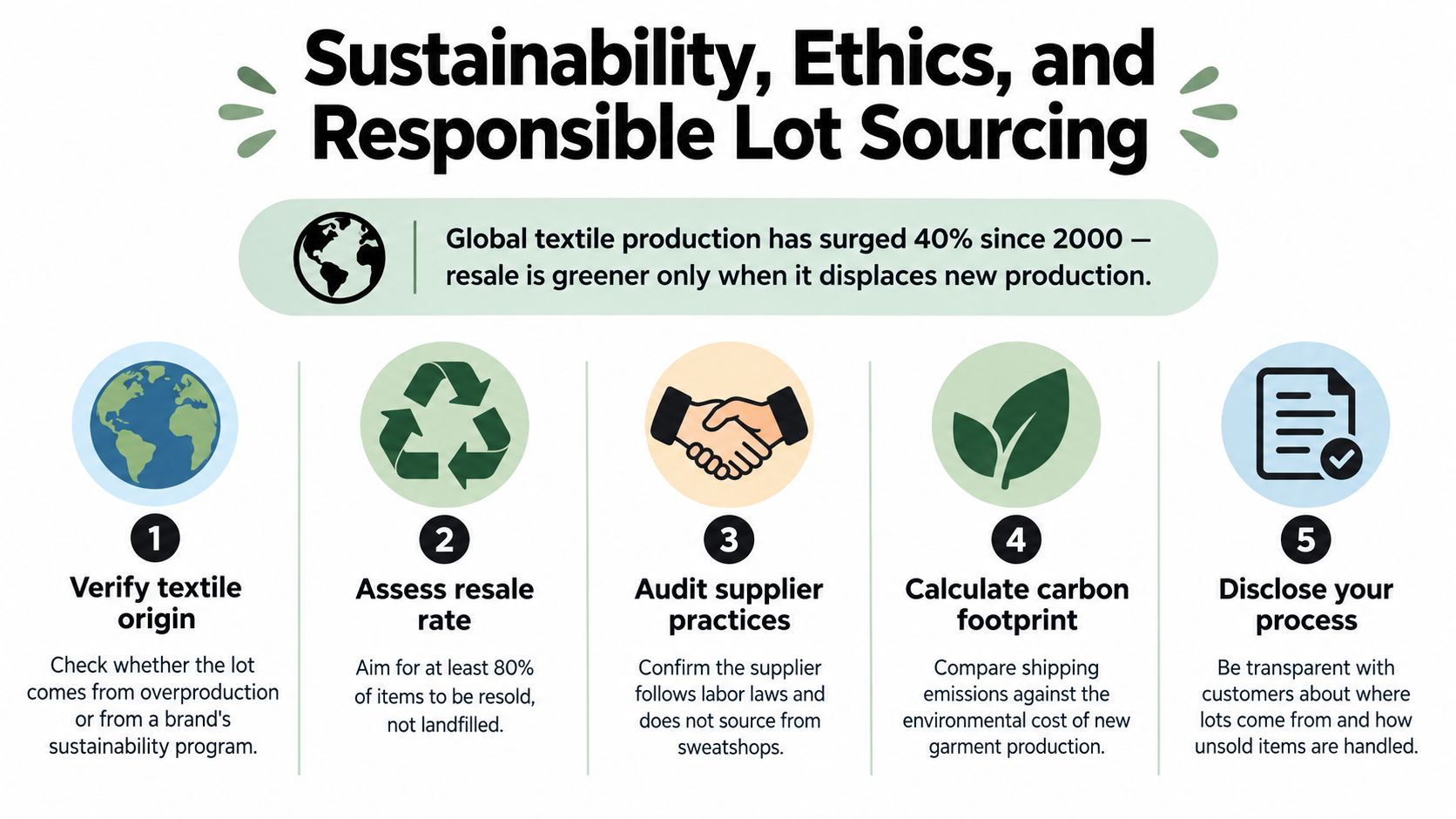
Sustainability, Ethics, and Responsible Lot Sourcing
Resale isn't automatically sustainable just because someone buys a used or liquidated garment. The outcome depends on what the clothing is, whether it's wearable, where it goes next, and what happens to pieces that don't sell. Buyers should ask for evidence about the lot's composition and disposition instead of making broad environmental claims.
The supply context is substantial: global textile production rose from 8.3 kilograms per person in 1975 to 15.5 kilograms in 2023, and is projected to reach 18.8 kilograms per person by 2030, according to the United Nations Environment Programme's textile production summary. That larger supply base helps explain why overstock, returns, and discontinued goods enter secondary channels. It doesn't prove that every liquidation purchase prevents waste.
Ask for traceable condition information
Ask suppliers whether a lot contains new overstock, customer returns, used garments, damaged goods, or a mixture. Request clear grading definitions and defect disclosure. Find out how the supplier separates reusable apparel from material that's no longer suitable for resale, and how unsold or damaged items should be handled.
The export picture also calls for care. The UNECE overview of discarded-clothing trade reports that in 2021, the United States accounted for 15% of global discarded-clothing exports, while Asia received 28%, Africa 19%, and Latin America 16%. The same UNECE material notes that reusable clothing can be mixed with textile waste when quality separation is difficult. A buyer should ask what a supplier means by “reusable,” not assume the label settles the question.
For your own leftover inventory, keep disposition records. Repair wearable pieces, try an outlet or donation route when appropriate, and investigate textile recycling for garments that can't be resold. Don't promise customers that a lot is environmentally beneficial unless you can explain what happened to the goods.
For more on how secondhand clothing is sold in bulk, use this guide to used clothing by the bale, then ask the supplier what grading and end-of-life information they can provide for the specific lot you're considering.
Your 30-60-90 Day Plan and Common Questions
A small test order gives you evidence before you scale. Set up the records and workflow before you send payment, then use actual sell-through and defect experience to decide what to buy next.
Days 1–30
- Choose a test lot: Pick a format and size your current team can process without disrupting normal sales.
- Prepare your intake sheet: Track manifest details, physical counts, condition grades, photographs, and disposition.
- Set up one primary channel: Use the venue where your customers already shop and you can list consistently.
- Reconcile after sales begin: Compare the supplier's description with what arrived, then compare your expected prices and costs with the actual results.
Your checkpoint is a reliable record of sellable units, processing work, realized prices, and remaining stock.
Days 31–60
Review which brands, categories, sizes, and conditions sold, and which stayed on the rack or in storage. Tighten your buying preferences around that evidence. Add another sales channel only if it offers a clear route for inventory your current channel handles poorly.
Days 61–90
Consider a larger or custom lot only if the test order's sell-through and condition were acceptable for your business. Ask the supplier to confirm grading, defect disclosure, and claim procedures in writing. Re-run the cost worksheet with the new freight, labor, storage, and inventory assumptions before you commit.
Common questions
What's the right minimum order? There isn't one that fits every seller. Choose the smallest format that lets you test the supplier and process without tying up cash you need elsewhere.
What if the lot is under-described? Photograph the issue, compare the goods with the written description and manifest, and contact the supplier through the stated claim process. Keep questionable items out of active listings until you resolve the discrepancy.
What should I do with slow movers? Improve the listing first if the photos or descriptions are weak. If the item still doesn't move, reprice or bundle it, then shift it to a lower-cost channel instead of holding it indefinitely.
When should I walk away? Pass if the supplier won't explain condition grades, won't clarify how discrepancies are handled, or can't provide enough detail for you to estimate a realistic sellable-unit cost.
OneTrendyCloset offers curated brand-name apparel liquidation boxes in multiple sizes, mix-and-match brand selection, and custom quotes for specific lots. If you've worked through the cost and sell-through math and want to compare a box or custom order with your plan, visit OneTrendyCloset.