Friday afternoon. The front rack looks picked over in the good way, the denim wall looks ignored in the bad way, and a supplier invoice is sitting open while you try to decide whether to buy another box before the weekend traffic hits.
That's the wholesale problem for boutique owners. It isn't “where do I buy clothes.” It's whether this next order will restock winners, clog your stockroom, or eat the cash you need for payroll, shipping, or your next trend test.
Every order is a bet. You're betting on demand, on the supplier's honesty, on your ability to price the pieces correctly, and on whether the size run makes any sense for your customer. Get it right and wholesale clothing for boutique owners becomes a margin tool. Get it wrong and you've built yourself a clearance rack with an invoice attached.
The blunt truth is that most boutique owners don't fail on the big decision. They fail on the small ones. They buy too much of the wrong category because the per-piece price looked cheap. They reorder too late on a proven seller. They jump to pallet volume before they've earned the turn. They accept vague defect terms and act surprised when half the “deal” needs steaming, sorting, or discounting.
Table of Contents
- The Boutique Owner's Wholesale Sourcing Dilemma
- Wholesale Channels Boutique Owners Actually Buy From
- Liquidation Boxes Versus Brand Distributors
- MOQ, Pricing, and the Real Cost Per Piece
- Quality Checks That Protect Your Margins
- Choosing the Right Box Size or Pallet Volume
- Planning Reorders Around Turnover and Cash
- A Simple Sourcing Checklist for Your Next Order
The Boutique Owner's Wholesale Sourcing Dilemma
A new boutique owner usually starts with the same assumption. If the unit cost looks low enough, the order is smart.
That's backwards.
A cheap box of slow sizes, weak colors, or tired styles is expensive the minute it lands. A more predictable case from a disciplined supplier can be the better buy because it reaches the floor faster, needs less triage, and has a cleaner path to full-price sell-through.
The real tension sits in the back room
Boutique sourcing is a constant argument between cash flow, assortment freshness, and inventory risk.
You want enough inventory to look full and exciting. You also need enough liquidity to react when a category suddenly starts moving. If you lock too much money into one oversized order, you lose flexibility. If you buy too cautiously, your best customers see the same stale rack two weeks in a row and stop checking in.
Practical rule: Don't judge a wholesale order by how cheap it sounds. Judge it by how fast you can sell the good pieces without heavy markdowns.
Why small decisions matter more than supplier hype
Most supplier marketing is built to make buying feel easy. “Deep discounts.” “Mixed brands.” “Exclusive lots.” Fine. None of that answers the questions that protect your store.
Ask these instead:
- How much sorting will this order require once it arrives
- Will the size spread fit my customer or just fill hangers
- Does this channel let me test a trend without overcommitting
- Can I reorder winners quickly, or am I buying a one-and-done assortment
- What happens if the box arrives with stains, seam issues, or moisture damage
Those are the questions that separate a profitable restock from a pile of “maybe we can move this on live sale.”
Wholesale Channels Boutique Owners Actually Buy From
Boutique owners usually buy from four practical channels. Each one has a place. Each one also has a trap.
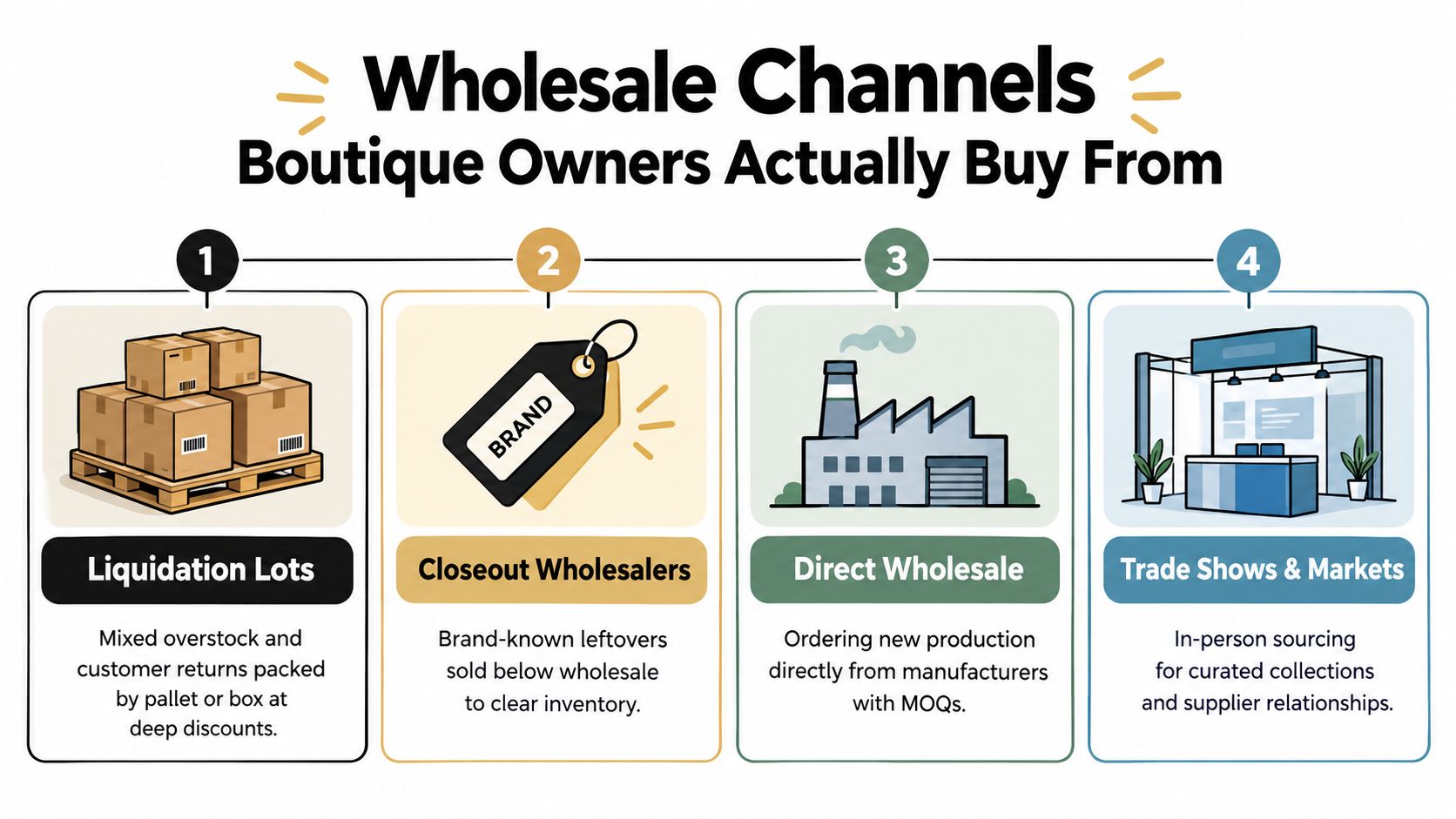
Liquidation lots
Liquidation lots are the grocery grab bag of apparel sourcing. You get mixed overstock, shelf pulls, and sometimes customer returns packed by box or pallet. The upside is low entry cost and the ability to test categories without committing to large factory runs.
The downside is obvious. The mix can drift. You may get winners. You may also get odd sizing, off-season fabric weights, or styles that require more labor than the discount justifies.
If you want a primer on how mixed lots are typically structured, browse examples of clothing lots for resale.
Closeout wholesalers and direct wholesale
Closeout wholesalers are the bulk-bin aisle version of branded inventory. These sellers move leftover goods below standard wholesale to clear inventory. They're useful when you want known labels without stepping into full-price distributor terms, but runs can be shallow and reorders can disappear overnight.
Direct wholesale from manufacturers is cleaner. You're buying new production, usually with clearer specs and better size consistency. The tradeoff is commitment. Minimums can force you to buy deeper than you should if your customer hasn't proven the style yet.
A lot of buyers still need a visual map before these channels click. This video helps frame how sourcing options differ in practice.
Trade shows and markets
Trade shows and markets are where boutique owners go when they want curation, relationships, and a cleaner point of view. You can touch fabric, compare finishing, and ask annoying questions face to face. That matters.
It also takes time, travel, and discipline. Plenty of owners overspend at markets because everything looks good under showroom lighting.
If you buy at a market without a hard category budget, you're not sourcing. You're shopping.
Liquidation Boxes Versus Brand Distributors
For most boutiques, this is the fork in the road. Do you buy liquidation boxes for lower entry cost and variety, or do you buy from brand distributors for consistency?
The answer is both. Just not in equal amounts for every store.
What each channel is good at
Liquidation boxes are useful when you need affordable variety, trend experiments, or filler inventory that keeps the floor fresh. Brand distributors are better for anchor categories that your customer already buys from you without much persuasion.
If you want to see how branded bulk inventory is typically positioned, look at brand-name clothing pallets.
| Criterion | Liquidation Boxes | Brand Distributors |
|---|---|---|
| Per-unit cost | Usually lower on paper | Usually higher on paper |
| Minimum order | Easier entry for smaller tests | Often stricter pack or case rules |
| Mix predictability | Variable | More consistent |
| Size run consistency | Uneven at times | Usually cleaner |
| Brand recognition | Can be strong if curated well | Stronger and easier to merchandise |
| Labor after receiving | More sorting and grading | Less triage |
| Return risk | Higher if terms are vague | Lower if specs are documented |
| Reorder reliability | Hit or miss | Better for repeat winners |
My recommendation for most boutiques
Use a portfolio approach.
Keep your core assortment anchored by distributor or cleaner wholesale buys. Use liquidation boxes around that core for experiments, opportunistic brand pickups, and short-run novelty. That mix gives you stability without turning the store into a predictable catalog.
The trap is going all in on one side. Stores that rely only on distributors often look polished but boring and margin-tight. Stores that rely only on liquidation often look chaotic because the assortment lacks continuity.
Buy consistency for your bread-and-butter categories. Buy surprise for your edges.
Where liquidation works best
Liquidation is strongest when you know exactly what role the box needs to play:
- Trend test for a silhouette you don't want to commit to
- Price ladder filler when your floor is missing lower-ticket options
- Brand spice to break up an assortment that feels too samey
- Live-sale fuel for pieces that move better in fast, personality-driven selling environments
That's where wholesale clothing for boutique owners becomes tactical instead of random.
MOQ, Pricing, and the Real Cost Per Piece
Minimum order quantity is not a status symbol. It's a cash-flow gate. Treat it that way.
A supplier can quote a low number per piece and still hand you a bad deal if the order volume is wrong, the freight is ugly, or the box needs too much labor after arrival.
Use landed cost, not quoted cost
Your true cost per piece is simple:
quoted unit price + allocated supplier fees + freight + receiving labor + prep time, divided by sellable units
Most boutique owners skip the last part. That's the mistake. If a box arrives with a chunk of inventory that must be discounted, repaired, or written off, the usable units carry more of the cost.
| Cost Component | Liquidation Box (100 pcs) | Brand Case (36 pcs) |
|---|---|---|
| Supplier quote | Low headline cost | Higher headline cost |
| Freight | Variable and often meaningful | Usually easier to estimate |
| Sorting labor | Higher | Lower |
| Steaming and prep | Often higher | Usually lower |
| Defect exposure | Higher if mix is loose | Lower if specs are clean |
| Sellable unit predictability | Lower | Higher |
| True unit cost after receiving | Can climb fast | Often steadier |
The cheap order that isn't cheap
Here's what happens in real stores. You buy the lower quoted option because the spreadsheet looks cleaner at first glance. Then the order lands and your team spends hours opening, sorting, re-tagging, steaming, checking measurements, and deciding what can even hit the floor.
That labor is not free just because you didn't invoice yourself for it.
A more expensive-looking case can outperform because it reaches the rack faster and stays closer to full-price territory. That's the difference between cost and value.
How to judge MOQ without fooling yourself
Before you say yes to any MOQ, ask three blunt questions:
- Can this category turn at the pace the order requires
- Do I have physical room to receive and process it without burying other stock
- If half the styles underperform, can my cash flow absorb it
Apparel inventory is commonly benchmarked at about 4 to 6 turns per year, which works out to roughly 61 to 91 days of inventory on hand, while faster-moving fashion can reach 8 to 12 turns and luxury often runs slower at 2 to 4 turns, according to apparel inventory turnover benchmarks. If your order volume pushes you well past your realistic turn window, the price break isn't a win. It's a storage problem in disguise.
Quality Checks That Protect Your Margins
Receiving day is where bad buying gets exposed. If you don't have a repeatable inspection process, you'll miss defects, lose claim windows, and end up putting flawed merchandise on the floor because you're too busy to sort it properly.
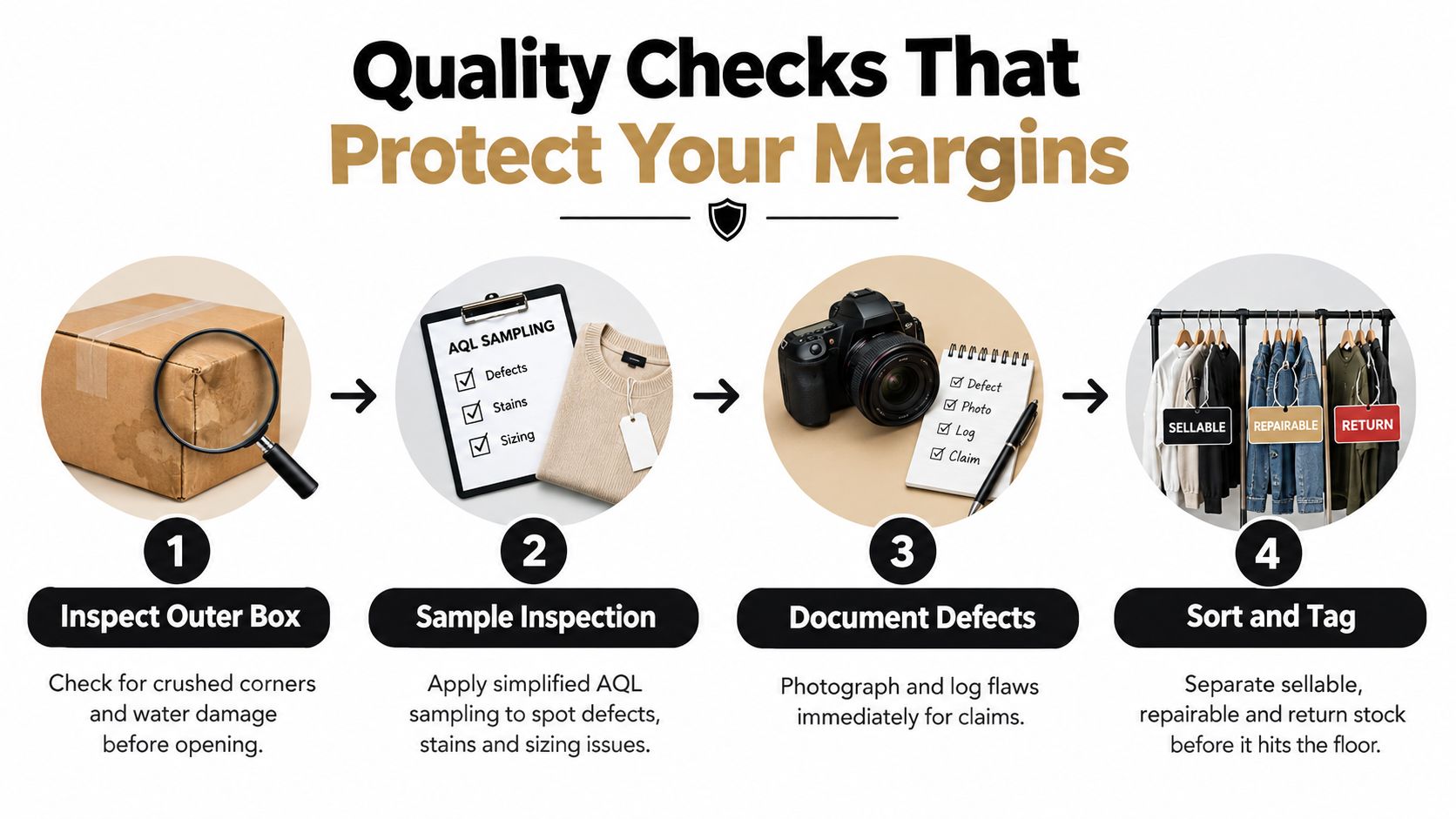
Start with the box before the clothes
Inspect the exterior first. Crushed corners, water marks, musty odor, sloppy relabeling, or mixed-category stickers all tell you something about handling before you cut the tape.
Then sample from across the shipment, not just the top layer. Pull pieces from different parts of the box and check for recurring issues, not just isolated flaws.
Garment inspections commonly use AQL-style rules, with AQL 2.5 often applied to major defects, AQL 4.0 to minor defects, and zero tolerance for critical defects, according to this explanation of acceptable quality levels in garment inspection. For a boutique, that translates into plain English. Stains, holes, broken seams, moisture damage, and mislabeled country-of-origin tags are not “small issues.” They're claim material.
Use a three-bucket grading method
Don't overcomplicate this. Sort every received piece into one of three buckets:
- A-grade means sell at planned price with normal prep
- B-grade means discount, bundle, or reserve for alternative channels
- Reject means claim, return, donate, or remove from normal inventory flow
That single habit keeps ugly inventory from contaminating your pricing.
Receiving rule: If you wouldn't feel good handing the piece to a full-price customer, don't let it drift into regular stock just because the invoice already hurt.
The four defect categories worth logging
Track defects by type. You'll spot supplier patterns faster.
| Defect type | What to watch for |
|---|---|
| Fabric flaws | Stains, snags, pilling, fading, odor |
| Construction issues | Broken seams, missing snaps, twisted hems |
| Sizing inconsistency | Label and actual garment not matching well |
| Style fatigue | Dated prints, stale cuts, out-of-window themes |
Document problems with photos and written counts right away. File claims fast. Suppliers respect organized buyers more than vague complainers.
Choosing the Right Box Size or Pallet Volume
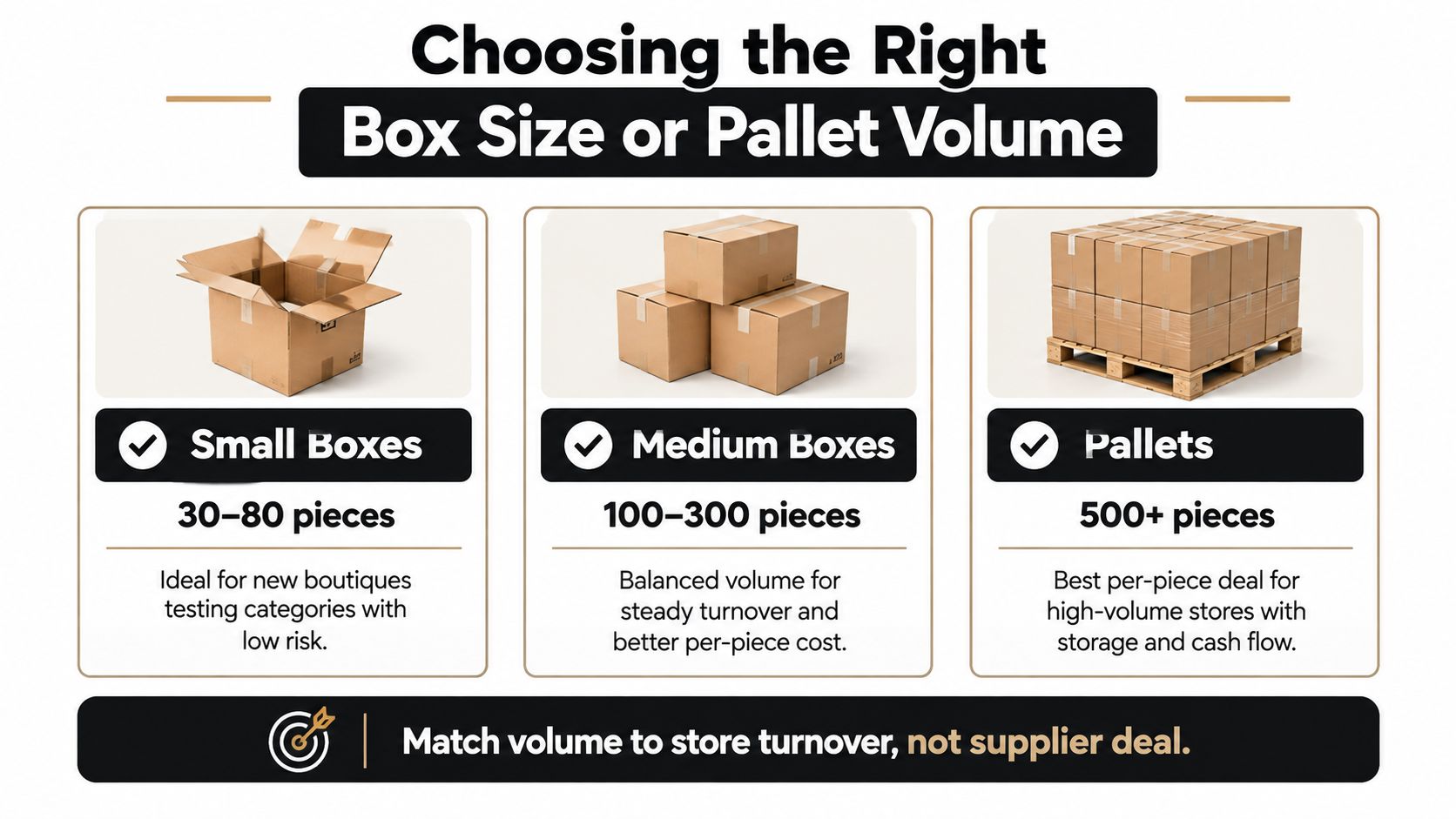
Order volume should match your turn rate, cash, and storage capacity. It should not match the supplier's enthusiasm.
That's where many boutiques get sloppy. They jump from test orders straight to pallets because the per-piece price improves. Then the stockroom fills up, the floor doesn't move the category fast enough, and cash gets trapped in cardboard.
When small boxes make sense
Small boxes are ideal when you're testing a new category, trying a new supplier, or buying into a short-lived trend. They let you learn cheaply and keep your mistakes contained.
They're also useful when your boutique has a strong point of view and you only need accent inventory, not a full category rebuild.
When medium volume is the sweet spot
Medium orders usually work best for established stores with repeat traffic and a stable category mix. You get enough volume to matter, but not so much that one weak style swallows a month of cash.
If you're evaluating suppliers in this range, one option in the market is OneTrendyCloset, which offers curated brand-name apparel liquidation boxes in multiple sizes and custom lots for boutiques and resellers. The practical value is flexibility. You can test box sizes before moving into larger custom volume.
When pallets are worth it
Pallets only make sense when three things are already true:
- The category has proven sell-through
- You have physical space to process and store the order
- Your team can receive, inspect, and merchandise volume quickly
If even one of those is missing, pallet economics can collapse.
Use a category-first order formula
Your target order size should come from category demand, not supplier convenience.
Use this simple planning frame:
monthly unit sales by category x supplier lead time + safety stock = target buy
Then sanity-check the mix. If your store mainly sells tops, don't let a cheap bottoms deal hijack the budget just because it landed in your inbox.
Industry coverage also points to a useful shift here. JOOR's wholesale industry trends notes that in-season buying is rising and that a hybrid wholesale approach is increasingly seen as effective. That fits what smart boutiques already know. Buy closer to demand. Don't front-load risk just to feel “prepared.”
Planning Reorders Around Turnover and Cash
The best reorder timing comes from discipline, not optimism.
Take a common boutique scenario. Post-holiday cash is tight. Plus-size tops sold quickly. Denim is still hanging. You've got one open budget slot for inventory and a local event coming up that could move fresh product if you time it right.
What a smart quarter looks like
The first order should chase proof, not ego. Reorder the category that sold, even if another rack looks visually emptier. Empty because it sold is healthy. Full because it stalled is the problem.
Then, once the category proves itself again, move into a cleaner replenishment buy with better consistency. After that, use a smaller tactical order to support a known selling window, not to rescue weak categories.
| Order | Timing | Channel | Budget | Category Focus |
|---|---|---|---|---|
| Order 1 | Early quarter | Small liquidation box | Tight and controlled | Test plus-size tops |
| Order 2 | Mid-quarter after validation | Brand distributor or cleaner wholesale case | Larger but targeted | Replenish proven winners |
| Order 3 | Before event or demand spike | Smaller replenishment box | Focused reserve | Fill gaps in top-performing sizes and colors |
Let turnover trigger the PO
The U.S. secondhand apparel market was reported to grow 14% in 2024, with online resale up 23% that year, and the broader report says secondhand outpaced the retail clothing market by 5x, according to thredUP's 13th Resale Report. The point for boutique owners isn't just resale growth. It's speed. Consumers are trained to buy value and freshness quickly when the assortment is right.
That means your reorder discipline matters more than your trend predictions.
Don't place the next PO because you're tired of looking at an empty bar on the shelf. Place it because the category earned it.
A Simple Sourcing Checklist for Your Next Order
If you want wholesale clothing for boutique owners to stay profitable, build a routine and stick to it. Don't reinvent your buying logic every week based on whichever vendor emailed you last.
The pre-order gate
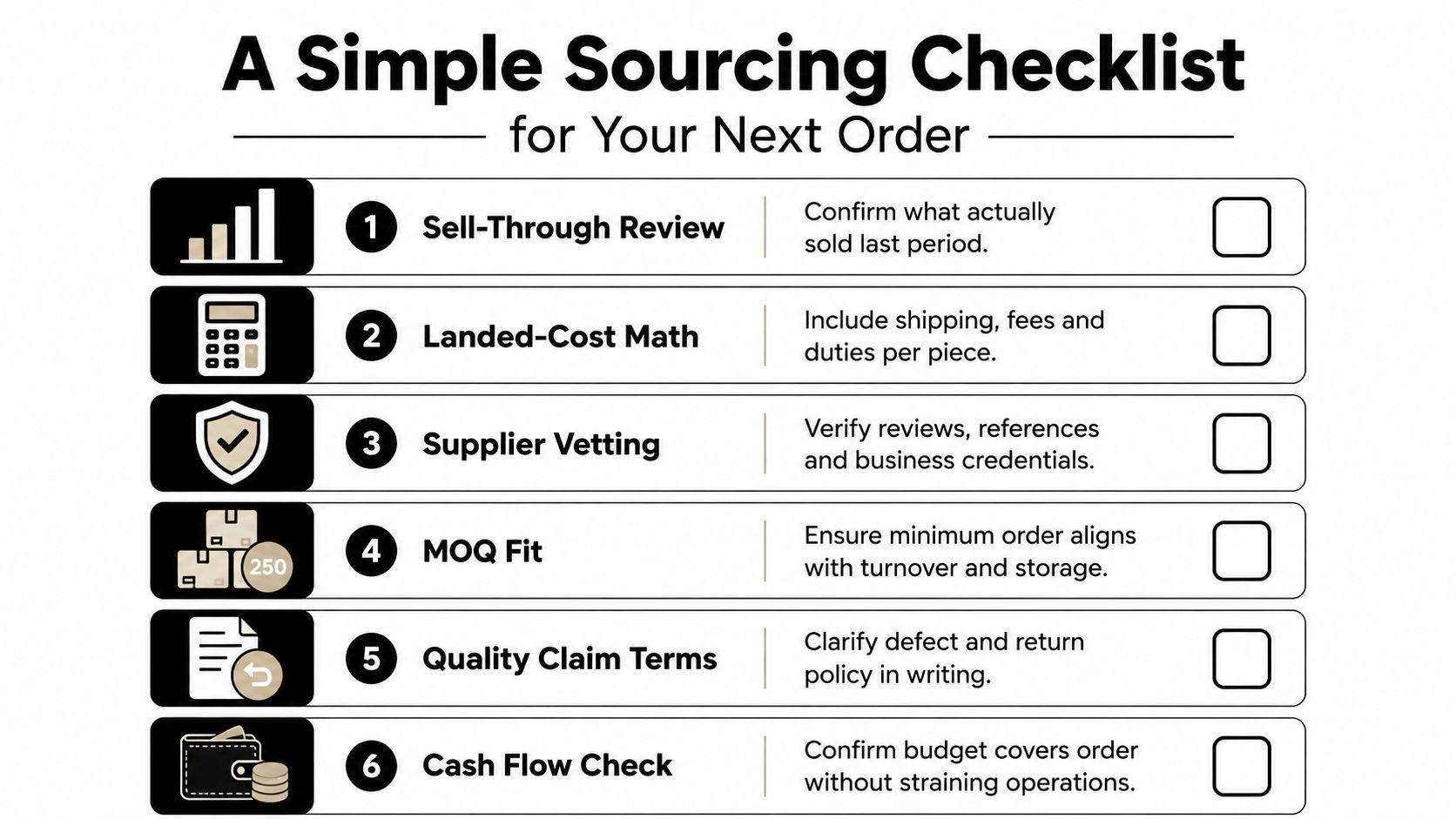
Run every purchase through this short checklist:
- Sell-through review. Check what moved by category, size, and price band
- Landed-cost math. Add freight, prep labor, and expected defect drag before approving the order
- Supplier vetting. Confirm the seller can describe assortments, claim terms, and shipping clearly. If you're comparing vendors, this guide on choosing a wholesale supplier for clothing is a useful reference point
- MOQ fit. Make sure the volume aligns with your storage, your turn rate, and your realistic pricing power
- Quality claim terms. Get defect handling and timeline details in writing
- Cash buffer. Leave room for operations and the next opportunity. Don't spend yourself into inflexibility
The habits that actually save money
Most boutiques don't need more supplier lists. They need better habits.
First, test small before scaling. Second, track category-level performance, not just overall sales. Third, protect cash so one “great deal” can't dominate the month.
The global secondhand apparel market is already large enough to shape sourcing decisions. One 2025 industry report estimates it at $202.39 billion and projects it to reach $346.34 billion by 2030, implying 11.3% CAGR, while another widely cited resale report projects $367 billion by 2029 with roughly 10% annual growth, according to The Business Research Company's apparel resale market report. That scale is why branded wholesale and liquidation inventory can move quickly when you curate it well. But scale won't save sloppy buying. Process will.
OneTrendyCloset offers brand-name apparel liquidation boxes and custom lots for boutiques that want flexible order sizes instead of one rigid volume jump. If you need a practical sourcing option for testing smaller boxes, adjusting brand mix, or moving toward larger restocks without changing vendors, visit OneTrendyCloset.