Cheapest is the wrong question in wholesale apparel. If you're buying wholesale cheap sweatshirts to resell, the pallet sticker doesn't tell you what the stock is worth once you sort the duds, photograph the keepers, pay platform fees, and absorb returns. The business metric is recoverable value, and that's the number most bargain hunters ignore until their cash is tied up in unsellable fabric.
The sweatshirt market is big enough that small sourcing mistakes get expensive fast. The broader apparel market was estimated at US$1.8 trillion in 2024 and is projected to reach US$2.3 trillion by 2030 with about 4% CAGR over 2024 to 2030, while global textile and apparel trade was estimated at US$875 billion in 2024 after growing at roughly 1% CAGR since 2019, which tells you sweatshirts sit inside a huge, mature system where scale matters and bad buying gets magnified across channels Wazir Advisors report. Sweatshirt-adjacent trade is also a real cross-border category, with HS code 6110 exports valued at about US$56.25 billion in 2021 and roughly US$59.17 billion in a later reporting year, so this isn't some side alley in apparel, it's a heavyweight lane GlobalEdge apparel and textiles trade stats.
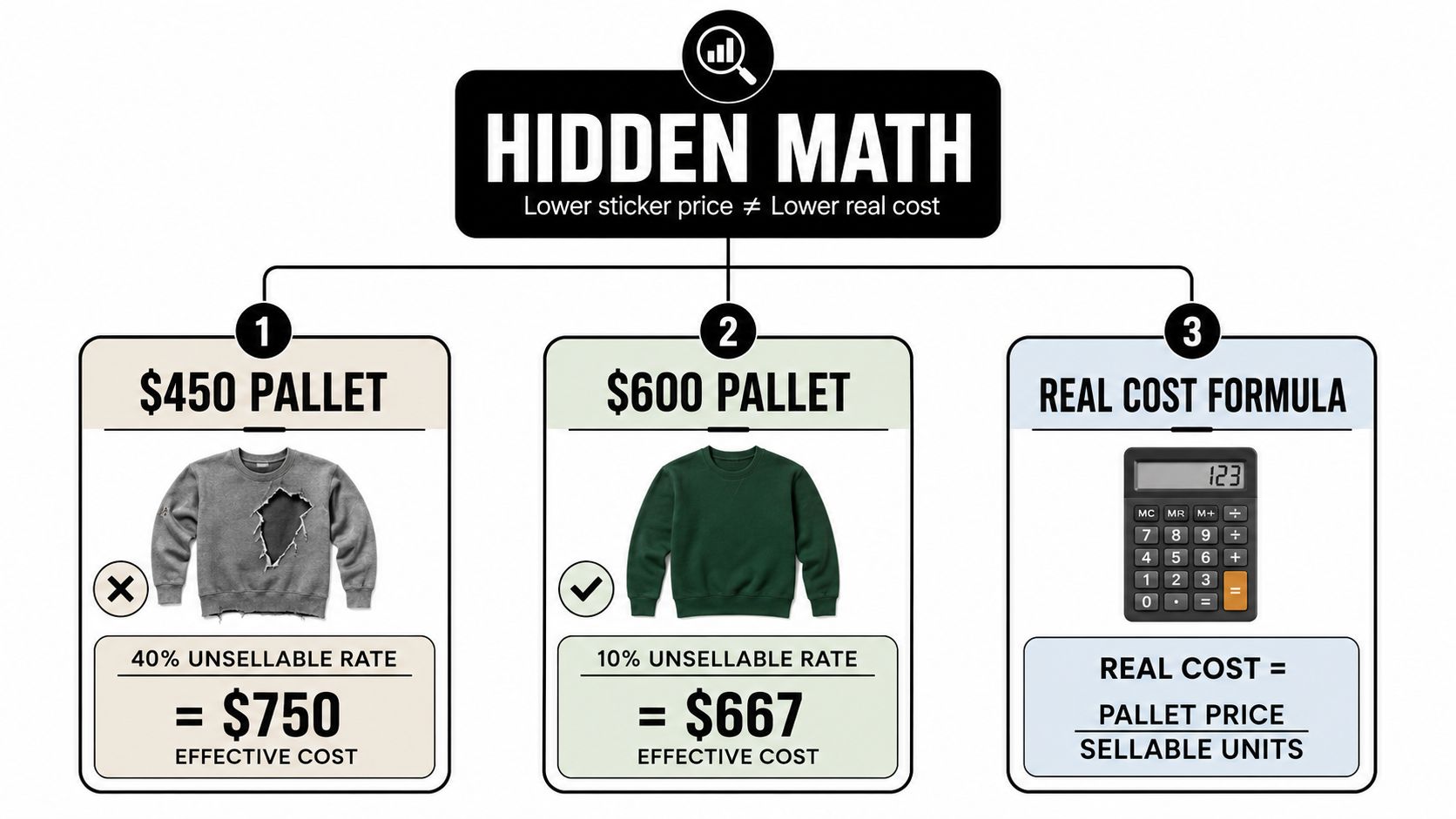
Table of Contents
- Why Cheapest Is Rarely the Best Deal
- The Lot Types Resellers See
- Reading Quality Without Touching the Garment
- Liquidation Boxes Compared With New Wholesale
- Pricing Expectations and Minimum Orders
- A Realistic Buying Scenario for a New Reseller
- The Reseller's Pre-Buy Checklist
- Smart First Moves and Common Traps to Avoid
Why Cheapest Is Rarely the Best Deal
The lowest pallet price is often the most misleading number in the room. A buyer who grabs the cheapest lot usually pays for it later through sorting labor, damage write-offs, weak sizing runs, and the dead weight of pieces that never should've been bought in the first place.
Recoverable value beats sticker price
Recoverable value is simple. It's the sellable units in the lot, multiplied by the price you can realistically realize, minus the costs that eat into the sale before money hits your account. That includes your freight, platform fees, storage drag, returns, relisting time, and any rework.
Practical rule: don't ask what the pallet costs. Ask what each sellable sweatshirt costs after you've removed the trash.
The common trap is buying a mystery lot because the headline price looks low, then discovering the assortment is too uneven to process quickly. If you don't have time to inspect, grade, photograph, and reroute defects, the bargain becomes a labor problem, not an inventory win.
Mid-tier stock usually beats bargain-bin chaos
Wholesale buyers who source better tend to prefer graded overstock or cleaner shelf-pull style lots over pure mystery returns, because the spread between sellable and unsellable pieces is easier to manage. That matters even more in apparel, where size integrity, color consistency, and wear condition decide whether a sweatshirt lists cleanly or sits forever.
Early-stage resellers get burned when they chase the headline number before they've built the process to handle it. If your photography setup is weak, your grading is inconsistent, or you don't know where to reroute damaged pieces, you're not sourcing inventory, you're buying homework.
The Lot Types Resellers See
The secondary market does not hand you one clean sweatshirt category. You will see different lot structures, and each one carries its own paperwork quality, condition risk, and level of surprise. If you do not know the format, you cannot judge the deal.
What each lot type usually looks like
Manifest pallets are the easiest to read. They usually come from retailer returns, closeouts, or warehouse clearouts, and the seller gives you item counts and category data, sometimes with SKU-level detail. The manifest helps, but it still will not tell you how many pieces are stained, stretched, or missing tags.
Customer return pallets are usually the roughest. These often come from Amazon returns, big-box returns, or similar reverse-logistics streams, and they are heavy on consumer damage, wear, and seasonal leftovers. They can work for experienced graders, but they punish anyone who cannot sort fast or spot repair costs before buying.
Mixed liquidation boxes are the wildcard. They might come from third-party logistics unloads, estate-style clearouts, or broad liquidation feeds, and they often include apparel alongside unrelated categories. If you are buying sweatshirts specifically, the word “mix” should make you cautious, not excited. It can hide thin counts, off-season colors, and a pile of pieces you will not list.
Overstock rolls or shelf pulls are the cleanest entry point for newer buyers. They are usually banded, boxed, and easier to verify because they come from brand overstock or store-shelf removals. The condition risk is lower, and the assortments are more predictable.
OneTrendyCloset offers mixed-brand apparel liquidation boxes for resellers and boutiques, which fits buyers who want a curated assortment instead of a blind gamble.
| Wholesale Sweatshirt Lot Types at a Glance | Typical Source | Packaging | Condition Risk | Best Fit For |
|---|---|---|---|---|
| Manifest Pallets | Retail returns, closeouts, warehouse clearouts | Palletized, often banded | Moderate, because condition still varies | Sellers who can grade quickly |
| Customer Return Pallets | Amazon returns, big-box returns | Palletized, sometimes floor-loaded | High, due to consumer damage and wear | Experienced graders and refurbishers |
| Mixed Liquidation Boxes | 3PL unloads, broad liquidation feeds | Boxed, mixed assortment | High, because apparel is not guaranteed | Buyers with flexible channels |
| Overstock Rolls or Shelf Pulls | Brand overstock, store shelf pulls | Banded or boxed | Low to moderate | Newer resellers and boutique sellers |
Match the lot to the channel
A flea market vendor can live with visual inconsistency because the buyer is already browsing. A Poshmark lister needs cleaner pieces, better photos, and less sorting time. A live-sale host can still do well with mixed condition if the seller can explain value on camera and move units fast.
The wrong lot format slows cash flow before the first listing goes live. If your sales channel needs polished inventory, do not buy a box full of sorting work just because the sticker price looks low.
The safest lot is the one that matches your sales channel, not the one with the loudest discount tag.
Reading Quality Without Touching the Garment
You don't need to hold a sweatshirt to know whether it's worth buying. You need to read the manifest like a buyer who's been burned before. The clue trail is in the GSM, the fiber mix, and the construction details that tell you whether a piece feels cheap in hand or looks cheap on camera.
GSM and blend tell you most of the story
Industry guidance commonly places lightweight crewnecks around 200 to 220 GSM, midweight around 300 GSM, and heavyweight around 350 GSM or higher, with 300 to 400 GSM repeatedly cited as the practical quality band for retail-ready sweatshirts Noviestyle quality guide. More GSM usually means more warmth, better drape, and a fuller look, but it also means bulk. That bulk can hurt comfort if the garment is too stiff for everyday wear.
Fiber blend matters just as much. Cotton-poly blends in the 250 to 350 GSM range are usually the safe bet for durability, wrinkle resistance, and resale-friendly wear, while heavier 320 to 400+ GSM pieces suit outdoor, workwear, or premium streetwear positioning Sino FineTex heavyweight fabric guide. Heavier constructions also cost more to produce because they use more fiber, and that pushes input cost upward.
Construction details separate resale winners from filler
Look for the signals that buyers notice in photos and in hand. Double-needle hems, coverstitched seams, ribbed cuffs, and a lined hood usually read as more serious than a flimsy open-bottom fleece. Tubular knit versus cut-and-sew also matters, because the cleaner build often photographs better and holds shape longer.
| Sweatshirt Quality Markers and Resale Mapping | Common Range | Resale Price Ceiling | Buyer Expectation |
|---|---|---|---|
| Lightweight | Under 220 GSM | Low ceiling | Thin hand-feel, casual wear |
| Standard Midweight | 240 to 280 GSM | Moderate ceiling | Everyday wear, decent structure |
| Premium Fleece | 300 GSM and up | Higher ceiling | Better drape, warmth, more substantial look |
| Cotton-Poly Blend | 250 to 350 GSM | Strong resale fit | Durable, easy-care, repeat wash tolerance |
| Heavy Outdoor or Streetwear Build | 320 GSM and up | Higher perceived value | Bulkier feel, more premium positioning |
A 280 GSM 80/20 cotton-poly pullover with a lined hood can usually clear a stronger resale lane than a flimsy open-bottom piece, while a 220 GSM sweatshirt usually tops out lower because it reads lighter and less substantial to the buyer. The rule is blunt. If a manifest skips GSM, fiber, and weight, assume the seller wants you to stop asking questions.
Liquidation Boxes Compared With New Wholesale
Liquidation boxes and new wholesale solve different jobs. Liquidation gives you recoverable value through lower entry cost and uneven inventory. New wholesale gives you cleaner sizing runs, more consistent presentation, and less sorting work. Treating them as the same purchase is how resellers end up with dead stock.
Risk is the trade-off, not price alone
Liquidation boxes fit sellers who can process uncertainty and separate winners from duds fast. New wholesale fits sellers who need predictable product, tighter brand control, and less time spent grading. If you move stock quickly and have the labor to sort, liquidation can make sense. If you need repeat colors, stable sizing, and a cleaner listing workflow, buy new.
| Liquidation vs New Wholesale, Side-by-Side | Liquidation Boxes | New Wholesale |
|---|---|---|
| Factor | Lower entry cost, but variable quality | Higher predictability, cleaner product |
| Condition | Can include returns, shelf pulls, and defects | Usually fresh, unworn, and consistent |
| Minimums | Often one pallet or smaller test lots | Case packs or larger buying commitments |
| Return Exposure | Higher, because condition varies | Lower, because stock is uniform |
| Platform Compatibility | Good for live sales, discount channels, and flip markets | Strong for boutiques, branded stores, and curated listings |
The split is plain. Side hustlers moving 20 to 40 units a week usually do better with liquidation because they can absorb grading and push volume in bursts. Boutiques that need size runs and consistent merchandising usually should buy new wholesale. If you care about repeat colors and a clean rack, pay for the predictability.
Hidden costs can wipe out the discount
A cheap pallet stops being cheap once you add repair labor, photography, repacking, and returns handling. Platform fees also cut deeper than buyers expect, especially when item-level charges or case rates apply. Freight can do the same when residential delivery or a liftgate shows up on the invoice.
See our full comparison of box-of-hoodies liquidation versus new wholesale purchasing. That side-by-side matters because a low sticker price means nothing if defects and fees eat the margin before the first sale.
Pricing Expectations and Minimum Orders
Pricing swings by channel, but the ranges matter less than the math around them. A sweatshirt lot that looks cheap on paper can still be a poor buy if the minimum order locks you into more inventory than you can clear. The smarter move is to match your channel to the smallest lot structure that still gives you workable margins.
What buyers actually see in the market
Used customer-return pallets typically land between $2 and $6 per piece. Manifest pallets with mixed apparel usually sit around $3 to $8 per piece. Branded overstock closeouts often fall in the $4 to $10 per piece range. New blank wholesale from major distributors clusters around $3.50 to $7 at case minimums of 12 to 24 pieces. Those are the lanes buyers plan around, not the fantasy pricing people post in clickbait listings.
Minimum order structure changes the game just as much as price. Liquidation often lets you enter with a single pallet. Blank wholesale usually wants case packs. Closeout channels can push toward larger commitments, sometimes truckload style, depending on the seller and the mix.
| Sweatshirt Price Bands by Channel and MOQ | Channel | Price Per Piece | Typical MOQ | Notes |
|---|---|---|---|---|
| Used customer-return pallets | Liquidation | $2 to $6 | Single pallet | Higher defect risk, more grading |
| Mixed apparel manifest pallets | Liquidation | $3 to $8 | Single pallet | Better visibility, still mixed condition |
| Branded overstock closeouts | Closeout | $4 to $10 | Case or larger | Cleaner product, stronger consistency |
| New blank wholesale | New wholesale | $3.50 to $7 | 12 to 24 pieces | Better for repeats and uniformity |
Price drift has made bad buys easier to spot
Recent industry coverage says some liquidation truckloads that used to sell for $5,000 now sell for $9,000 to $12,000, which is a loud signal that cheap inventory has become harder to source profitably B-Stock reseller trends coverage. That doesn't mean liquidation is dead. It means the buyer has to be more disciplined about recoverable value.
If your lot only works when every piece sells cleanly, you probably bought the wrong lot for your channel.
A Realistic Buying Scenario for a New Reseller
Maria runs weekend live sales from a two-bedroom apartment and wants to stay near a $1,200 first buy. She is choosing between a $900 customer-return pallet with roughly 150 units and about 35 percent A-grade, and a $650 case of 96 new blanks from a regional distributor. She sells on Poshmark, eBay, and live streams, and she needs stock she can move without drowning in sorting.
The return pallet looks bigger, but the first question is recoverable value after real costs. Maria spends two evenings grading it, about seven hours total, and flags obvious defects before checking size labels, stains, pilling, and seam issues. If only about 90 units end up fit to list or bundle, the pallet is already more expensive per usable piece than the invoice suggests. Add photography time, packaging, and the extra handling needed to split stock across Poshmark, eBay, and live sales, and the margin gets thinner fast.
Here is the part many new resellers miss. A returned sweatshirt that sells for less after a fee-heavy platform cut, a return, or a discounted bundle does not contribute the same way as a clean blank that moves quickly at a steadier price. Maria can still route the best pieces to Poshmark, the average ones to eBay, and the weaker ones to live sale lots, but every channel takes its own cut. By the time she absorbs shipping, platform fees, and the cost of the duds, the pallet needs a lot of clean exits just to keep up.
The 96 new blanks are less exciting and easier to live with. The size run is predictable, the photography is faster, and she spends less time making judgment calls on damage. That leaves her with cleaner unit economics and less operational strain. For a first buy, that matters more than chasing a lot that looks bigger on paper.
Maria should buy the option that gives her the fastest path to sellable inventory, not the one that forces her to rescue every unit.
The Reseller's Pre-Buy Checklist
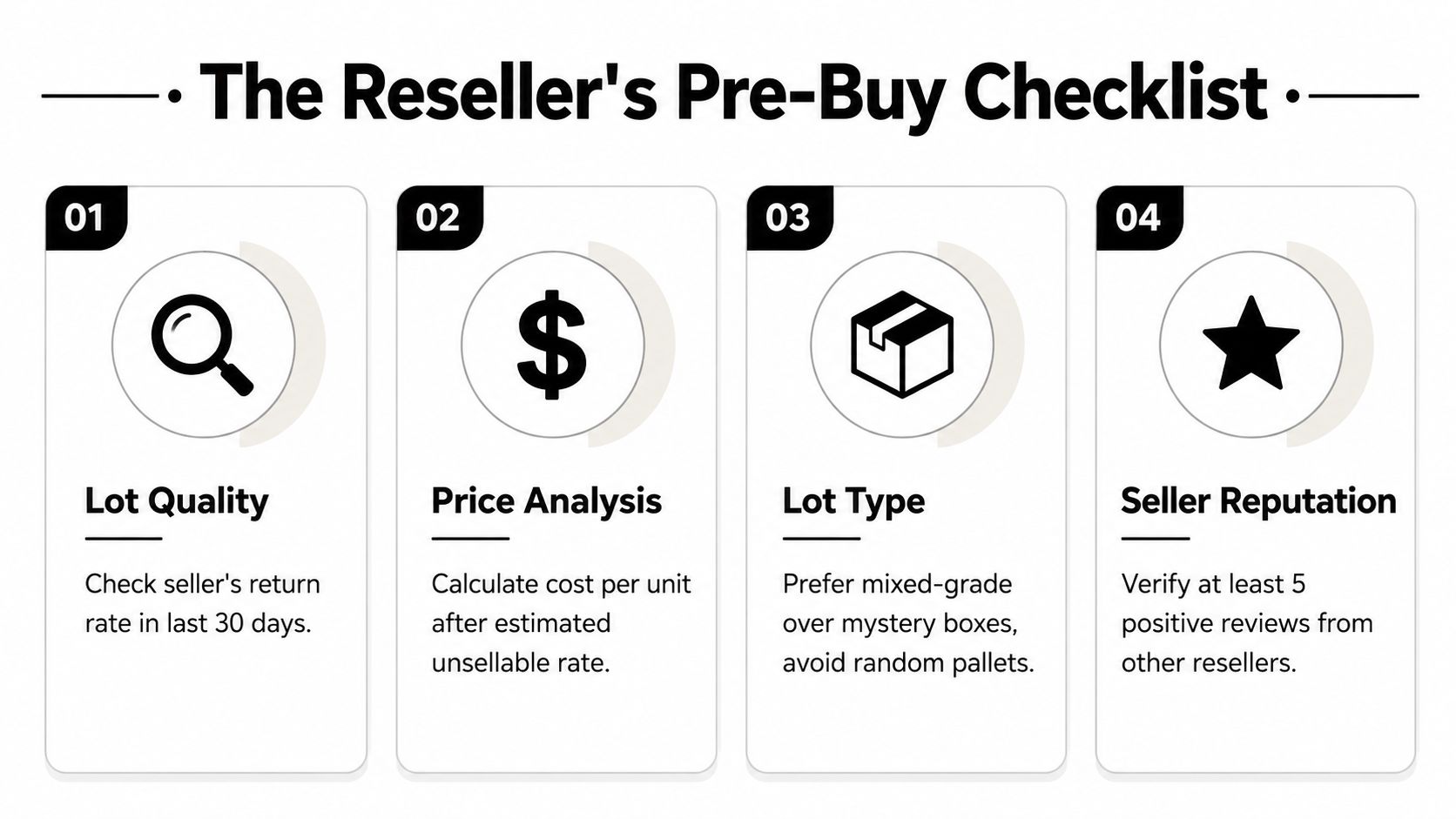
Before you wire money, run the lot through a hard checklist. If the seller dodges any item, treat that silence as the answer.
Verify the lot before you care about the price
- Manifest check: Read the counts, categories, and brand mix, then compare them to the photos. If the paperwork says sweatshirts and the images show a random apparel dump, stop.
- Seller remedy policy: Ask what happens if the manifest is off, the count misses badly, or the lot arrives mixed in a way that was not disclosed. A seller who will not spell out adjustments, returns, or partial refunds is handing you all the risk.
- Freight terms: Confirm whether the quote includes liftgate and residential delivery before you commit. Freight-only pricing looks cheap until the truck shows up and the invoice grows.
- Delivery condition: Photograph the pallet, stretch wrap, box corners, and any crushed packaging before the truck door closes. If the outside looks abused, you want proof before you sign.
- Physical grading: Check for holes, stains, pulls, pilling, broken zippers, missing hood strings, ink marks, and damaged cuffs. Missing or unreadable size labels are not minor, they slow every resale decision.
- Fiber and weight review: Confirm the GSM band, read the blend, and reject vague fiber claims that do not match the season or the asking price. A seller who hand-waves fabric details is usually hiding weak stock.
- Unit economics: Work out your cost per wearable unit after defects, then layer in platform fees, shipping splits, and returns. If the paper math fails, the lot will fail harder in your listing queue.
Photograph everything first: box tops, manifest pages, and damaged pieces should all be documented before the truck door closes.
Clean buying is simple. Take the total lot cost, divide it by the expected sellable units, then add the hidden costs that eat margin. If an $800 pallet only turns into $400 of recoverable stock after defect adjustment and fee drag, you bought a loss with shipping attached.
Smart First Moves and Common Traps to Avoid
Start with a small lot you can verify, not a truckload built on hope. A first buy should teach you grading, defects, and sell-through without burying you in freight or dead stock.
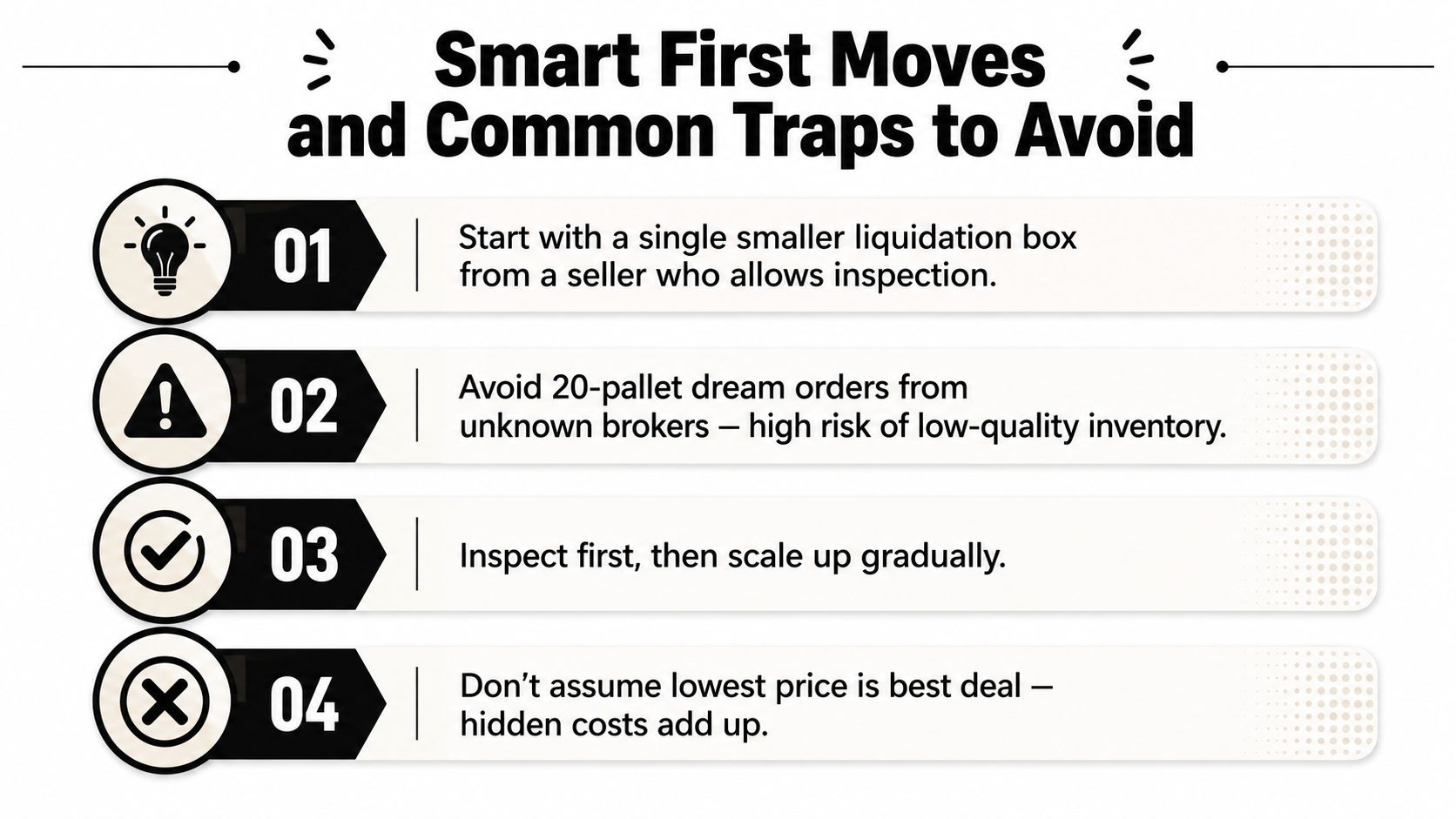
What to do first and what to skip
- Buy one test lot: Grade it, list it, and track what moves before you scale up.
- Ask for manifest access before any deposit: If a platform hides the manifest until after you pay, treat that as a warning sign.
- Use third-party inspection on pallet orders: For bigger buys, pay for an outside check if you cannot inspect in person.
- Work local when possible: Regional liquidators and warehouse sales let you judge condition before money changes hands.
- Check return terms before you commit: A new wholesale account with returnable terms gives you room to confirm fit, quality, and size consistency.
- Ignore the headline price: If the quote looks unusually low, inspect the fee stack before you chase it.
The other trap is bad lot structure. Some sellers label a mixed apparel dump as sweatshirt inventory because the listing sounds cleaner. That does not help you if the box is tee-heavy and the heavier pieces you need are missing. If a seller talks up brand names without clear proof, walk away. Counterfeit complaints and empty claims eat time, and they create chargeback risk if you resell at scale.
Watch the money math, too. A lot can look fine on paper and still fail once you add defect allowances, platform fees, return loss, and your own labor. If you cannot explain your break-even item by item, you are buying inventory, not margin.
OneTrendyCloset sells curated apparel liquidation boxes for resellers, so buyers can start with a smaller, inspectable lot instead of guessing on a blind pallet.