The popular advice is to chase the lowest price per piece and buy the biggest lot you can afford. That's usually the wrong buy. A cheap garment you can't sell, can't list quickly, or have to mark down twice costs more than a higher priced piece that fits your shop and moves. If you're asking where can I buy bulk clothing for cheap, judge sources by landed cost per sellable unit, not the advertised sticker.
Table of Contents
- Where Cheap Bulk Clothing Actually Comes From
- What a Cheap Lot Really Costs
- Condition Grades to Demand in Writing
- Freight Minimums and Order Size
- Which Source Fits Your Selling Channel
- Mistakes That Wipe Out a Low Price
- Place a Small Test Order First
Where Cheap Bulk Clothing Actually Comes From
Cheap in bulk rarely means conventional full-price wholesale. It usually means inventory that already missed its first chance to sell, came back as a return, or was bought for a different purpose. Six channels matter most for a U.S. reseller in 2026.
| Source | Typical condition | Typical minimum | Price pattern | Best buyer | Main risk |
|---|---|---|---|---|---|
| Liquidation auctions | Returns, shelf pulls, some new with tags | One pallet | Deep discount off retail plus buyer fees | Volume resellers | Blind mix and defects |
| Closeouts | New overstock or end of season | Case or style pack | Below regular wholesale | Boutiques chasing current goods | Season may already be late |
| Curated liquidation boxes | Grade A new, like new, or light wear | About 50 items | Mid bulk price, better per piece in larger counts | Small resellers and boutiques | Styles vary with stock |
| Overstock marketplaces | Unsold new retail | Case packs | Under retail, above rag rates | Sellers who want a manifest | Narrow sizes and colors |
| Used-clothing bales | Graded secondhand, often by weight | One bale | Lowest cost per pound | Thrift, export, rag trade | Many pieces will not resell |
| Imported new wholesale | Factory-new | Hundreds of units | Low ex-factory price | Experienced importers | Duty, freight, and lead time |
Read the table by minimum and blindness
Two rows explain most bad purchases. A liquidation pallet can look like the cheapest row because the hammer price is spread across hundreds of mixed returns. It fits only if you have space, sorting time, and cash to absorb pieces that won't sell in your channel. You're not buying a product line, you're buying unknown work.
A curated box near a 50-piece start works differently. The per-piece price is higher, but the assortment is narrower and the test is cheaper in total cash. For a boutique or marketplace seller, that limited exposure lets you learn the actual grade, brand mix, and size run before you commit to storage you don't have.
Don't crown a winner from this table. Match the minimum to cash on hand, and match how blind the assortment is to the hours you can spend inspecting, steaming, measuring, and photographing. If you can't process a pallet in a week, its discount is theoretical.
Why this supply exists
The volume isn't mysterious. The UNEP sustainable fashion highlight notes that global clothing production doubled between 2000 and 2015, while the average number of times garments were worn fell by 36%. That gap left large volumes of excess, unsold, returned, and lightly used inventory for secondary channels.
The same source puts the waste at approximately 92 million tonnes of textile waste globally each year, equivalent to a truckload landfilled or incinerated every second. That context matters because secondary supply is plentiful, but it's uneven. One box holds branded overstock, the next holds dated styles and shopworn returns.
Practical rule: If a seller won't state count, grade, category, and shipping in writing, you don't have a price yet. You have a guess.
Anonymous social-media sellers are a weak starting point for that reason. A reputable liquidation supplier, closeout channel, or established marketplace gives you paperwork you can dispute. Start your supplier comparison with the checklist in this guide to choosing a wholesale supplier for clothing, then request grading, expected counts, sizes, categories, shipping terms, and return policy before you pay.
What a Cheap Lot Really Costs
Use one formula for every quote:
Landed cost per sellable unit = (lot price + freight + sorting labor + packaging) / units graded sellable
Add listing preparation and a shrink allowance if you want a fully loaded number. The denominator is the point. You're dividing by pieces you can sell, not pieces that arrived in the box.
A worked 60-unit example
The Closo bulk buying model illustrates a 60-unit closeout with a $600 purchase plus $45 inbound freight, $90 sorting labor, $60 listing preparation, and a $72 shrink allowance, creating an $867 total cost basis for 53 sellable units. After $1,484 in gross resale revenue and $223 in marketplace fees, the modeled profit is $394. Treat that as a teaching benchmark, not a promised return.
| Line | Amount |
|---|---|
| Lot price | $600 |
| Inbound freight | $45 |
| Sorting labor | $90 |
| Listing preparation | $60 |
| Shrink allowance | $72 |
| Total cost basis | $867 |
| Sellable units | 53 of 60 |
| Gross resale revenue | $1,484 |
| Marketplace fees | $223 |
| Modeled profit | $394 |
The sticker math says $600 divided by 60 is $10 per piece. The sellable math says $867 divided by 53 is about $16.36 per piece. That difference is where small resellers lose money while thinking they bought cheap. Seven units didn't become inventory, but they still consumed freight and labor.
How fast the margin thins
Contribution margin per sellable unit is the number to watch after the lot sells. In that model, if expected net revenue after fees and shipping is $24 and fully loaded cost is $16, contribution is $8. A 20% fall in realized price cuts contribution to $3.20. One weak brand mix, late season, or heavy markdown cycle can erase most of the profit without the lot price changing at all.
That's why I would model three cases before comparing suppliers:
- Optimistic case: Most pieces grade sellable, you list quickly, and realized prices hold near your comp research.
- Expected case: A normal share needs markdowns, a few pieces stall, and listing takes the time you budgeted.
- Downside case: Damaged, seasonal, or odd-size units become dead stock, and you write them off or donate them.
If the downside case puts you negative, the lot isn't cheap. It's a bet. Tighten the specification, lower the order size, or walk away.
What to subtract before you decide
Inbound freight is only the first added cost. Subtract inspection and grading time, cleaning, photography, listing labor, packaging, marketplace and payment fees, any outbound shipping subsidy you offer buyers, and write-offs. Sellers who price by gut feel usually forget their own hours, then wonder why a busy month produced no cash.
Favor lots that allow brand or category preferences. Tighter control doesn't guarantee a sale, but it cuts mismatched pieces that need new photos, new keywords, and deeper markdowns. A fully blind mix forces you to become an expert in categories you never planned to sell.
Use the steps in this breakdown of how to figure out wholesale price to build your own worksheet, then run every supplier quote through the same rows. Don't let one seller quote ex-freight while another quotes delivered and call the first one cheaper.
Condition Grades to Demand in Writing
Condition words do the most damage in bulk buying because sellers and buyers use them differently. Get definitions before money moves.
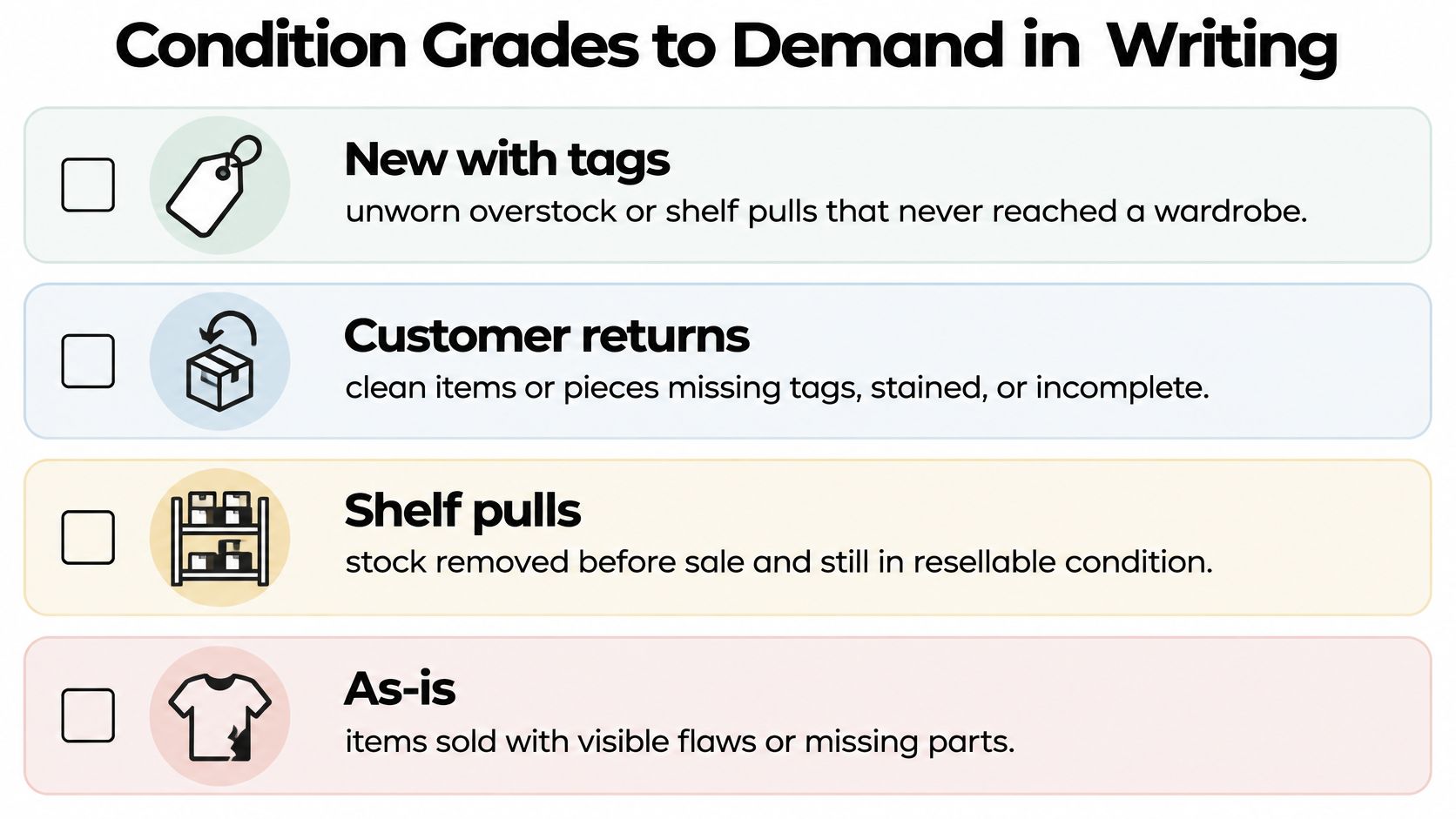
Use this checklist as your visual reference for the terms below.
Plain definitions to agree on
New with tags means unworn overstock or shelf pulls that never reached a wardrobe. Tags may be retail tags, and packaging may be imperfect, but the garment shouldn't show wear.
Customer returns are the widest category. Some pieces are clean and tried on once, others are missing tags, stained, incomplete, or worn. The 2025 Radial State of Returns report found that 56% of apparel and footwear brands reported return rates of at least 30%, and resale value can be reduced by fraud, damage, shrinkage, or items becoming unsaleable. Return-origin lots vary for a structural reason, not because one seller is careless.
Shelf pulls are stock removed before sale and still in resellable condition, often because a store changed assortment or closed a location. As-is means visible flaws or missing parts are part of the deal.
Used bales are often sorted A, B, and C. A-grade can suit resale, B-grade usually needs markdowns or repair, and C-grade usually belongs in donation, recycling, or rags rather than boutique stock. Our Grade A merchandise is new with tags, like new, or has minimal wear. Ask any supplier to define Grade A that plainly.
Don't accept "good condition" as a grade. Ask what flaw would move a piece out of that grade.
Paperwork to send before you pay
Put these requests in one email so the answer becomes part of the order:
- Grading definitions: Written criteria for each grade in the lot, including stains, holes, odor, pilling, missing buttons, and broken zippers.
- Expected defect rate: A stated range, plus what happens if your count exceeds it.
- Size and brand distribution: Expected ranges by category, not a single hero brand in a photo.
- Representative photos: Pictures of typical units pulled from the same stock, including tags and flaws.
- Manifest where one exists: SKU, brand, size, and condition by line if the channel provides it.
- Unit-group labels: Each group marked as new with tags, customer returns, shelf pulls, damaged, or uninspected.
We guarantee the total item count and quality grade as specified in your order, while specific items, styles, and brand distribution can vary with inventory, and we communicate significant limitations before the order is finalized. That distinction matters. Count and grade are promises, exact styles in a liquidation assortment are not.
Ask how a quality dispute is settled. In our case, we may offer credit toward future orders at our discretion for quality disputes. If a supplier offers credit rather than cash, put that into your cost model because your cash stays tied to that supplier.
Ask about the resale certificate requirements in your state as well, so qualifying wholesale purchases aren't charged sales tax at retail. Then, when the first delivery arrives, grade every piece against the written standard and photograph exceptions the same day. A dispute supported by dated photos is a business conversation. A dispute from memory two weeks later isn't.
Freight Minimums and Order Size
Shipping can rewrite a good merchandise price in one line. Quote freight to your actual zip code, with the delivery type you'll use, before you call any lot cheap.
This comparison shows why order size changes the shipping method and the unit math.
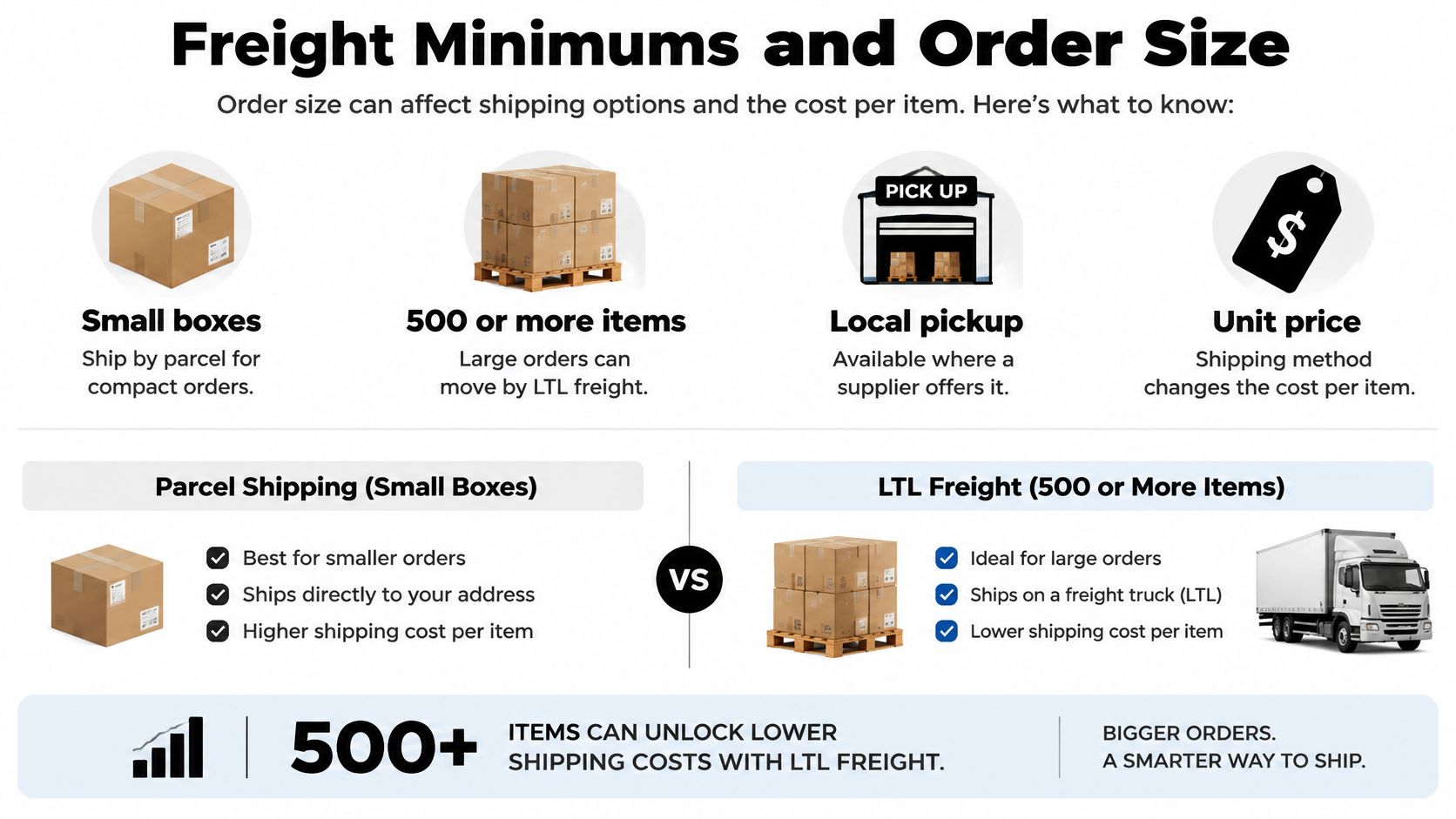
Parcel, freight, and pickup
Small boxes move by parcel, which suits a test order delivered to a shop, home office, or storage unit. Our LTL freight shipping is available for large orders of 500+ items, and local pickup is available where we offer it. Freight lowers cost per piece at volume, but it can add liftgate, residential delivery, appointment, or storage complications if you don't have a dock or a place for a pallet.
For larger orders, we often include free standard shipping. Treat free shipping as a real discount only after you compare the total merchandise price with a paid-freight quote to the same address. Sometimes free freight is better, sometimes the merchandise price absorbed it. Compare totals, not labels.
Use the size ladder as a risk ladder
Our prebuilt liquidation boxes come in sizes of 50, 100, 150, 200, 500, 750, and 1000 items. Read that ladder by risk, not ambition.
- 50 items: A test of grade, brand fit, processing time, and sell-through in your channel.
- 100 to 200 items: A repeat order once the first box proved its yield and you know your listing speed.
- 500 items and up: A cash commitment to one condition mix, justified only when freight savings and a better per-item price outweigh concentrated risk.
Larger quantities usually improve per-item pricing, but they also mean one wrong seasonal call fills your racks. Stay at the smallest minimum until sellable yield is known. A discount on 500 pieces you can't move is more expensive than full test pricing on 50 you can.
Auction and import add-ons
A pallet auction adds cost after the bid. Budget the buyer's premium, destination freight, and sometimes a liftgate or residential fee on top of the hammer price. Sellers who compare hammer price to a delivered box price are comparing different products.
Imported wholesale needs duty in the same worksheet. The Texas Tech U.S. apparel imports briefing reports that effective duty rates increased by 9.5 percentage points for cotton-dominant apparel and 10.2 points for man-made-fiber apparel from 2024 to 2025, while calculated duty rose 75.7% and 51.2%, respectively. Add brokerage, payment fees, inland freight, and weeks of lead time, and a low ex-factory price can lose to a domestic box you can list this month.
Get the freight quote, delivery conditions, and minimum in writing on the same document as the merchandise price. Separate quotes hide the real unit cost.
Which Source Fits Your Selling Channel
Sorting speed and audience fit matter as much as the invoice, as this curation work shows.
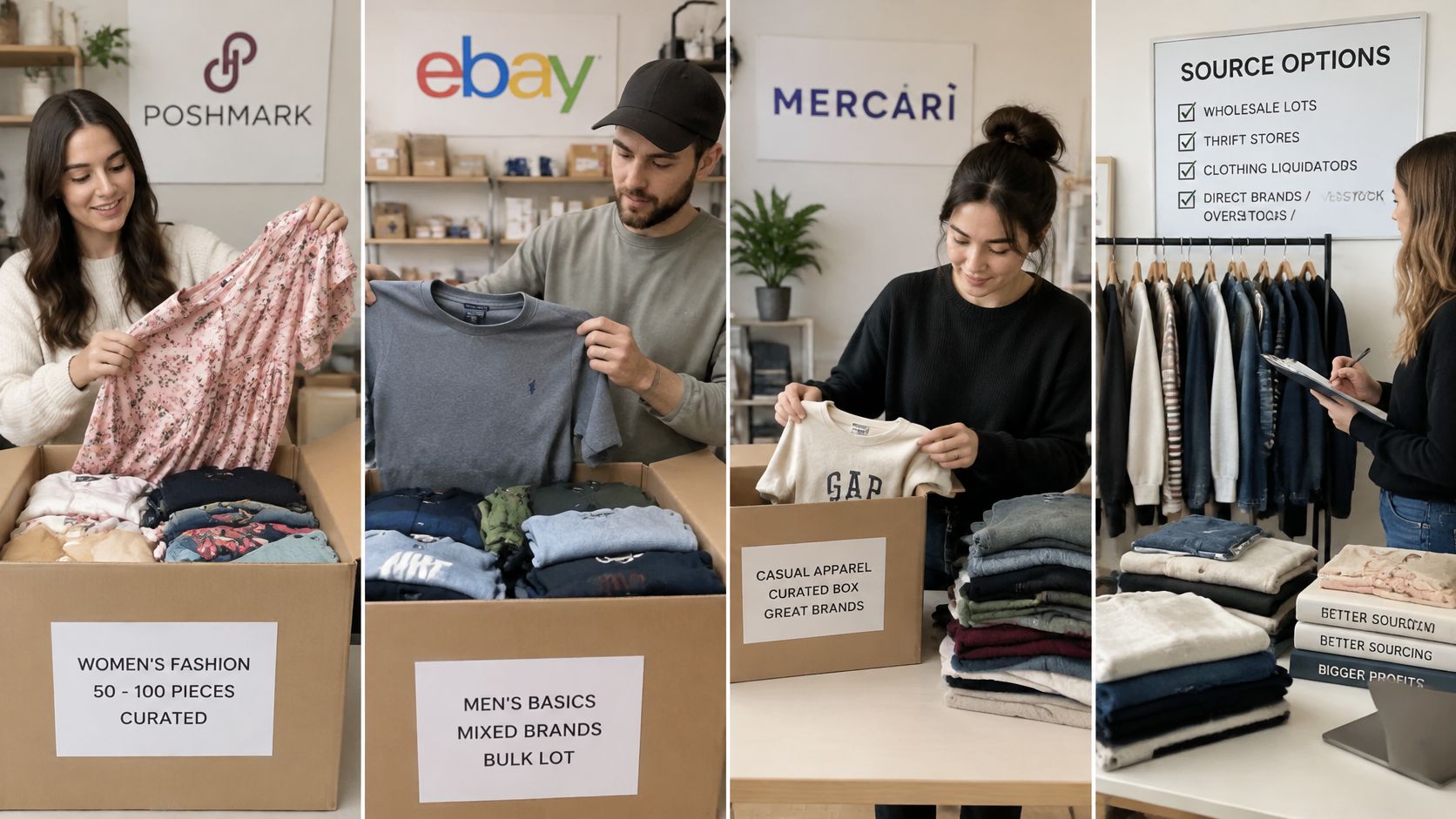
Scene one, the new marketplace seller. You're listing on Poshmark, eBay, or Mercari from a spare room. Start with a 50 to 100 piece curated box and specify men's, women's, or kids items, a season, categories such as tops, bottoms, outerwear, or dresses, and size ranges, with requests accommodated based on available inventory. The ThredUp 2025 Resale Report projects the global secondhand apparel market to reach $367 billion by 2029, so demand can support small sellers, but only if the assortment matches what your buyers search for.
Scene two, the boutique owner. Your racks need a coherent look, not random filler. Tell us your budget and preferred brands and we'll tailor a box or pallet through a custom quote. We carry brands including Nike, Adidas, Calvin Klein, Tommy Hilfiger, Levi's, Champion, Under Armour, Columbia, GAP, Old Navy and American Eagle, and availability varies with current inventory.
This short walkthrough shows how curated inventory gets organized for resale channels.
Scene three, the experienced volume seller. You already know your defect rate, you have storage, and someone can sort all day. Bid on a liquidation pallet at auction, because your operation can absorb the blind mix.
Scene four, the thrift or export buyer. Take a used bale by weight only if you have labor to pull out the unsellable share and a channel for lower grades. Pick the scene that's yours and eliminate the rest.
Mistakes That Wipe Out a Low Price
Season and returns policy ruin more cheap lots than a modest difference in per-piece price. Heavy outerwear that arrives in late spring sits through summer, ties up cash, and often sells later at a markdown just to clear space. Buy for the selling window you'll have after sorting and listing, not the weather on the day you find the deal.
Trusting a thumbnail brand is the next error. A listing photo with one recognizable logo doesn't make every piece that brand, and assuming it does turns a supposed branded box into a mixed-brand lot you'll price lower than planned.
Treating liquidation like retail leaves buyers unprepared. Many liquidation purchases are no-return or limited-remedy deals, so you can't send back the pieces you dislike and keep the winners. Price that finality into the order size instead of discovering it after delivery.
A cheap mixed lot can also dump kids' sizes or off-brand filler into an adult shop. Those pieces aren't free just because they arrived in the box. They take photos, storage, and listing time, or they become donations bought with your money.
Seller red flags
- No verifiable business history: You can't confirm the seller has shipped comparable lots before.
- Friends-and-family payment only: You give up ordinary payment dispute options.
- No promised item count: You can't calculate cost per piece or prove a short shipment.
- Stock photos only: You never see the actual condition range you're buying.
- Same-day wire pressure: Urgency replaces the paperwork a legitimate wholesale order should have.
Any one flag deserves a pause. Two or more should end the conversation, no matter how low the quoted price sounds.
Place a Small Test Order First
Pick the one channel that matches your cash and sorting time, then buy the smallest useful test this week. For most boutique owners and marketplace or live-sale sellers, that's a 50-item curated brand-name box, not a blind pallet and not an import container.
We've provided wholesale brand-name liquidation boxes for resellers since 2013 and now serve over 5,000 happy customers, so our curated boxes are built for this kind of test. A custom quote fits better when you have a fixed budget and a brand list your shop can't compromise on.
Before you pay
Write down five things and get them confirmed:
- Grade: The written condition standard for the pieces in the box.
- Item count: The exact number you should receive.
- Categories: Gender, season, category, and size preferences, subject to stock.
- Shipping method: Parcel, freight, or pickup, with the total delivered cost.
- Quality remedy: What happens if grade misses the description.
The step-by-step sequence in this guide on how to order wholesale will help you keep those confirmations in order. Don't let a verbal promise substitute for the order details.
When the box arrives
Grade every piece against the standard and separate sellable, markdown, repair, and write-off piles. Log the hours you spend sorting, cleaning, photographing, and listing. Record realized prices, platform fees, and shipping subsidies as pieces sell, not from memory at month end.
Then compute landed cost per sellable unit and contribution for the whole lot. Reorder the same specification only if contribution still holds in your downside case. If the yield was honest but the mix missed your shop, request a custom quote with your budget and preferred brands instead of jumping to a random auction.
Move toward a 500-piece freight order only after two small lots confirm sell-through at prices your channel pays. That's the point where a lower per-item price becomes a real saving, because you've proved the pieces, process, and buyers first.
Start with a 50-item curated brand-name liquidation box from OneTrendyCloset, grade every piece against the written standard, and calculate your landed cost per sellable unit before you scale. Tell us your budget, categories, and preferred brands for a custom quote, and we'll build a test box or larger lot around the inventory your boutique or marketplace shop can sell.