You've found a wholesale listing with recognizable shoe brands, a tempting pair count, and a price that looks far below retail. The excitement is real, but so is the uncertainty. Are the pairs new, shelf pulls, or customer returns? Will the size run fit your buyers? Can you sell the shoes locally, online, or across a border without creating a compliance problem?
A profitable purchase starts before the pallet arrives. You need to understand how the lot was built, what the grading language means, how many pairs are genuinely sellable, and what each pair must earn after freight, preparation, marketplace fees, returns, and aging. The strongest reseller doesn't chase the lowest pallet price. They build a sourcing process that produces predictable per-pair economics.
Table of Contents
- Introduction to Shoes Pallets Wholesale for New Resellers
- How Wholesale Shoe Pallets Work in the Retail Ecosystem
- Common Types of Shoe Pallets and What Each Means for Resale
- Grading and Condition Categories Explained Simply
- Expected Yield and Resale Margins With Real Math
- Logistics Shipping and Inspection Checklist Before You Scale
- Choosing Your First Pallet and Planning Profitable Next Steps
Introduction to Shoes Pallets Wholesale for New Resellers
Your first shoe pallet can look like a shortcut to a full inventory wall. A listing might show branded athletic footwear, mixed sizes, and a bulk price that makes each pair appear inexpensive. Then the pallet arrives. Some boxes may be clean and ready to list, while others contain missing laces, mismatched sizes, scuffed soles, or styles that don't fit your audience.
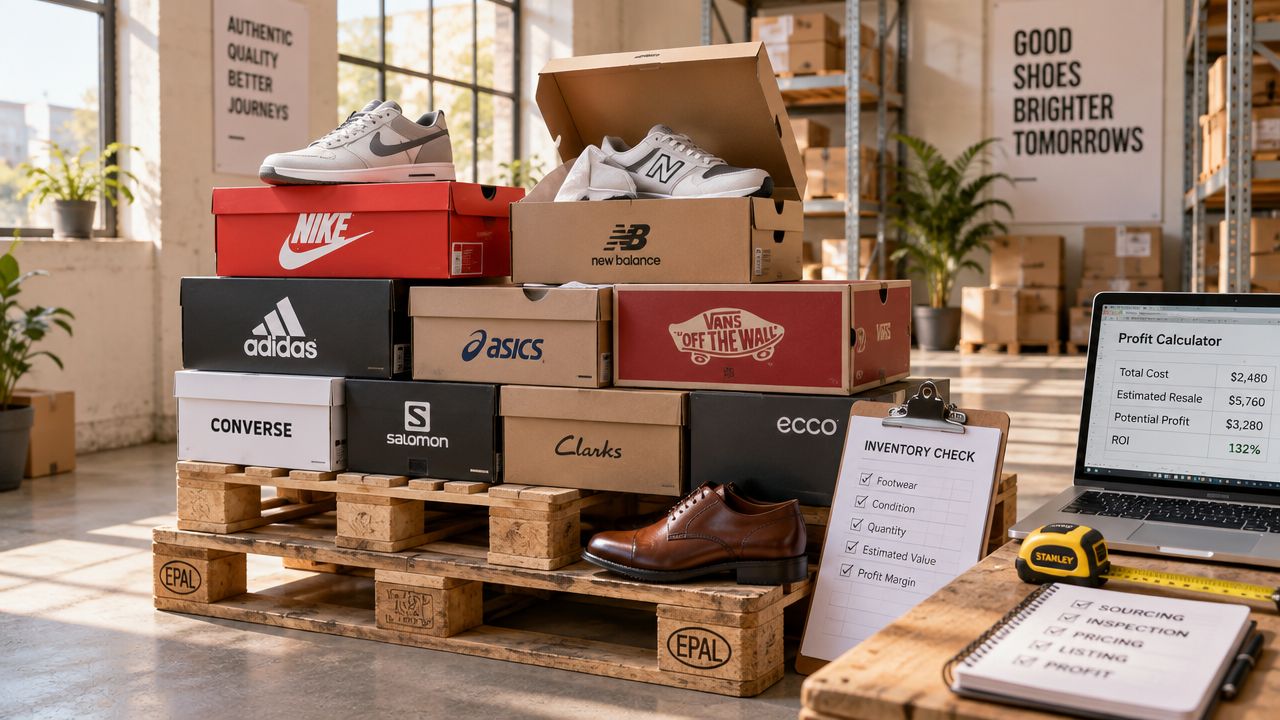
That outcome doesn't mean shoes pallets wholesale is a gamble. It means the buyer must evaluate the lot as a small operating system, not as a pile of individual bargains. Liquidation footwear commonly comes from retail overstock, canceled orders, shelf pulls, and customer returns, so each source creates a different level of sorting and resale work. Liquidation.com's shoe wholesale overview describes formats ranging from athletic shoe pallets of 80 to 150 pairs to case-pack truckloads of 15,000 to 20,000 pairs, showing how bulk footwear operates across several purchasing scales.
The per-pair mindset
Suppose a pallet contains pairs from a familiar brand. The brand name may help attract attention, but it doesn't guarantee that every pair will sell at the same speed or price. A clean athletic shoe in a common size may support one sales strategy, while an incomplete returned pair may belong in a different channel altogether.
A seasoned buyer asks four questions before paying:
- What am I buying? Brand, category, size distribution, condition, and whether the lot is manifested.
- What will arrive? Boxes, loose pairs, damaged packaging, odors, missing components, or mismatched shoes.
- Where will I sell it? A specialty buyer, off-price shop, marketplace customer, local jobber, or export customer.
- What does each sellable pair need to earn? Not the advertised retail price, but the expected net amount after every practical cost.
Practical rule: Treat the pallet price as the beginning of the calculation, not the profit.
The path to repeatable results is straightforward, although it requires discipline. Learn how the inventory enters liquidation, choose a pallet type that matches your audience, decode the grade, inspect the shipment, calculate expected recovery, and record what sells. That process turns a one-off deal into a sourcing method you can improve with every purchase.
How Wholesale Shoe Pallets Work in the Retail Ecosystem
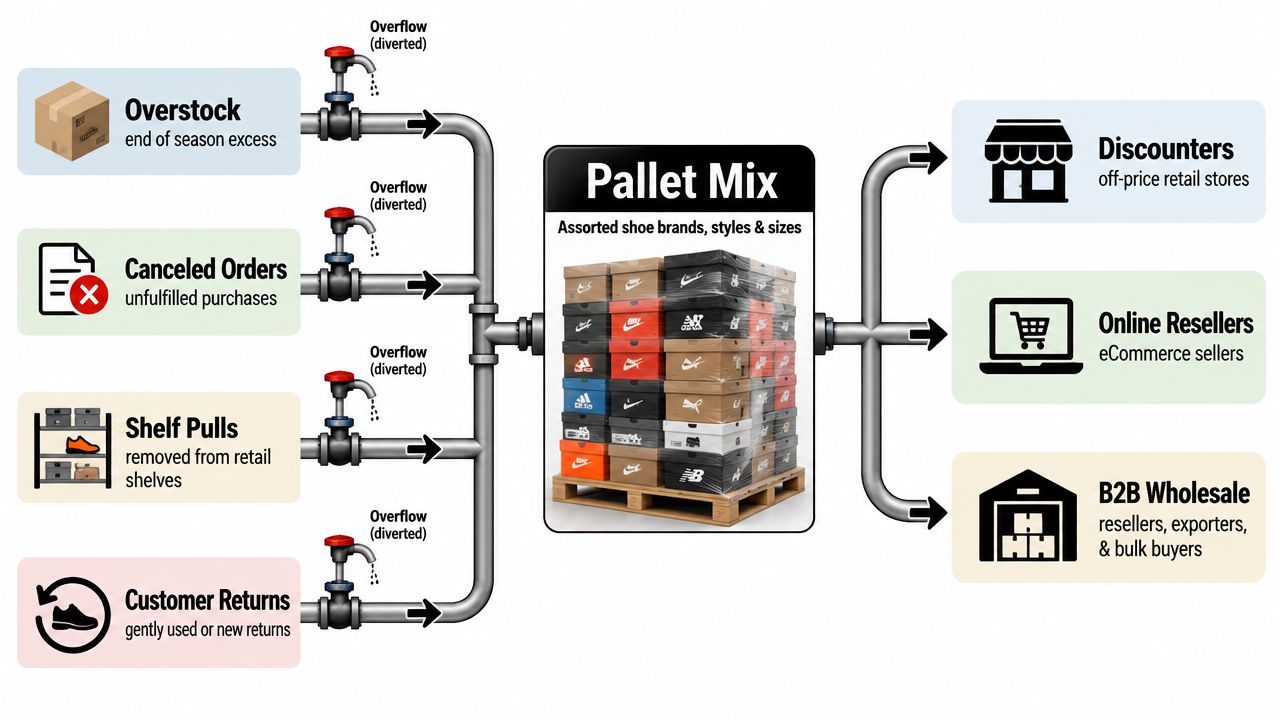
Retail footwear moves through a pipeline. A retailer orders inventory, stores it, displays it, sells some of it, and eventually needs a way to handle pairs that no longer fit its sales plan. A pallet is one of the overflow valves in that pipeline.
The inventory may come from overproduction, canceled orders, warehouse closeouts, seasonal excess, shelf pulls, or customer returns. Liquidation doesn't necessarily mean the retailer failed or closed. It often means the retailer needs to clear stock that occupies space, belongs to a past assortment, or can't remain in the primary sales channel. Orotex Liquidation's explanation of shoe pallets describes this historical role and connects branded liquidation supply with major footwear companies.
Follow the inventory path
A simplified flow looks like this:
- Retail or brand inventory enters a secondary channel after the original sales plan changes.
- A liquidation intermediary or wholesaler groups similar or mixed footwear into cases, pallets, or truckloads.
- The reseller buys the lot and takes responsibility for receiving, sorting, cleaning, photographing, listing, pricing, and fulfilling orders.
- A secondary customer buys through a marketplace, discount store, boutique, live sale, B2B account, or export channel.
The intermediary's job is to consolidate inventory. Your job is to understand what that consolidation hides. A mixed pallet may contain useful variety, but it can also combine different brands, categories, conditions, and size runs. Pair count alone doesn't tell you how much work the lot requires.
Why manifests matter
A manifest is the inventory record supplied for a lot. Depending on the seller, it may identify brands, styles, sizes, quantities, condition, or estimated retail information. A detailed manifest narrows uncertainty. An incomplete or unmanifested listing leaves you relying more heavily on supplier reputation, photos, inspection rights, and your own risk tolerance.
Brand concentration also changes the sales process. Recognizable names can make listing and customer education easier, but a premium brand mix doesn't remove the need to verify authenticity, condition, and permitted resale. The right question isn't, "Are these branded shoes?" It's, "Can I identify the pairs, grade them accurately, and place them with buyers who value this specific mix?"
Common Types of Shoe Pallets and What Each Means for Resale
A pallet type should match your selling method. A boutique owner may want a coherent category and presentable packaging, while a jobber may prefer a lower acquisition cost and accept more sorting. An online seller often needs enough information to create accurate listings, and an export buyer must also consider destination-market rules.
Compare the main formats
Mixed-brand assorted pallets offer variety across brands, styles, and sizes. They can suit live sales, flea markets, discount shops, and marketplaces where variety helps maintain a broad catalog. The trade-off is inconsistent pricing and more work deciding where each pair belongs.
Brand-specific lots concentrate demand around one recognizable name. That can simplify merchandising, but it also makes authenticity checks, condition verification, and size availability especially important. A brand-specific pallet isn't automatically safer than a mixed lot.
Athletic-focused pallets may appeal to buyers seeking running, training, basketball, or casual sneakers. Athletic shoes often benefit from clear product photography and model identification, so a manifest can be valuable when you list online.
Category-specific pallets, such as kids' or dress footwear, work best when your audience already shops that category. A kids' lot may fit a family-focused discount store, while dress shoes may suit formalwear buyers or seasonal events. Category focus reduces assortment confusion, but it can limit your outlets if demand is narrow.
Manifested and unmanifested loads aren't separate product categories, but they represent different information conditions. A manifested lot generally gives you more forecasting material. An unmanifested lot may offer an attractive entry price, but you should reserve it for a channel and budget that can tolerate uncertainty.
For broader context on how branded liquidation assortments can fit a reseller's sourcing plan, see this guide to brand-name clothing pallets.
| Pallet Type | Typical Mix | Risk Level | Best For |
|---|---|---|---|
| Mixed-brand assorted | Several brands, categories, and size runs | Medium to high | Live sales, discount stores, broad marketplaces |
| Brand-specific | One principal brand across styles and sizes | Medium | Brand-focused online sellers and boutiques |
| Athletic-focused | Sneakers and performance or lifestyle footwear | Medium | Marketplace sellers and sneaker-oriented shops |
| Kids' or dress category | A focused customer segment | Medium | Specialist retailers and targeted local sales |
| Manifested lot | Inventory details supplied before purchase | Lower information risk | Buyers who need forecasting and organized listings |
| Unmanifested lot | Limited detail, often broader assortment | Higher information risk | Experienced buyers with flexible outlets |
Use three filters before selecting a format: audience, handling capacity, and cash exposure. If you can't inspect or process a varied lot quickly, variety can become a storage problem. If your customers already seek a particular category, a focused pallet may produce cleaner listings and faster decisions even when its per-pair cost is higher.
Grading and Condition Categories Explained Simply
Condition labels are useful only when they describe what you'll physically receive. “New” might mean unworn shoes in original packaging, while “returns” can include anything from a customer who tried on a pair indoors to a pair with visible wear. Ask the supplier how the grade is assigned, whether pairs are inspected, and how missing components are handled.
What the common grades mean in practice
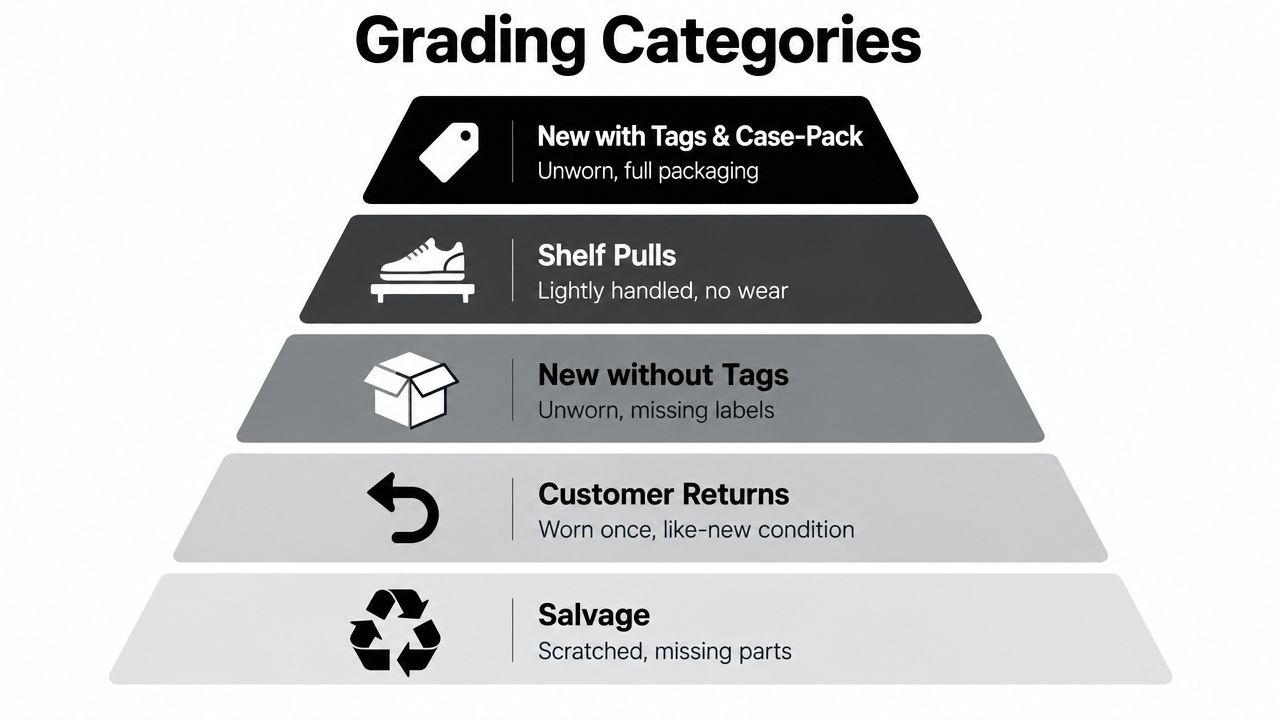
New with tags and case-pack is the most straightforward condition. Shoes should be unworn, packaged, and suitable for standard retail presentation, although you still need to verify pair matching and packaging at receipt.
Shelf pulls were removed from store displays or retail shelves. They may have been handled or tried on, and boxes may show wear, but the shoes can remain close to new. Inspect soles, insoles, laces, tags, and surface finish.
New without tags generally describes unworn merchandise missing labels or retail identifiers. The pair may be clean, but you'll need accurate measurements, model details, and condition wording for the listing.
Customer returns require the widest inspection. One pair may be like new, while another may show a worn sole, dirt, odor, creasing, or a missing accessory. Don't treat a return grade as a uniform product condition.
Salvage is the repair, parts, donation, or recovery tier. Scratches, severe wear, missing components, or mismatched pairs may make normal resale impractical. Some buyers can recover value through parts or specialized outlets, but a beginner shouldn't price salvage as retail inventory.
Why the grade changes your economics
Two pallets can contain the same number of pairs and produce very different results. One may arrive with clean boxes, matching pairs, complete laces, and common sizes. The other may require cleaning, relacing, repackaging, photographing, and discounting before the first sale.
Create your own receiving categories rather than accepting a supplier label without checking it:
- Ready to list: Clean, complete, matched, and accurately identifiable.
- Needs preparation: Sellable after cleaning, new packaging, or minor presentation work.
- Needs markdown: Complete but visibly worn, damaged, or difficult to price at the top of your range.
- Not normally sellable: Mismatched, unhygienic, severely damaged, or incomplete.
A detailed manifest can justify a higher per-pair acquisition cost because it reduces sorting risk and improves forecasting. Find Liquidation's shoe pricing guidance describes a wide spread between case-pack new shoes and department-store shelf pulls, with the difference driven by condition, brand tier, resale certainty, and manifest quality. The lesson is simple: cheap per pair isn't cheap if many pairs consume time or can't enter your chosen channel. For more background on pallet purchasing decisions, consult this explanation of liquidation by the pallet.
Expected Yield and Resale Margins With Real Math
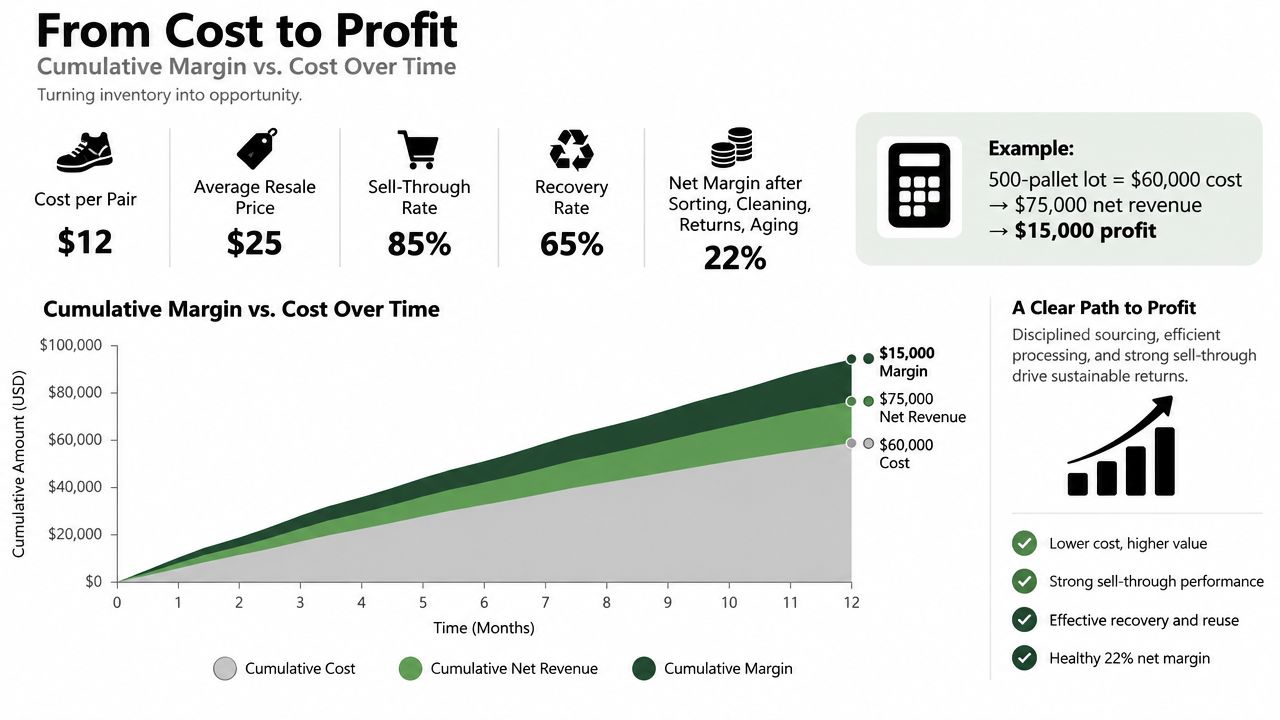
The useful number isn't the advertised pallet price. It's the expected net return from the pairs you can sell. Start with this basic formula:
Landed cost per acquired pair = total purchase cost, freight, and applicable fees divided by total pairs received.
Then calculate a second figure:
Expected net contribution per pair = expected selling price minus marketplace or payment fees, preparation cost, shipping subsidy, returns allowance, and landed cost.
You should also estimate recovery by channel. Independent liquidation guidance places footwear recovery at about 35% to 65% of cost for specialty B2B and verified-buyer marketplaces, 22% to 45% for off-price retail, and 8% to 18% for mixed-pallet jobbers. These figures come from Forthclear's footwear liquidation playbook, which also notes that inventory older than 9 months had lower recovery in Q1 2026 than its 2024 benchmarks. Treat those ranges as planning references, not promises for your specific pallet.
A simple example
Suppose you buy a lot containing 100 pairs. Your purchase invoice, freight, and other acquisition charges create a total landed cost of $1,200. Your landed cost is therefore $12 per acquired pair. That number doesn't mean every pair must sell for more than $12, because some pairs may require preparation or may move through a lower-value channel.
Now sort the lot:
- 70 pairs are ready to list.
- 20 pairs need cleaning, new packaging, or markdown pricing.
- 10 pairs aren't suitable for your primary resale channel.
Your effective cost for the 90 potentially sellable pairs is higher than the original $12 figure, because the 10 unsellable pairs still consumed capital. If preparation costs add to the lot, include them before judging the result. If marketplace fees and returns reduce your realized revenue, subtract those too.
Category and channel change the answer
An athletic pair with a recognizable model may perform differently from a formal shoe with limited local demand. A specialty B2B buyer may accept a larger assortment than an individual marketplace customer, while a mixed-pallet jobber may require a much lower acquisition cost to absorb sorting risk.
Build a spreadsheet with one row per pair or product group. Record condition, brand, category, size, intended channel, expected selling price, actual selling price, preparation time, and final disposition. After the first cycle, compare your forecast with actual recovery. Your next offer should reflect evidence from your own operation, not just the supplier's headline price.
The following video can provide a visual supplement to the inventory and margin discussion:
Logistics Shipping and Inspection Checklist Before You Scale
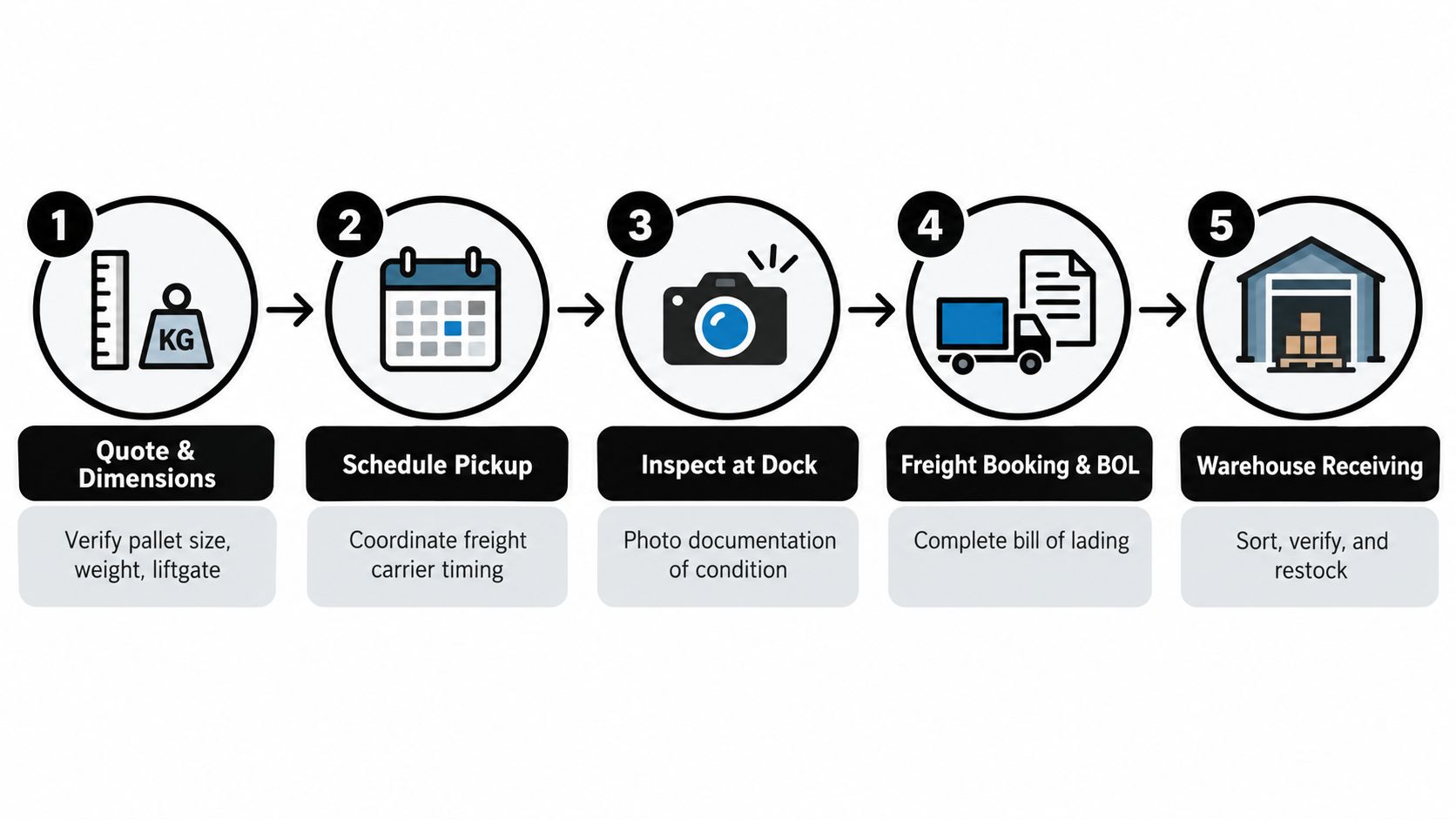
A good pallet can become a poor purchase if the delivery details are vague. Before you accept a quote, confirm the pallet count, dimensions, weight, freight terms, delivery appointment process, and whether your location can receive a truck. Ask whether you need a dock, forklift, or liftgate, and clarify who pays accessorial charges.
Use a receiving workflow
- Review the quote. Match the advertised pair count with the invoice and confirm whether freight is included or billed separately.
- Plan the delivery. Give the carrier accurate access information. A residential location, narrow entrance, or site without unloading equipment may require a different arrangement.
- Document the arrival. Photograph wrapping, cartons, labels, pallet damage, and visible water or crushing before opening the shipment.
- Check the paperwork. Compare the bill of lading with the shipment and record shortages or obvious damage before signing without comment.
- Sort immediately. Separate ready-to-list pairs, preparation items, markdown stock, and non-sellable goods.
Inspect the pairs, not just the boxes
Open cartons and check that the left and right shoes match in brand, model, color, size, and condition. Look at the outsole, upper, insole, tongue label, laces, fasteners, and interior for wear, odor, moisture, or contamination. A clean outer box doesn't prove that the shoes inside are ready for resale.
Domestic and export buyers also face different questions. Via Trading's shoe liquidation information notes that footwear is marketed for resale and export, but a buyer still needs to verify destination-country requirements. Used or returned footwear can raise sanitary, labeling, customs, or import-condition issues depending on the destination. New overstock usually presents a different compliance profile from customer returns or shelf pulls, so keep those categories separate in your records and ask the carrier, customs broker, or relevant authority for destination-specific guidance.
Scale only after you can explain the first lot. Record pair counts, condition outcomes, time spent sorting, sales by channel, returns, and unsold aging inventory. Then request a custom quote based on the categories and size runs that performed well, rather than increasing volume blindly.
Choosing Your First Pallet and Planning Profitable Next Steps
Choose your first lot by matching inventory, customer, and operating capacity.
If you sell through local discount channels, a mixed pallet may give you flexibility. If your buyers search for athletic footwear, a focused athletic lot may reduce merchandising work. If you list every pair online, prioritize a manifest and a condition profile you can photograph and describe accurately. If you export, verify destination rules before comparing supplier prices.
Your storage space matters as much as your budget. Leave room to separate grades, stage photography, hold returned goods, and keep sellable inventory away from questionable items. A small test purchase gives you useful operating data. Track the same measures for every lot, including acquired pairs, sellable pairs, preparation hours, realized revenue, channel, returns, and remaining stock.
Don't compare suppliers only by advertised price. Compare the clarity of their manifests, condition definitions, freight terms, inspection policy, and response to specific questions. A supplier that can build around your audience may be more useful than one offering a cheaper blind assortment.
For a broader starting point, review current pallets for sale and use the same per-pair worksheet for every option. OneTrendyCloset offers curated brand-name apparel liquidation boxes, mix-and-match selection, and custom quotes for resellers who want to move from smaller tests toward custom lots. That apparel focus means it isn't a substitute for a shoe specialist, but its custom-lot model illustrates how a buyer can communicate budget, category, brand preferences, and quantity needs instead of accepting an entirely blind assortment.
The goal is a repeatable footwear sourcing strategy. Buy a lot you can inspect and sell, learn what your customers purchase, then scale only when the recorded recovery supports the next order.
If you're building a broader resale operation alongside footwear, visit OneTrendyCloset to review curated brand-name liquidation boxes and custom lot options for boutiques, marketplace sellers, and live-sale hosts. Use your target category, budget, and sales channel to request an assortment that fits your inventory plan rather than buying without a clear outlet.