You need pallets today, and the first search for “pallets near me” usually produces a confusing mix of recyclers, free listings, brokers, and sellers who quote a price without explaining the grade. Don't start by driving to the closest yard. Start by defining the pallet your product can use, then compare condition, treatment, quantity, and delivered cost.
The practical process is simple: find the right local sources, vet the pallets and supplier, price equivalent grades, and pick up the order without creating a second logistics problem. Free pallets can work, but they're only one option. A reliable used pallet supplier often saves more time than a free listing that requires sorting, repairs, and another trip.
Table of Contents
- What You Actually Need Before You Start Calling Yards
- Where Pallets Near You Actually Come From
- Reading Pallet Grades and Specs Like a Buyer
- Choosing Between New, Used, and Free Pallets
- Reading Local Pallet Prices Without Overpaying
- Pickup Logistics and the Move to Repeat Supply
- Common Mistakes That Cost You Time and Money
What You Actually Need Before You Start Calling Yards
A pallet yard can't give you a useful quote if all you say is, “I need some pallets.” Before you call, write down the product dimensions, loaded weight, quantity, destination, and handling equipment. Those details determine whether a standard pallet is suitable or whether you need a custom size.
Start with the load
Measure the footprint of the product and note whether cartons, bags, drums, or equipment will overhang the deck. Record the total loaded height, including any overhang, and the weight of one completed pallet. A shipment of bagged feed may need a durable deck and stable stacking surface, while retail cartons may prioritize consistent dimensions and clean boards.
Then confirm how the pallet will move. A forklift may need entry from two sides or all four sides, and a pallet jack may require a specific opening. Common options include the 48×40 GMA pallet, 48×45 Chep-style pallet, 40×48 block pallet, and odd-size stringer pallets. Don't assume the most common size is automatically the right one.
Ask five questions before accepting a quote
Tell the supplier whether the pallet enters a closed-loop warehouse, supports a one-time domestic shipment, or leaves the country. Export shipments typically require ISPM-15 treatment, and the receiver may reject untreated or improperly marked wood.
Your supplier filter should include:
- Size: Confirm the exact length and width, not just “standard.”
- Weight: Ask whether the quoted grade supports your loaded product.
- Entry: Specify forklift and pallet-jack access.
- Treatment: Confirm heat treatment and export markings when required.
- Quantity: State the immediate order and whether you'll reorder.
Practical rule: A low unit price means nothing until the pallet passes your size, load, treatment, and quantity requirements.
Use those five decisions to measure every quote later. If one yard offers a cheaper pallet but can't confirm dimensions or treatment, it hasn't offered a comparable product.
Where Pallets Near You Actually Come From
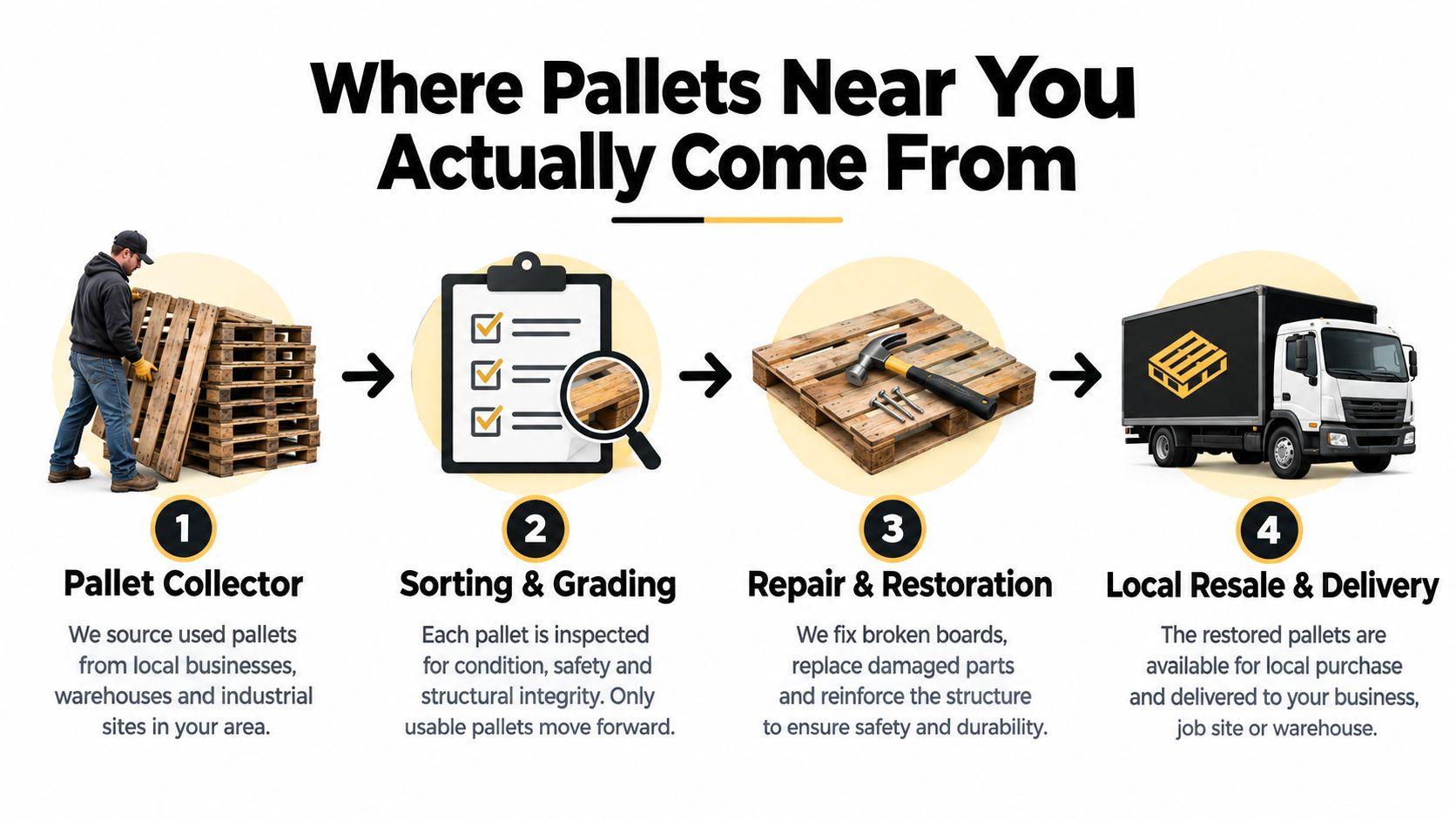
Local pallet availability usually comes from the secondary market, not a nearby factory producing brand-new units for every buyer. Wood pallets move through reuse, repair, sorting, and resale networks. The Pallet Foundation reports that 95% of wooden pallets are recycled, and its summary of Virginia Tech research describes expanded recovery areas at landfill facilities. For municipal solid waste facilities, recovery areas rose from 33% to 62%, while construction-and-demolition facilities rose from 27% to 45%, as documented in the Pallet Foundation's wooden pallet recovery summary.
Match the source to your buying situation
Recyclers and repairers are the first call for recurring orders. They collect used pallets, sort them by size and condition, repair usable units, and resell them locally. Because they handle volume, they're often the most practical source when you need consistent grades or delivery.
Brokers aggregate inventory from multiple yards. They can help when your local recycler is short on a particular size, but their coordination adds a margin layer. Ask where the pallets will ship from and whether the broker controls the grade inspection.
Online classifieds and local groups can produce inexpensive or free pallets from businesses with surplus stock. The tradeoff is inconsistency. Listings may disappear, quantities may be overstated, and the pallets may be mixed sizes or damaged. Treat these sources as opportunistic, not as your main supply plan.
Don't rely on the back door
Retailers, grocery distribution centers, beverage plants, and big-box stores may have pallets leaving their facilities, but access varies. Call first, ask who handles surplus pallets, and confirm whether pickup is allowed. Showing up without an appointment can waste the trip, especially if the site requires a flatbed, loading equipment, or a specific pickup window.
Auction houses and liquidation yards become useful when a region has excess inventory. They can offer unusual sizes or mixed lots, but inspect before bidding and calculate transport before assuming the lot is cheap. If you're also evaluating liquidation inventory, pallet liquidation sourcing guidance can help you think about the difference between a bulk lot and a repeatable supply relationship.
Reading Pallet Grades and Specs Like a Buyer
A grade is only useful if the supplier applies it consistently. Grade A generally means a clean, structurally sound pallet with intact stringers, usable top and bottom decks, consistent construction, and little or no visible repair work. It suits repeat shipments, warehouse handling, and customers who expect a uniform presentation.
Grade B can remain structurally useful while showing stains, discoloration, mixed appearance, or light repairs. It often fits one-way domestic shipments where appearance matters less than function. Grade C requires much closer inspection. Broken stringers, multiple repairs, mixed construction, missing boards, or partial damage can create failures during lifting and stacking.
| Grade | Condition | Best For | Inspection Red Flag |
|---|---|---|---|
| Grade A | Clean, intact, consistent, and lightly used | Recurring shipments and demanding warehouse handling | Cracked stringer, loose deckboard, or unreported repair |
| Grade B | Structurally usable with stains or light repairs | One-way domestic freight and cost-conscious operations | Uneven deck, excessive repairs, or mixed dimensions |
| Grade C | Damaged, heavily repaired, or inconsistent | Scrap, limited-duty work, or projects after inspection | Broken stringers, missing boards, and unstable load surface |
Understand the specification, not just the label
The GMA pallet refers to the 48×40 Grocery Manufacturers Association format. The plan notes identify a 2,800-pound dynamic load rating and a preferred 6,000-pound static rating, but you should still confirm the supplier's construction and rating for your specific pallet. Dynamic capacity applies while the pallet is being handled, while static capacity concerns a stationary load. Product distribution, deck condition, rack support, and moisture can change real-world performance.
Look at the pallet itself. A split stringer, protruding nail, loose board, severe twist, or crushed block is a reason to reject the unit or downgrade it. Don't let a clean top surface distract you from damage underneath.
Decode treatment and marks
For international export, ask for a legible ISPM-15 stamp. HT indicates heat treatment, DB means debarked, and KD means kiln dried. EPAL identifies pallets made within the European Pallet Association system. These marks don't replace a physical inspection, and an unclear or missing export mark can create a receiver problem.
For a broader buying context, compare the stock and specifications described in pallets for sale listings, but request the exact grade and treatment rather than relying on a product title.
Choosing Between New, Used, and Free Pallets
New pallets make sense when the load is heavy, the shipment will cycle repeatedly, the customer requires uniform equipment, or a failure would cost more than the purchase premium. They're also easier to specify because you can control dimensions, construction, and treatment from the start.
Used pallets are usually the sensible middle ground. Grade A gives you a cleaner, more consistent unit, while Grade B can lower the cost for one-way domestic shipments. Used stock is especially practical when a local recycler can supply the same size and grade on a repeat basis.
Free pallets fit a narrow set of jobs. A one-time move, farm project, workshop build, or scrap project may not justify a paid order. They're a poor choice for export, regulated receiving environments, or shipments where inconsistent dimensions will cause loading problems.
| Factor | New Pallets | Used Pallets | Free Pallets |
|---|---|---|---|
| Price | Highest purchase cost | Moderate, based on grade | No purchase price, but pickup costs remain |
| Availability | Usually dependable by specification | Strong near logistics and manufacturing areas | Irregular and listing-dependent |
| Structural reliability | Most consistent | Depends on grade and inspection | Highly variable |
| Export compliance | Can be ordered with treatment | Must be verified on each supplier's stock | Often uncertain |
| Sorting time | Low | Moderate, if grade is controlled | High |
The decision rule is straightforward: match the pallet tier to the product, destination, and number of trips. Don't pay for new pallets when a verified Grade B unit safely handles a one-way shipment. Don't accept free pallets when a failed load, rejected export shipment, or wasted afternoon costs more than the order.
Reading Local Pallet Prices Without Overpaying
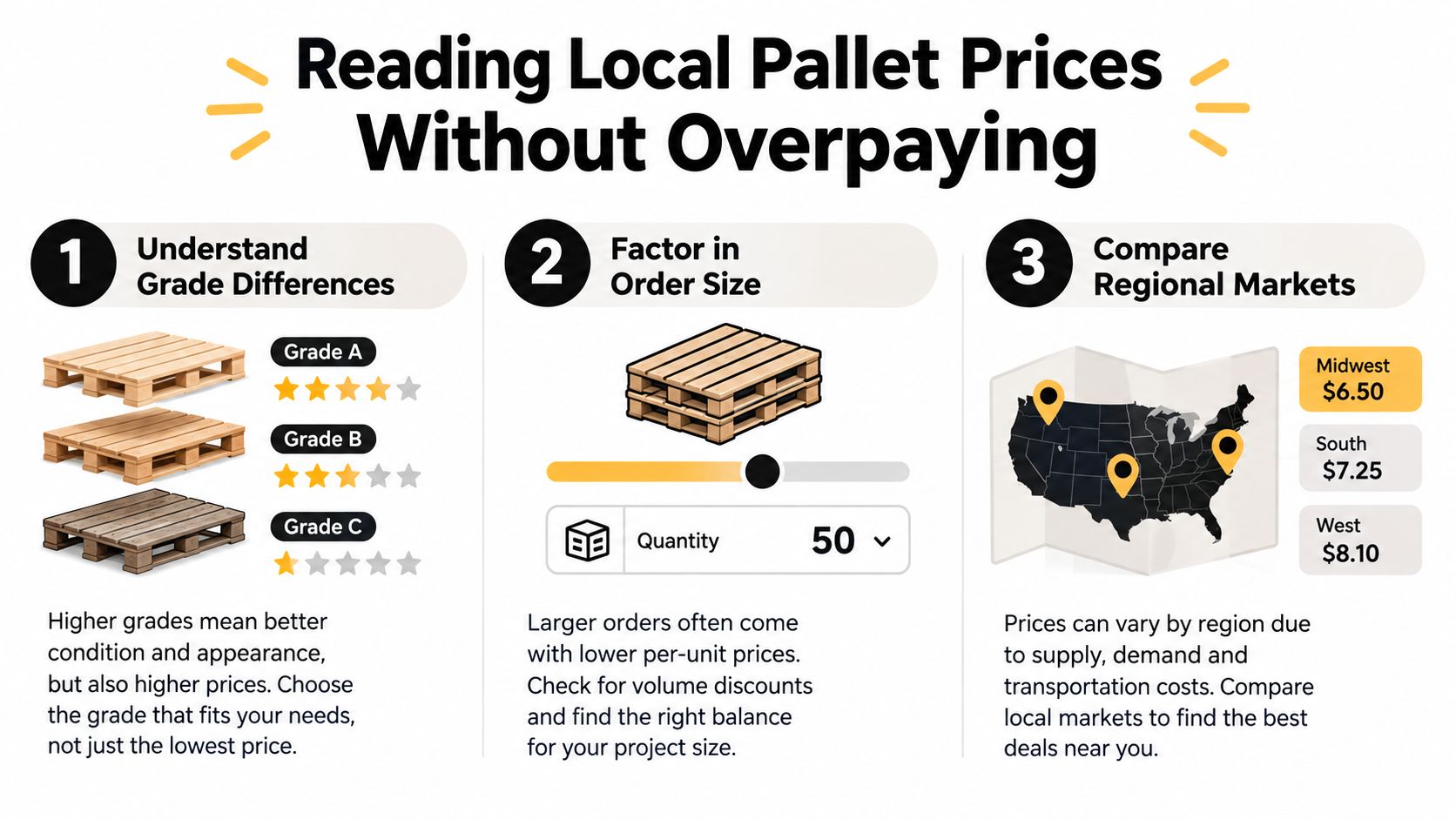
A pallet quote isn't comparable until the grade, size, quantity, pickup terms, and delivery charges match. A 48×40 Grade A pallet and a mixed Grade B/C load aren't competing offers, even if both sellers call them “used pallets.”
A 2025 U.S. pricing report lists national averages of $8.41 for new pallets and $1.42 for pallet cores, with price dispersion reaching 30% between the highest- and lowest-priced markets. The same 2025 used-pallet pricing report identifies the Southeast and Central regions as typically more competitive, while premium clusters including Hawaii, California, Connecticut, Massachusetts, and Alaska averaged 18.2% above the national mean. Arkansas, Mississippi, Tennessee, South Carolina, and South Dakota averaged 6.8% below it.
Build a quote you can compare
Call three local yards and use the same wording each time. Ask for the exact pallet size, grade, treatment, quantity, and whether the price is for pickup or delivery. Separate the unit price from freight, fuel surcharges, loading charges, grading fees, and minimum-order requirements.
Independent market guidance places used 48×40 GMA pallets in approximate bands of $4 to $8 for Grade A, $2 to $5 for Grade B, and $0.50 to $2 for Grade C, while noting that direct end-user sales can be higher and that yards in the same metro can differ by 25% to 50%. Review the used-pallet price guidance for sellers and buyers as a reference point, then verify your local delivered quote.
Ask this directly: “I need [quantity] 48×40 GMA pallets, [grade], for [pickup or delivery], and [heat treatment requirement]. What's the total price, including loading and freight?”
Push for a volume discussion at the quantities you use, including 50, 100, and 250 units, rather than asking vaguely for a “bulk discount.” The supplier may offer better terms, stage the order, or explain that delivery becomes more efficient at a larger load. Don't accept a vague “around” price. Get the final amount, available quantity, condition, and pickup window before leaving home.
Pickup Logistics and the Move to Repeat Supply
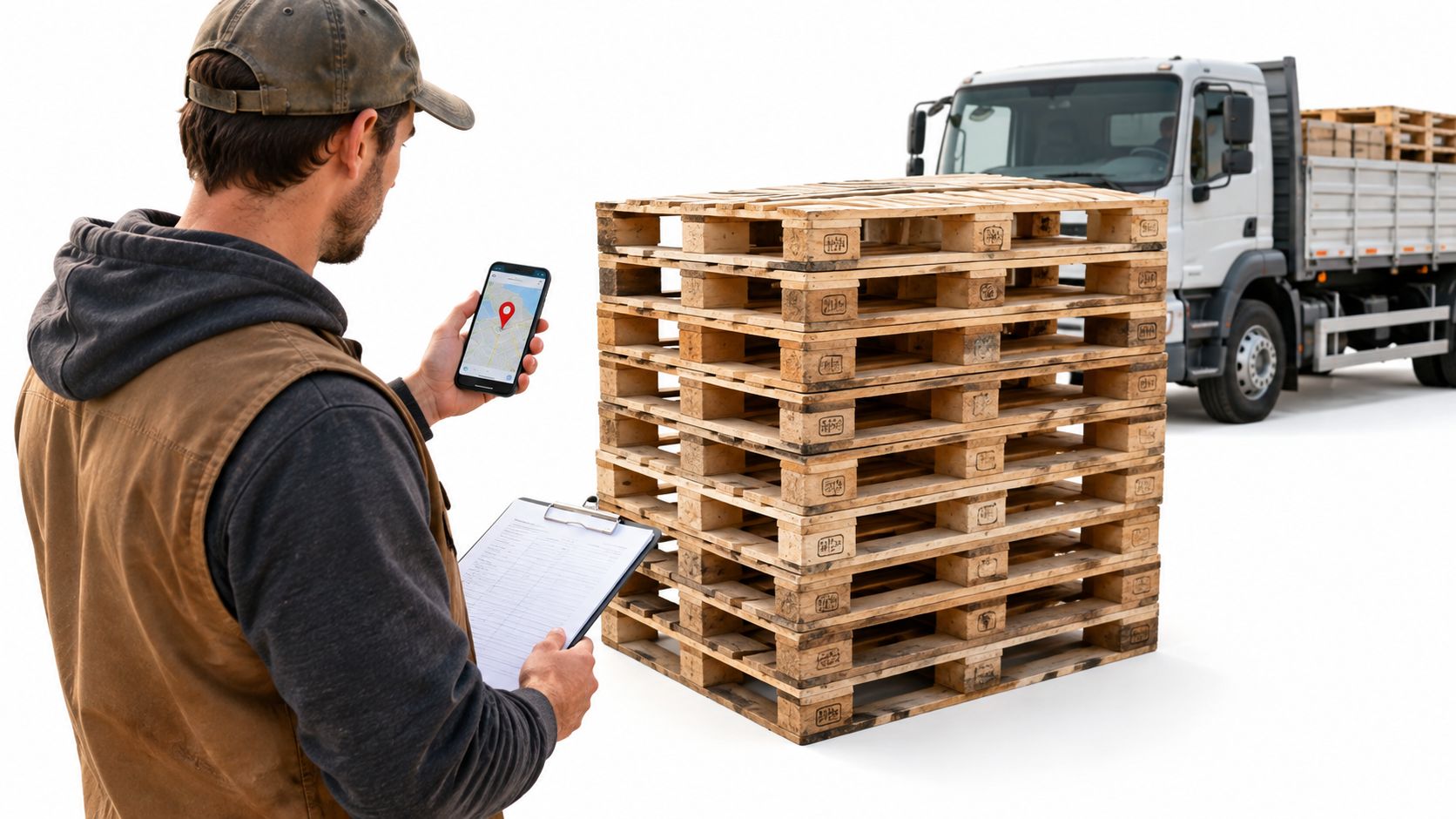
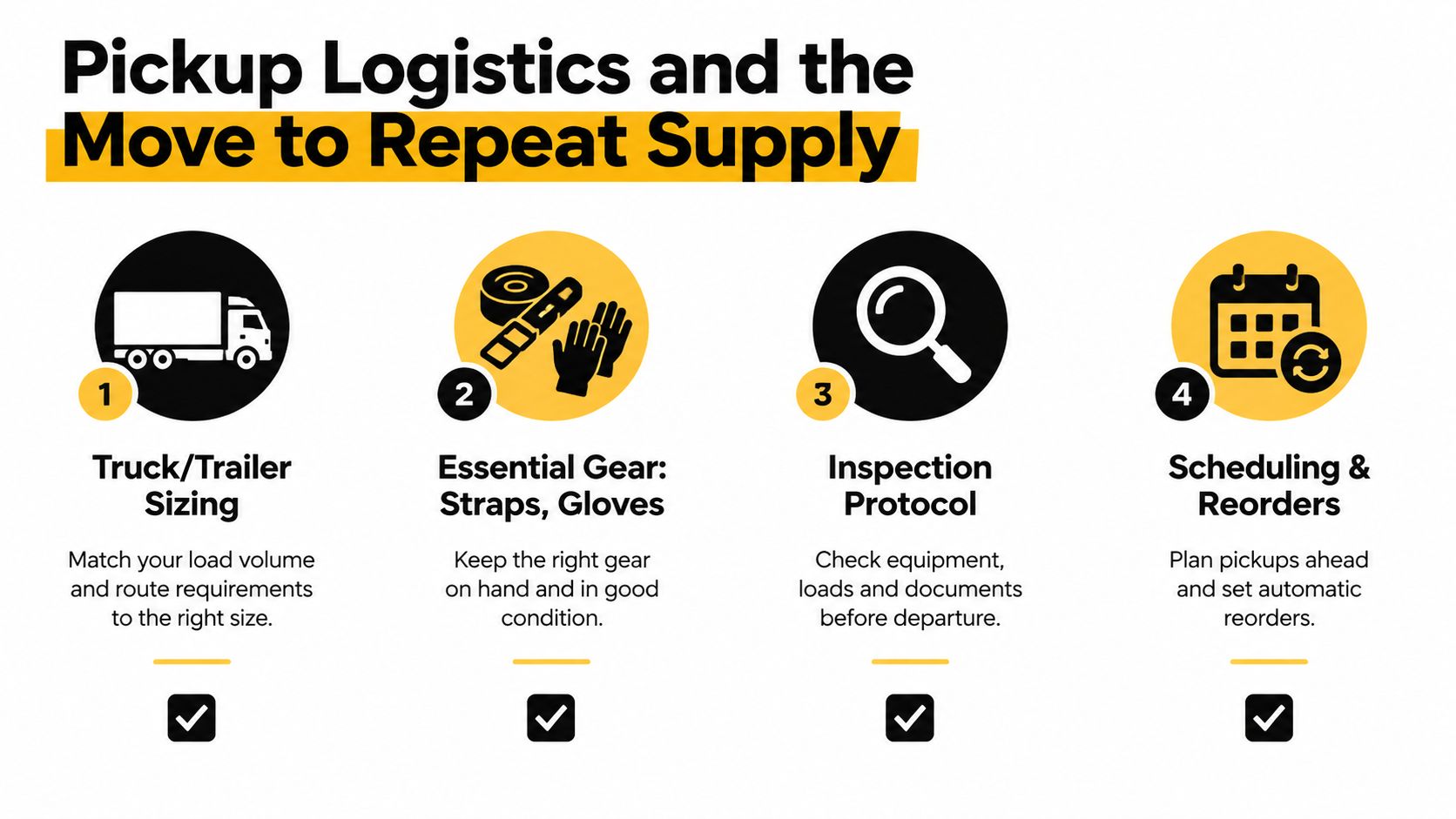
The cheapest pallet is not the cheapest order if your vehicle can't carry it safely or the yard can't load you. Confirm the pallet count, stackability, estimated load height, vehicle access, loading method, and whether the supplier provides a forklift. A pickup truck may handle a small order, but larger quantities generally require a trailer or commercial delivery arrangement. Never guess. Ask the yard what equipment and vehicle configuration it expects.
Use a written pickup checklist
Bring work gloves, tie-down straps, a tarp when weather threatens, and bungees for securing loose coverings. Inspect the load before it's placed on the vehicle. Count the pallets, confirm the size and grade, look for broken stringers and loose deckboards, and photograph the stack if the order is being collected for a business.
- Confirm loading help: Ask whether a forklift operator will load you and whether the operator needs clear access.
- Prepare the vehicle: Use a flat, suitable deck and protect the load from shifting.
- Secure the stack: Use rated straps and check the load after leaving the yard.
- Plan the receiving area: Make sure you have a dry, level place to unload and sort.
You should also account for the difference between pickup and delivery at 50, 100, and 250 pallets. Those quantities don't automatically produce the same economics for every yard. At each level, compare pallet price, vehicle rental, fuel, labor, loading time, and delivery charges. A free pickup can stop being free once travel and sorting consume the day.
The following video provides a visual look at practical pallet handling and pickup considerations.
Turn a yard into a supplier
If you'll reorder, stop making emergency calls. Ask the yard whether it can reserve a grade, stage pallets before your pickup window, and support a weekly or monthly schedule. Give the supplier your expected range, preferred size, acceptable grade variation, and delivery requirements.
Managed marketplace sourcing is becoming more useful than informal free-only hunting. ZIP-based directories and marketplace pages now emphasize verified suppliers, pickup, delivery, and quote requests, which reflects the need for repeatable supply. Guidance on all-time trading also reinforces the broader business lesson: dependable purchasing depends on repeatable relationships, not last-minute availability.
Common Mistakes That Cost You Time and Money
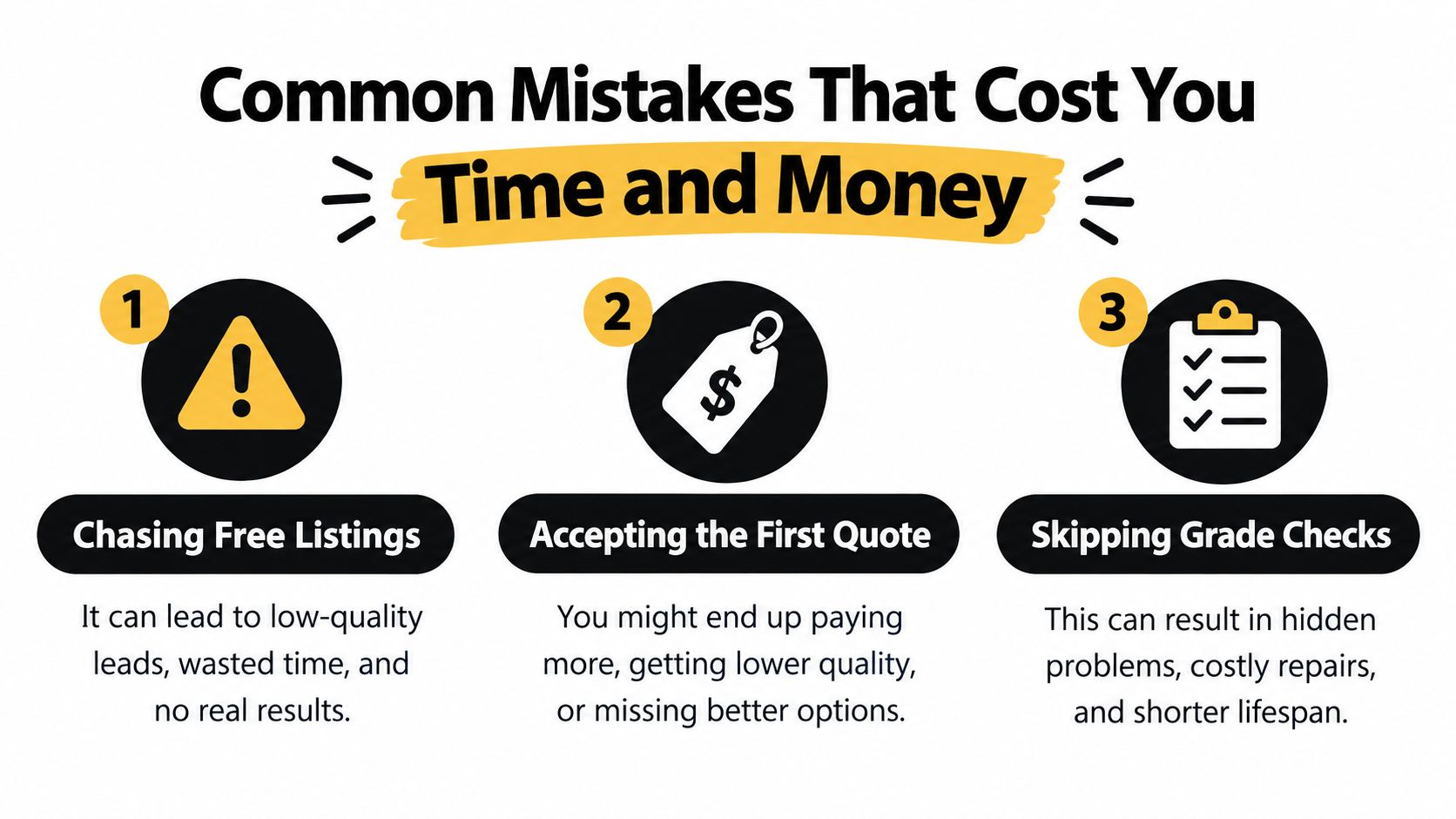
The reflex to grab free pallets causes more wasted trips than most first-time buyers expect. A free listing may involve an uncertain quantity, mixed sizes, damaged boards, no loading assistance, and a pickup window that doesn't match your schedule. If your shipment needs consistent pallets, compare the full cost of sorting and replacement against a firm quote from a recycler.
Mistake one, accepting the first reasonable-sounding quote
A supplier can quote a low number by changing the grade, size, or quantity. A $1 difference between two quotes may conceal a $0.50 downgrade in pallet condition, but don't treat those figures as universal market rules. Ask what the number includes and request a photo or inspection description of the actual stock.
Mistake two, checking treatment after loading
If your shipment is going abroad, verify the ISPM-15 marking before the pallets go onto the truck. Look for a clear stamp showing the required treatment information, and ask the supplier to confirm that the mark applies to the pallets being sold. Untreated or improperly marked pallets can be rejected at the receiving point.
Mistake three, ignoring thresholds and backups
Delivery economics can change sharply when you miss a supplier's minimum order or load threshold. A small order may carry a disproportionate freight charge, while a larger scheduled delivery may be priced differently. Ask for pickup and delivery terms at the quantities you need instead of assuming the unit price tells the whole story.
Keep this discipline checklist beside your phone:
- Confirm grade before paying: Define the acceptable condition in writing.
- Confirm treatment before loading: Inspect the stamp when export compliance matters.
- Confirm the pickup window before driving: Get the date, time, quantity, and loading plan.
- Confirm a backup supplier: Don't build your operation around one uncertain yard.
If you need inventory for a resale operation alongside dependable pallet sourcing, OneTrendyCloset offers curated brand-name apparel liquidation boxes, custom quotes, and pallet-sized apparel orders based on stated budget, brands, and quantity needs. Visit the site to request a custom lot and plan your apparel inventory and pallet requirements together.