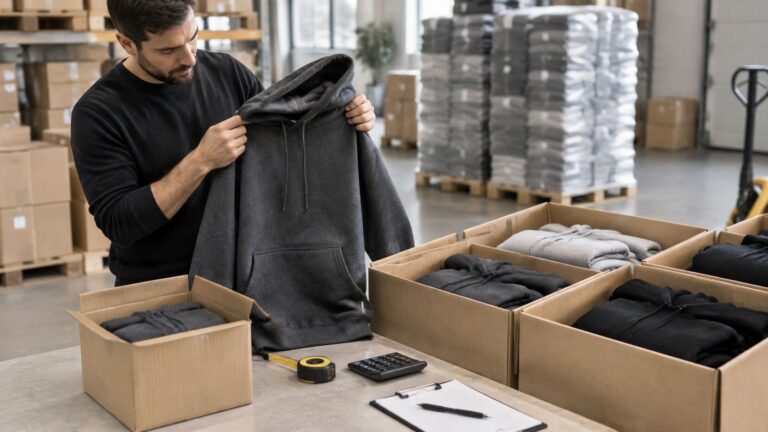
Buying the biggest lot at the lowest price per piece isn't automatically smart sourcing. It can leave you paying freight, sorting damaged clothing, and storing sizes your customers don't buy. A smaller, better-matched lot of women's clothes can produce more usable inventory and return your cash sooner.
The buying decision starts with sellable units, not estimated retail value. Count the garments you can realistically prepare, offer, and sell at a worthwhile margin. Then decide how much inventory your space, sales channel, and working capital can support.
Table of Contents
- What Counts as a Lot of Women's Clothes
- How Source and Condition Change the Lot
- How to Judge Sellable Pieces Before You Buy
- How Resellers Use a Women's Clothing Lot
- What to Do When Half the Lot Sits
- Promises a Liquidation Lot Does Not Make
- Start With a Sized Test Box
What Counts as a Lot of Women's Clothes
A lot of women's clothes is a group of garments sold together in one purchase. It isn't necessarily a coordinated outfit, a complete size run, or a collection from a single brand. The lot might contain selected merchandise, unsorted returns, or graded secondhand clothing.
Common formats for a lot of women's clothes
| Format | Typical count | Usual condition | Best fit |
|---|---|---|---|
| Curated or test box | Small fixed count stated on the order | Mixed brands at a stated grade | First order or boutique restock |
| Standard mixed box | Supplier's stated box count | New with tags, shelf pulls, returns, or a stated blend | Marketplace restock |
| Clothing pallet | Confirmed count or disclosed estimate | One condition family or a declared mix | Volume sellers with storage |
| Weight-sold bale | Sold by weight; piece count estimated | Often graded secondhand | Buyers who sort by weight |
| Manifested shelf pulls | Count listed on the manifest | Generally unworn; tags may be cut | Resellers seeking limited preparation |
| Customer-return lot | Count listed on the manifest | Returned merchandise requiring inspection | Buyers equipped to check each garment |
The packaging doesn't establish the quantity. A pallet of coats and a pallet of lightweight tops can occupy similar space while containing very different garment counts. Likewise, a bale's shipping weight doesn't tell you how much usable clothing it contains unless the seller distinguishes packaging weight from garment weight.
For a first purchase, I'd choose a small, category-focused test box rather than an open-ended assortment. You need enough merchandise to evaluate preparation work and buyer response, but not so much that an unsuitable mix consumes your restocking budget.
Keep quantity and quality separate
Treat piece count, weight, and grade as separate invoice fields. Each answers a different question: how many garments you're buying, what you're transporting, and what condition you should expect.
A manifest adds another layer. It records whatever the supplier specifically lists, such as category, brand, size, or quantity. Don't assume a document includes garment-level detail just because it's called a manifest.
Before choosing the format, check your operational limits:
- Storage: Assign clean, dry shelving or rails before delivery.
- Preparation: Reserve somewhere to inspect, steam, measure, and photograph garments.
- Listing capacity: Buy against the inventory you can process, not the inventory you hope to process.
- Cash reserve: Leave money for packaging, selling costs, and the next useful restock.
Buying rule: A smaller box you can put in front of customers is more useful than a pallet you can only store.
A pallet becomes reasonable when you already have a repeatable receiving process, suitable space, and demonstrated demand for its assortment. More volume should extend a working operation, not substitute for one.
How Source and Condition Change the Lot
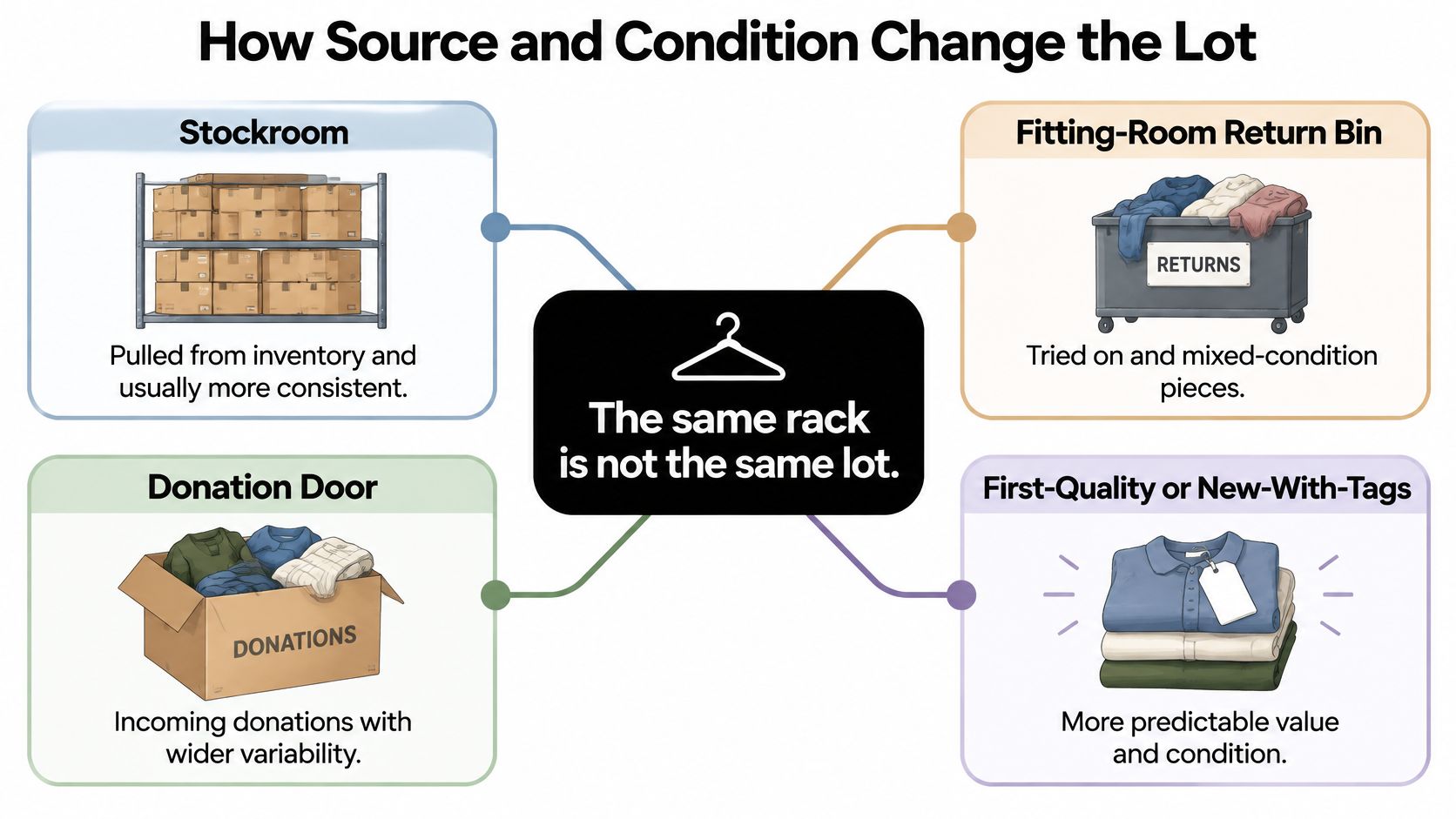
A larger lot can be a worse buy if its source leaves you with incomplete, damaged, or hard-to-sell garments. Stockroom overstock, fitting-room returns, and donations can look similar on a rack, yet each stream may bring different preparation needs and resale descriptions. Judge the pieces you can sell, not the apparent value of the pile.
Start with the inventory stream
New with tags means tags are attached, not that every garment is flawless. An unworn blouse may still have a pulled thread, storage odor, or shop-floor mark. First-quality merchandise should meet the seller's stated standard, not merely retain its ticket.
Shelf pulls and new-without-tags goods may need less preparation, but check where security devices or labels were removed. Look for exposed-shoulder fading and handling marks on pale fabrics.
Customer returns call for closer checks. A dress may look unworn but be missing its belt, making it incomplete despite pristine fabric. Returns can also have deodorant transfer or stretched elastic that a folded photograph won't show.
The same source checks apply to a box of hoodies, where cuffs, drawstrings, fleece surfaces, and tag status affect what you can list.
Grade definitions matter more than letters
Secondhand suppliers may use letter grades, but the letters aren't universal standards. Read the stated tolerances:
- Higher-grade secondhand: Check limits for visible wear, stains, and missing components.
- Wear-grade merchandise: Confirm whether wash wear, fading, or pilling is acceptable.
- Repair or clearance merchandise: Identify defects and decide whether the pieces still suit your sales channel.
The wider supply context helps explain why these streams keep appearing. The Ellen MacArthur Foundation's fashion analysis reports that global clothing production approximately doubled over the period it examined, while average garment use declined substantially over the same period.
Surplus does not guarantee resale value. A lower piece count can outperform a larger lot when more garments are complete, wearable, and suited to your buyers. Account for the time and cost of repairs or extra preparation; a cheap lot can still lose money if too few pieces are sellable.
For a mixed-source order, get the grade definition and source proportions in writing. Otherwise, prices may compare lots with very different levels of wear, completeness, and preparation work.
How to Judge Sellable Pieces Before You Buy
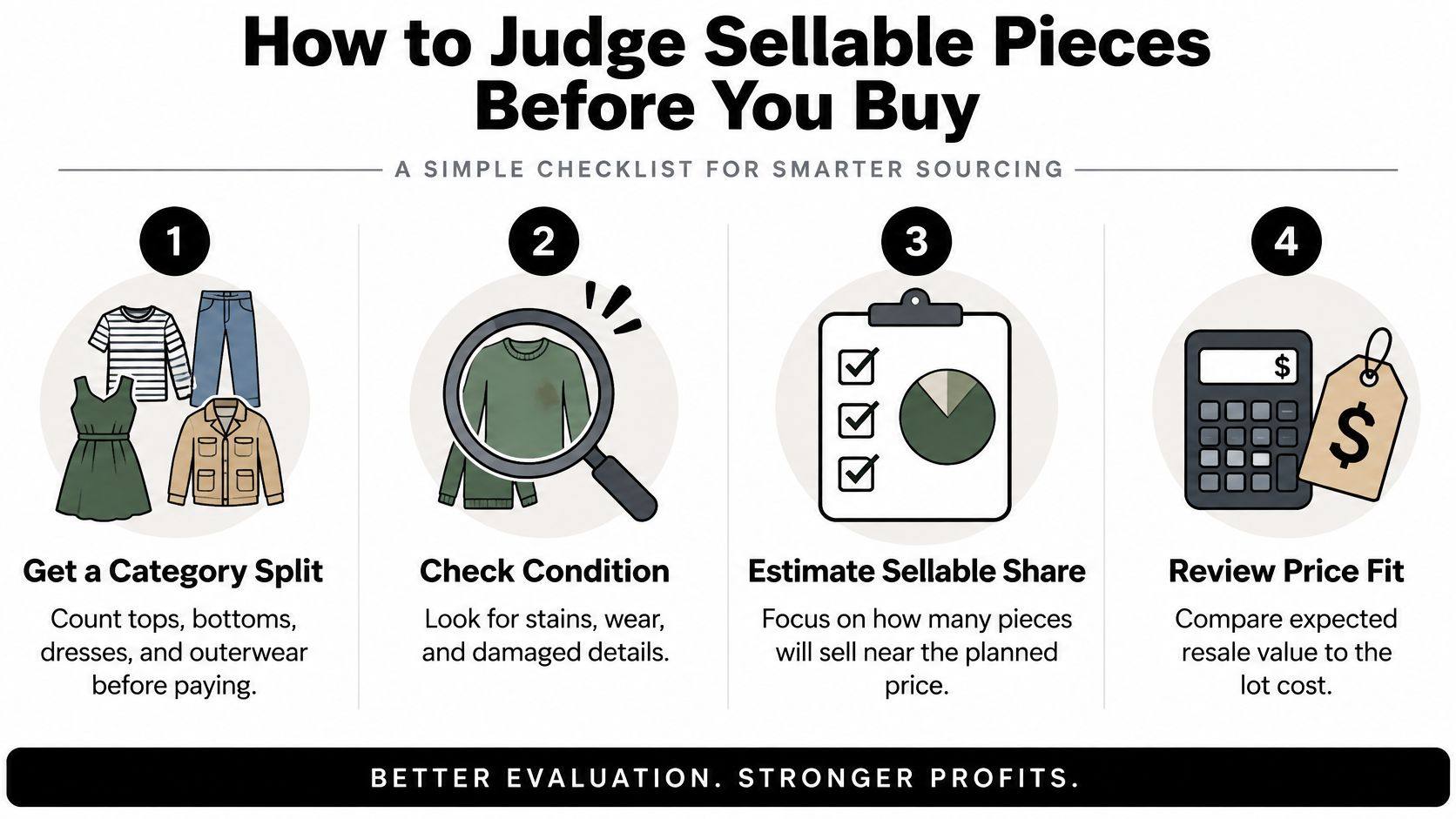
Ask how many garments will sell near your planned price, not how many will arrive. A recognizable label doesn't compensate for the wrong season, unsuitable measurements, or preparation work that costs more than the garment can return.
Use this evaluation before committing cash.
Run the pre-buy checks
Get the category split. Separate tops, bottoms, dresses, and outerwear. A broad women's assortment isn't useful if most of it belongs to a category you struggle to sell. Treat an undisclosed mix as an unresolved risk, not a pleasant surprise.
Check size concentration against your customers. Request size-band shares and identify any concentration outside your established demand. There's nothing unsellable about a particular size, but there may be no reliable buyer for it through your current channel.
Planned-price sellable units = total garments − garments expected to remain unsold or require deep discounts.
Measure a representative sample. Record bust, waist, hip, rise, inseam, garment length, and stretch where relevant. Keep flat measurements distinct from body measurements, and use the same measuring method across comparable garments. A familiar tag size isn't a substitute for fit information.
Assign explicit condition codes. Separate new with tags, excellent used condition, wash wear, pilling, staining, seam damage, and missing components. A garment can have several defects, so retain the individual codes rather than hiding everything under a single grade.
Calculate the remaining margin. Include landed inventory cost, cleaning, repairs, photography, listing labor, platform charges, packaging, and seller-paid shipping. Keep expected clearance proceeds separate from planned-price sales so optimistic leftovers don't make a weak purchase appear profitable.
Fit deserves particular attention. The Size.ly fashion ecommerce benchmarks report a 24.4% online apparel return rate, with 53% of sellers identifying size or fit as the main return reason.
Translate inspection into a buying decision
Pre-buy checks for a women's clothing lot
| Check | Acceptable | Stop or renegotiate |
|---|---|---|
| Category split | Categories match demonstrated demand | Mix hidden or dominated by a weak category |
| Size bands | Concentration fits your customer base | Most stock falls outside your buyers' sizes |
| Grade rules | Named grade plus defect examples | Only broad terms such as good or mixed |
| Sample inspection | Seams, elastic, stains, pilling, and missing parts checked | Only selected promotional photos |
| Sellable-unit math | Planned-price sales support costs and labor | Estimated retail used as profit proof |
Inspection should go beyond appearance. CottonWorks' quality-testing guidance identifies dimensional stability and durability considerations that affect garment fit and serviceability. Check elastic recovery, seam integrity, underarm wear, inner-thigh abrasion, and twisted construction rather than judging only the front of the garment.
Compare landed cost per planned-price sellable unit, not just purchase cost divided by delivered pieces. A smaller box can win that comparison even when its advertised cost per garment is higher.
If the only condition description is vague, renegotiate the description before negotiating the price. A discount doesn't resolve uncertainty about what you're buying.
How Resellers Use a Women's Clothing Lot
The right assortment changes with the selling channel. A boutique owner needs a coherent rail, a marketplace seller needs individually describable garments, and a live-sale host needs merchandise buyers can understand quickly.
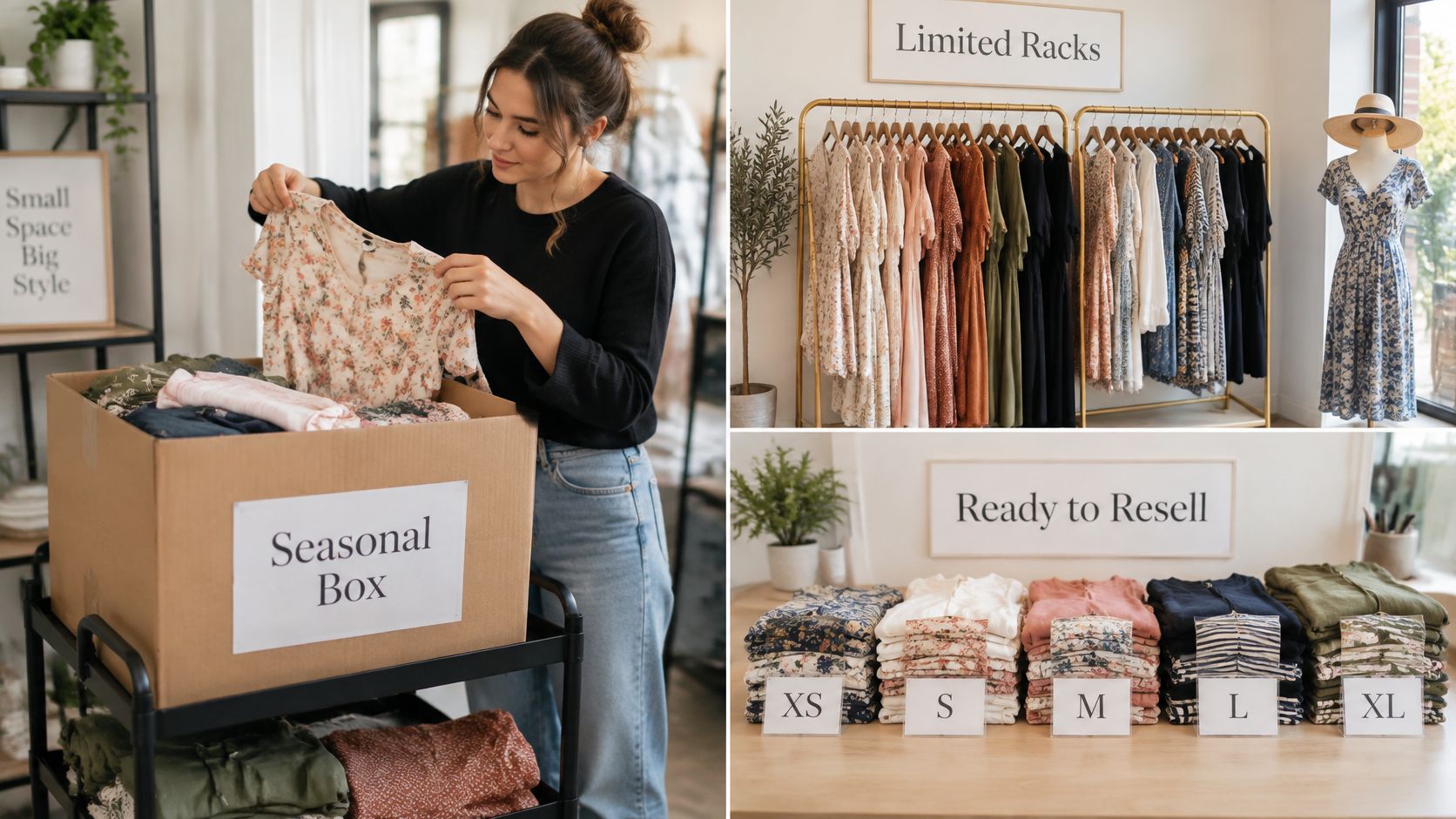
A boutique's receiving area should support sorting before garments reach the sales floor.
A boutique needs a usable assortment
Say a boutique sells relaxed workwear. A seasonal mix of compatible tops and dresses gives the owner options for outfit displays, coordinated rails, and customer recommendations. Random occasionwear or a disconnected size run may consume the same purchasing budget without supporting those sales.
The trade-off is breadth versus coherence. Taking unfamiliar brands can work when the fabric, silhouette, and fit suit the store. Taking unrelated categories just to increase the piece count usually creates more merchandising work.
- Useful buy: Categories and sizes that replenish gaps on existing racks.
- Weak buy: An assortment selected mainly for label recognition or ticket value.
Marketplace sellers need listing-ready information
On Poshmark, eBay, or Mercari, each garment must stand on its own. Use a SKU, record measurements, photograph care and brand labels, and show flaws clearly. A categorized manifest can help organize receiving, but it doesn't replace your listing inspection.
Fit-related returns are a recognized fashion ecommerce problem, as described in the ACM study on probabilistic size recommendations. For an independent reseller, practical fit notes should describe the garment's shape and stretch without guaranteeing that it will fit every buyer with the same tagged size.
If you're establishing the workflow, use the guide to starting an online clothing business to organize the selling process before increasing purchasing volume.
This video provides an additional reference alongside your channel planning.
Live sales need advance preparation
A live-sale host benefits from recognizable merchandise and a condition description that's easy to explain aloud. Inspect garments off-camera, arrange them in selling order, and keep defect notes attached to the correct items.
Opening an unchecked bale during a show sacrifices control. Damage, missing parts, or a confusing assortment can interrupt the presentation and leave the host improvising disclosures.
Choose your primary sales channel before choosing volume. The same assortment can be efficient for a seller with a measurement-and-listing station and unsuitable for a boutique with limited display space.
What to Do When Half the Lot Sits
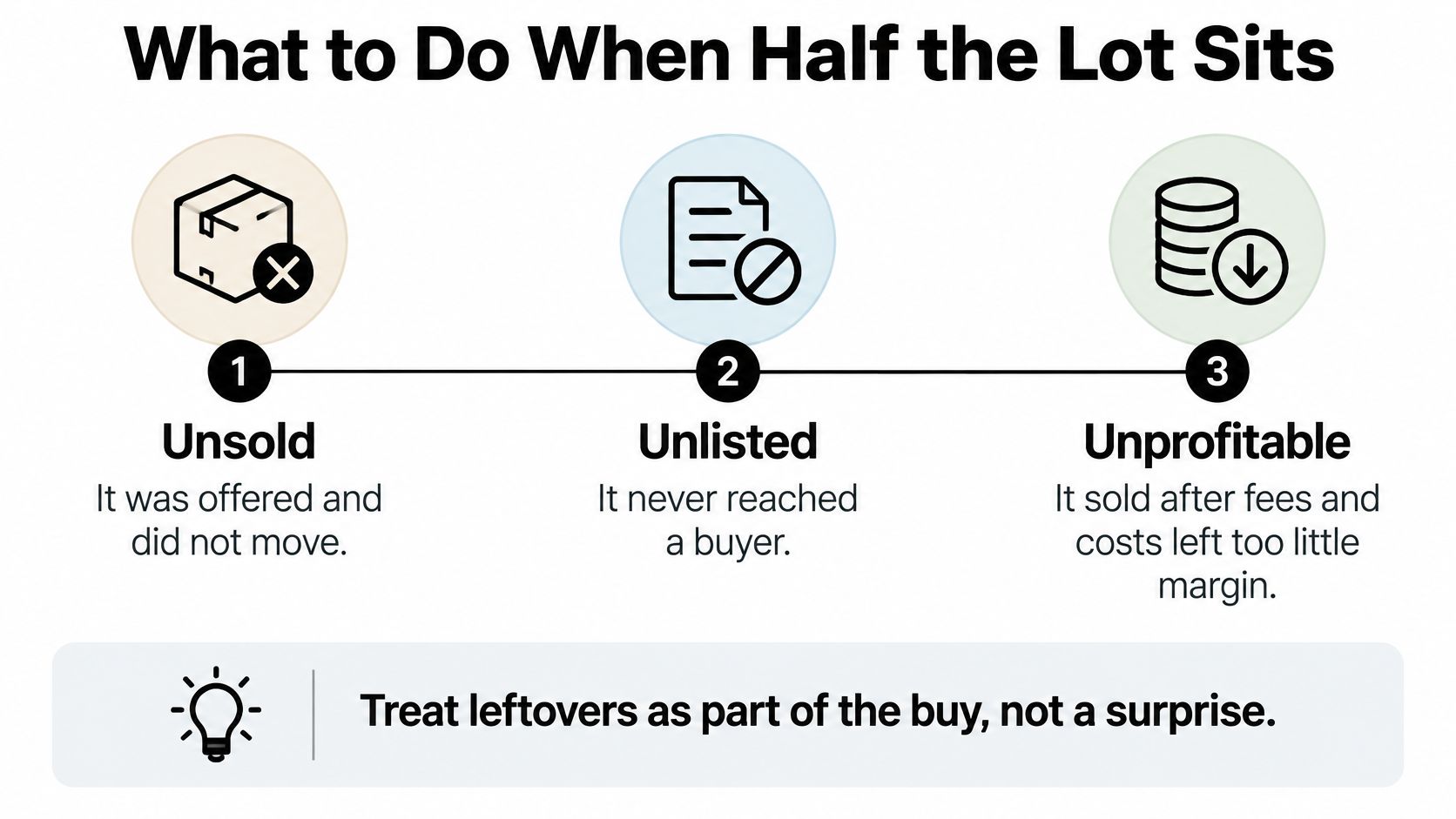
Unsold means buyers had the opportunity to purchase the garment and didn't. Unlisted means you haven't offered it yet. Unprofitable means it sold, but the proceeds didn't justify its costs.
Those problems need different responses. Discounting won't fix an unlisted backlog, and another listing platform won't rescue a garment whose preparation cost already exceeds its likely return.
Keep these distinctions visible when reviewing inventory.
Build an exit sequence before delivery
Start by offering the cleanest, strongest merchandise at realistic resale prices. Use completed-sale comparisons where available, not original tags or ambitious asking prices. Keep acquisition dates and listing dates separate so you can identify whether the delay happened in preparation or after launch.
Next, reassess items that received exposure without purchases. Improve weak photographs, correct incomplete measurements, and check whether the listing title identifies the garment accurately. Don't reduce a price merely because the item has been sitting in a storage bin.
Then change the offer where individual selling no longer makes sense:
- Bundle compatible basics: Combine garments by size, use, and condition rather than making miscellaneous clearance bags.
- Cross-list selectively: Move suitable pieces to another marketplace while maintaining accurate stock control.
- Use live-sale clearance: Set a minimum acceptable recovery before the show.
- Remove unsuitable stock: Route wearable donations and damaged textiles to organizations that explicitly accept them.
The overproduction reporting from TheIndustry.fashion cites estimates that up to 40% of garments produced globally remain unsold. That industry-wide estimate isn't a forecast for your box, but it challenges the assumption that available clothing will always find a profitable buyer.
Review cash rather than clearance activity
Track each category's listed stock, sold stock, net proceeds, preparation labor, and remaining inventory. Include returns and discounts in the category that generated them. Otherwise, a strong dresses category can conceal losses from slow-moving bottoms.
An exit sale is useful when it releases cash and space. It isn't evidence that the original purchase was profitable.
Use predetermined review dates and category-specific markdown rules. If outerwear is moving and tops aren't, investigate the tops instead of discounting the whole lot.
For unlisted merchandise, address capacity first. Simplify photography, batch measurements, or reduce the next order. Buying more stock while the receiving queue remains blocked ties up additional cash without creating more buying opportunities for customers.
Finally, reorder what worked: the categories, size bands, and condition levels that produced acceptable net proceeds. A successful clearance is a recovery tactic, not a reason to buy the same weak assortment again.
Promises a Liquidation Lot Does Not Make
Estimated retail value is not expected resale revenue. It doesn't account for current demand, missing accessories, marketplace costs, or the time required to prepare a listing. An impressive ticket total can coexist with a disappointing cash return.
A fair offer identifies what the seller is committing to and what remains uncertain. Read the product description and order terms together rather than treating a photograph as the entire agreement.
Separate the commitment from the illustration
- A manifest: Supports the details expressly listed, not an assumed selection of exact styles.
- Sample photographs: Show only the pictured goods unless the offer explicitly identifies them as the exact lot.
- Brand references: Don't establish an equal distribution of every named label.
- Seasonal descriptions: Need enough specificity to distinguish immediate stock from merchandise you'll have to hold.
The useful standard is straightforward:
The supplier should stand behind the ordered count and stated grade, while disclosing significant limitations before payment.
We guarantee the total item count and quality grade specified in the order. Specific items, styles, and brand distribution can change with inventory, and significant limitations are communicated before the order is finalized.
Read the remedy before you need it
Our sales are final, with exceptions for significant quality discrepancies from stated grade descriptions. For quality disputes, we may offer credit toward future orders at our discretion. Don't assume that disliking colors or silhouettes creates the same issue as receiving merchandise outside the agreed grade.
Preserve the order confirmation, shipping documentation, and receiving photographs. Record discrepancies while unpacking, keeping affected garments identifiable rather than mixing them immediately into existing stock.
Allow for processing, transit, and freight handling in your purchasing decision. A seasonal opportunity becomes less useful if the delivery and preparation schedule leaves too little time to sell it.
Finally, don't authenticate apparently high-end merchandise solely from a familiar logo. Examine labels, stitching, hardware, and construction, then seek qualified authentication when appropriate. A low acquisition cost isn't a reason to make an authenticity claim you can't support.
Start With a Sized Test Box
Buy the smallest practical assortment that matches categories and size bands you already understand. Your first objective is to establish whether the merchandise works through your operation, not to achieve the lowest possible advertised cost per piece.
We sell brand-name liquidation boxes for boutiques, online sellers, and live-sale hosts. When building a box, you can specify women's items, seasonal preferences, categories such as tops, bottoms, outerwear, and dresses, and preferred size ranges. We accommodate requests based on available inventory.
Make the request operational
Describe what you can sell and what would create a problem. A clear request is more useful than a broad preference for popular brands.
- Customer fit: State the size ranges your customers buy.
- Category needs: Identify replenishment gaps and unwanted categories.
- Seasonal timing: Explain whether you need merchandise for immediate listing or later release.
- Preparation tolerance: Distinguish straightforward inspection from repairs you're willing to undertake.
Use our wholesale ordering guide to prepare the request. Keep the agreed specifications with your receiving records so you can evaluate the order against what was arranged.
Scale the successful portion
Treat the test as a purchase with a measurable outcome. Record which garments were ready to sell, which required intervention, and which generated worthwhile proceeds. Give the assortment enough selling exposure to distinguish a genuine demand problem from a preparation delay.
If you need a different arrangement, tell us your budget and preferred brands so we can tailor a box or pallet through a custom quote. Keep those preferences grounded in your customers rather than using the quote to assemble an untested wish list.
Expand only when you can explain why the next order should work. The strongest reason is a repeatable result from a suitable assortment, not the availability of a larger shipment.
OneTrendyCloset offers brand-name apparel liquidation boxes and custom quotes for resellers buying a lot of women's clothes. Visit OneTrendyCloset with your budget, preferred categories, and size ranges to discuss an inventory-matched test order before committing to more volume.