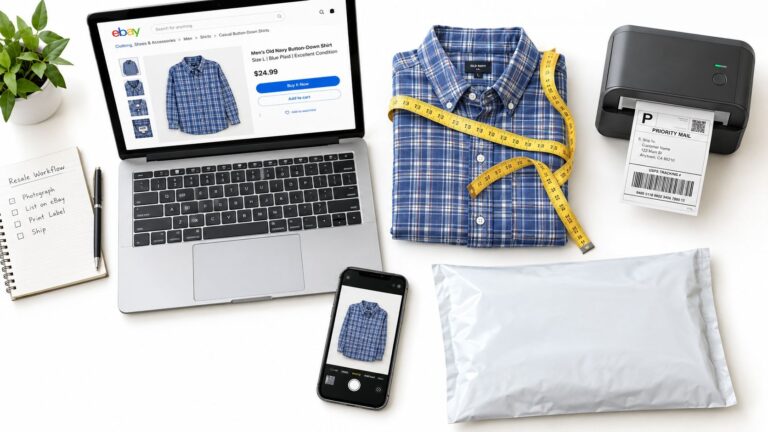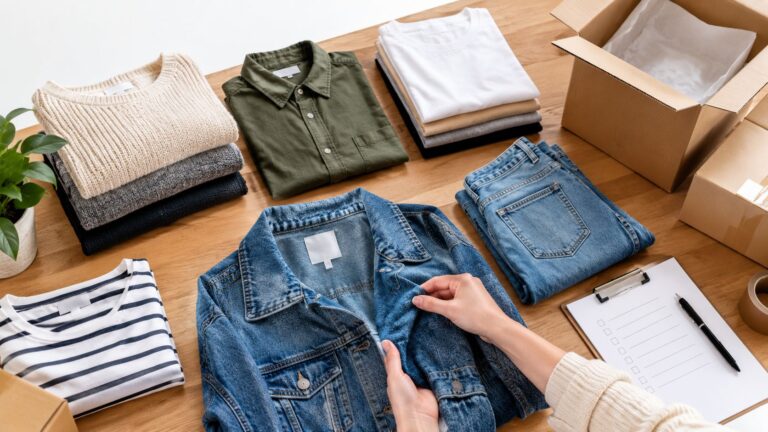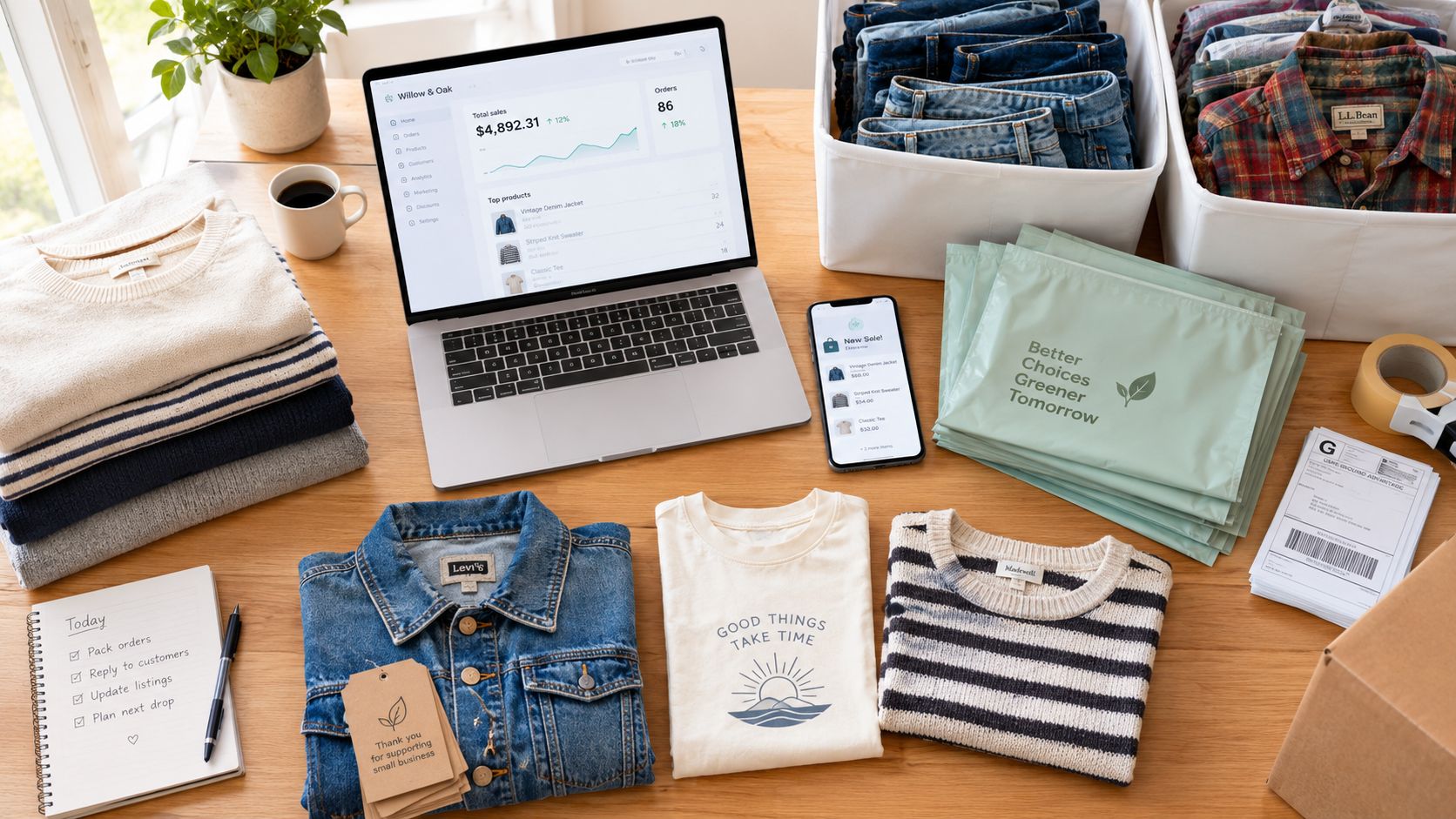
At 6 a.m., a new reseller is already sorting yesterday's thrift haul across the kitchen table. One jacket needs a stain check, three tops need measurements, and a pair of jeans still has no price. Before the day job starts, she photographs each item, prints labels, and wonders whether another sourcing trip will create profit or just more laundry-room inventory.
That's the core question behind how to start selling clothing online. You're not making one decision called “start a clothing business.” You're choosing where to source, what to buy, how much cash to tie up, which channel fits your stock, how to fulfill orders, and when to reinvest. The online apparel market reached $880.9 billion in 2025 and is projected to surpass $1.2 trillion by 2030, according to online clothing shopping market data. Demand exists, but demand alone won't protect a weak buying decision.
Table of Contents
- The Real Decision Behind Starting a Clothing Resale Business
- Choosing a Resale Model That Matches Your Time and Capital
- Sourcing Inventory From Thrift to Liquidation Pallets
- Picking Categories That Actually Move and Pay
- Pricing, Listing, and Grading Your Inventory
- Choosing Where to Sell Based on Channel Fit
- Marketing, Fulfillment, and Scaling Operations
The Real Decision Behind Starting a Clothing Resale Business
Your launch should begin with four constraints, not a niche brainstorm:
- Available capital: How much can you spend without needing immediate sales to cover personal expenses?
- Weekly hours: Can you inspect, photograph, list, pack, and answer messages every day, or only on weekends?
- Storage space: Do you have a rack and shelves, or are you stacking inventory in plastic tubs?
- Unsold-inventory tolerance: Can you hold slow pieces for a season, or must every item move quickly?
These constraints determine the resale model you can operate without creating a bottleneck. A seller with limited cash and plenty of time can make thrift flipping work. A seller with more capital but little time may need consistent wholesale lots and a simpler listing process. Someone with no storage should avoid bulky mixed inventory, regardless of how attractive the manifest looks.

Build the decision stack in order
Start with the operating model, then choose inventory. After that, select the selling channel, set a pricing floor, and create a fulfillment routine. Branding, paid promotion, and larger purchases come later.
That order matters because every item has more than a purchase cost. Your unit economics include cleaning, supplies, photography time, marketplace fees, shipping materials, returns, storage, and the cost of capital sitting in unsold stock. A $4 purchase isn't cheap if it takes twenty minutes to prepare and remains listed for months.
Use a simple item-level record from the first day:
- Purchase cost.
- Preparation time.
- Listing price and expected sold price.
- Selling fees.
- Shipping and packaging cost.
- Return or defect risk.
- Net contribution after direct costs.
Operating rule: Don't ask whether an item is popular. Ask whether you can process it, sell it, and replace it at a profit within your actual schedule.
Online clothing is already a mainstream buying path. The same market source estimates that 59.4% of U.S. apparel sales are online and 47.9% of apparel transactions worldwide are e-commerce transactions. That creates room for new sellers, but it also means buyers compare your photos, measurements, delivery speed, and return experience with established operators.
Success comes from sequencing decisions correctly. You don't need a perfect category on day one. You need a small test, clean records, and enough discipline to stop buying what doesn't earn its space.
Choosing a Resale Model That Matches Your Time and Capital
The four models below behave differently. Treat the figures as planning ranges rather than universal prices, because supplier terms, geography, brand mix, and condition can change the economics.
| Model | Startup Capital | Hours/Week | Inventory Volume | Core Skill |
|---|---|---|---|---|
| Thrift flipping | Low | High | Low to moderate | Fast identification and detailed listing |
| Wholesale lots | Moderate | Moderate | Moderate to high | Category buying and repeat-channel management |
| Liquidation pallets | High | Moderate to high | High | Inspection, grading, storage, and disposal control |
| Curated vintage or boutique resale | Moderate | High | Low to moderate | Taste, storytelling, and premium merchandising |
Thrift flipping
Thrift stores, garage sales, and local buying let you start with limited capital. You'll pay more per piece than a pallet buyer in some cases, but you can inspect every garment and avoid being trapped by weak inventory.
This model rewards time and judgment. You need to recognize fabric, construction, brand signals, era, flaws, and demand quickly. It's a strong starting point for someone who can source consistently but doesn't yet know which categories deserve a larger commitment.
Wholesale lots
Wholesale lots make sense when you want repeatable volume and already understand your customer. A focused lot of activewear, denim, or branded casualwear is easier to process than a blind assortment.
The risk is consistency without flexibility. If your channel can't absorb the same category every week, the supplier's predictable volume becomes your storage problem.
Liquidation pallets
Liquidation pallets suit operators with storage, suitable transport, and a tolerance for unpredictable manifests. You need room to sort, a process for damaged goods, and a realistic outlet for items that aren't worth individual listing.
New sellers often buy pallets because the per-piece cost looks attractive. That's backwards. First prove that you can grade and move a smaller batch, then increase volume.
Curated vintage or boutique resale
Curated resale can produce the strongest margins because the value comes from selection, presentation, and trust. It also scales slowly. Finding distinctive pieces, researching them, measuring them, and writing useful descriptions takes time.
Choose your model by constraint, not aspiration:
- Limited capital and flexible time: start with thrift flipping.
- Moderate capital and a defined audience: test wholesale lots.
- Storage, equipment, and processing capacity: consider liquidation.
- Strong fashion judgment and patience: build curated vintage or boutique resale.
The right first model is the one you can run for several weeks without borrowing money, overflowing your storage, or skipping listings.
Sourcing Inventory From Thrift to Liquidation Pallets
Sourcing is a ladder. Move upward only when the next level improves your contribution margin after processing, not merely because it offers a lower sticker price.
| Sourcing channel | Price-per-piece planning range | Condition to expect | Weekly movement | Verification |
|---|---|---|---|---|
| Thrift stores and garage sales | Low to moderate | Mixed, inspectable | Small batches | Check every item before purchase |
| Estate sales | Low to moderate | Often older, variable | Small to moderate | Inspect fabric, odor, stains, and sizing |
| Consignment racks | Moderate | Usually screened | Moderate | Confirm brand, condition, and price flexibility |
| Overstock wholesale lots | Moderate | New or excess stock | Moderate to high | Review category and size mix |
| Customer-return liquidation pallets | Variable | Mixed grades and defects | High if capacity exists | Review manifest, sample pulls, and policies |
Start with inspectable inventory
Thrift stores and garage sales give you control. Look for clean labels, intact seams, working zippers, stable fabric, and flaws you can disclose clearly. Estate sales can uncover older quality garments, but odor, storage damage, and unusual sizing need stricter inspection.
Consignment racks reduce some condition risk but often carry higher acquisition costs. Buy only when the expected sold price still leaves room for fees, shipping, and time.
Move to lots with evidence
For overstock or returns, ask for a manifest with brand, category, size, condition, and quantity. Request sample pulls before committing. A supplier that won't explain the mix is asking you to underwrite its uncertainty.
Check five things before ordering:
- Sample pulls: Do the samples resemble the promised grade?
- Manifest quality: Does it show category and size detail, or only broad labels?
- Return policy: What happens when the shipment materially differs from the description?
- Shipping damage: How are compressed, wet, or mishandled cartons handled?
- Category mix: Can your chosen channel sell the assortment without excessive markdowns?
Customer-return pallets require the most discipline. A manifest can help, but it can't replace inspection. Budget labor for sorting, cleaning, repair decisions, photography, and disposal.
Sourcing rule: Never commit more than 20% of your starting capital to one pallet until you've proven sell-through with a smaller test order.
Watch for clothing-specific red flags. Unsorted mixed-season lots create storage pressure, while vague category descriptions hide an unusable size mix. Be cautious when the supplier provides no breakdown for cultural or religious apparel that may sell slowly in your audience. “Brand name” also means little without condition, category, and size information.
Before scaling, compare your actual landed cost with the expected sold price from completed listings. This guide to liquidation by the pallet can help you think through pallet buying, but your own test order should decide whether a supplier belongs in your operation.
Picking Categories That Actually Move and Pay
Category choice is a margin decision. Your favorite style matters less than whether the item sells at a price that compensates for acquisition, preparation, storage, fees, and customer service.
Use three filters for every category:
- Sell-through by 60 days. How much of the test cohort sells within your chosen window?
- Average sold price after fees. Use completed sales, not optimistic active listings.
- Shelf cost per unit. Include storage, shipping supplies, returns, cleaning, and the opportunity cost of space.
Vintage denim, branded athleisure, workwear, and distinctive outerwear often offer better economics than anonymous basics because buyers search for recognizable construction, fit, or brand value. Fast-fashion basics are a common trap. They're easy to find, but competition keeps prices low and minor flaws can erase the margin.
A simple comparison makes the point. A $4 pair of vintage Levi's 501 jeans listed around $38 may justify measurements, photography, and shipping if comparable items sell near that level. A $3 fast-fashion blouse that sits unsold can become the more expensive item after storage and handling time.
| Category | Avg Cost | Sell-Through (60d) | Gross Margin | Best Channel |
|---|---|---|---|---|
| Vintage denim | Low to moderate | Test by brand and fit | Often strong when authentic and measured | Marketplace |
| Branded athleisure | Moderate | Test by style and size | Moderate to strong | Marketplace or standalone |
| Workwear | Low to moderate | Test by utility and condition | Strong for durable pieces | Marketplace or live |
| Statement outerwear | Moderate to high | Seasonal and slower | Strong, with storage risk | Marketplace or standalone |
| Fast-fashion basics | Low | Often competitive | Thin unless bundled | Live or bundle listings |
| Graphic tees | Low to moderate | Depends on design and brand | Variable and often crowded | Live or marketplace |
Match the category to the channel
Structured denim photographs and ships well. Accessories create variety and pace in live auctions. Bridal and formalwear can justify longer listing windows, detailed measurements, and a more deliberate buyer journey.
Run two category cohorts during your first 90 days. Keep acquisition rules, listing quality, and pricing discipline consistent. Reinvest only in the cohort that clears both your sell-through requirement and your margin floor. Don't expand the assortment until you know which category pays for your time.
Pricing, Listing, and Grading Your Inventory
Your price must protect the business before it attracts a buyer. Start with this planning formula:
Price = cost ÷ (1 − target margin) + platform fee allowance + shipping buffer
The formula isn't a substitute for sold-listing research. Use it to establish a floor, then adjust for actual completed sales, seasonality, brand demand, condition, and size.
A practical markup structure looks like this:
- Fast-turn: 2.2x to 2.5x cost for common items or cash recovery.
- Balanced: 2.8x to 3.2x cost for proven categories with healthy demand.
- Premium or collector: 3.5x or an auction floor when rarity and condition support patience.
These are starting frameworks, not guaranteed outcomes. If the market won't support your floor, reject the item or bundle it. Lowering the price after purchase doesn't turn bad inventory into good inventory.
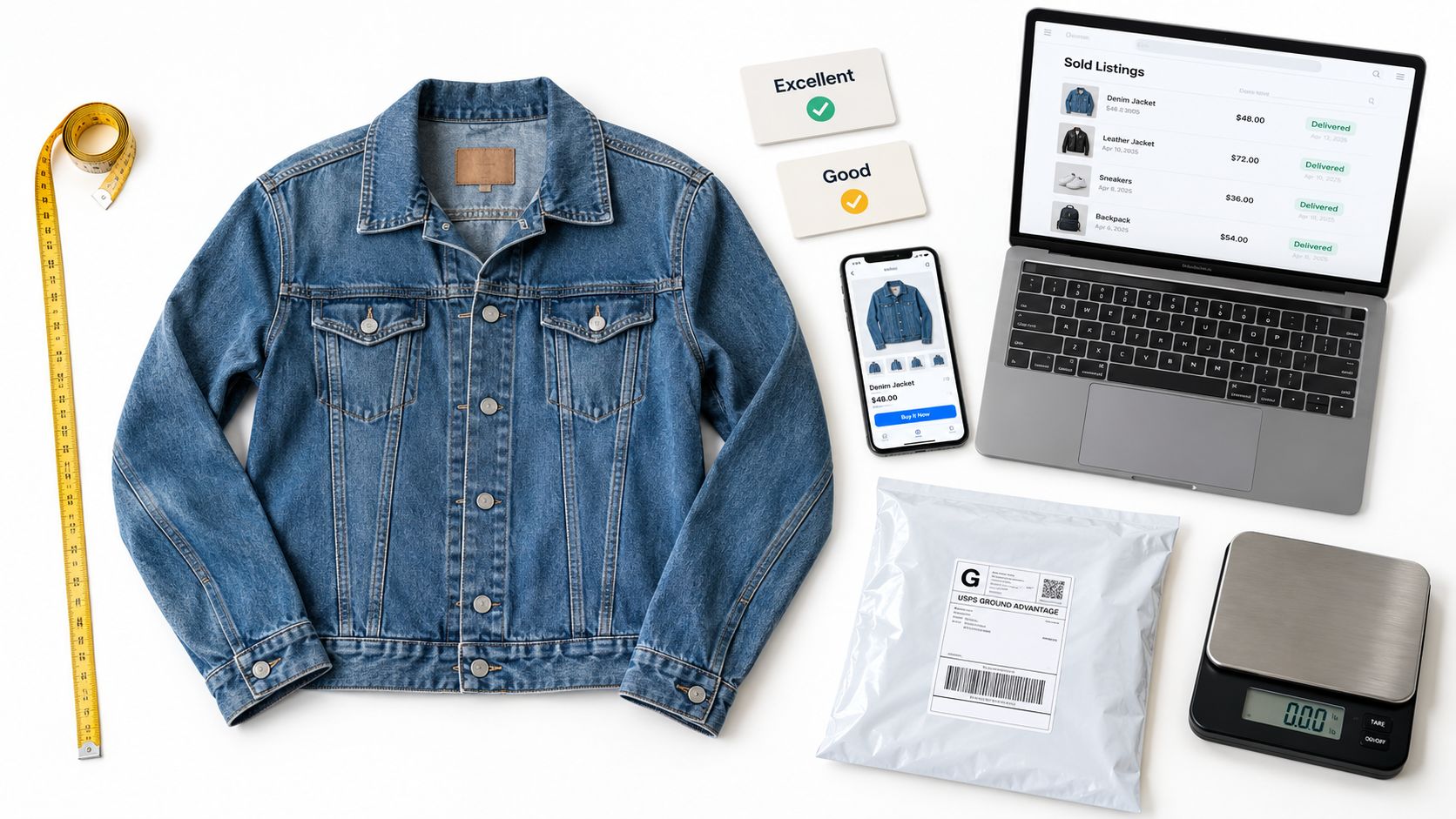
Grade condition like a buyer
Use standardized grades wherever the platform supports them:
- New with tags
- New without tags
- Excellent
- Very good
- Good
Each lower tier should trigger a deliberate price adjustment, often roughly 15% to 25%, depending on the defect, brand, and buyer expectations. Photograph stains, pilling, missing buttons, stretched elastic, and hem wear. Hiding defects creates returns and damages trust.
A reliable listing includes the brand, garment type, fit, color, material when known, size, measurements, condition, and flaw disclosure. Put the strongest search terms near the beginning of the title. Use a flat lay on a neutral surface for the first image, then add measurement photos and close-ups of labels or defects.
Use a ten-minute intake routine
Set a timer for each ordinary item:
- Attach an inventory tag and record cost.
- Inspect and grade condition.
- Steam or clean according to the garment's care requirements.
- Measure the relevant dimensions.
- Weigh the packed item, not just the garment.
- Photograph the front, back, label, measurements, and flaws.
- Check sold comparables.
- Set the price floor and listing price.
- Write the title and description.
- Publish the listing and assign a storage location.
Bulky sweaters, boots, and coats can destroy margin when you guess shipping weight. Record packed weight before publishing. For larger sourcing decisions, this overview of used clothing by the bale is useful background, but your own landed-cost calculation remains decisive.
Choosing Where to Sell Based on Channel Fit
Pick the channel that matches your inventory and your available labor. Don't build a standalone store because it looks professional if you still need a platform to provide discovery.
| Channel | Total Fees | Traffic Source | Auth Burden | Fulfillment Load | Best Inventory Type |
|---|---|---|---|---|---|
| Established marketplace | Fee stack can include 12% to 18% with payment processing | Built-in platform traffic | Higher for selected branded categories | Moderate | Searchable, individually listed items |
| Live-selling platform | Platform fees and selling costs vary | Host audience and live discovery | Depends on category and platform | High during shows | Varied lots, mid-priced vintage, accessories |
| Standalone store | Software, payment, marketing, and fulfillment costs vary | Your audience and paid acquisition | You manage trust and proof | You control the process | Consistent assortment and repeat purchases |
Established marketplaces
Marketplaces such as Poshmark, eBay, Mercari, Depop, and Vinted offer existing buyer traffic. They also impose fee stacks, return windows, performance standards, and, for some branded categories, authentication gates. Those rules can reduce control, but they give a new seller a place to test demand without first building an audience.
List one-off, searchable pieces here. Denim, branded activewear, workwear, and distinctive jackets benefit from buyer search intent. Learn the policies before buying expensive branded inventory. This practical guide to selling on Poshmark covers marketplace basics, but you still need to calculate your own net proceeds.
Live-selling platforms
Live selling rewards variety, presentation, and a host who can keep the room moving. Whatnot and similar channels suit mixed lots, accessories, mid-priced vintage, and items that benefit from comparison or styling.
The format punishes slow preparation. You need inventory sorted before the show, a reliable camera setup, a way to track claims, and someone who can pack orders afterward. A live channel is a poor choice if you can't staff it consistently or if every item requires a long explanation.
Standalone stores
Shopify or WooCommerce gives you control over merchandising, customer data, bundles, and repeat-buyer communication. It doesn't automatically provide customers. You'll need an audience, email capture, organic content, partnerships, or paid acquisition that you can measure against contribution margin.
Use this channel after repeat buyers and reliable replenishment exist. If your capital is under $5,000 and you have no audience, start with a marketplace. Choose live selling if you carry high-variety lots and can host regular shows. Choose a standalone store only when your customer data shows that buyers will return.
Apparel ecommerce coverage also highlights fast shipping, personalized discovery, smooth digital experiences, counterfeit risk, low-grade products, and cross-border complexity as operating issues, not optional details. This overview of apparel ecommerce challenges is a useful reminder that channel selection must account for logistics and trust.
Marketing, Fulfillment, and Scaling Operations
Growth becomes manageable when marketing, fulfillment, and buying follow one weekly cadence. Every week, review which items sold, which listings received attention without converting, where returns came from, and how much cash remains available for replenishment.
Set a reinvestment rule before sales create excitement. A practical starting point is to put 60% to 70% of net profit back into inventory at your target cost of goods, while reserving the rest for taxes, supplies, returns, and slow periods. Don't reinvest every dollar. A business that can't absorb a weak month has no real buying power.
Run a fixed operating rhythm
Monday: Review sales by category, channel, brand, size, and age. Mark items that need a price change or better photos.
Tuesday: Source only against gaps shown in the sales data. If denim sells while generic tops sit, your buying list should reflect that difference.
Wednesday: Photograph and list in batches. Consistent listing volume is more valuable than occasional bursts followed by silence.
Thursday: Prepare bundles, email offers, social posts, and live-show inventory. Poshmark and Mercari sellers can use sharing and bundle offers, while Instagram Live and Whatnot depend on predictable show schedules.
Friday: Reconcile orders, fees, shipping, refunds, and cash. Restock when sell-through supports it, not when a supplier sends an attractive promotion.
Choose fulfillment by workload
Self-ship works well while order volume remains manageable. Use labeled poly mailers, a scale, a label printer, standardized packing slips, and one primary carrier workflow. Keep storage locations tied to inventory IDs so you don't spend show or listing time hunting for sold items.
Move to a 3PL or prep center when packing takes more than two hours daily or when fulfillment errors begin damaging reviews. Outsourcing adds cost, so compare the fee with the value of the hours you recover. Don't outsource chaos. Clean your SKU system and return process first.
| Metric | Target | Action Trigger |
|---|---|---|
| Net margin | 15% to 25% | Reprice, reduce acquisition cost, or drop the channel |
| Inventory turn | 4 to 6 weeks | Slow buying and promote aging stock |
| Reorder point | 30 days per SKU | Replenish only proven items |
| Packing workload | Under 2 hours daily | Evaluate a 3PL or prep center |
| Profit reinvestment | 60% to 70% | Keep a cash reserve outside inventory |
Use a 90-day launch checklist
Days 1 to 30: Choose the resale model, open the necessary accounts, create your inventory spreadsheet, define condition grades, and source a first batch of 100 to 200 units only if your storage and processing capacity support it.
Days 31 to 60: List aggressively, test titles and prices, track actual shipping costs, and aim for 15 to 30 sales as a learning target. Treat each sale as evidence about category, channel, and buyer objections.
Days 61 to 90: Compare cohorts, optimize the strongest channel, establish a marketing rhythm, and decide whether to scale or pivot. Don't expand because the business feels busy. Expand because the records show that the work produces acceptable net margin.
Avoid the mistakes that trap new sellers: buying liquidation pallets before learning to grade, ignoring packed weight on bulky garments, chasing trends without sell-through data, burying shipping and returns inside the margin, postponing sales-tax responsibilities until a notice arrives, and reinvesting cash needed for slow months.
Resale rewards operators who treat thrifting as sourcing, not as the entire business. Your advantage comes from buying selectively, listing consistently, shipping accurately, and reinvesting only where the numbers support another purchase.
OneTrendyCloset supplies curated brand-name apparel liquidation boxes, mix-and-match selections, and custom quotes for boutiques, marketplace sellers, and live-sale hosts. If you're ready to test wholesale inventory without committing immediately to a large pallet, visit OneTrendyCloset and review the available sourcing options.