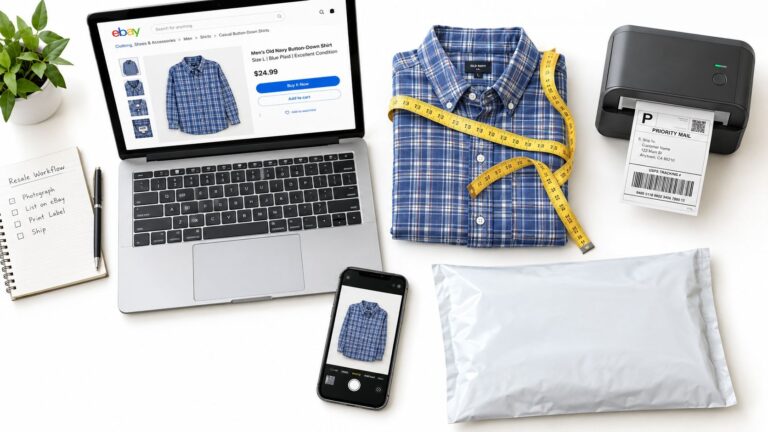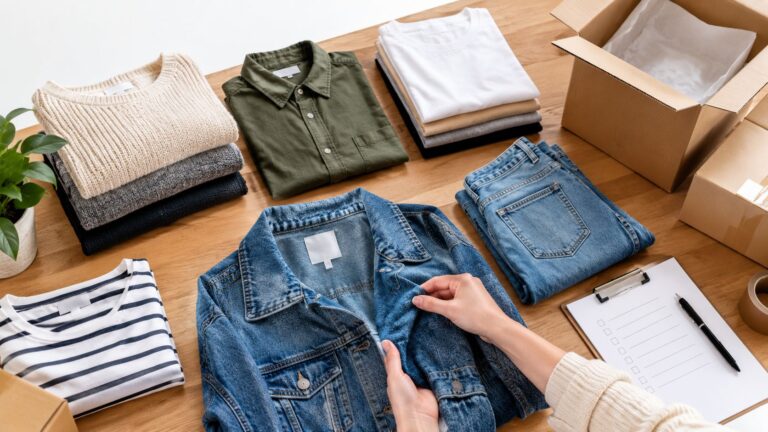
You've got a garage full of clothing, a liquidation box still wrapped in plastic, and a laptop open to sold listings while dinner burns in the kitchen. The first few sales feel easy. Then the unsold pieces multiply, shipping materials eat cash, and a “great deal” starts looking like expensive storage.
That's the part most guides skip. Learning how to start a clothing resale business is easy. Staying profitable after the market gets crowded is the core challenge. You need a defined customer, repeatable sourcing, accurate unit economics, and operating habits that stop small mistakes from becoming permanent margin loss.
Table of Contents
- Why a Clothing Resale Business Is Worth Starting in 2026
- Laying the Business Foundations Before You Buy Anything
- Sourcing Inventory From Wholesale Liquidation Boxes and Other Channels
- Pricing for Profit With Real Unit Economics
- Choosing the Right Sales Platforms for Your Resale Model
- Branding, Listings, and Daily Operations That Protect Margin
- Scaling From First Box to Full Resale Business
Why a Clothing Resale Business Is Worth Starting in 2026
Resale is no longer a narrow activity limited to dedicated thrifters. The category now has enough scale to support serious supplier relationships, inventory planning, and sales across marketplaces, websites, and live formats. thredUP's 2025 Resale Report estimated the global secondhand apparel market at $227 billion in 2025 and projected online resale to grow at a 13% CAGR to $40 billion.
The demand shift matters because mainstream buyers behave differently from occasional bargain hunters. They search by brand, style, condition, fit, and use case. That creates room for a seller who can curate a clear assortment instead of dumping unrelated garments into a marketplace.
The opportunity is real, but it isn't automatic
Resale also has a strong growth record. GlobalData reported that the resale apparel market grew 17.6% in 2024 to $204.7 billion, while thredUP said secondhand apparel expanded 2.7 times faster than the broader global apparel industry and represented 9% of global apparel spending by 2024.
That momentum gives you a favorable category. It doesn't excuse poor buying. The easy arbitrage period is over, and marketplaces are full of sellers using similar suppliers, photos, and pricing tactics. Your advantage has to come from specialization, disciplined purchasing, faster inventory decisions, and a recognizable point of view.
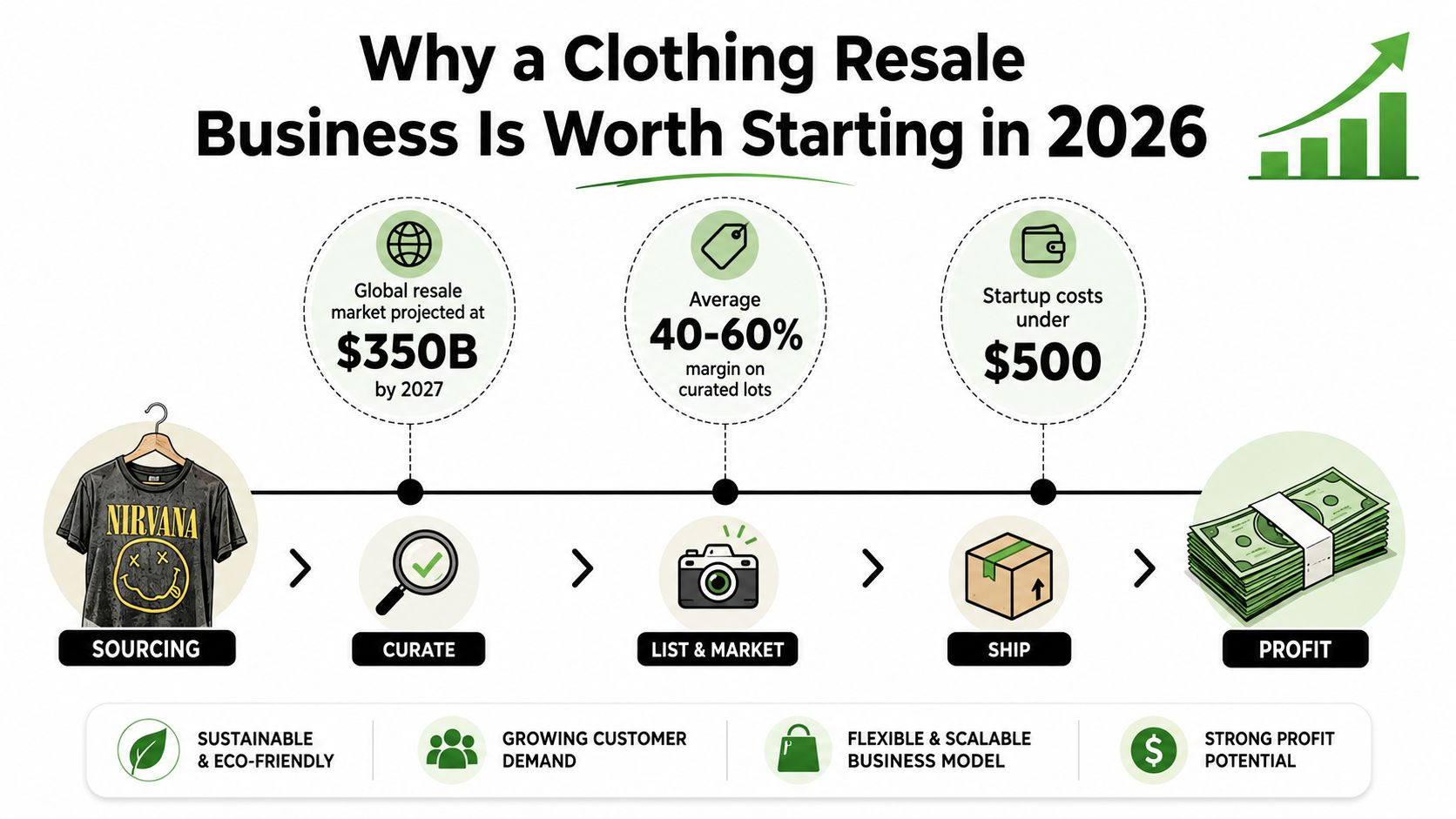
A solo operator can still enter because the basic tools are accessible. You can source, photograph, list, pack, and answer customers without a warehouse or large staff. But treat that accessibility as a way to test a retail model, not as proof that every purchase will work.
The winning mindset: Your inventory isn't an investment account. It's cash waiting for a buyer, and every day it sits creates a decision you need to measure.
Laying the Business Foundations Before You Buy Anything
Don't buy your first box until you know what you're legally selling, who you're selling to, and how much cash you can afford to lock in inventory. New sellers often focus on finding cheap clothing because purchasing feels productive. In practice, a vague business setup and weak cash controls can damage profit before the first listing goes live.
Set up the business and tax process
Choose between a sole proprietorship and an LLC based on your circumstances, state requirements, and professional advice. Register the business with your home state, obtain the relevant sales tax ID, and request a resale certificate if your state and supplier require one. A resale certificate can let qualified businesses purchase inventory for resale without paying sales tax at the point of purchase, while still leaving you responsible for following collection and reporting rules.
Keep business money separate from personal money from the beginning. Use a dedicated bank account, save supplier invoices, and record shipping, packaging, marketplace deductions, and refunds as they happen. If you're unsure about state registration or sales tax obligations, ask a local accountant rather than copying another reseller's setup.
For supplier research, this guide to wholesale clothing suppliers can help you compare the type of vendors available before you commit to a purchasing routine.
Pick a lane that improves every decision
A niche isn't just a logo or an Instagram theme. It determines what you buy, how you photograph it, which keywords you use, and why a shopper follows you instead of another general seller.
Consider lanes such as:
- Women's contemporary: Focus on recognizable brands, wearable outfits, and consistent sizing information.
- Streetwear: Build around silhouettes, graphics, subculture references, and fast-moving style signals.
- Kidswear: Prioritize condition, bundles, practical categories, and clear measurements.
- Luxury or designer: Invest more time in authentication, documentation, condition grading, and careful presentation.
Start narrow enough that you can recognize a bad buy quickly. You can broaden later, but a mixed closet makes it harder to identify which customers and categories actually support your margins.
Build a cash model before spending
Separate available cash into inventory, supplies, platform deductions, and an operating buffer covering the first 90 days. Don't put every dollar into merchandise. You still need money for inbound freight, labels, mailers, refunds, equipment, and replenishment.
Set a break-even rule before purchasing. For example, require a test lot to recover its total landed cost within the first 30 days after listing. That doesn't mean every item must sell immediately. It means the lot needs a measurable cash-conversion target, and slow pieces need a planned markdown or alternate channel instead of indefinite storage.
Sourcing Inventory From Wholesale Liquidation Boxes and Other Channels
Sourcing isn't about finding the cheapest garment. It's about finding inventory you can identify, price, photograph, and sell without consuming more time than the margin supports. Beginners should use more than one channel, but they shouldn't use every channel at once.
| Channel | Typical Margin | Effort Level | Risk for Beginners |
|---|---|---|---|
| Thrift stores and bins | Often strong on individually selected pieces | High sorting and travel effort | Low purchase risk, high time risk |
| Garage sales and estate buys | Can be strong when buying curated groups | Irregular and relationship-driven | Medium, because quality varies |
| Wholesale liquidation boxes and pallets | More volume, with margins dependent on manifest and condition | Lower per-piece sourcing effort, higher receiving effort | High if the lot is blind or freight is unclear |
| Brand or boutique closeouts | Potentially predictable brand and category fit | Moderate negotiation and purchasing work | Medium, especially if minimums are large |
Thrift stores and bins teach product recognition quickly. Garage sales and estate buys can produce distinctive inventory, but availability is inconsistent. Brand or boutique closeouts may give you cleaner assortments, yet sellers often need stronger cash reserves and a clear sales plan.
Understand what a liquidation lot really contains
Wholesale liquidation boxes can include overstock, customer returns, shelf pulls, or mixed-condition apparel. A manifest may show brands, categories, sizes, and condition grades, but the level of detail varies by seller. Manifested and graded lots reduce uncertainty. Unmanifested lots transfer more risk to you.
Don't assume a brand-name mix means every piece is premium. A lot can contain a few excellent garments alongside commodity basics, damaged items, awkward sizes, or categories you don't sell. Ask about condition, defect policy, packing method, freight, and whether the quoted price includes delivery.
Buy one small box before you consider a pallet. Receive it, inspect every item, photograph representative pieces, calculate your actual landed cost, and track the sell-through of the lot by brand and category. This gives you evidence about the supplier instead of relying on a seller's product photos.
A pallet can also hide logistical problems. Heavy freight may cost more than expected, sealed boxes may contain customer returns, and a category mismatch can leave you with products you never intended to sell. If you wanted apparel and most of the lot turns out to be home goods, the low unit cost won't save you.
For a deeper look at bulk purchasing, review this explanation of liquidation by the pallet.
My buying rule: Use liquidation for volume and thrift sourcing for curation. The combination gives you a replenishment path without forcing your entire business to depend on blind inventory.
Pricing for Profit With Real Unit Economics
Never bid on a lot because the advertised retail value looks impressive. Start with the amount you can realistically collect after the item sells, not the amount another seller hopes to receive.
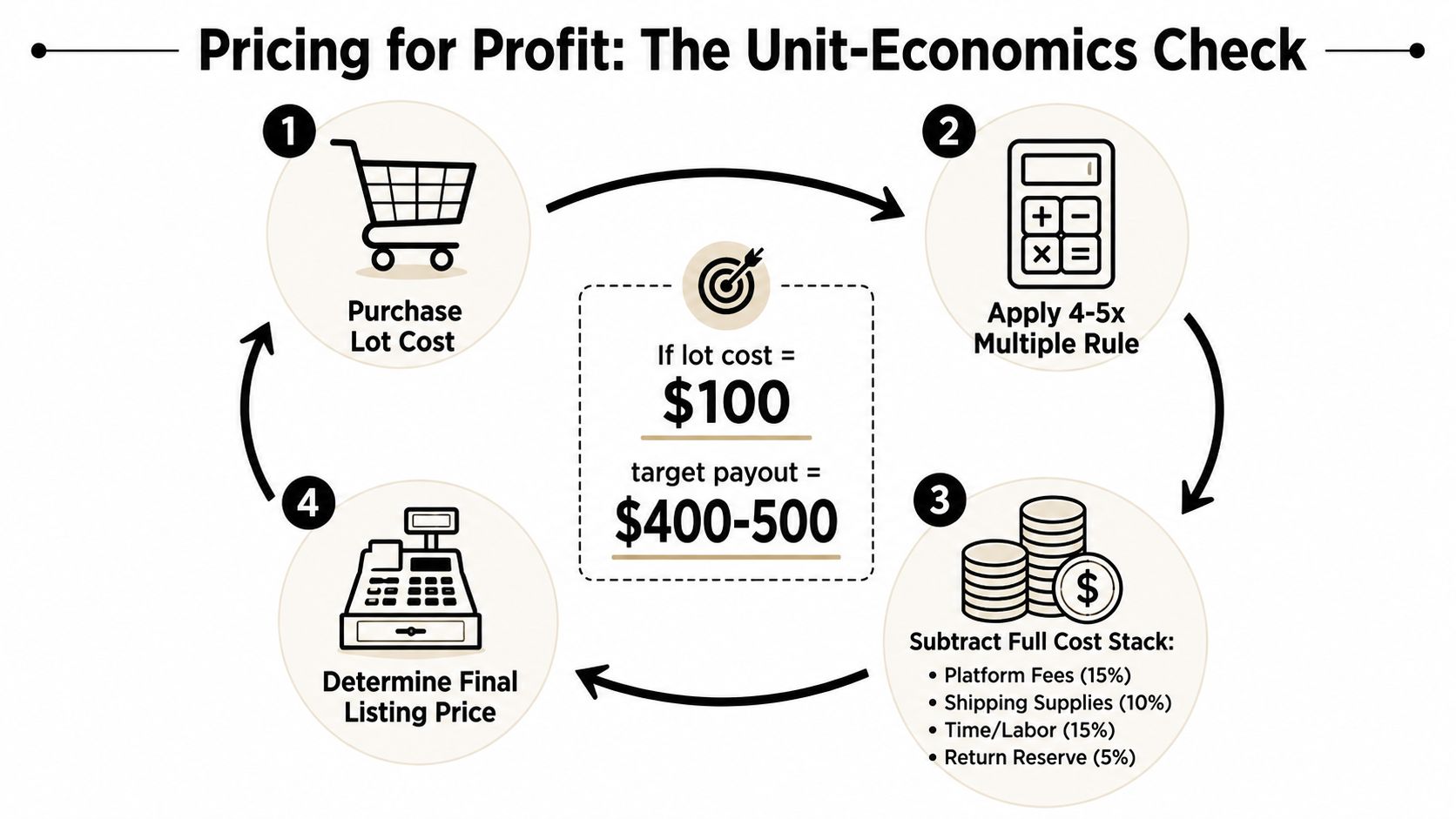
Practitioner guidance commonly uses a 4 to 5 times cost-to-resale multiple for lower-value inventory, with marketplace fees, shipping, packaging, returns, and operating costs treated as deductions. Resale pricing guidance also commonly recommends listing around 15% to 20% above the intended realized price, then reducing unsold items by roughly 10% after 30 days. These are working benchmarks, not guarantees.
Run the check before you purchase
Calculate landed cost first:
- Start with the inventory purchase price.
- Add inbound shipping, freight, or truck charges.
- Allocate supplies and preparation costs.
- Estimate marketplace commission and payment processing.
- Reserve for outbound shipping, returns, discounts, and promotions.
- Subtract all deductions from the expected sale price.
Suppose your landed cost for a garment is $20. A 4 to 5 times multiple creates a preliminary resale range of $80 to $100. You still need to confirm that similar items sell in that range on the platform where you intend to list them.
Use sold listings from the previous 90 days rather than active listings. Active listings show what sellers want. Sold listings show what buyers accepted. Check comparable brand, style, size, condition, season, and shipping terms before you approve the purchase.
Find the quiet margin killers
Bidding wars make sellers justify a price they should have rejected. Heavy garments create shipping surprises. Promoted listings and final-value fees can turn a profitable-looking sale into a weak payout. Returns add another deduction, especially when measurements and condition notes are incomplete.
Use a spreadsheet with one row per SKU. Include purchase cost, allocated freight, expected sale price, platform deductions, packaging, shipping responsibility, discount, refund reserve, and final payout. If the item doesn't clear a 3 times markup after your full cost stack, leave it out of the buy pile. You don't need to win every lot. You need to protect cash for the next good one.
Here's a practical visual walkthrough of the pricing workflow:
Choosing the Right Sales Platforms for Your Resale Model
You don't need every marketplace. You need two channels that fit your inventory and that you can operate accurately.
| Platform | Total Fees (approx.) | Best Fit Audience | Live-Sale Friendly |
|---|---|---|---|
| eBay | Varies by category and account setup | Broad search-driven demand, branded basics, collectibles, and unusual pieces | Limited |
| Poshmark | Varies by current fee policy and order value | Women's mid-market, social discovery, bundles | No native live focus for every seller model |
| Mercari | Varies by current policy and transaction details | General apparel and value-conscious shoppers | Limited |
| Depop | Varies by current policy and payment setup | Vintage, streetwear, trend-led and younger shoppers | Not its primary strength |
| Vinted | Varies by market and current policy | Value-oriented secondhand buyers and bundles | No |
| Shopify | Subscription, payment, and app costs vary | Sellers building a direct brand and customer list | Not by itself |
| Whatnot | Varies by current policy and seller arrangement | Live auctions, rapid selling, community-led shopping | Yes |
| Facebook Marketplace | Varies by transaction method and local arrangement | Local pickup, bundles, and quick-moving value inventory | Informal live interaction |
Check each platform's current fee page before publishing prices. Policies change, and your spreadsheet should use the exact deductions for the account and category you operate in.
Match the channel to the merchandise
eBay is useful when shoppers search for a specific brand, garment, size, or model. Poshmark suits sellers who can present coordinated apparel and encourage bundles. Depop makes more sense for vintage and streetwear with strong visual identity. Mercari and Vinted can work for value-focused inventory, while Facebook Marketplace helps move local bundles without a shipping workflow.
Shopify becomes useful when you have a clear brand and enough repeat demand to justify owning the customer relationship. Whatnot fits a seller who can prepare a show, sort merchandise into a compelling sequence, and sell comfortably in real time.
For a practical Poshmark setup, this guide to selling on Poshmark offers a starting point, but don't let one platform dictate your entire model.
Anchor on two platforms. Cross-list only when your inventory control is reliable, because oversells, stale listings, and duplicate customer messages create real costs. Add a third channel only after the first two produce consistent profit and you can explain exactly what the new channel will improve.
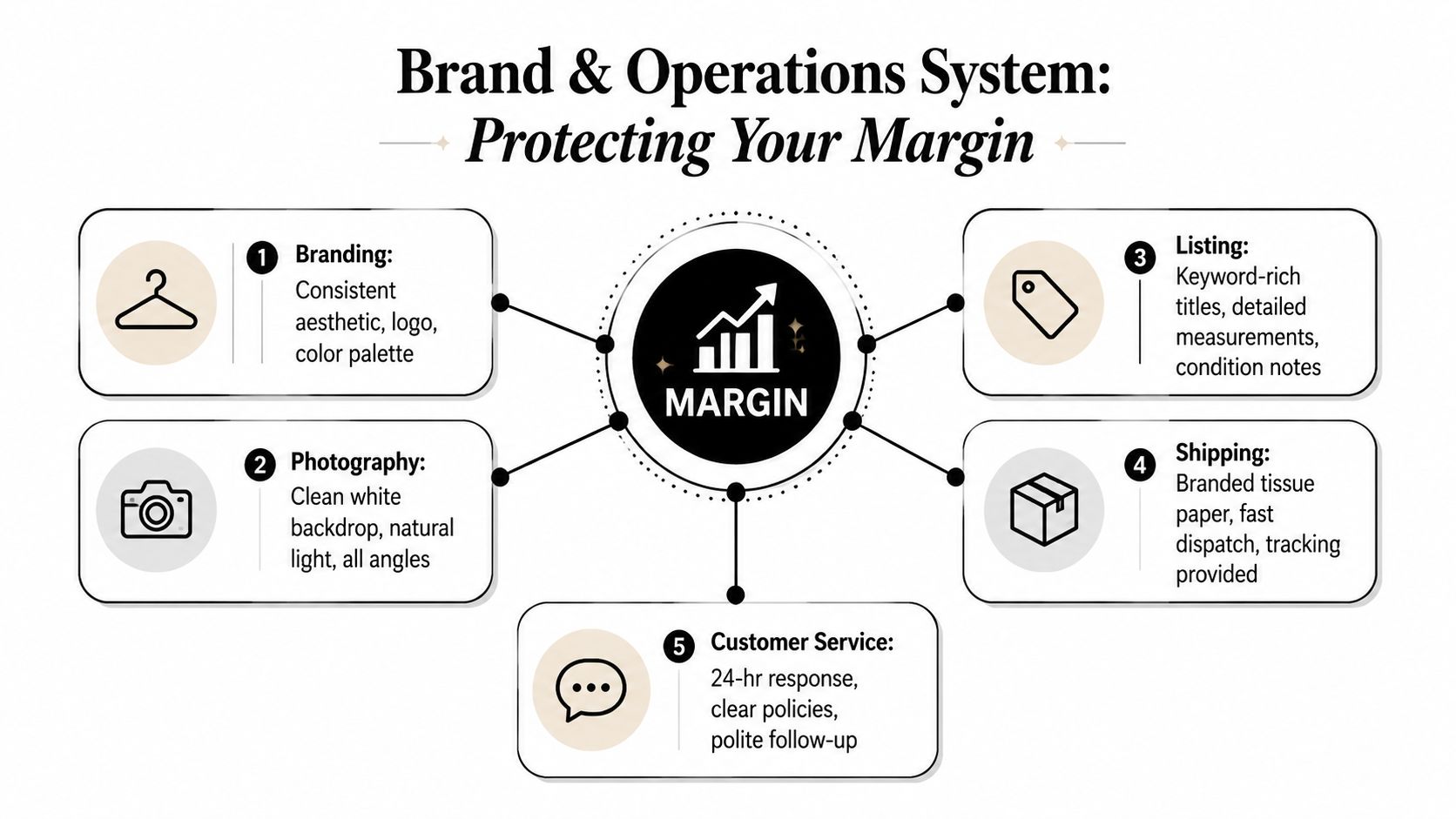
Branding, Listings, and Daily Operations That Protect Margin
A resale brand isn't a decorative logo pasted onto random inventory. It's a promise about what shoppers can expect to find, how you present it, and why they should return. A niche-first identity also protects your buying discipline because it gives you permission to reject items that don't fit.
Build the operational system around the customer's path from discovery to delivery. A weak photo lowers clicks, a vague condition note creates questions, poor packing leads to complaints, and slow responses make a buyer choose another seller.
Make each listing answer the buyer's questions
Use a repeatable photo sequence:
- Front and back: Shoot the garment flat or on a consistent hanger with enough space to judge shape.
- Brand and size label: Capture the label closely so buyers can verify identity and size.
- Fabric content tag: Show composition and care information when available.
- Condition details: Photograph stains, pulls, wear, missing buttons, or repairs instead of hiding them.
- Styled view: Add one wearable shot when it helps communicate fit, proportion, or personality.
Write titles around searchable facts, not vague adjectives. Include the brand, garment type, notable style, size, color, and relevant condition. Add measurements and disclose flaws plainly. A precise listing reduces repetitive messages and gives the buyer fewer reasons to return the item.
Treat shipping as part of the product
Stock poly mailers in the weight brackets you use most, keep a scale near your packing station, and bake free-shipping costs into the listing price when a platform encourages that offer. Don't promise a shipping speed your workflow can't sustain. A 24-hour dispatch standard is a strong operating target, but only if inventory is stored, labeled, and easy to retrieve.
Create one location for intake, one for photography, one for unlisted stock, and one for ready-to-ship orders. Track each SKU from purchase through listing and final sale. At minimum, monitor:
- Sell-through rate: Which cohorts turn into sales?
- Average days to sale: Which items tie up cash?
- Return rate: Which categories or descriptions create problems?
- Gross margin per unit: Which buys deserve replenishment?
Review those metrics weekly. Your daily rhythm should include intake, inspection, grading, listing, shipping, customer responses, and restocking. Strong operations don't make weak inventory profitable, but they stop avoidable leakage from consuming the profit your good buys created.
Scaling From First Box to Full Resale Business
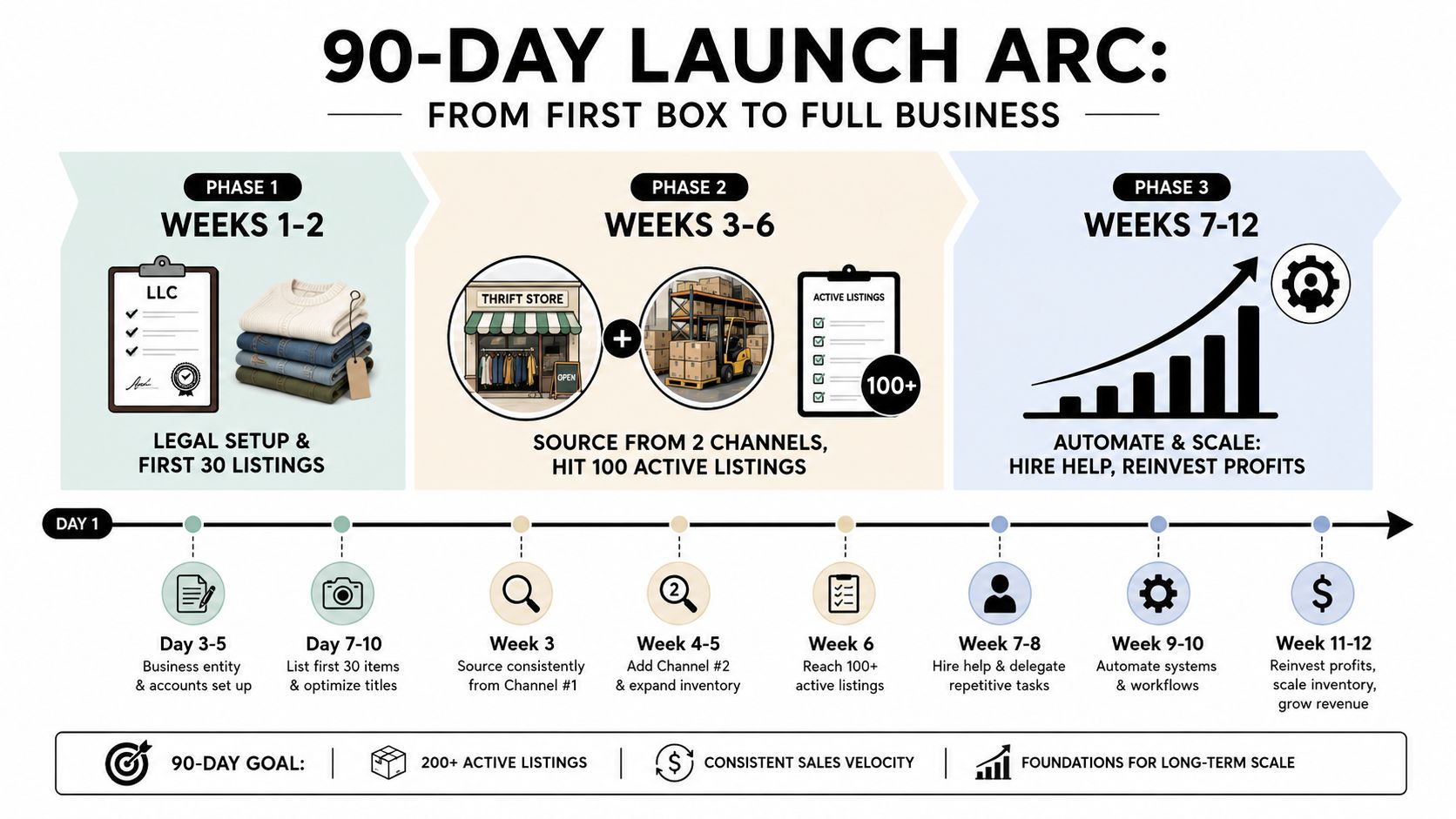
Scale by proving a process, not by purchasing a larger pallet. Your first 90 days should answer basic questions: what sells, where it sells, how quickly it moves, and which sourcing channel gives you repeatable quality.
Use a measured launch sequence
During weeks 1 and 2, finish legal setup, create your bookkeeping system, and list 30 pieces from a small first box. Photograph everything consistently and record each item's cost, condition, measurements, platform, and eventual outcome.
During weeks 3 through 6, source from two channels and work toward 100 active listings. Compare each channel by sell-through, days to sale, defect rate, and total preparation time. Don't add another supplier just because the first one feels exciting. Add one only when the data shows a genuine supply problem.
During weeks 7 through 10, test live selling if your inventory and personality fit the format, then add a second platform if your first channel is controlled. During weeks 11 through 13, cut stale items, revise weak listings, improve your inspection checklist, and document the steps someone else could eventually perform.
Grow only when the numbers justify it
Use 70% sell-through within 30 days as a decision threshold for adding a second sourcing channel, as outlined in your operating plan. Hire a part-time photographer or picker when repetitive work limits sourcing and customer service, not merely because the business looks busy. Consider a private website after monthly revenue reaches a threshold you can define from your own fixed costs and repeat-customer demand.
Move from mixed pallets to curated truckloads only after you understand your category mix and can sell the volume. Bigger inventory magnifies bad buying.
Watch for these warning signs:
- Inventory older than 90 days: Markdown, bundle, relist, or move the item to a different channel that matches its buyer.
- COGS above 35%: Stop purchasing, audit landed costs, and raise prices or narrow the assortment.
- Returns rising in one category: Inspect that category again, improve measurements and photos, or stop buying it temporarily.
- Trend chasing: Compare the trend against your own sold data and reinvest in proven categories instead of buying for excitement.
A clothing resale business becomes durable when every purchase has a reason, every SKU has a location, and every weak result produces a specific correction. Start with one manageable box, measure the result, and earn the right to buy more.
OneTrendyCloset offers curated brand-name apparel liquidation boxes, mix-and-match brand selection, and custom quotes for resellers planning inventory around a budget, preferred brands, and quantity needs. Visit OneTrendyCloset to review an apparel sourcing option that can support a controlled test order before you expand your resale operation.