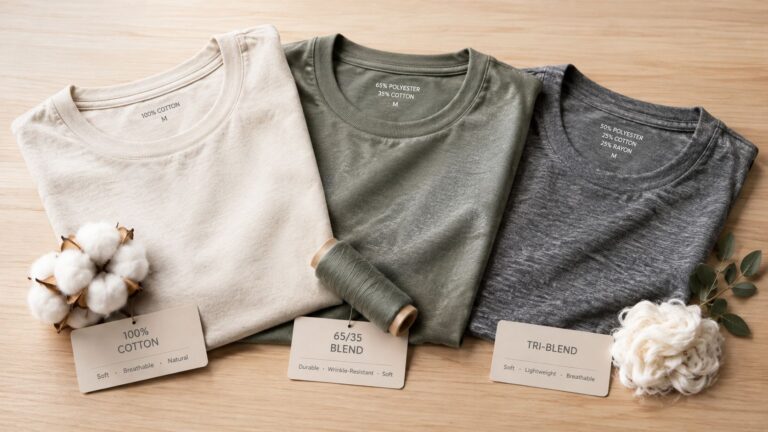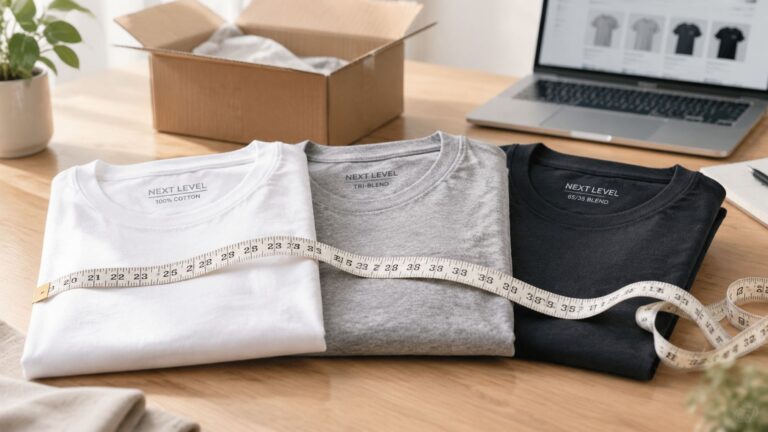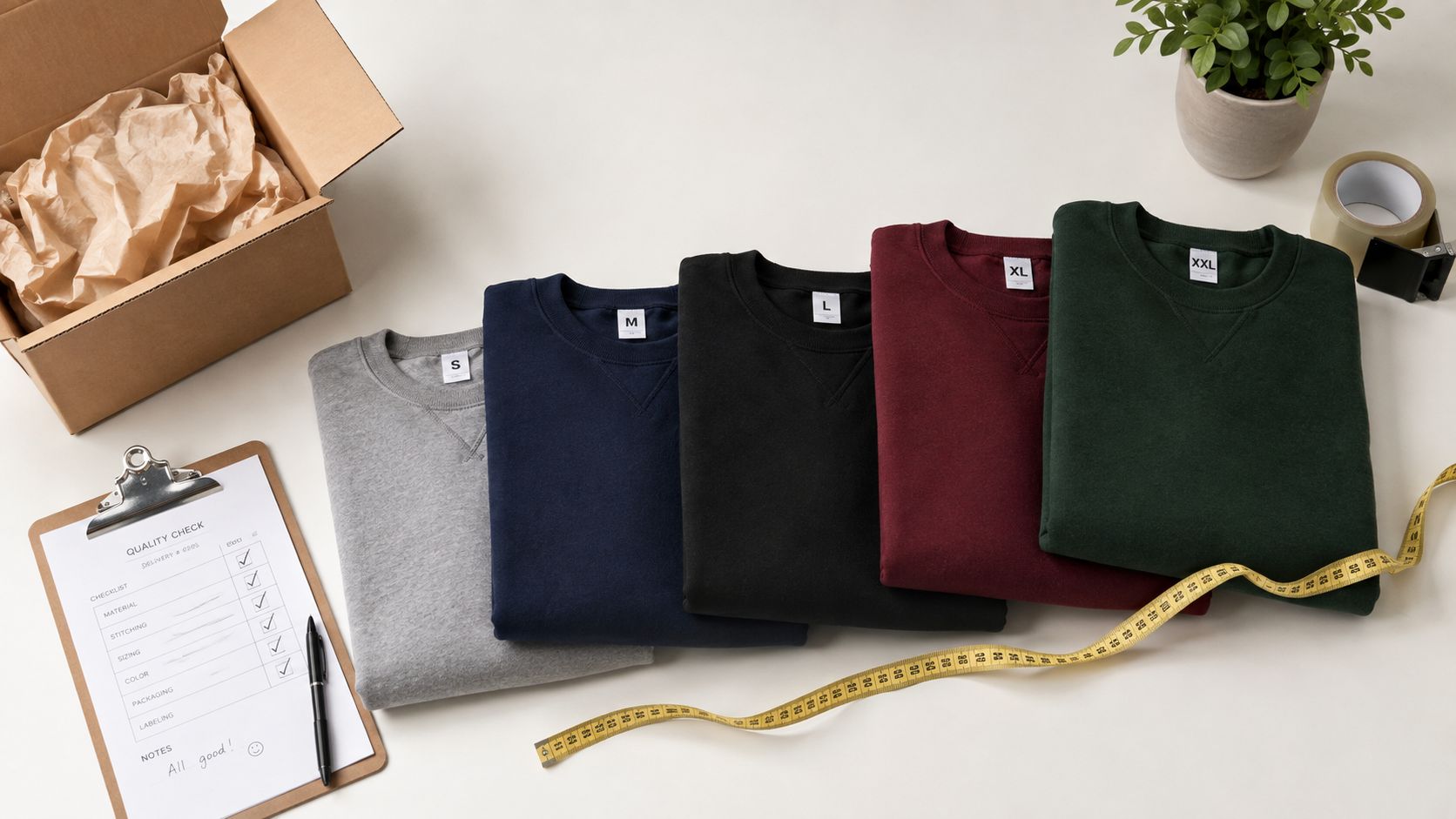
You've added sweatshirts to your store, ordered a small run of Gildan blanks, and now you're facing the decisions that affect profit: which models deserve shelf space, whether your decorator can print them cleanly, how customers will interpret the size chart, and whether a suspiciously cheap listing is genuine. The garment itself is only part of the purchase. Blend, fit, sourcing, and inventory continuity determine whether a Gildan sweatshirt becomes a dependable SKU or a return-heavy experiment.
Gildan is a sensible starting point because its sweatshirt range sits inside a long-established activewear business, not a short-lived blank-apparel trend. This guide focuses on the operating choices that matter to resellers, including the 18000 Heavy Blend crewneck, hooded alternatives, fabric behavior, decoration, fit communication, authorized wholesale sourcing, and liquidation inventory as a controlled supplement.
Table of Contents
- Why Gildan Wholesale Sweatshirts Matter for Resellers
- Gildan's Wholesale Footprint and What It Means for Buyers
- Inside the Gildan 18000 Heavy Blend and Common Alternatives
- Fabric Chemistry, Printing, and Care Behavior
- Fit, Sizing, and Stocking Decisions Across Models
- Where to Source Gildan Wholesale Sweatshirts
- Choosing the Right Channel and Next Steps
Why Gildan Wholesale Sweatshirts Matter for Resellers
A small reseller usually starts with a narrow test. You might order a few cartons of Gildan 18000 crewnecks, send them to a local screen printer, or run a first sample through a DTG partner. The design may be ready, but the uncomfortable questions arrive quickly: Will the print look saturated on a cotton-polyester fleece? Will the sleeves feel too loose? Will customers return medium and large sizes because the listing promised a closer fit?
Those questions make the Gildan 18000 useful as a baseline. Its 50/50 cotton-polyester construction gives you a familiar middle ground, and independent product references describe the style as an approximately 8.0 oz/yd² fleece with air-jet yarn and pill-resistant finishing, as detailed in this Gildan 18000 Heavy Blend crewneck product reference. It's substantial enough for teamwear, school programs, event merchandise, and everyday resale without forcing you into a premium blank before demand is proven.
Start with a controlled SKU test
Treat the first purchase as an operating test, not a full catalog launch.
- Test one dependable crewneck: Use the 18000 to evaluate color demand, print quality, packaging, and customer feedback.
- Measure the finished garment: Record chest, body, sleeve, and cuff dimensions before decoration and after laundering.
- Publish the fit: State whether the garment feels relaxed, whether layering is comfortable, and how customers should compare it with a sweatshirt they already own.
- Review the decoration method: A 50/50 fleece may suit screen printing and selected transfer processes better than a standard high-cotton DTG workflow.
Gildan's wholesale credibility also reduces the risk of building a store around an obscure blank that distributors may stop carrying. The company was incorporated on May 8, 1984, as Textiles Gildan Inc., and by 1994 it had shifted operations exclusively to activewear in the screenprint channel, according to Gildan's annual information. That history matters because resellers need replenishable basics, not garments that disappear after one purchase.
Practical rule: Choose the blank that makes your next reorder straightforward. A sweatshirt that sells well once but can't be replenished in the same fit and color creates more work than margin.
The rest of your decision is operational. Confirm the source, match the blend to the print process, explain care, stock sizes according to your sales channel, and use liquidation inventory only where inconsistency won't damage your core assortment.
Gildan's Wholesale Footprint and What It Means for Buyers
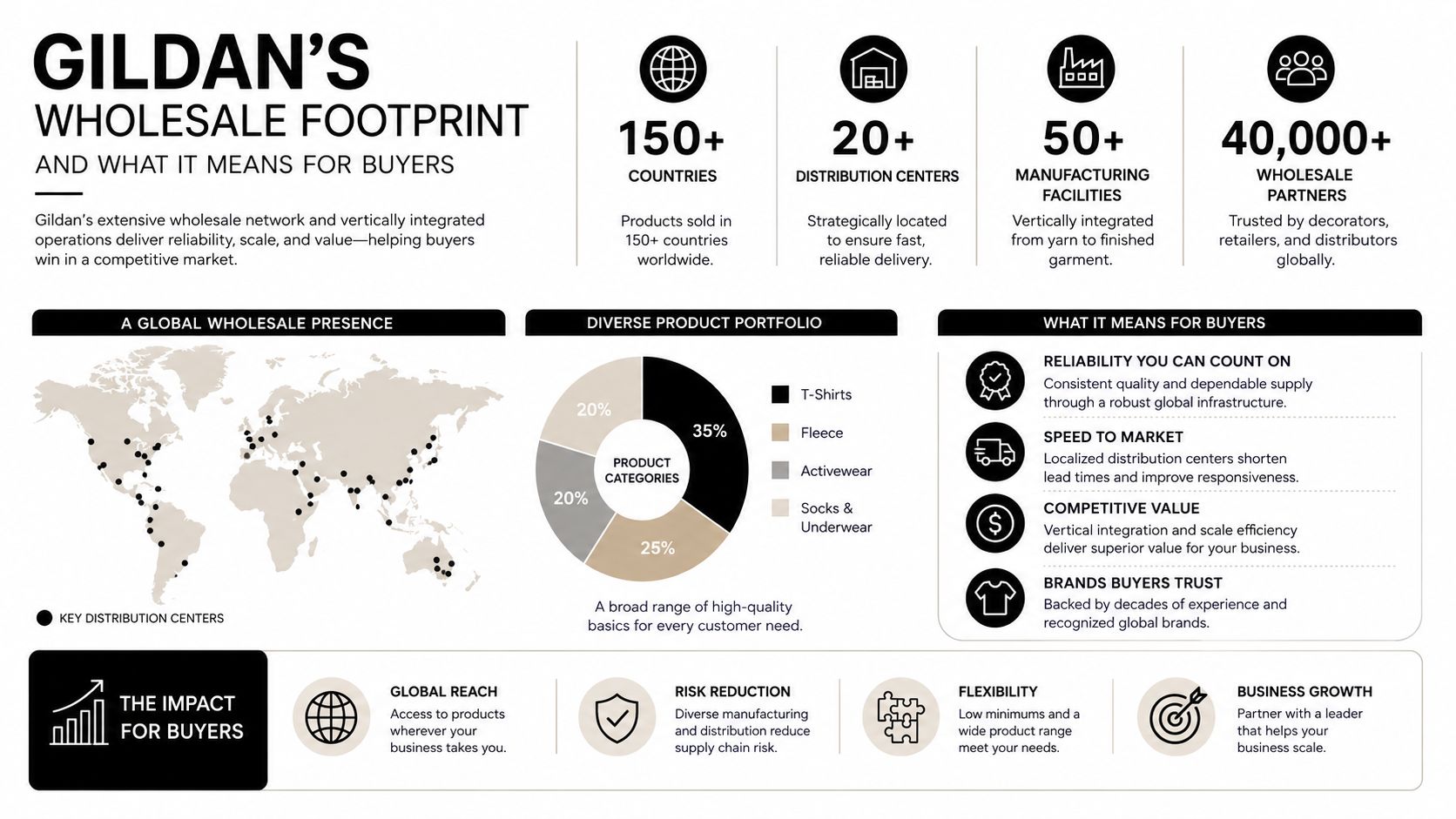
A small reseller can build a dependable sweatshirt range around Gildan because the brand operates within a much larger activewear business. Gildan reported $3.271 billion in fiscal 2024 sales, with 89.0% in the United States, 3.3% in Canada, and 7.7% in other international markets, according to its fiscal 2024 annual information. That geographic mix helps explain why North American decorators, wholesalers, and resellers commonly recognize Gildan blanks.
The company's history supports the same conclusion. Gildan was incorporated in 1984, moved exclusively into activewear in 1994, opened its first offshore sewing facility in Honduras in 1997, and had become the leading United States distributor of 100% cotton T-shirts by 2001, according to the company history summary. These milestones describe a vertically integrated basics operation, not a label built around one short-lived sweatshirt trend.
Scale changes your buying choices
A large manufacturer cannot guarantee every color and size at every moment. It does give a reseller a stronger basis for repeat orders than a one-off private-label source. Gildan's latest annual information identifies Activewear as 85% of total net sales and Innerwear as 15%, a mix described in the segment breakdown in Gildan's annual filing.
That operating scale affects three decisions:
- Plan replenishment around core demand. Established fleece styles let you track sales and reorder proven colors instead of rebuilding the assortment around seasonal novelty.
- Spread risk across models. A reseller can combine crewnecks, hoodies, and different fabric positions, then reserve budget for the styles that turn.
- Reduce explanation at the sales counter. Decorators and buyers already recognize Gildan model numbers, which makes quoting, sampling, and artwork discussions more direct.
Use the brand's scale as a planning advantage, not as permission to buy blindly. Keep purchase-order records, inspect incoming cartons, and identify substitutes for discontinued shades or temporary stock gaps. Verify marketplace listings carefully as well. Counterfeit or misidentified listings can create inconsistent measurements, fabric content, and packaging, even when the title says Gildan.
For a liquidation-box workflow, treat irregular inventory as a supplement to the repeatable wholesale core. It can help test unusual colors or one-off opportunities, but inconsistent sizing and replenishment make it a poor foundation for a signature assortment. Corporate scale supports reliable buying. Your inspection and inventory controls determine whether that advantage reaches the customer.
Inside the Gildan 18000 Heavy Blend and Common Alternatives
If a reseller needs one dependable sweatshirt to test demand, start with the 18000 Heavy Blend crewneck. It combines a 50/50 cotton-polyester fleece with an approximately 8.0 oz/yd² weight, air-jet yarn, and pill-resistant finishing, as detailed in this technical product reference for the Gildan 18000. Polyester improves durability and helps limit shrink risk. Cotton keeps the hand-feel familiar and gives decorators a workable surface.
Choose nearby models by customer use, not by model number alone. The 18500 adds a hood and kangaroo pocket for conventional pullover demand. The 18200 uses a full-zip format, making it more practical for layering and staff apparel. A ring-spun cotton option shifts the offer toward softness and a more natural print surface, while bringing different shrinkage and pricing considerations.
Gildan Sweatshirt Models at a Glance
| Model | Blend | Approx. Weight | Pockets | Closure | Price Tier |
|---|---|---|---|---|---|
| 18000 Heavy Blend Crewneck | 50/50 cotton-polyester | 8.0 oz/yd² | None | Pullover | Value core |
| 18500 Heavy Blend Hooded | 50/50 cotton-polyester | Similar Heavy Blend positioning | Kangaroo pocket | Pullover hood | Value to core |
| 18200 Heavy Blend Full Zip | Heavy Blend construction | Product-specific | Front pockets | Full zip | Core layering |
| 12000 ring-spun cotton option | 100% cotton ring-spun | Product-specific | None | Pullover | Softer, higher-positioned option |
The 18000 earns first-SKU status because it serves several buying situations. Schools can use it for group decoration, teams can issue it as a uniform layer, and online sellers can present it as an everyday crewneck. Its clean face suits common decoration workflows, but the blend still calls for a physical test before a large decorated order.
Keep the assortment operationally clear. Use the 18500 when a customer specifically wants a hood and pocket. Choose ring-spun cotton when hand-feel or DTG detail justifies leaving the Heavy Blend baseline. A Comfort Colors bulk buying guide can help when evaluating a softer, fashion-led assortment, but that positioning differs from the 18000's dependable value role. Stock the crewneck as the repeatable core, then add alternatives only when customer demand supports their fit, decoration, and replenishment requirements.
Fabric Chemistry, Printing, and Care Behavior
The 18000's 50/50 construction should determine how you decorate and how you write your product listing. Polyester doesn't absorb aqueous ink in the same way cotton does, so standard DTG can produce less saturated results on this fleece unless the printer uses a polyester-aware workflow. The Gildan sweatshirt shrinkage and care guidance also ties dimensional change mainly to blend ratio and wash temperature, which makes care instructions part of your quality control rather than an afterthought.
Match the process to the surface
Screen printing is usually the safer starting point for bold artwork on a Heavy Blend crewneck. A smooth air-jet-spun face gives the decorator a stable surface, while the garment's structure supports large logos, names, and simple multi-color graphics. DTG can work, but order a test print before committing to a large run, especially if your design depends on bright colors, gradients, or dense coverage.
| Method | Behavior on Gildan 18000 | Reseller Note |
|---|---|---|
| Screen printing | Strong fit for bold, high-coverage graphics | Approve a physical sample and inspect ink feel |
| DTG | Polyester can reduce aqueous ink absorption and saturation | Use a polyester-aware pretreatment and test cure settings |
| Heat transfer | Can work across the blend with the correct transfer | Check adhesion, stretch, and edge finish before scaling |
| Embroidery | Structured fleece supports logos and simple lettering | Stabilize the garment to limit puckering |
| Sublimation | Not the default choice for a cotton-poly fleece | Review sublimation guidance for apparel before selecting the process |
Keep the listing honest. Say that the fleece blend offers a balance of warmth, durability, and printability. Don't promise a soft, high-cotton DTG finish if the garment and process haven't produced it.
Put care instructions beside the size chart
Recommend cold washing and low-heat drying to reduce dimensional change. Tell customers not to iron directly over the print, and add a warning about chlorine bleach for pigment-dyed styles where relevant. These instructions protect the decorated surface and help the buyer understand why their garment should not be treated like an undyed all-cotton sweatshirt.
Listing language should answer the return before it happens: describe the blend, fit, wash method, drying temperature, and whether the print has a raised or soft-hand finish.
Your decorator should also record the test garment's measurements before and after washing. That record gives you defensible listing copy and helps detect a production problem before a full batch reaches customers.
Fit, Sizing, and Stocking Decisions Across Models
Fit is where many Gildan listings become vague. The 18000 and 18500 aren't identical customer experiences, even though they share the Heavy Blend family. The crewneck generally presents a relaxed, roomier shape, while the hoodie adds bulk through the hood, pocket, and cuff construction. A fashion-leaning style such as the SF500 belongs in a different merchandising conversation because its appeal is closer to a modern silhouette than a traditional value blank.
Independent wholesale guidance describes Gildan sweatshirt fit as generally true to size while emphasizing model-level variation. It also notes that wholesale listings can extend through 5XL and that manufacturers or distributors disclose shrinkage tolerances of about 5%, as discussed in this Gildan sweatshirt fit guide. Don't collapse that information into “order your normal size.” Customers need to know what normal means for your specific model.
Write fit copy that reflects the buyer's use
A customer buying a crewneck for a T-shirt layer may want their usual size. A customer planning to wear a thermal shirt underneath may prefer more room. Your listing should state the silhouette and invite shoppers to compare the garment measurements with a sweatshirt they own.
| Model | Fit Profile | Size Range | Recommended Stock Ratio (S-M-L-XL-2XL) |
|---|---|---|---|
| 18000 crewneck | Relaxed, traditional Heavy Blend shape | Broad run, with listings extending to 5XL | Adjust from your own sales history, with extra attention to core adult sizes |
| 18500 hoodie | Roomier feel because of hood and pocket construction | Broad run, with many listings extending to 5XL | Hold a deeper core run if hoodies drive your traffic |
| SF500 pullover | More fashion-led and closer-looking silhouette | Style-dependent | Keep the range narrower until demand proves itself |
The requested 2-3-3-2-2 curve can serve as a starting test for S through 2XL in a prepacked marketplace assortment, but treat it as a test allocation rather than a universal demand statistic. Your own sales history should replace it once you have enough order data. A print-on-demand seller can carry broader size access without pre-packing every size, while a marketplace seller holding physical stock must balance availability against cash tied up in slower sizes.
Make extended sizes a deliberate decision
Don't promise every color through 5XL unless your supplier confirms it for that exact shade. Use separate size and color availability notes, and photograph or measure the actual garment. A clear caveat about fit tolerance is better than a vague “unisex” label that leaves the customer guessing.
Where to Source Gildan Wholesale Sweatshirts
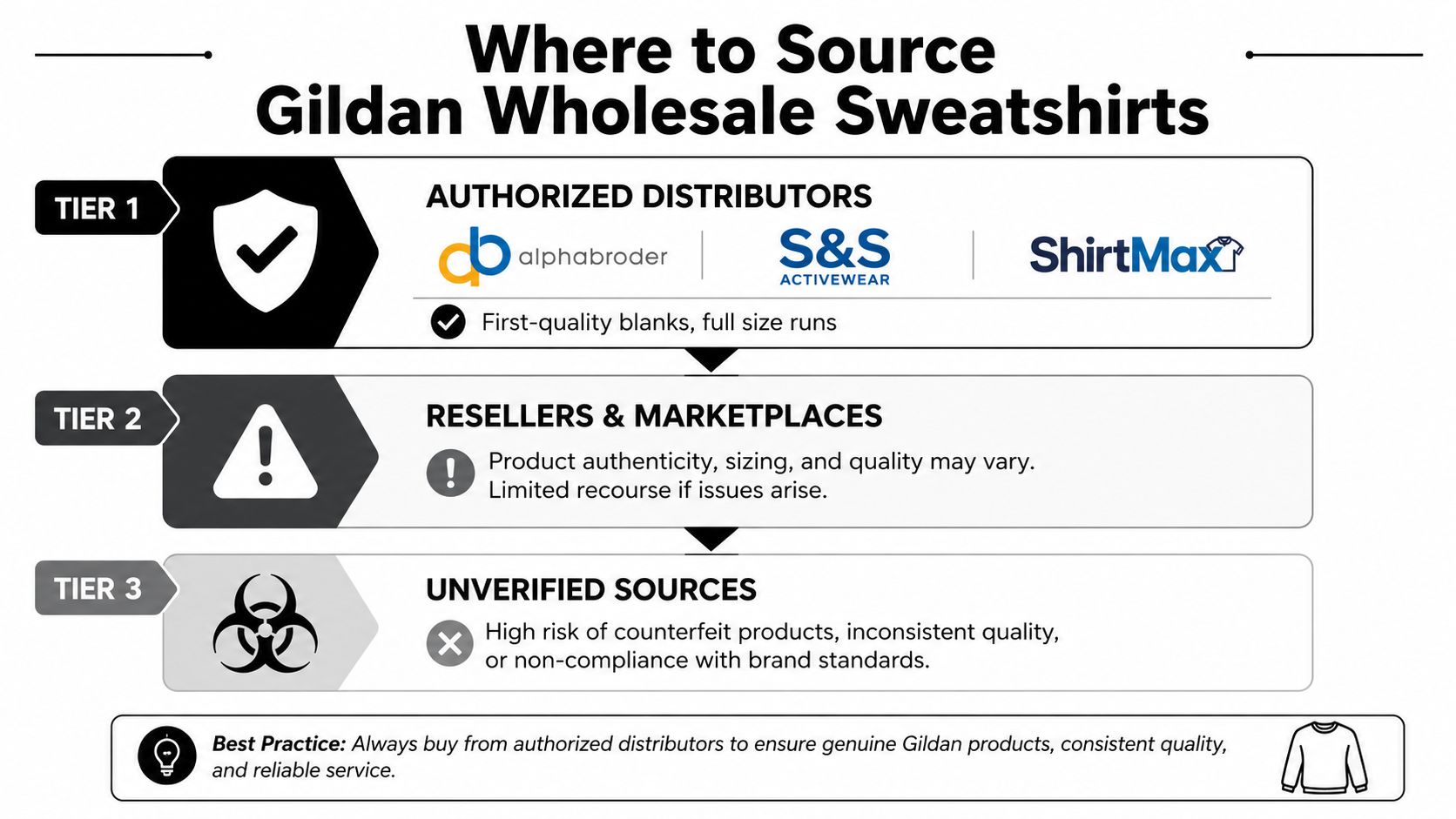
Source according to the damage a bad lot could cause. For a core program where you need matching sizes, consistent colors, and repeatable invoices, start with an authorized apparel distributor. Established distributors such as alphabroder, S&S Activewear, and ShirtMax are the kind of suppliers resellers should investigate for first-quality blanks, documented model numbers, and regular replenishment.
A second tier includes wholesale marketplaces that aggregate smaller distributors. They can help a new buyer compare terms and test an order, but you need to verify who fulfills the garment, what “new” means, and whether the seller can provide traceable documentation.
Use liquidation as a separate inventory lane
Liquidation and customer-return boxes can complement traditional wholesale when you understand the trade-off. They may contain overstock or boxed returns, but color, size continuity, condition, and model mix aren't guaranteed. That makes them unsuitable as the only source for a decorated school order or a core size run.
Use a simple risk hierarchy:
- Authorized distributors: Best fit for recurring blanks, known specifications, and replenishment.
- Reseller marketplaces: Useful for comparison and smaller tests, but verify fulfillment and documentation.
- Liquidation lots: Suitable for opportunistic resale, live sales, and mixed inventory, not guaranteed continuity.
- Unverified listings: Avoid prices that look disconnected from normal wholesale conditions unless provenance is documented.
A liquidation workflow can still work well. Sort every arrival by model, size, color, condition, and label. Photograph defects, separate sellable returns from decoration-ready blanks, and never mix unverified pieces into a listing that promises first-quality stock.
Before placing an order, use this wholesale clothing supplier sourcing guide to build a supplier checklist. Then ask for invoices, return terms, condition definitions, and a clear explanation of how the lot was acquired.
The sourcing process is easier to understand when you see how a wholesale apparel order can move from supplier selection to inspection and resale.
Don't confuse a low unit cost with a low operational cost. A cheap box that contains unusable sizes, damaged garments, or inconsistent labels can consume more labor than a first-quality case from an authorized source.
Choosing the Right Channel and Next Steps
The right channel depends on whether your priority is continuity, margin, or discovery. Buy from an authorized distributor when a customer has already approved a design and you need a predictable run. Use apparel closeouts when the color or model is less critical and you can price around limited availability. Use liquidation boxes for speculative inventory that you can sort, photograph, and sell through more than one channel.
For most new sweatshirt assortments, stock the 18000 as the default crewneck and add the 18500 as the hooded upgrade. Keep the merchandising message distinct. The 18000 is the practical fleece baseline. The 18500 gives shoppers the hood and kangaroo pocket they expect from a conventional pullover.
A practical 30-day sourcing plan
Days 1 through 7: Request quotes from an authorized distributor and a liquidation supplier. Ask for model numbers, available sizes, condition details, color continuity, shipping terms, and any authenticity paperwork.
Days 8 through 14: Order a small test quantity of the 18000. Have your decorator run the design using the exact process intended for production. Wash one decorated sample, measure it again, and inspect the print, cuffs, seams, and surface.
Days 15 through 21: Publish the listing with garment measurements, fit notes, blend information, care instructions, and a clear statement about the decoration finish. Track customer questions before expanding the range.
Days 22 through 30: Reorder the proven core through the most reliable channel. Add the 18500 only after you know whether your audience wants hoodies, and route liquidation inventory into separate listings where mixed sizes and colors are acceptable.
OneTrendyCloset can be considered for curated liquidation boxes, mix-and-match brand selection, and custom quotes based on stated budget, preferred brands, and quantity needs. To request a custom quote, submit your target Gildan models, size preferences, color priorities, desired quantity, and budget, then ask the supplier to confirm condition and availability before payment.
OneTrendyCloset offers curated brand-name apparel liquidation boxes and custom lots that can complement a first-quality Gildan wholesale sweatshirt program with more speculative inventory. Visit OneTrendyCloset with your preferred models, sizes, colors, quantity, and budget ready so you can request a lot aligned with your resale channel.