An estimated 2.71 billion people shopped online in 2024, representing 33% of the world's population, according to a Research and Markets report. For an apparel reseller, access to shoppers isn't the same as access to profit. A recognizable label can attract attention, but it won't pay for sorting damaged garments, answering fit questions, or processing avoidable returns.
Buying brand name clothing online works better when you treat liquidation as a measurable supply stream rather than a discounted mystery box. Buy against a written condition standard, retain evidence of what you've received, and calculate profit on the pieces you can sell. The cheapest box can be the most expensive inventory on your shelf.
Table of Contents
- Channels for Brand Name Clothing Online
- What a Wholesale Clothing Lot Really Contains
- Measurements That Cut Return Risk
- How to Prove Authenticity on Mixed Lots
- Profit Left After Fees and Prep
- From a Test Box to the Next Order
Channels for Brand Name Clothing Online
U.S. retail e-commerce sales increased 43%, from $571.2 billion in 2019 to $815.4 billion in 2020, while clothing and clothing-accessories store sales fell from $269.5 billion to $201.4 billion, according to the U.S. Census Bureau. Those are different measures, total online retail versus clothing-store sales, but together they explain the abrupt change in how sellers reached customers.
That shift made digital inventory presentation central to apparel selling. A boutique could sell beyond its neighborhood, while a marketplace seller could operate without a shopfront. The practical sourcing question became less about finding any stock and more about finding stock that could be inspected, described, and replenished economically.
Where resellers buy brand-name clothing online
| Channel | Best for | Price position | Condition control | Main risk |
|---|---|---|---|---|
| Retailer liquidation auctions | High-volume resellers with receiving space | Deep-discount opening bids; landed cost rises with bidding and freight | Manifested or mixed grades, sometimes partly blind | Freight, bid competition, and unsellable units |
| Curated wholesale boxes | Boutiques, marketplace sellers, live-sale hosts | Below-retail wholesale pricing with an assortment charge | Brand preferences and box size may be selectable | Shallow depth in any particular style |
| Marketplace wholesale listings | Testing a single label | From clearance-level bargains to near-resale pricing | Only what item photos, terms, and seller records establish | Counterfeits, fees, and weak recourse |
| Direct brand or jobber closeouts | Specialists in known labels | Negotiated closeout pricing below regular wholesale | Can specify new-with-tags or shelf-pull stock in writing | High minimums and limited allocation |
| Used clothing bales | Thrift-style operators and weight buyers | Weight-based pricing rather than retail-value pricing | Supplier-defined grades, subject to inspection | Heavy labor and an unsellable share |
Price position isn't a margin forecast. An auction discount may suit a warehouse operation that can consolidate freight and recover value from imperfect pieces. The same purchase can overwhelm a seller working from a spare room.
Curated boxes suit sellers on Poshmark, eBay, Mercari, Depop, and Whatnot when assortment flexibility matters more than repeat quantities. Ask whether brand selection is guaranteed, a preference, or merely an example of previous contents. Those descriptions aren't interchangeable.
Match the channel to your operating limits
Marketplace wholesale listings can help test demand for a label without committing to a broad assortment. Request photographs of the actual lot, not just a representative garment, and read the payment and dispute terms before moving the conversation off-platform.
Direct closeouts make more sense when you know the label's customer, sizing, and resale ceiling. Used bales belong in a different buying model altogether: you need space, sorting capacity, and outlets for lower-grade goods, not just strong marketplace photography.
Buying rule: Choose the channel your team can process, not the channel advertising the largest retail-value discount.
For the next order, choose one primary supply channel. Treat alternatives as controlled tests rather than building a simultaneous sourcing stack that leaves you unable to identify which supplier produced the profitable inventory.
What a Wholesale Clothing Lot Really Contains
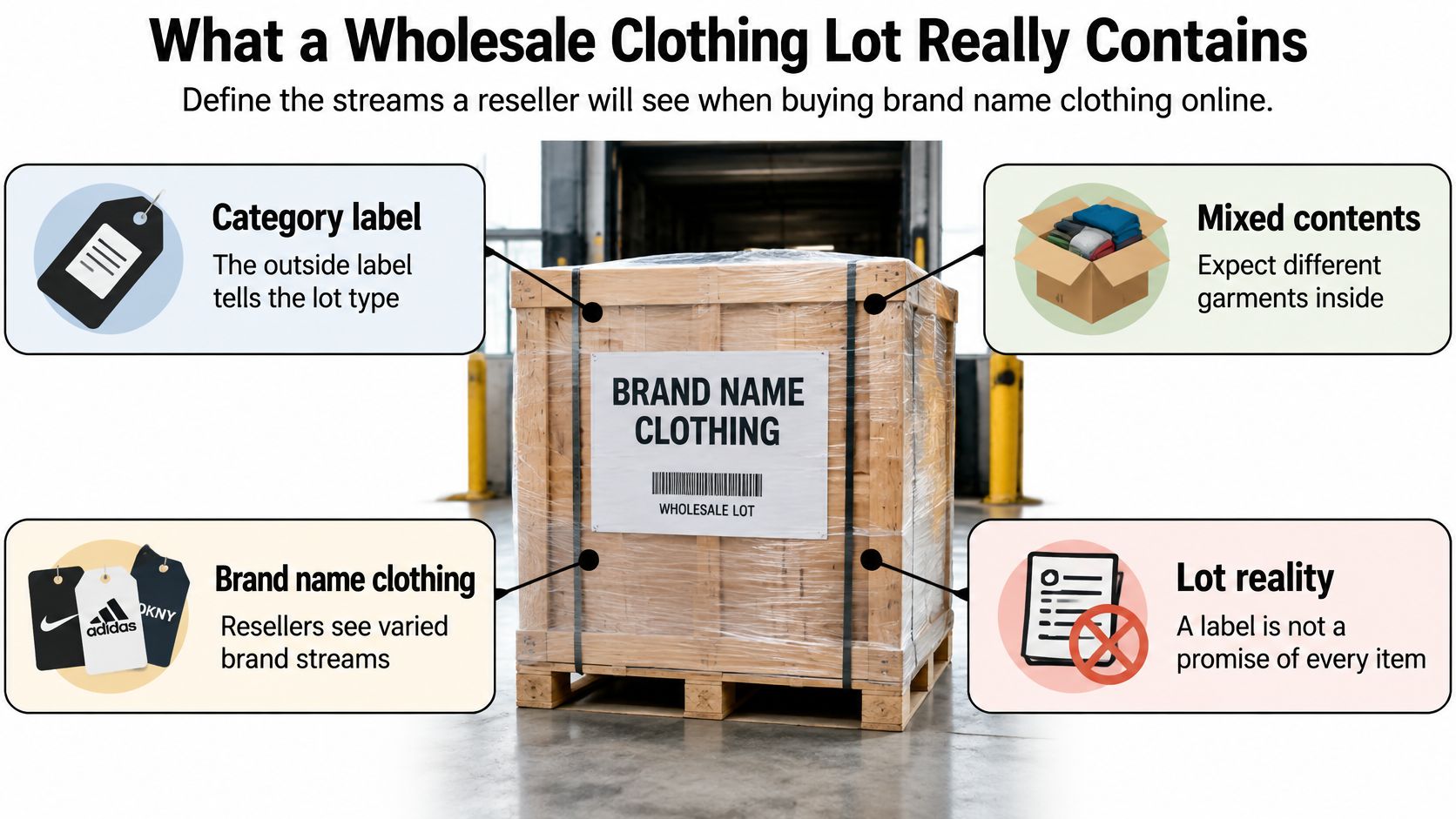
A wholesale lot resembles a sealed crate at a warehouse dock. The outside label tells you the category, not the condition of every garment inside. A mixed-brand assortment may contain desirable labels and still require different listing treatments for different pieces.
Use the crate model to separate the supplier's description from the claims you'll eventually make to customers.
Read the stock stream before the brand list
Say a supplier offers a mixed apparel box containing overstock, shelf pulls, and customer returns. You shouldn't assign the whole shipment a single retail condition just because the garments arrived together.
- First-quality and new-with-tags stock: Unworn overstock or unsold retail can be straightforward to prepare, but inspect for storage damage, security-tag holes, and shop wear. A tag doesn't cancel a defect.
- Shelf pulls: These have been removed from retail selling space. Check for hanger marks, fading, missing accessories, and clearance stickers before deciding how to describe them.
- New-without-tags stock: Missing tags don't establish that an item has never been worn. Use this condition only when the garment and its provenance support it.
- Customer returns: A return is a supply category, not a condition grade. The piece may be untouched, tried on, washed, altered, or damaged.
- Secondhand stock: Donation, closet-clearance, and thrift streams require individual inspection. Supplier grades such as A, B, and C need written definitions because the letters alone don't tell you what's acceptable.
A pallet describes how inventory is grouped and shipped. A curated box describes a smaller selected assortment, potentially organized around brands or categories. Neither term guarantees a particular condition, and neither makes a mixed assortment equivalent to a uniform case pack.
For a closer look at purchasing formats, use this guide to wholesale clothing lots when comparing supplier descriptions.
Turn the offer into written acceptance terms
Before paying, ask for the piece count or selling weight, the brand range, and the condition mix. Establish whether photographs show the actual goods and whether excluded defects include odors, holes, missing closures, or altered hems.
The supplier should also explain how shortages and misgraded pieces are handled. A clear rejection rule is more useful than a broad assurance that everything is resale ready.
Use the accompanying video alongside the written lot description, not as a substitute for order-specific terms.
Your listing voice should follow the garment, not the invoice category. An unworn piece with attached retail tags can be described accordingly; a returned piece with wash wear belongs in a used condition category. When the history is uncertain, describe what inspection establishes rather than inventing a cleaner history.
Measurements That Cut Return Risk
68% of consumers surveyed globally had returned clothing or footwear during the previous year, 61% cited poor fit, and 33% said the item didn't match its online description or images, according to Rithum's 2025 Global Returns & Profit Impact Report. For mixed-brand inventory, that makes measurement and description part of margin control, not optional listing polish.
A generous return policy doesn't tell a shopper whether a discontinued jacket will fit. Give buyers information they can compare with a garment they already own, rather than asking them to trust that every brand interprets a tagged size the same way.
The checklist below puts fit information ahead of the purchase decision.
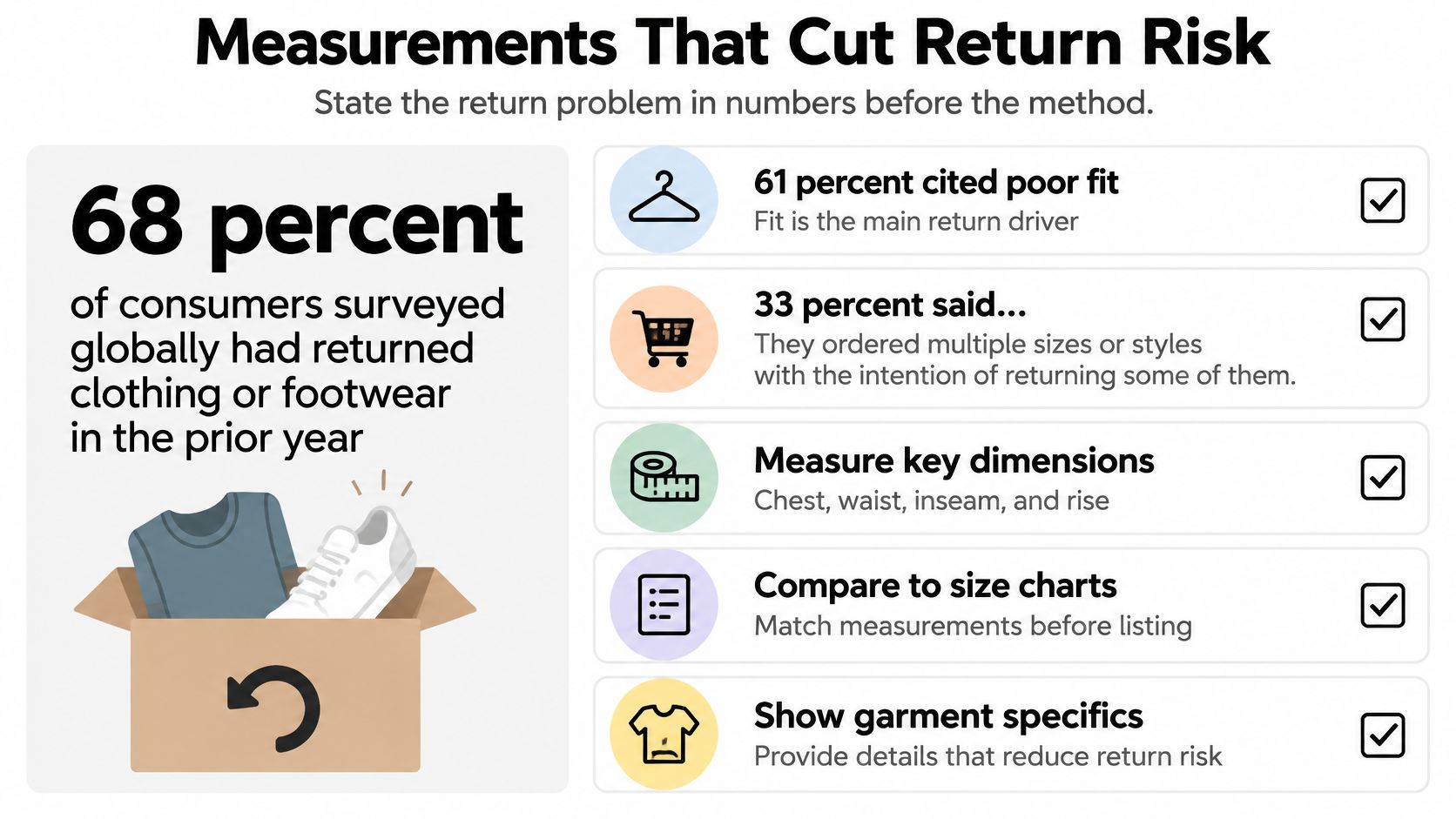
Build a repeatable flat-lay routine
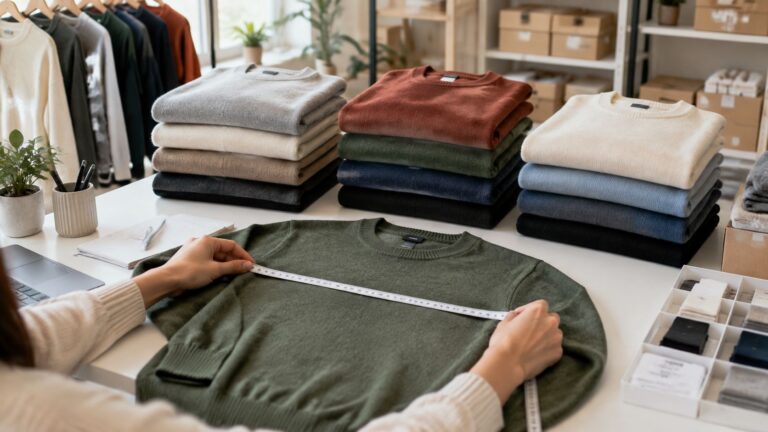
- Photograph the garment flat. Use a clean surface, consistent lighting, and front-and-back views. Smooth wrinkles without pulling the fabric into a shape it won't hold when worn.
- Record applicable dimensions in inches. Use a flexible tape for pit-to-pit, waist, rise, inseam, sleeve, and total length. State your measurement method, particularly where sleeve or rise measurements begin.
- Keep the tagged size beside the measurements. Don't replace the tag with your own guessed size. If measurements appear inconsistent with the label, disclose both.
- Describe fabric and cut. Record the fiber information available on the care label, note stretch, and identify the cut as slim, regular, or relaxed when the garment supports that description.
- Add a confidence line. Distinguish measured information from an estimate based on a comparable garment or a tag-only description. Don't let an estimate look like a physical measurement.
A flat waist measurement isn't a body measurement. Explain whether you've recorded width laid flat or doubled that width, and avoid stretching an elastic waistband without saying so.
For activewear, note whether the fabric recovers after gentle stretching. For structured jackets, measure with the garment fastened in its normal wearing position.
Flat measurements by garment type
| Garment | Measure these | Skip or note |
|---|---|---|
| Denim | Waist, rise, inseam | Tagged size is not the measured waist |
| Jackets | Pit-to-pit, sleeve, total length | Add shoulder only if the seam is clear |
| Activewear | Pit-to-pit, waist, length, stretch | Note fabric recovery; a tag hides fit |
| Vintage | Pit-to-pit, waist, and the length that applies | Ignore modern size charts |
| Mixed or discontinued labels | Tagged size beside the numbers | Confidence line indicating measured, estimated from a comparable, or tag only |
Sort a mixed box into measurement workflows before listing. Denim can move through a waist-rise-inseam station, while tops and jackets use a chest-sleeve-length station. A spreadsheet with separate fields is easier to audit than measurements buried in free-form notes.
Buyers need a comparison they can make at home, not a promise that the garment fits true to size.
If a measurement is missing, retrieve the item and take it. Guessing saves a moment during listing but leaves the buyer carrying uncertainty you could have removed.
How to Prove Authenticity on Mixed Lots
A 2025 experiment involving 524 U.S. consumers found that information precision, authenticity, and reduced perceived risk increased trust, which then increased purchase intention, with effects differing between company-controlled and seller-controlled platforms, according to the study indexed by EconPapers. The practical lesson isn't to add stronger reassurance to listings. It's to make your evidence more specific.
A recognizable logo, attached hangtag, or supplier invoice doesn't independently prove authenticity. Build a traceable record, then use qualified authentication when the label, value, or warning signs justify it.
The process below connects supplier records with the information a buyer can inspect.
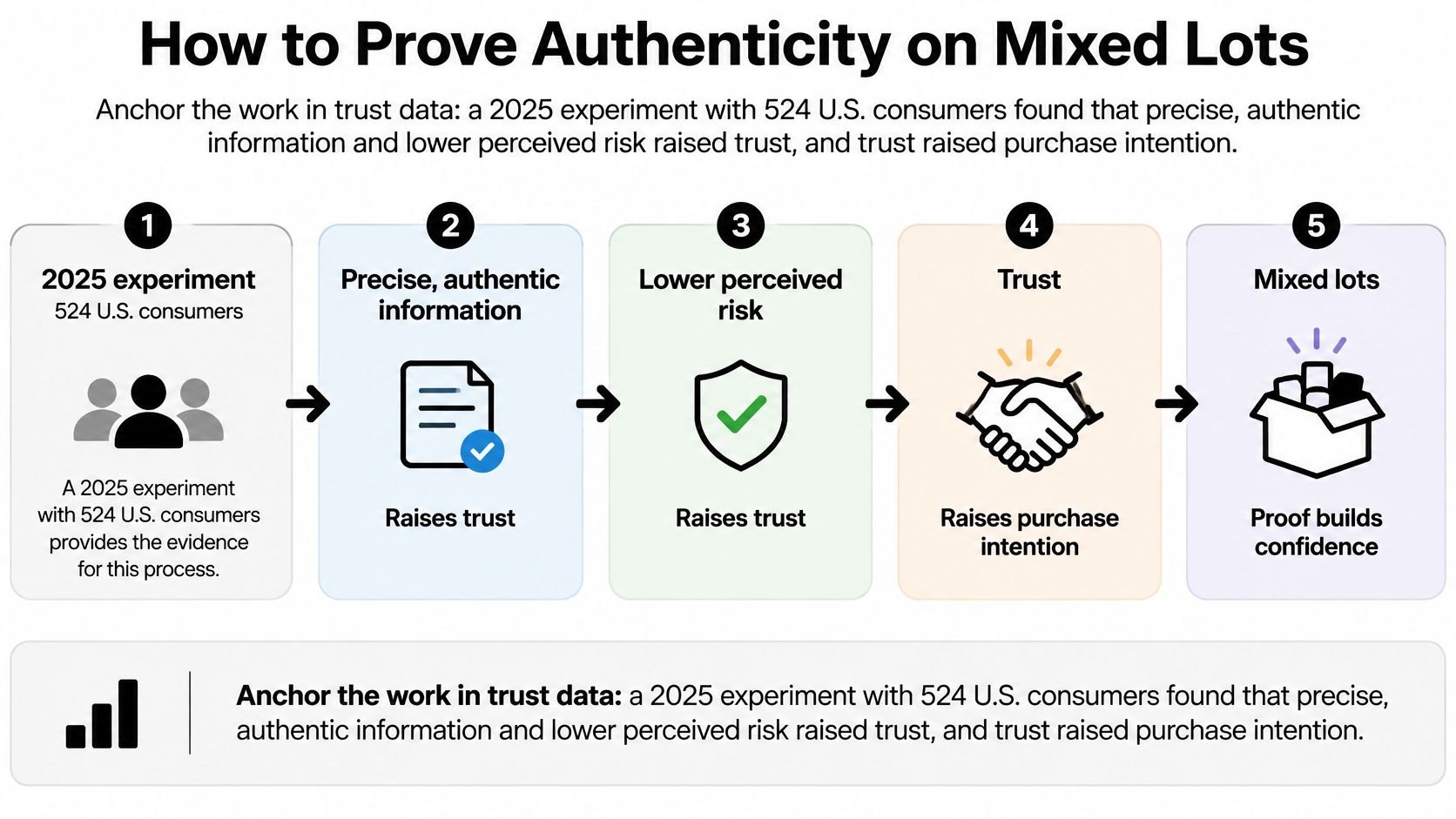
Make an evidence file during intake
Connect the garment to its shipment. Retain the invoice, supplier identity, lot reference, and box or pallet identifier. Assign an internal inventory code that follows the garment into its listing and storage location.
Capture identifying details before preparation. Photograph brand and care labels, style identifiers, hardware, stitching, and packaging where relevant. An RN identifies a registered business; don't treat it as a unique authentication certificate.
Separate provenance from condition. Record the supplier's category and your inspected condition in different fields. Preserve the original intake record even if cleaning changes the garment's presentation.
Use a fixed defect vocabulary. Hole, stain, pull, missing button, odor, and altered hem are useful descriptions. Add location and photographs instead of hiding a material defect behind a vague phrase such as minor wear.
Escalate uncertainty rather than advertising through it. Compare identifiers and construction details with dependable brand references. If doubt remains, quarantine the item or obtain appropriate authentication before offering it for sale.
Publish a workable dispute process. Tell customers how to contact you, what photographs help assess the issue, and which policy applies. Your instructions must remain consistent with marketplace rules and applicable consumer rights.
For a large bale, sampling can help decide whether to accept or investigate the shipment. It doesn't establish the authenticity or condition of every unexamined garment. Each piece still needs the checks required for its eventual listing.
Know what your evidence can establish
Brand as labeled isn't a safe workaround for suspected counterfeit goods. If you can't responsibly support the listing, don't sell the item under that brand merely by softening the wording. Keep uncertain stock out of the sellable inventory count while you resolve it.
Likewise, an invoice establishes where you bought something, not necessarily its complete manufacturing history. The strongest file combines purchase records, item-level photographs, consistent identifiers, and any specialist assessment needed for that product.
Keep the buyer-facing listing concise: clear label images, accurate condition, visible flaws, and defensible claims. Retain the fuller file privately, removing supplier-sensitive or personal information before sharing documents. That gives you usable evidence when a customer asks a reasonable question or a marketplace requests support.
Profit Left After Fees and Prep
Fashion generated an estimated 2.5–5 billion excess items in 2023, worth roughly $70–140 billion, according to Mordor Intelligence's secondhand apparel market analysis. Access to excess stock isn't enough. A reseller needs inventory that can be verified, prepared, and sold at a price customers will pay.
The discount becomes misleading when you divide the purchase price by everything delivered rather than everything sellable. Donations, unresolved authenticity questions, and damaged pieces consumed cash even if they never become listings.
Sample net on a 40-piece brand-name box
The following is a hypothetical planning example, not a supplier quote, carrier rate, or marketplace fee schedule. Every amount is an assumption for illustrating the calculation; replace it with your own order terms and selling costs.
| Line | Amount | What it assumes |
|---|---|---|
| Box cost | $400 | Paid to the supplier, freight in included |
| Pieces received | 40 | Mixed brands and sizes |
| Listable keepers | 32 | Eight pieces excluded from resale |
| Cost per keeper | $12.50 | Box cost divided by keepers, before labor |
| Average sale price | $28 | Illustrative marketplace sale, not retail |
| Platform fee | About $4 | Assumed charge for this example, not a published rate |
| Outbound shipping if seller pays | $7 | Assumed cost for a domestic garment shipment |
| Prep, photos, and cleaning | $3 | Small assumed labor allowance per keeper |
| Returns reserve | $2 | Assumed allowance for refunds and reships |
| Rough net per keeper | −$0.50 | Sale less the listed costs, before other overhead and taxes |
Under these hypothetical assumptions, the shipment loses money on each keeper before accounting for storage, subscription expenses, or additional markdowns. The apparent wholesale saving doesn't survive the selling process.
The prep allowance also deserves scrutiny. Time intake, steaming, photography, measurement, listing, and shelving separately, then assign labor cost even when you're doing the work yourself. Unpaid owner time still limits how much inventory the business can process.
Change the purchase before changing the spreadsheet
You have several legitimate ways to improve the result:
- Negotiate a more usable assortment. Better condition or stronger category alignment can matter more than a lower headline price.
- Choose a different selling format. Compatible lower-value garments may suit bundles or live sales, provided the combined return covers the work.
- Review shipping responsibility. Buyer-paid shipping changes your calculation but may also change what customers will pay for the garment.
- Reduce handling duplication. Capture measurements, defects, and label photographs during the same intake pass rather than retrieving stock repeatedly.
Don't remove the returns reserve just to make the purchase look profitable. Record actual return-related losses and adjust the allowance as your selling history develops.
For marketplace execution, this guide to selling clothes on eBay can help connect inventory preparation with listing decisions. Pull current fees from the platform's own account tools rather than carrying a remembered rate into a new category.
Pass test: If the realistic selling price doesn't leave enough after preparation and selling costs, change the channel, assortment, or purchase price before ordering more.
From a Test Box to the Next Order
U.S. clothing and clothing-accessories retail establishments fell from 143,534 in 2017 to 121,610 in 2022, while electronic-shopping and mail-order firms increased 33%, from 33,241 to 44,322, according to the Census Bureau's analysis of the Economic Census. Those counts describe a changing retail structure, not a guarantee that an individual online seller will succeed.
You don't need a shopfront to add inventory. You do need a purchasing rhythm that doesn't outrun your cash, storage, or ability to publish accurate listings. Scale the process that produces acceptable results, not the size of the delivery.
Start with a box you can finish processing
Choose an assortment matched to customers you already understand. Recent completed sales and your own transaction records are more useful than ambitious asking prices on unsold listings.
A seller focused on denim shouldn't accept an unrelated category merely because the labels sound expensive. Nor should a new account assume it can list every brand or condition on every marketplace. Check category eligibility and selling restrictions before purchasing stock for Amazon or another restricted channel.
For a new operation, this guide to starting a clothing resale business online provides a useful starting framework. Keep the first purchase small enough that an unsuitable assortment won't prevent you from buying replacement inventory.
Before paying, put your purchasing limits in writing:
- Maximum landed spend: Include freight, handling, and any other supplier charges.
- Preferred inventory: Name the brands, garment categories, sizes, and condition classes your buyers request.
- Minimum acceptable keeper rate: Define what qualifies as listable before the shipment arrives.
- Processing capacity: Reserve enough space and working time to finish intake rather than leaving stock sealed.
Reorder against completed results
A promising opening weekend isn't sufficient evidence for a larger commitment. Separate garments that sold from those merely listed, and track whether discounts or promoted listings were necessary to complete those sales.
Use a simple supplier scorecard rather than relying on memory.
| Decision | Evidence to review | Reason to pause |
|---|---|---|
| Reorder the same box format | Keeper rate, realized sale prices, preparation time | Acceptable garments require too much handling |
| Request a more focused brand mix | Sales by brand and garment category | Strong labels still leave slow sizes or unsuitable styles |
| Ask for a custom lot or pallet | Repeatable packing, documentation, receiving capacity | Larger freight or storage needs haven't been costed |
A reorder should tighten the specification. Ask for more of the categories that sold profitably and fewer of those that tied up cash. Keep enough detail to distinguish a supplier problem from a pricing, photography, or demand problem.
Move to custom volume only when receiving is ready
A custom quote is useful when you can state budget, preferred brands, quantity needs, and exclusions clearly. Curated-box suppliers can be an option alongside auctions and jobbers when you want to influence assortment without purchasing a uniform closeout.
Before moving to a pallet, confirm delivery access, unloading arrangements, storage locations, and how disputed pieces will be documented. Ask whether the same packing standard and paperwork apply to the larger order. Familiarity with a sales contact isn't a substitute for written terms.
Don't reorder until the first shipment has been measured, graded, listed, and checked against its actual economics. The right next order is the one your operating results support, even when that means staying with smaller boxes.
OneTrendyCloset offers curated mixed-brand apparel boxes, mix-and-match brand selection, and custom quotes for boxes or pallets based on your budget and inventory needs. Visit OneTrendyCloset with your preferred brands, quantity needs, and condition questions, then evaluate the proposed assortment against your keeper-cost and profit requirements before ordering.