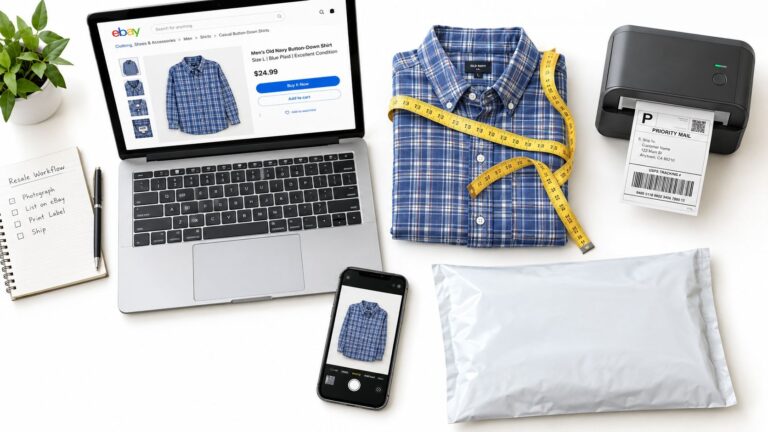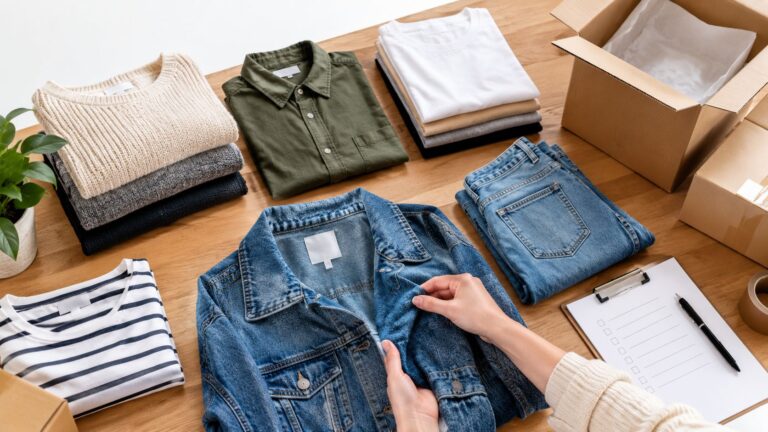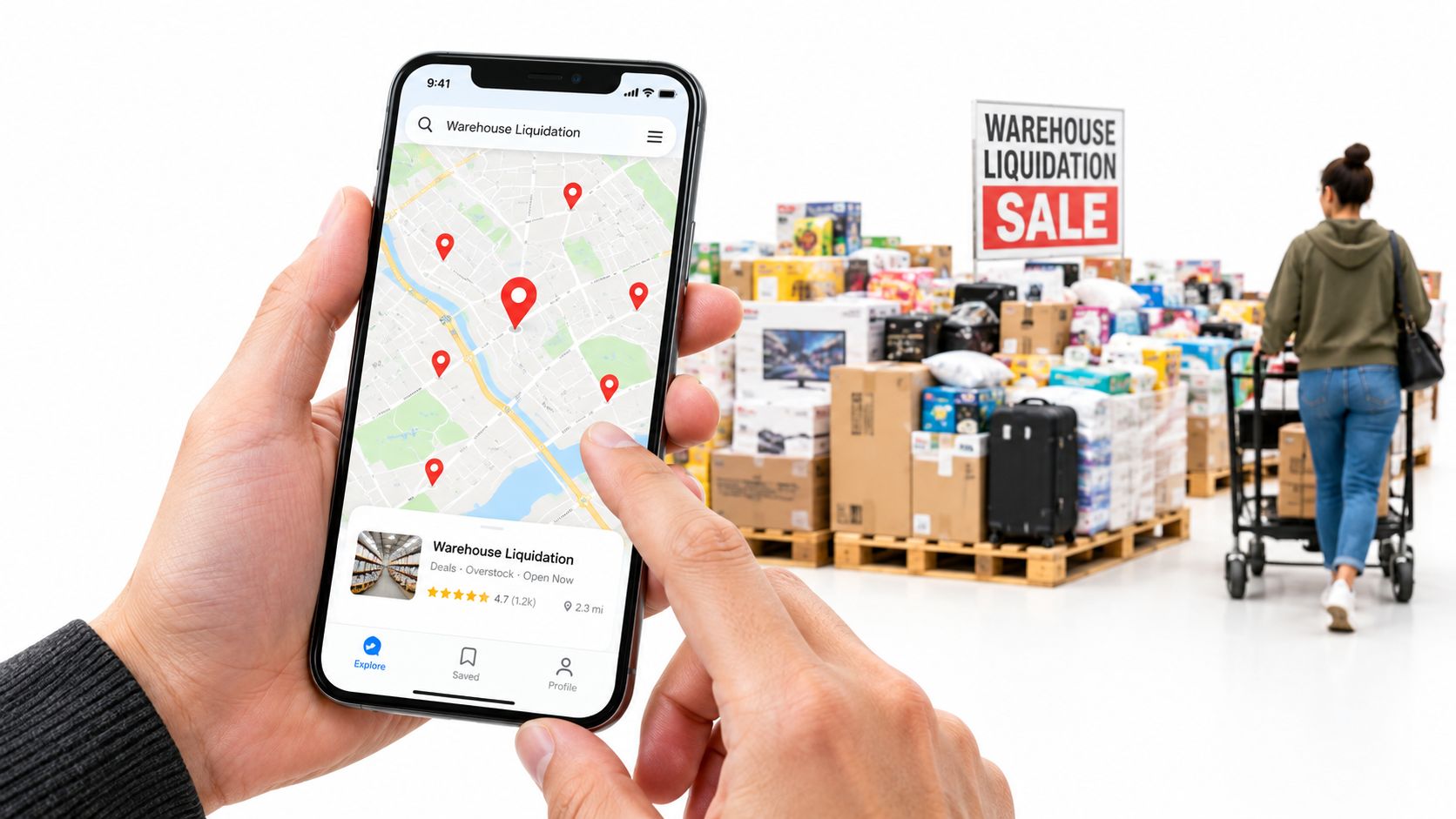
Retail closures are not a side story anymore. Coresight tracked 8,270 U.S. store closures in 2025, against 5,270 openings, for a net loss of roughly 3,000 stores, and closure activity was still running high into 2026 even as the pace moderated (U.S. store closure tracker data). That's why searches for stores liquidating near me keep rising. More inventory is getting pushed into local markets, but more noise is showing up too.
I've seen both sides of it. Some liquidation events are packed with clean shelf-pulls, unopened fixtures, and real resale margin. Others are little more than tired clearance leftovers spread across folding tables with “all sales final” signs and prices that still don't make sense. The hard part isn't finding a sale. It's figuring out which one deserves your time, your gas, and your buying budget.
Table of Contents
- Why Local Liquidation Sales Are Everywhere Right Now
- How to Search for Stores Liquidating Near Me
- What to Expect When You Arrive at a Liquidation Sale
- Inspection and Negotiation Tactics That Actually Work
- When Curated Wholesale Boxes Beat Local Liquidation
- Safety, Logistics, and Payment Essentials
- Choosing the Right Sourcing Path for Your Goals
Why Local Liquidation Sales Are Everywhere Right Now
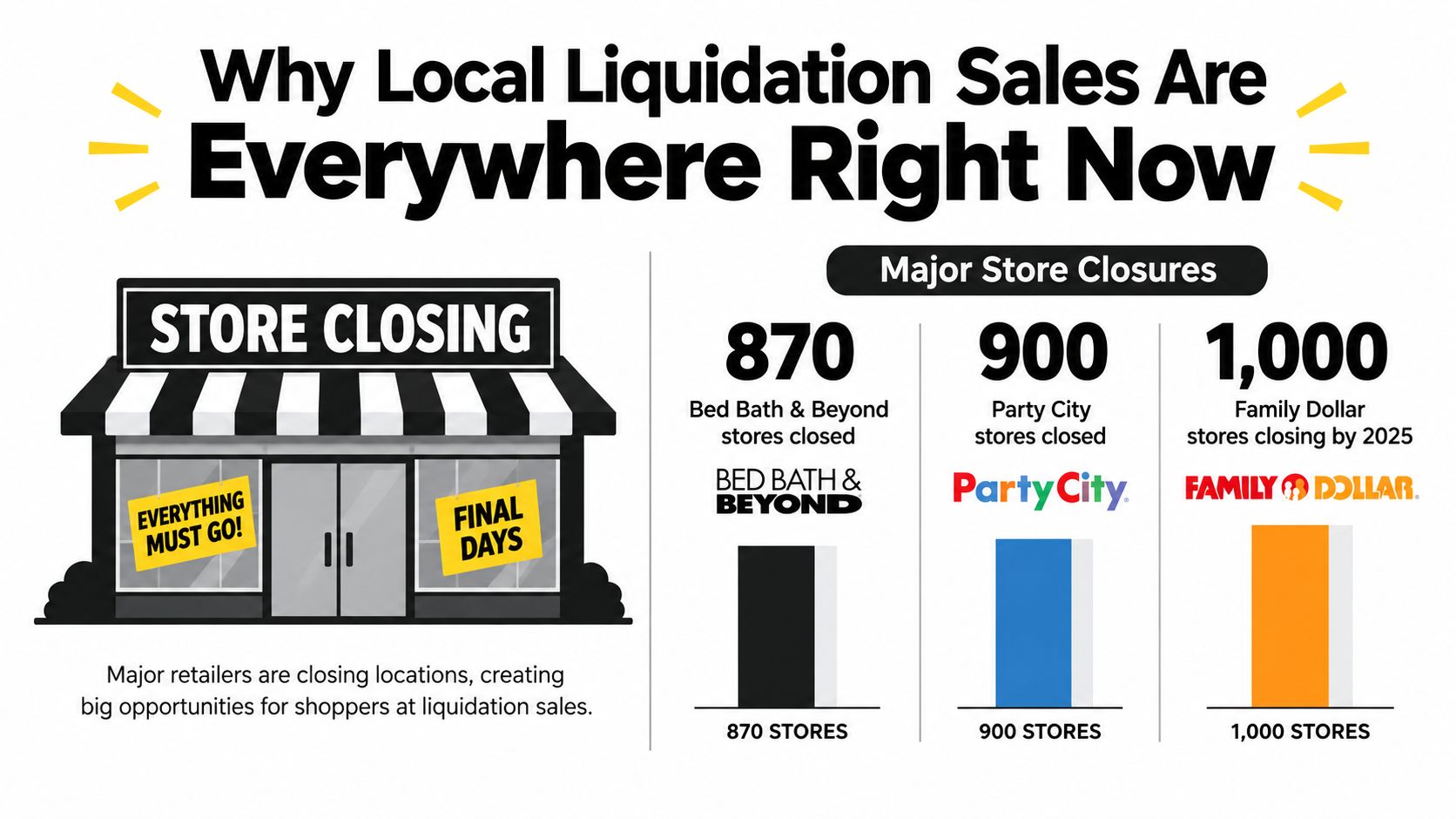
More stores are closing, and that inventory has to land somewhere. By the time the public sees a big yellow liquidation banner, a lot of merchandise has already been rerouted into side channels, short-term warehouse sales, and local liquidator floors. That is why local liquidation feels busier than it did a few years ago, even if the quality from one event to the next is all over the map.
Where the inventory actually shows up
A straight store-closing sale is only one version of liquidation now. I see more inventory pushed through warehouse events, temporary pop-ups, former big-box spaces, and independent liquidator showrooms than many new buyers expect. That shift matters because the sourcing decision is no longer just, “Is there a sale near me?” The better question is whether that sale is close enough to the original shutdown to still have clean, profitable merchandise.
Four Lights Analytics reported 13,446 verified U.S. retail and facility closure events through August 2026, including 6,304 retail events. California led with 1,053 closures, followed by Texas with 651 and Florida with 647. The same reporting tied 2,552 events to WARN filings by September 2026, which helps explain why inventory often hits some local markets in clusters instead of a steady trickle (state-by-state closure data).
That clustering creates a real trade-off for resellers. A busy metro can give you multiple shots at fresh inventory in one month. It also attracts more buyers, faster cherry-picking, and more operators trying to pass off tired closeouts as liquidation.
Why some events are worth the trip and others are not
The best local liquidation events usually share a few traits:
- Fresh inventory flow from a recent closure, not cartons that have changed hands three times.
- Category consistency such as home goods, apparel, fixtures, seasonal, or boxed electronics.
- Pricing logic that lets a buyer estimate resale margin without guessing.
- Staff who can answer basic questions about source, replenishment, and discount timing.
The weak events show their problems fast. Mixed-condition product, open boxes, random assortments, no clear markdown structure, and workers who only repeat “all sales final” are common warning signs. If the room feels more like a clearance dump than a liquidation pipeline, I usually leave early.
That is the part many guides skip. Finding a liquidation event is easy. Deciding whether it deserves your gas, half a day, and buying budget is the essential skill.
For some resellers, the answer is to stop chasing every local event. If the nearby options are thin, heavily picked over, or too inconsistent by category, a curated wholesale box can be the smarter buy because the margin is easier to model before you ever load the car.
How to Search for Stores Liquidating Near Me
Searching too broadly leads to poor results. If you type only stores liquidating near me, you'll get a mix of clearance pages, old listings, and generic directory content. Better searches use intent modifiers and local terms together.
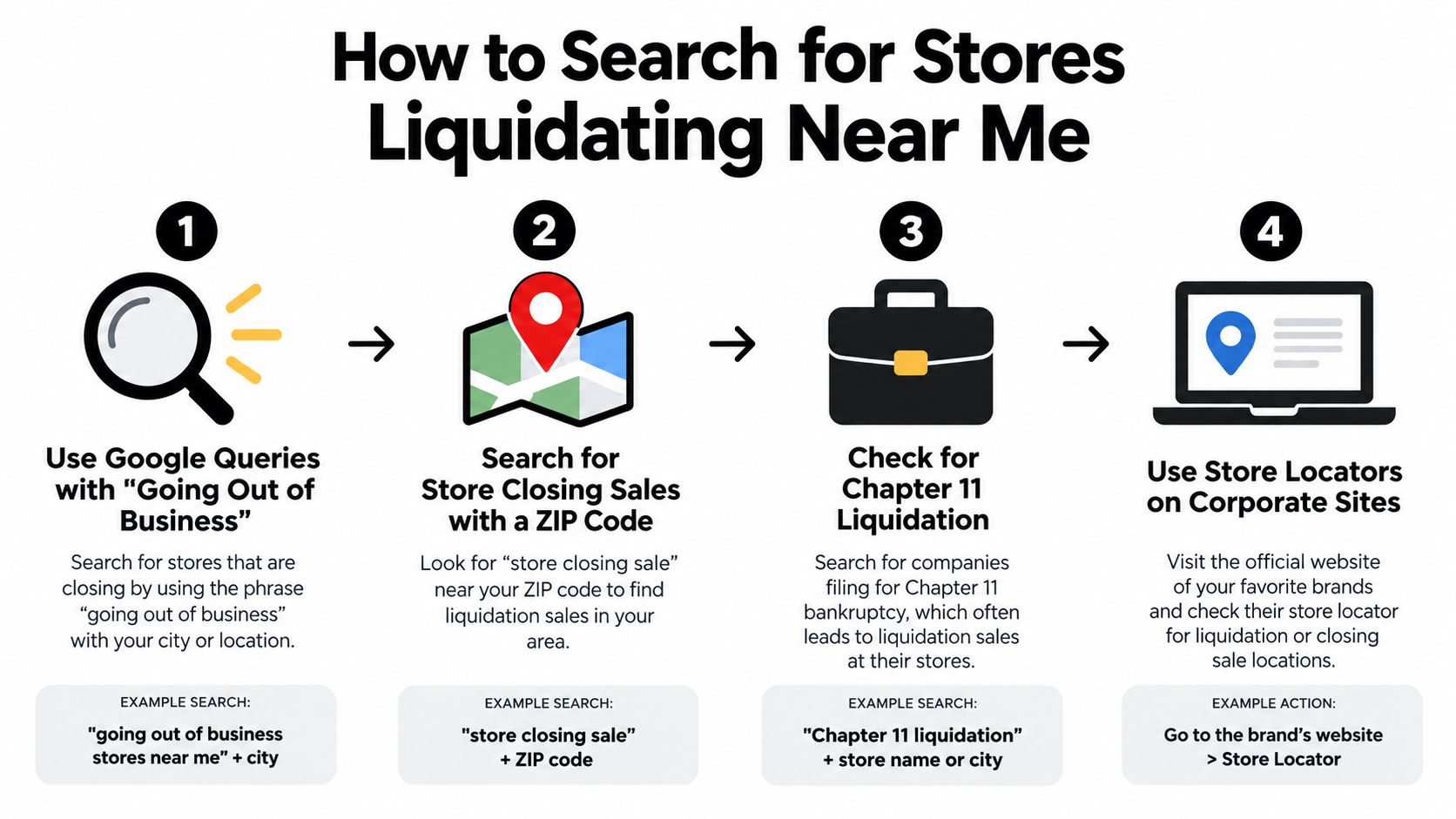
Start with searches that signal an actual closing
Use Google with combinations like:
- “going out of business” + your city
- “store closing sale” + ZIP code
- “chapter 11 liquidation” + city name
- specific chain name + “closing” + your area
Those queries are better than a broad liquidation search because they catch chain announcements, local news pages, landlord listings, and public sale notices. Corporate store locators can help too, especially when a chain posts closure details before local inventory starts circulating.
If you want more inventory channels beyond local storefront events, it helps to review how nearby pallet supply tends to surface through a mix of direct sellers and secondary markets in this guide to finding pallets near you.
Check the platforms where operators actually post
Google is only step one. A lot of good leads surface elsewhere first.
- Auction marketplaces often list pallet lots, fixtures, and business liquidation inventory before the public hears about an in-person event.
- Facebook Marketplace and Craigslist are where smaller operators unload mixed lots, shelving, and leftover categories quickly.
- Instagram and TikTok can be surprisingly useful because liquidators post walk-through clips, opening-day footage, and same-day markdowns.
- Reseller groups and forums often have better timing intel than public search results because local buyers report what the floor really looks like.
A video walk-through can also help you spot how these events are advertised and staged before you drive out.
Build a repeatable local watchlist
One-off searching works if you're casually bargain hunting. Resellers need a system.
I'd keep a short watchlist that includes local liquidators, mall property pages, bankruptcy sale notices, and a few social accounts that post retail shutdowns in your region. Then set Google Alerts for phrases like your city plus “liquidation sale” or “store closing.”
The best local opportunities often show up with short notice. If you wait until Saturday morning to start searching, the sharp buyers already know where they're going.
What to Expect When You Arrive at a Liquidation Sale
A real liquidation floor has a rhythm to it, and it's not the same as walking into a normal clearance section. The serious buyers show up early. They park close, bring their own carts or gloves if the operator allows it, and head straight for the categories they already know how to price.
The first hour tells you a lot
If doors open at morning start time, people often line up well before that. The first few minutes usually decide who gets the clean boxed items, the best fixtures, the unopened back-stock, or the branded merchandise with obvious resale demand.
You'll usually see a mix of buyers:
- Weekend shoppers looking for cheap household goods
- Flippers with vans or pickups who already know what categories move
- Curiosity traffic that slows the aisles but doesn't always buy much
- Small business owners sourcing displays, racks, bins, or furniture
That mix matters. Family shoppers create congestion. Professional buyers strip the best inventory fast. Casual browsers leave behind a lot of opened product.
How most operators lay out the floor
Chain store closeouts often keep some structure by department. Apparel with apparel. Kitchen with kitchen. Seasonal with seasonal. Independent liquidation warehouses are less neat. You might find shelf pulls on one row, return-grade product on another, and a pallet of mixed hard goods sitting in the back with only a handwritten sign.
The cleanest setups usually label merchandise by category or by discount tier. The messier ones force you to inspect every piece because packaging and condition vary from item to item.
If the floor looks chaotic, slow down instead of rushing. Chaos hides damage, missing parts, and bad buys better than it hides bargains.
Checkout is usually slower than people expect
A lot of first-timers forget the back end. One table, one cashier, a calculator, and a growing line can turn a fast grab into a long wait. Some operators use sticker prices. Others use category pricing, flat-fill pricing, or pallet manifests.
The main trade-off is simple. Early arrival gets better selection but also more crowd pressure. Later arrival means calmer shopping but thinner inventory. On many floors, the sweet spot isn't the opening rush or the final hour. It's when the first wave has passed and the operator hasn't yet been picked clean.
Inspection and Negotiation Tactics That Actually Work
You make your money before checkout, not after. Most bad liquidation buys happen because the buyer got excited by the sign, the crowd, or the stated discount and stopped inspecting the actual product.
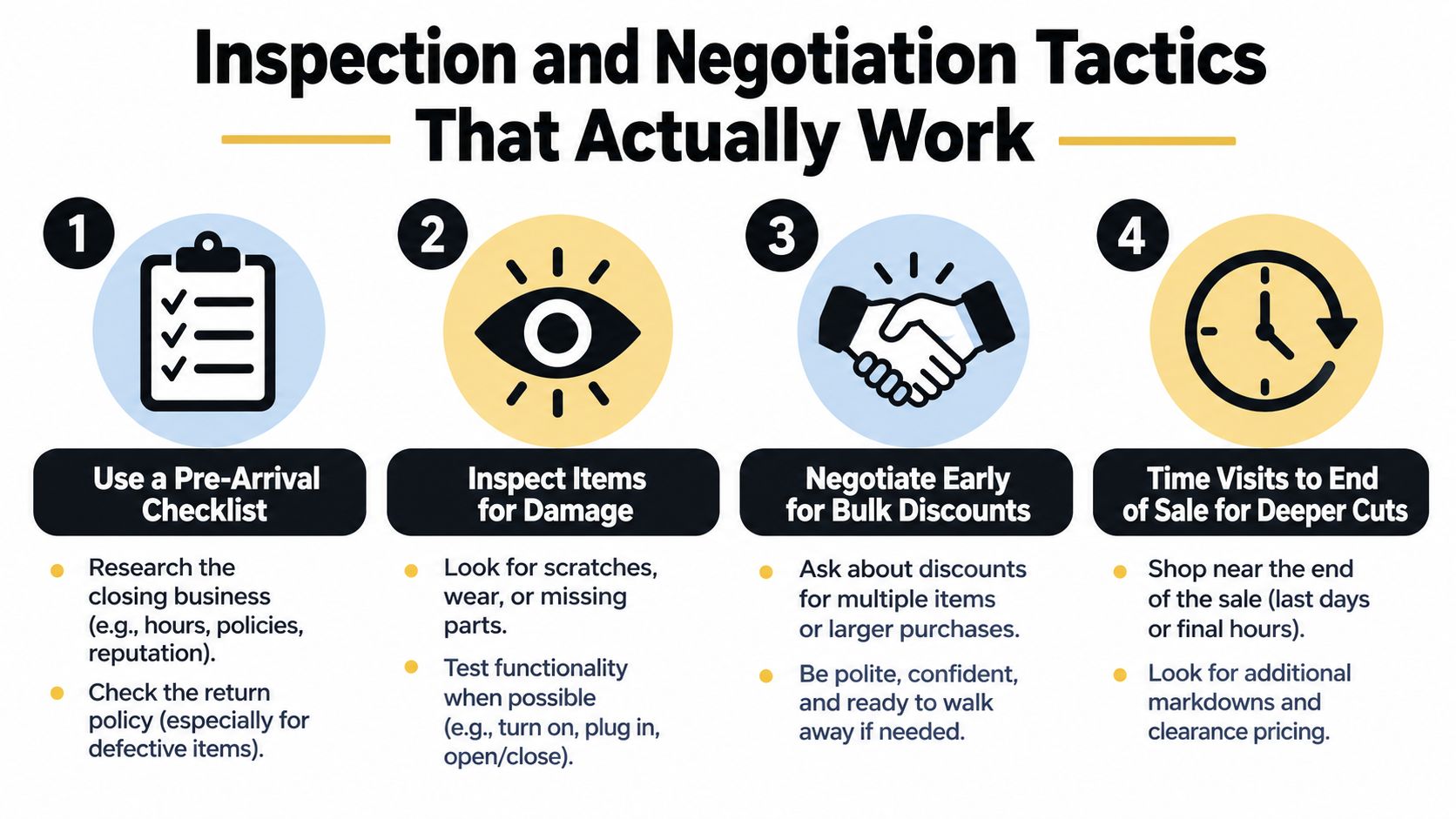
Inspect like the return counter won't help you
Before you leave home, confirm the return policy, accepted payment methods, and whether the event is selling store inventory, shelf-pulls, customer returns, fixtures, or mixed truckloads. Then bring tools that help you verify condition fast.
My standard kit is simple:
- Flashlight for checking corners, seams, interiors, and box contents
- Measuring tape for fixtures, furniture, and boxed appliances
- Charged phone for comps, model checks, and photos
- Work gloves if you'll be digging through pallets or metal shelving
On the floor, check sealed boxes first. Then inspect open items for missing hardware, cracked plastic, bent corners, broken zippers, detached cords, and signs that a “new” unit is really refurbished or previously handled. If serial labels are missing or scratched over, I usually move on.
A broader explanation of how pallet liquidation works can help if you're shifting from single-item closeouts into larger mixed buys. This overview of liquidation by the pallet is useful for that jump.
Negotiate based on timing, not bravado
Different stages of a liquidation event call for different behavior.
| Timing | What usually works |
|---|---|
| Opening day | Minimal negotiation. Focus on quality and speed. |
| Mid-event | Bundle categories, ask on volume, target slower-moving product. |
| Final stretch | Ask about remaining lots, display units, and full take offers. |
There's a real pricing logic behind this. Research summarized by Harvard Business School found that a dynamic markdown strategy can improve net recovery on cost by 2% to 7% of assets on hand, especially when operators preserve assortments early and sequence discounts based on demand instead of cutting everything evenly (liquidation pricing research summary). In plain terms, good operators don't need to bargain much on day one because the best inventory should still sell.
Red flags that kill a deal for me
Independent research on liquidation behavior also shows why timing matters. When buyers expect liquidation sales, they often delay purchases, which can worsen demand and push distressed sellers into a “death spiral.” That's one reason experienced operators try not to telegraph distress too early and manage markdown cadence carefully (research on liquidation timing and buyer behavior).
Here's what I skip:
- Restocked-looking inventory that doesn't match the original store
- Missing manifests on larger lots
- Heavy crowd damage from people tearing open cartons
- Dirty mixed bins where condition is impossible to verify quickly
Buyer filter: If you can't explain why the item is cheap, assume there's a reason.
When Curated Wholesale Boxes Beat Local Liquidation
Not every reseller should chase local store closings. Sometimes a curated box beats the hunt because the cost of a liquidation trip isn't just the purchase price. It's the drive, the waiting, the uncertainty, the loading, the sort time, and the chance you come home with half a buyable lot.
The hidden cost equation
A local event can look cheap and still be expensive. You might spend half a day to inspect a floor, fight through picked-over merchandise, and leave with an inconsistent mix that takes longer to test and list. A curated wholesale box shifts the trade-off. You give up some treasure-hunt upside, but you gain predictability.
That matters more than many new resellers realize. If you're selling on Poshmark, eBay, Mercari, Whatnot, or in a small boutique, consistent inventory is often worth more than random inventory.
Local liquidation versus curated boxes
| Factor | Local Liquidation Sale | Curated Wholesale Box |
|---|---|---|
| Selection | Unpredictable and event-dependent | More consistent by category |
| Time use | Travel, waiting, floor inspection, loading | Sorting and listing after delivery |
| Condition clarity | Varies widely by operator | Often easier to plan around if the supplier curates |
| Flexibility | You can hand-pick what you see | You trade some control for convenience |
| Best for | Opportunistic sourcing and one-off finds | Repeatable restocking and category focus |
There's also a shopper-behavior angle most liquidation guides miss. Research on store closures found that many households don't pivot to liquidation shopping. They move to the nearest open location or to online buying instead. One study cited in a Wharton working paper found that online orders from a closed-store location increased by 29% while omnichannel sales fell 5.5% when 10% of stores were closed (working paper on post-closure shopping behavior). For resellers, that means local closure hype doesn't always equal the best local buying environment. Sometimes the crowd is chasing the event while the better sourcing move is staying disciplined.
Who should choose which path
If you're new, curated lots are often the cleaner training ground. You can learn pricing, listing, and customer demand without burning whole days scouting.
If you're established, local liquidation works best as a supplement. Use it to top up categories, grab fixtures, or cherry-pick branded product when timing breaks your way. For apparel-focused sellers especially, a more predictable restock model like a mystery box wholesale option can make more sense than gambling your week on one local floor.
Safety, Logistics, and Payment Essentials
Liquidation mistakes aren't always pricing mistakes. Sometimes they're basic logistics mistakes. Buyers show up in sandals, drive a sedan to a fixture sale, or assume every operator takes cards and offers loading help. That's how a good buy turns into a bad day.
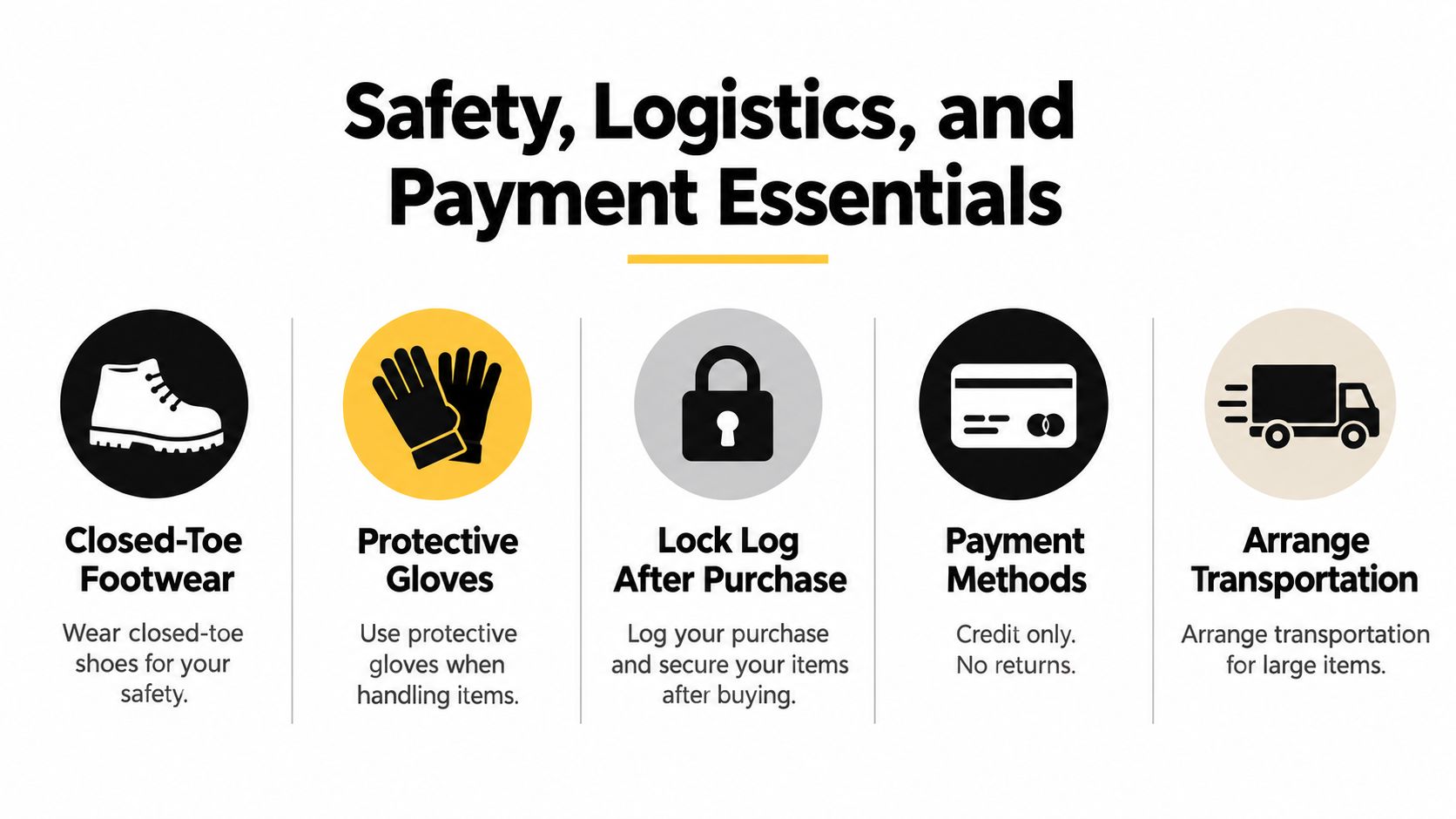
What to bring and wear
Closed-toe shoes are the baseline. Warehouses, former retail spaces, and pop-up liquidation sites often have broken packaging, loose shelving parts, or unstable stacks. Gloves help when you're handling pallets, metal racks, or dusty back-room inventory.
Bring a dolly or hand truck if the operator allows it. Bring moving blankets if you might buy fixtures, framed items, or electronics. If you think you may need a second person for loading, arrange that before you leave the house, not after you've already bought the lot.
Payment and pickup can break the deal
Always confirm payment terms before arrival. Some operators take cards. Some prefer cash. Some business liquidators expect methods that casual shoppers don't carry. A “great deal” isn't great if you can't pay for it or hold it.
A practical pre-buy checklist:
- Confirm accepted payment types before you drive over
- Ask about credit card minimums if the event looks small or independently run
- Check same-day pickup rules for large items or pallets
- Plan the vehicle first if you're shopping furniture, shelving, or bulk hard goods
A lot of buyers also forget to ask whether purchases must be removed by a certain time. If the operator wants everything out by end of day, you need labor and transport ready.
Leave room in your budget for the unglamorous stuff. Straps, blankets, bins, tape, and a second set of hands save more deals than flashy negotiation does.
What to do as soon as you get home
Don't let liquidation product sit in the garage for a week. Inspect it immediately, photograph any damage, and sort it by category and condition. Then price against current comps and get the best items listed fast while your buy cost is still fresh in your mind.
The buyers who recover cash quickest usually do one thing well. They process inventory right away instead of letting a liquidation haul turn into a storage project.
Choosing the Right Sourcing Path for Your Goals
The best sourcing channel depends less on what sounds exciting and more on how you operate. If you have limited storage, limited transport, and limited hours, random local chasing usually creates friction. If you've got category knowledge, flexible time, and room to process mixed buys, local liquidation can add real upside.
A simple decision filter
Use these three questions before you spend:
- How fast can this inventory reach the shelf? Hand-picked local product can move quickly if it's clean and obvious. Mixed lots can slow you down.
- How much uncertainty can you absorb? Some buyers enjoy testing unknowns. Others need consistency.
- Does the trip improve your total margin after time and travel? A cheap unit cost doesn't help if the buy eats a full day and creates extra work.
For new resellers, a controlled buy usually beats an adventurous one. For part-time flippers, local events make sense when they're close, fresh, and easy to inspect. For full-time operators, the strongest model is often blended sourcing. Use dependable inventory channels as your base, then cherry-pick local liquidation when the event quality is obvious.
Keep a sourcing log
A simple notebook or spreadsheet beats memory fast. Track the operator, category mix, condition, pricing style, and how the items resold. Within a few buying cycles, patterns show up. You'll spot which liquidators overprice, which events get picked too early, and which categories are worth a repeat trip.
The point isn't to find every sale. It's to build a sourcing process that fits your time, budget, and resale model. Search smarter, screen harder, and skip the events that only look good from the parking lot.
If you'd rather skip the uncertainty of local floor hunting and source apparel in a more controlled way, OneTrendyCloset offers curated brand-name liquidation boxes for resellers, boutiques, and marketplace sellers. It's a practical option when you want faster restocking, more predictable assortments, and a simpler path from purchase to listing.