You've got a box of branded apparel in your cart, and the price looks workable. But you haven't touched the inventory, checked the size distribution, or seen what the supplier considers good condition. Before you commit, you need to know whether you're buying merchandise you can sell or a sorting project you'll regret.
Table of Contents
- The Real Decision Behind Buying Liquidation Boxes
- Choosing the Right Box Size for Your Sales Channel
- Reading Brand Mix and Condition Like an Underwriter
- The Landed-Cost and Sell-Through Model
- Running a Controlled Pilot Before You Scale
- Supplier Policies, Pricing Signals, and Communication Habits
- Your First Week With a Liquidation Supplier
The Real Decision Behind Buying Liquidation Boxes
The hesitation usually comes down to practical questions. Will these sizes sell to your customers? Is the condition worth the asking price? Will the supplier ship the assortment they described?
Treat those questions as buying criteria, not worries to brush aside. A recognizable label won't compensate for unsuitable sizing, undisclosed damage, or inventory that arrives too late for your selling schedule.
Buy an inventory position, not a surprise
When you buy liquidation boxes, you're underwriting a small inventory position. You commit cash now and recover it through individual sales later, after preparation, fulfillment, discounts, and returns. Your job is to decide whether the likely recovery justifies the cost and work.
There's a substantial resale audience. The global secondhand apparel market grew 18% to approximately $197 billion in 2023, and 63% of surveyed secondhand buyers purchased online, according to the resale market findings reported by Fashion Dive. That demand makes apparel sourcing worth investigating. It doesn't make an unsuitable box profitable.
Before paying, write down what the purchase must deliver:
- Customer fit: Brands, categories, and sizes your existing buyers want.
- Usable condition: Defects you can disclose or repair without exhausting the margin.
- Commercial clarity: A written description of the assortment, fulfillment expectations, and remedies for discrepancies.
Don't buy because the box might contain something valuable. Buy because the expected assortment works without a lucky find.
Your first purchase should answer an operational question: can you turn this supplier's inventory into dependable contribution margin? A controlled test gives you evidence for the next decision, whether that's another box, a different vendor, or a custom pallet order.
The objective isn't to avoid every imperfect item. It's to price imperfections before they become your responsibility.
Choosing the Right Box Size for Your Sales Channel
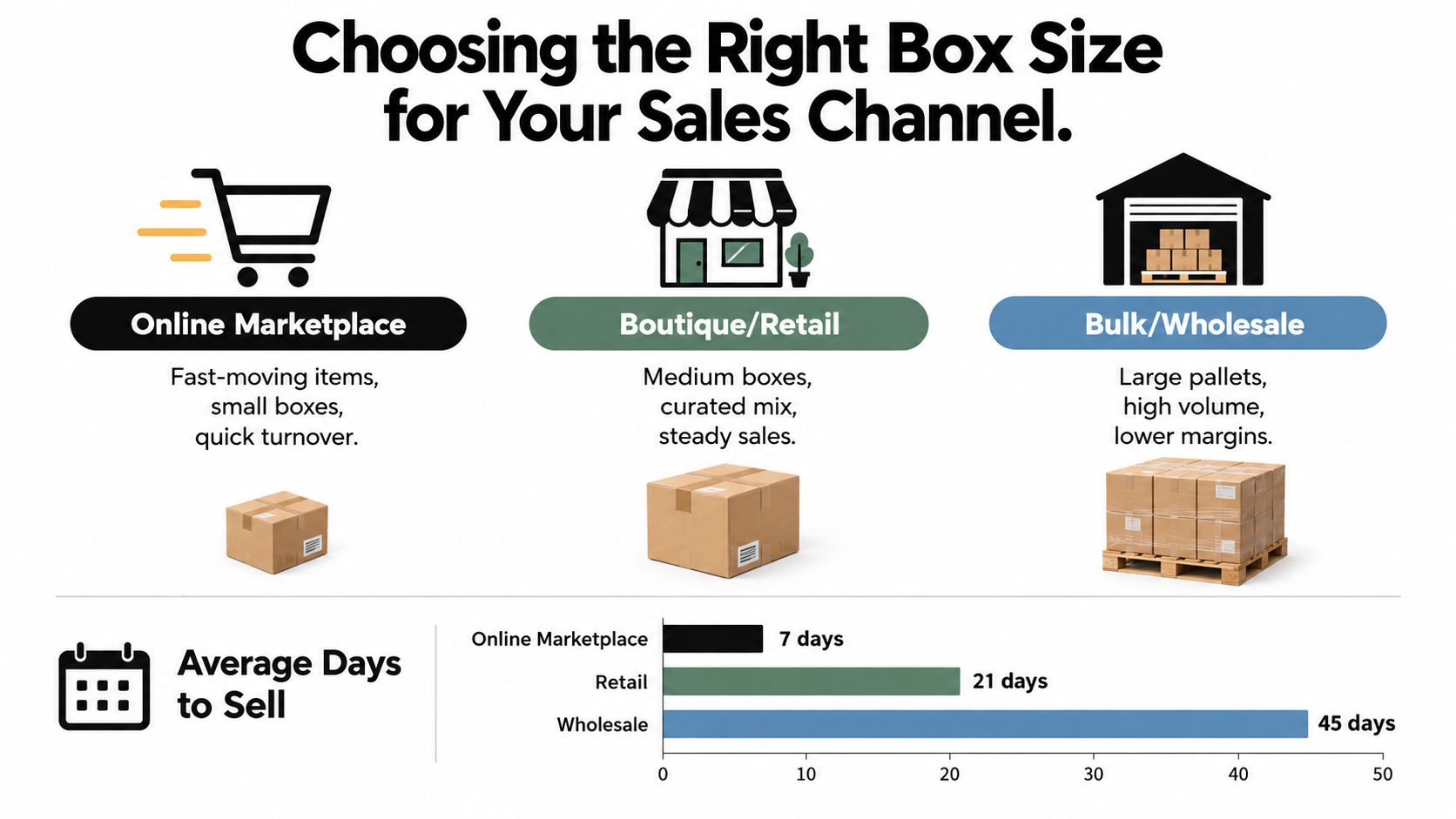
Choose volume around your processing capacity, not the supplier's largest discount. A cheaper item isn't cheaper in practice if you can't prepare it for sale or give it shelf space.
Use this channel comparison as a planning aid, not a sales forecast. Any illustrated turnover figures should be replaced with your own selling history.
Match the lot to the work
A boutique owner should favor an assortment that fits the store's identity and available racks. A curated, moderate-volume purchase can make sense when staff can inspect, steam, price, and merchandise the entire delivery. Don't order extra just because you have an empty back room.
A part-time Poshmark or eBay seller should start with a smaller lot. Each garment needs its own inspection, measurements, photographs, listing, and storage location. If you only have limited listing sessions, calculate capacity from completed listings, not from how many items you hope to photograph.
A Whatnot live-sale host needs inventory organized before going live. Consider category coherence, size sequencing, show preparation, and post-sale packing. An established host may handle more stock than a casual lister, but an audience doesn't eliminate sorting labor.
| Lot size | What to compare | Main capacity question |
|---|---|---|
| Small | Delivered cost and preparation time per usable item | Can you process it without delaying existing stock? |
| Medium | Total cash commitment and assortment concentration | Can your store or listing schedule absorb the mix? |
| Large | Freight, receiving, storage, and unsold-stock exposure | Do you have a repeatable workflow and proven demand? |
Compare quotes without assuming bulk wins
There's no defensible universal per-item landed price. Request actual quotes for different quantities, then compare cost per sellable unit, not cost per delivered garment.
A supplier with multiple box sizes and a custom-quote process can support gradual expansion without requiring you to change vendors. Ask whether brand preferences remain available at larger volumes and whether freight or handling terms change.
Your purchase ceiling should be the quantity you can fully process before the next buying cycle. Leave room for returned orders, existing inventory, and routine business interruptions. Buying at maximum theoretical capacity gives you no recovery space.
Reading Brand Mix and Condition Like an Underwriter
Compare two hypothetical boxes offered at the same price. One promises exciting labels but gives little detail about defects or sizing. The other contains less glamorous brands with a documented, consistent condition standard.
I'd favor the predictable assortment unless the first supplier provides enough evidence to justify its uncertainty. Your buyers purchase individual garments, not the reputation of the best label in the box.
Inspect the details that determine whether an item belongs in your store.
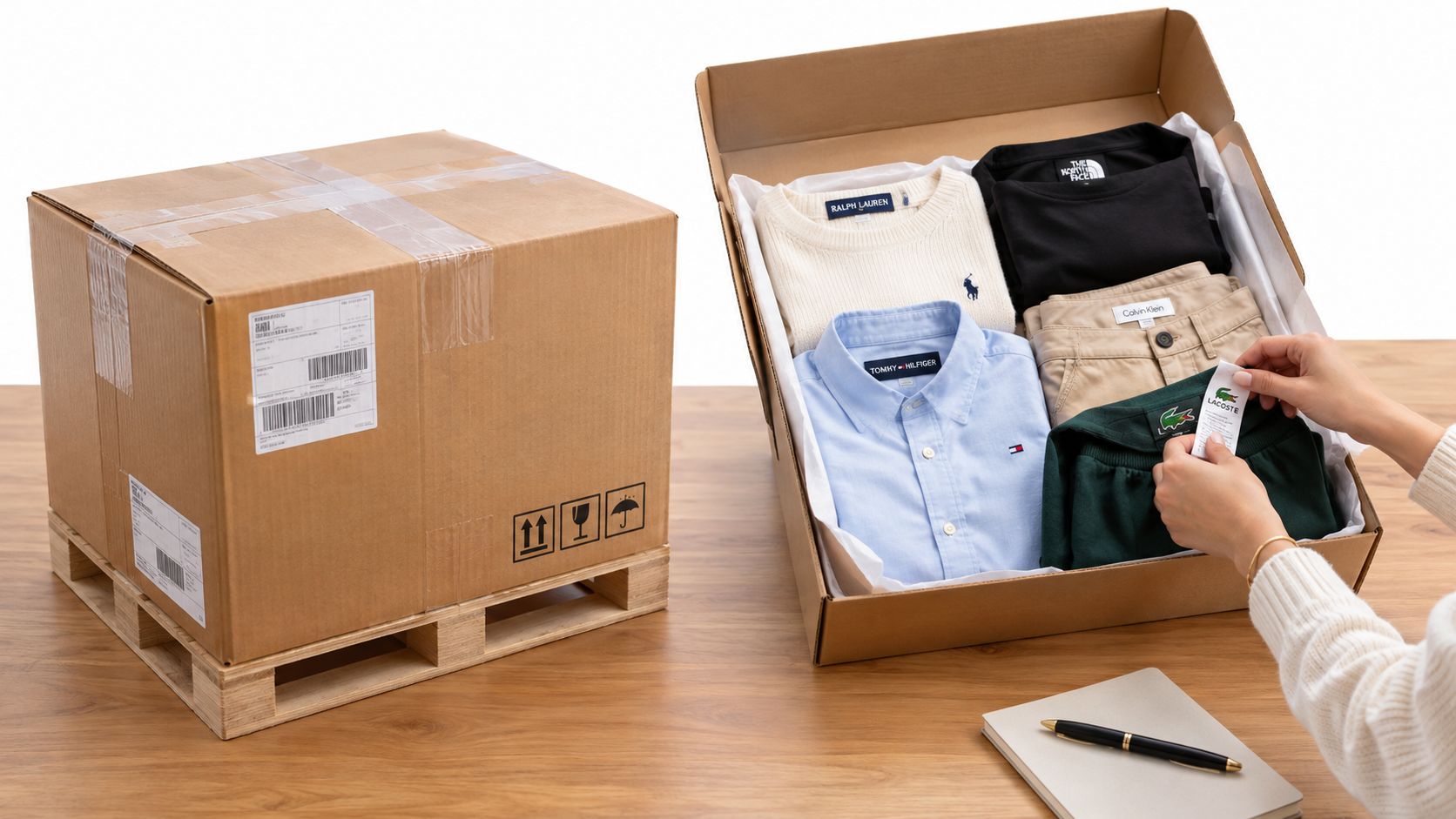
Separate brand appeal from assortment quality
A blind lot leaves more decisions until after delivery. A curated box lets you narrow the purchase around customer preferences, but curated doesn't mean guaranteed. Ask which details are commitments and which are examples.
| Buying factor | Blind assortment | Curated assortment |
|---|---|---|
| Brand selection | Evaluate an uncertain mix | Confirm available preferences |
| Size distribution | Budget for unsuitable sizes | Request the intended size curve |
| Condition | Expect inspection uncertainty | Require written grade definitions |
| Preparation | Allow for unpredictable work | Confirm what inspection excludes |
Brand recognition matters only in relation to your customer. A desirable brand in an unwanted category or unsuitable season can still require a markdown.
Make the grade describe a garment
Labels such as Grade A or Grade B aren't useful without definitions. Ask whether the grade permits stains, missing tags, damaged fasteners, altered hems, or signs of wear. Get clarity about inspection depth and whether sample photographs represent the actual lot.
- Authenticity and labeling: Check provenance, labels, and eligibility for your intended marketplace.
- Defect severity: Distinguish cosmetic issues from faults that affect wearability.
- Assortment concentration: Identify whether the box relies heavily on a narrow size, category, or season.
The European Commission's notified text on unsold-goods rules identifies counterfeit, legally non-compliant, and irreparably damaged products as distinct concerns. For a reseller, those are valuation issues, not minor sorting inconveniences.
A build-your-box option can reduce assortment uncertainty. It doesn't replace your own receiving inspection or justify paying full resale value for questionable pieces.
The Landed-Cost and Sell-Through Model
A supplier's invoice tells you what the shipment costs, not what it costs to sell. Build a worksheet that follows the merchandise from purchase through final disposition.
The sample below uses a hypothetical lot structure, not invented market prices. Replace every input with a quote, your operating costs, or conservative estimates from your own records.
Sample Landed-Cost Worksheet for a 100-Unit Liquidation Box
| Cost Line | Example Value | Notes |
|---|---|---|
| Supplier invoice | Quoted merchandise total | Exclude stated retail value |
| Inbound freight | Delivery quote | Include applicable receiving charges |
| Payment fees | Actual payment-method cost | Check before placing the order |
| Inspection labor | Inspection time × labor rate | Account for your own time |
| Cleaning and repair | Expected preparation expense | Separate routine cleaning from repairs |
| Packaging | Supplies used per fulfilled order | Include mailers and protective materials |
| Marketplace fees | Applicable platform charges | Use your actual selling channel |
| Expected discounts | Reduction from likely selling prices | Don't rely on active asking prices |
| Return reserve | Expected return-related expense | Include handling and unrecovered costs |
| Disposal cost | Expected responsible-disposition expense | Unsellable stock still costs money |
| Expected net sales | Conservative realized revenue | Base estimates on comparable sold listings |
Keep the calculation consistent
Use these formulas:
- Landed cost per sellable unit: Acquisition and preparation costs divided by expected sellable units.
- Contribution margin per box: Expected net sales minus total landed cost and variable fulfillment costs.
- Contribution relative to landed cost: Contribution margin divided by landed cost.
Define which expenses sit inside net sales and which remain separate. If you deduct marketplace fees from revenue, don't subtract them again as fulfillment costs. The same principle applies to return expenses.
The apparel return benchmarks compiled by Whitebox cite 22% for online apparel versus 6.2% in stores and support testing 30%–40% return exposure when fit, condition, or listing accuracy is uncertain. Treat return exposure as a scenario input, not as an automatic revenue write-off: returned garments may be resold, but you still need to account for handling, shipping, and markdown risk.
Underwriting check: A box must make sense at conservative sold prices, with imperfect items excluded from full-value inventory.
Compare suppliers using the same assumptions. Then test slower sales, lower realized prices, and more preparation work. If the purchase only works under favorable conditions, negotiate the price or decline it.
Running a Controlled Pilot Before You Scale
A test box should produce a buying decision, not just an unboxing impression. Set your criteria before ordering so an appealing garment doesn't distract you from weak overall results.
Use the following process to keep the test controlled.
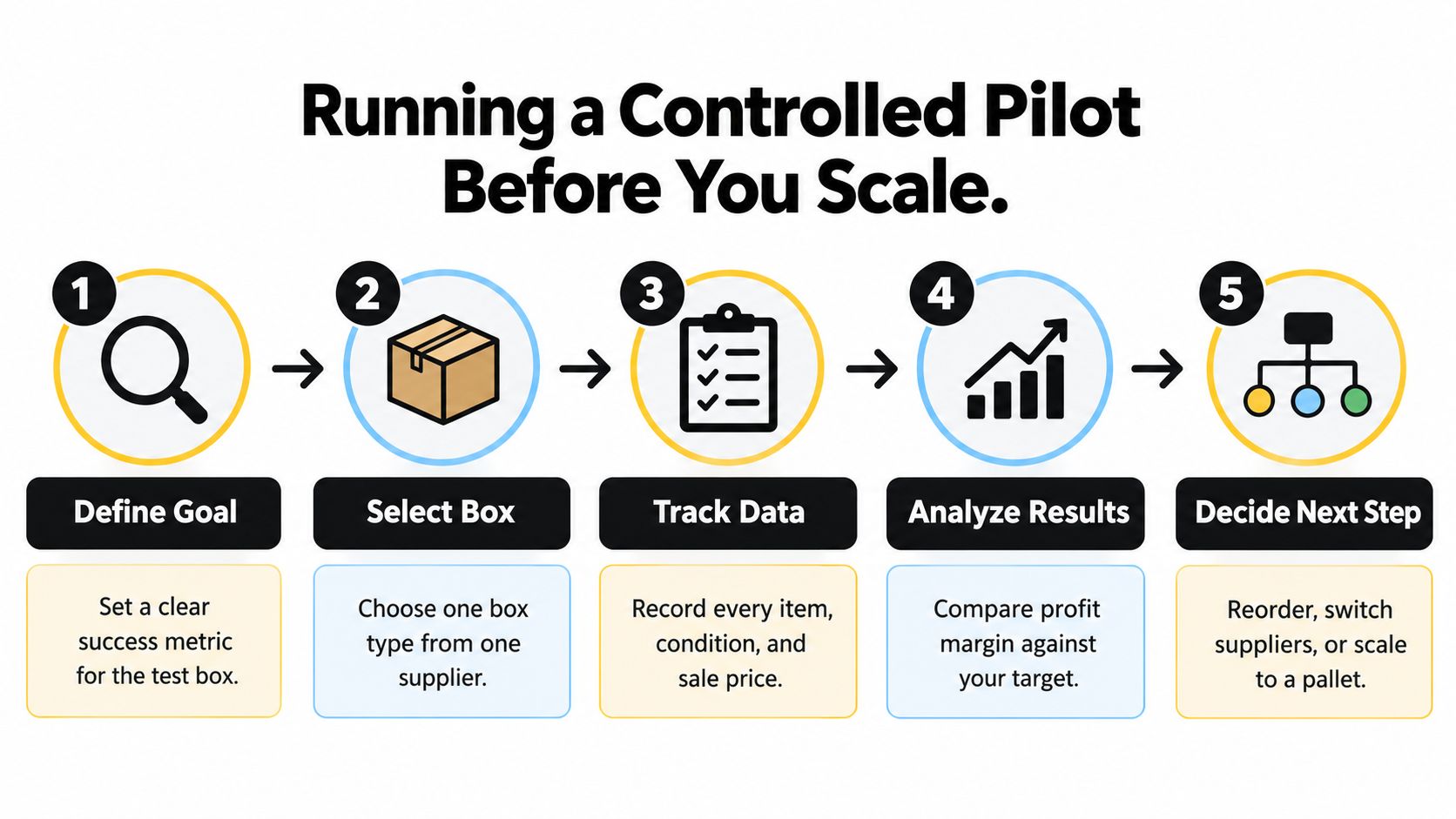
Define, receive, and list
- Define the purchase standard. Record your target customer, acceptable brands, size curve, season, condition requirements, and maximum landed cost per sellable unit. Set an acceptable loss limit as well.
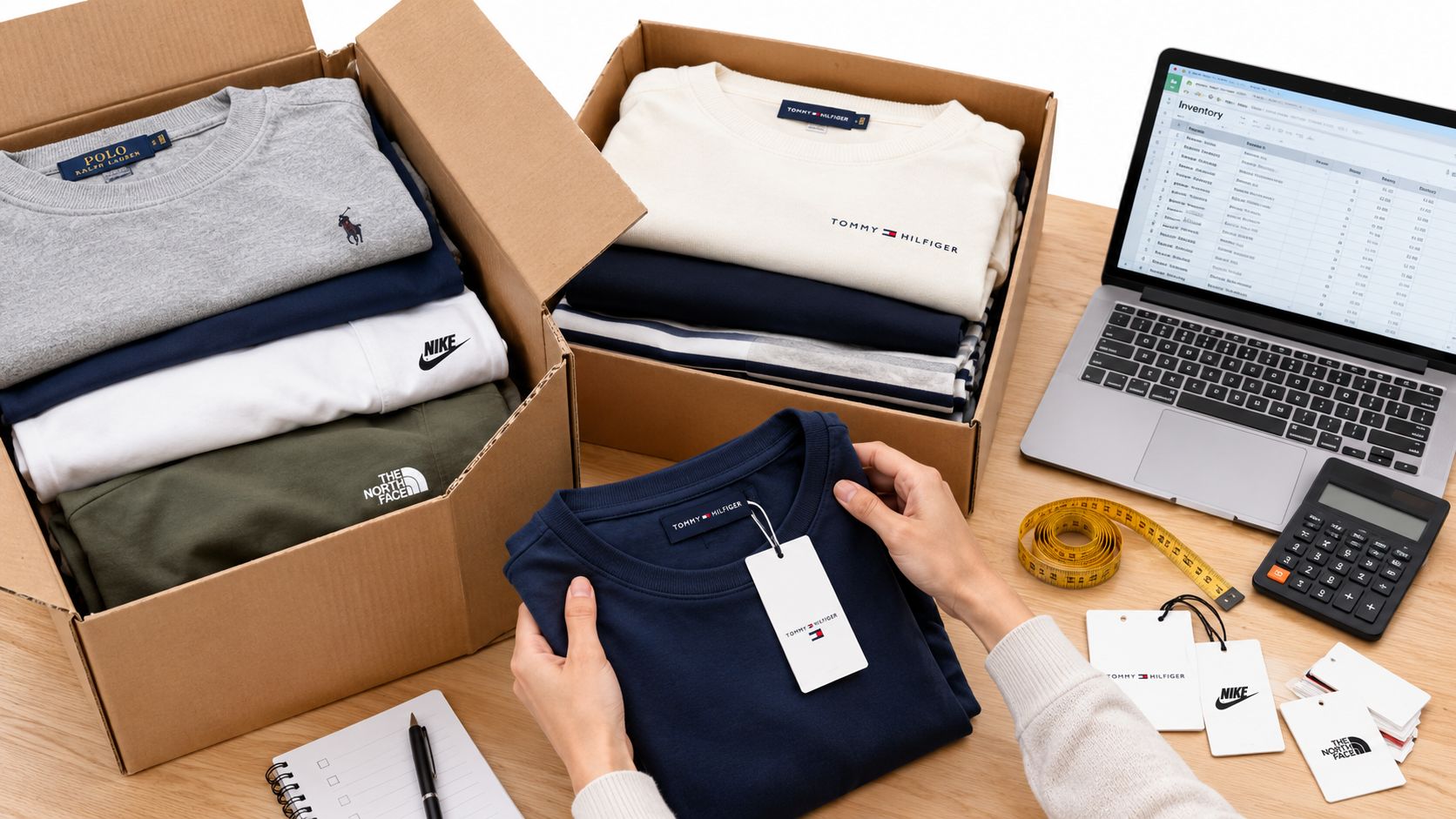
- Buy the smallest economically meaningful lot. On arrival, assign each garment an inventory ID. Photograph, measure, and classify it in a spreadsheet before mixing it with existing stock.
- List with complete disclosure. Include brand, style, tagged size, measured dimensions, condition, and visible flaws. Show the actual garment rather than relying on generic product photography.
For another purchasing perspective, review this guide to mystery-box wholesale sourcing alongside the supplier's written assortment commitments. The important distinction is how much uncertainty you're accepting before payment.
Track results and earn the reorder
- Measure the full outcome. Track units listed, units sold, days to sale, realized prices, return reasons, and contribution margin. The pilot framework and apparel-return guidance from Radial supports reviewing sell-through at 30, 60, and 90 days, with an illustrative reorder threshold of positive contribution after returns and at least 60% sell-through within 90 days.
- Choose the next purchase from the evidence. Reorder when the test meets your criteria. Switch suppliers when the delivered inventory consistently misses the agreement. Request a larger lot only when you know which categories and sizes performed.
Keep unsold and returned pieces attached to the original lot in your records. Otherwise, you'll credit the box for completed sales while forgetting the stock still occupying storage.
Use this video alongside your receiving checklist, without substituting it for your own recorded results.
A successful pilot gives you more than permission to spend. It gives you specific instructions for the next quote.
Supplier Policies, Pricing Signals, and Communication Habits
A supplier relationship becomes useful when something doesn't go as expected. Attractive product photos won't resolve a damaged shipment, a missing assortment commitment, or an order that arrives after your scheduled sale.
Before paying, find out how the vendor handles those situations. Don't assume an ordinary retail return policy applies to liquidation merchandise.
Keep the agreement, grading definitions, and quote together so you can compare delivery against the actual purchase terms.
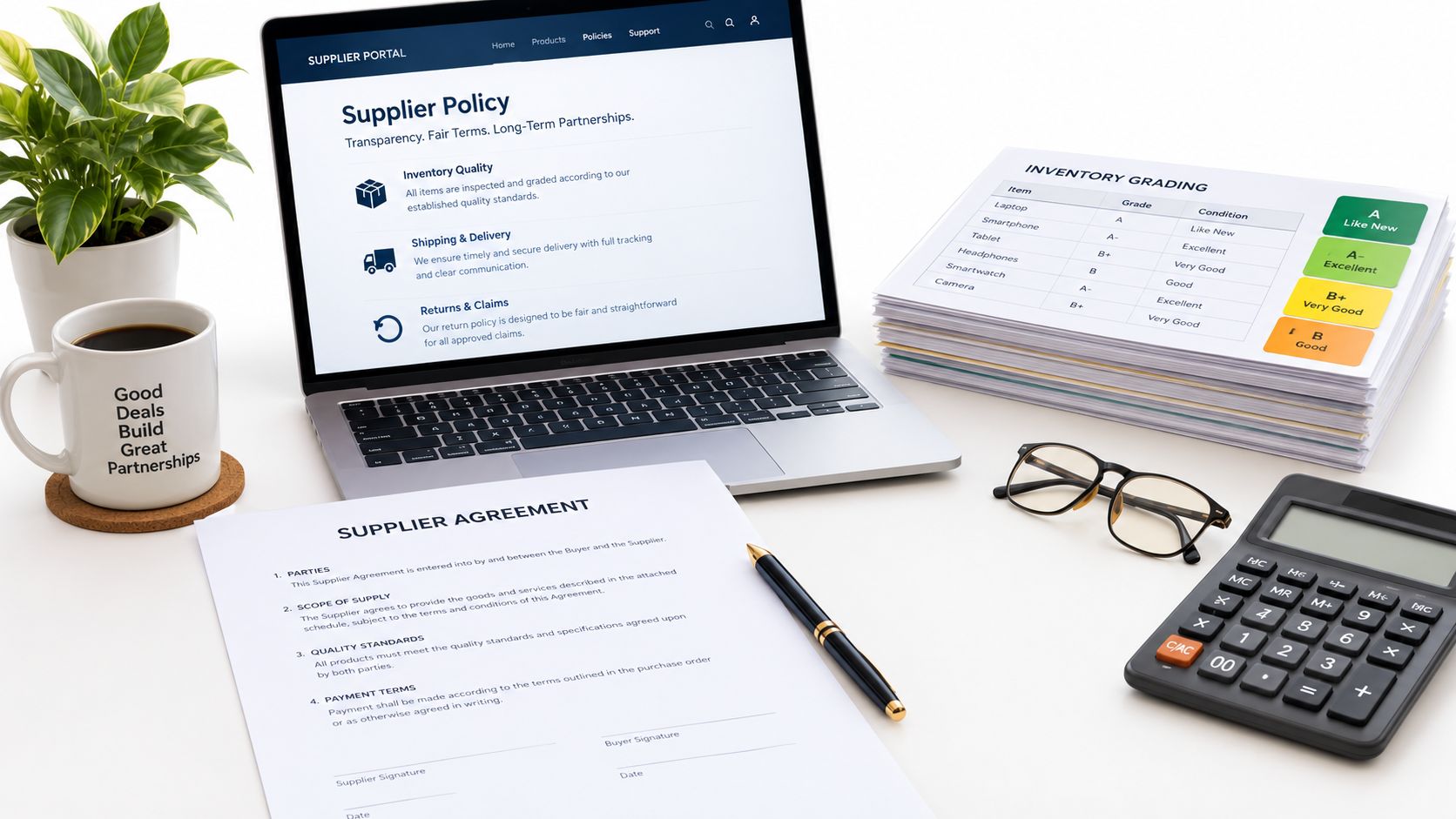
Read the remedies before the marketing
Ask what qualifies for a refund, replacement, or credit. A disappointing but accurately described assortment is different from missing merchandise or damage outside the agreed grade. Your invoice should make that distinction possible.
Confirm the reporting deadline and evidence requirements. Find out whether you must preserve packaging, submit photographs, return affected items, or obtain approval before shipping anything back.
A published FAQ and accessible email support are useful starting points. Written answers about your particular order matter more, especially when a custom assortment differs from standard offerings.
Run this checklist against any vendor:
- Pricing model: Confirm merchandise cost, delivery charges, payment fees, and quote validity.
- Customization: Establish which brands, categories, and sizes are selectable rather than merely preferred.
- Fulfillment: Separate preparation time from transit time and ask how delays are communicated.
- Support: Check published business hours and whether replies address your actual questions.
- Operating record: Review stated experience, documentation, and continuity without treating longevity as a guarantee.
Use this wholesale clothing supplier evaluation guide to organize the comparison. Keep supplier answers in the same spreadsheet as your quotes so lower pricing doesn't obscure weaker terms.
Test communication before committing. Send a specific question about defects or assortment boundaries. A fast but evasive answer is less useful than a clear explanation you can incorporate into the buying model.
Liquidation isn't automatically sustainable
Returned apparel can enter liquidation in mixed condition. In 2021, U.S. shoppers returned 16.6% of purchases, up from 10.6% in 2020, while online clothing returns could reach 33%, according to CTV News's reporting on excess retail inventory. That history helps explain why receiving inspection and responsible disposition belong in the purchase plan.
Buying surplus doesn't automatically extend every garment's life. If you ship unsuitable stock across borders, use excessive packaging, and discard the damaged pieces, you can transfer waste-handling costs downstream rather than solve them.
Give each condition bucket a deliberate destination:
- Listable as-is: Sell through the channel that fits the garment and its documented condition.
- Listable after repair: Mend or clean only when the likely recovery justifies the work.
- Outlet-only: Mark down wearable items or donate them to an organization that accepts that category and condition.
- Unsellable: Seek an appropriate textile-recycling route and confirm what the operator accepts.
Responsible donation means offering usable clothing that the recipient wants, not transferring your disposal problem.
Regulatory pressure reinforces the need for documentation. EU countries have been required to establish separate textile collection since January 2025, and the Ecodesign framework introduces an unsold-clothing destruction ban for large enterprises beginning in 2026, as described in the European Parliament's textile sustainability overview.
For international shipments, verify whether the goods are reusable inventory or textile waste and what documentation the destination requires. Don't assume a resale invoice settles that classification.
Keep records of provenance, repair, donation, and recycling. Those records support credible answers when customers ask how you source and handle inventory.
Your First Week With a Liquidation Supplier
Use your opening week to establish control, not to rush into a large order. You can complete the buying preparation even if fulfillment takes longer.
The sequence matters more than squeezing every task into a calendar deadline. Inspection starts when the shipment arrives, and scaling waits until you have meaningful sales results.
Turn the quote into an order specification
Begin with a supplier quote and your landed-cost worksheet. Replace assumptions with confirmed charges wherever possible, then identify the inputs that remain uncertain. If freight, condition, or assortment details are missing, the quote isn't ready for approval.
Send a request during the supplier's published support hours. State your budget ceiling, target customer, preferred brands, size needs, category exclusions, and intended selling channel. Ask the vendor to distinguish confirmed specifications from requests they can't guarantee.
Keep your first order narrow enough to evaluate cleanly. Changing brands, categories, and suppliers simultaneously makes it harder to determine why the purchase performed as it did.
Prepare the receiving workflow before delivery
- Create the record: Set up inventory IDs, condition fields, cost allocation, listing status, and disposition notes.
- Reserve the workspace: Clear an inspection surface and storage locations before the boxes arrive.
- Save the agreement: Keep the quote, policy terms, and supplier correspondence with the purchase record.
- Schedule the review: Put the pilot checkpoints on your calendar rather than relying on memory.
When the order arrives, inspect against the written specification before beginning routine listing work. Document discrepancies promptly and preserve whatever evidence the supplier requires.
Then execute the pilot rather than improvising around the most exciting pieces. Your early review should reveal listing bottlenecks and assortment problems, not become an excuse to order a pallet prematurely.
The durable habits are straightforward: test before expanding, account for costs directly, and record outcomes consistently. When you buy liquidation boxes this way, you're not depending on luck. You're building a purchasing system that tells you what to buy again, what to negotiate, and what to leave alone.
OneTrendyCloset offers brand-name apparel liquidation boxes in multiple sizes, mix-and-match brand selection, and custom quotes for custom boxes or pallets. Visit OneTrendyCloset with your budget, preferred brands, and pilot requirements, then evaluate the quote with your landed-cost worksheet before ordering.